
PG Wodehouse is one of my top favourite writers. I’ve read most of his books, and I’ve explored some of his intersections with cinema: the films he was involved in, and the films that were based on his books. Of the latter, I’ve realized again and again, there seem to be very few that do anything close to justice to Wodehouse’s inimitable blend of humour. Some of the shorter TV films (like Heavy Weather, starring Peter O’Toole as the eccentric Lord Emsworth) or TV series like Jeeves and Bertie are good (though Jeeves and Bertie, after a few good episodes, went off the rails).
But now and then I come across a film that has nothing to do with Wodehouse, but seems somewhat like a homage. With the same light-hearted charm of the master, the same frothy humour that never fails to appeal to me.
As in Spring in Park Lane.
The film begins with Judy Howard (Anna Neagle) ringing the doorbell of her home in London, only to have the door opened by a complete stranger (Michael Wilding). Judy is surprised, and the conversation that ensues has both her and the man quite baffled. It’s only with a little perseverance, and some help from the butler Perkins (GH Mulcaster), who comes rushing up from below stairs, for the fog to clear. This man, Richard, is the new footman.

Judy is surprised; Richard is quite obviously not the sort of person who fits her idea of the average footman. Her suspicions about this mysterious, obviously well-educated footman (who was wearing an Eton tie the first time she met him) increase with every passing hour. Richard, for instance, seems immensely knowledgeable about art. Can play the piano beautifully. And when the sniffy cook-cum-housekeeper Mrs O’Malley (Josephine Fitzgerald) barges in, he can even pretend, without missing a beat, to have just been checking the piano to see if it needed tuning.

Judy is the niece and secretary of Joshua Howard (Tom Walls), a very wealthy businessman who is currently away in South Africa but is expected back soon. Judy and her mother Mildred (Marjorie Fielding) live with Joshua and they’re a close, loving family.
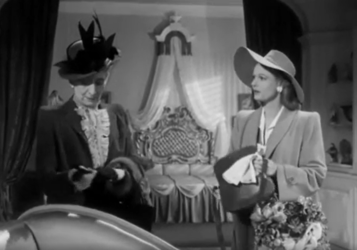
While Joshua is away, Judy handles work for him, including his deep interest in art. Joshua collects fine art, and has a grand picture gallery at home. To add to that, he’s arranged to buy, from a man named Francis Bacon aka ‘Streaky’ Bacon (Nigel Patrick) a painting by an Italian master Joshua has long admired.
Joshua doesn’t know it, but Streaky is a con-man. We are shown a glimpse of him collecting the forged artwork from a forger, then going in a car with a friend to Joshua’s home with the painting. Here, shown in to Judy’s office, Streaky gives her the painting and demands from her the payment of £2,000, which was what he had agreed upon with Joshua.
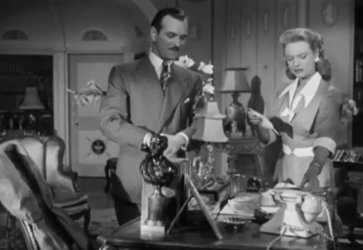
Judy has a look at the painting, and is a little undecided; she summons Richard, who immediately disses it as a fake. Streaky tries to protest, and to be indignant about this slight; but Richard is adamant. It’s a forgery. Judy, by now on firm ground (Richard is so confident, one can’t help but believe him), agrees with Richard. She refuses to give Streaky any money, and Streaky, grumbling, storms out of the house.
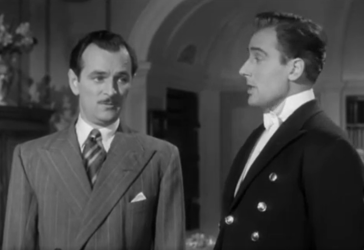
Richard steps out to see Streaky get into the waiting car, and has the presence of mind to make a note of the car’s number.
Other things now happen. One of Judy’s suitors makes an entry. This is Basil Maitland (Peter Graves), the famous film star, who insists that he be called ‘Bay-sill’, in the American style, rather than ‘Ba-sill’, as the British would pronounce it. Basil is hugely popular, and when he arrives to take Judy out on a date, it’s with droves of eager female fans crowding the doorstep to get Basil’s autograph.

Basil, though, is in love with Judy, and on the pretext of seeing Joshua Howard’s picture gallery before they go out, tries to get fresh with Judy. Judy is only half-willing; she seems to be still uncertain about her own feelings for Basil.
Richard, who’s holding on to Basil’s coat and Judy’s cloak all this while, cannot take it anymore and breaks up the canoodling by turning the lights on and off and on again and off again… in quick succession. This puts Basil off his stride, and a flustered Judy insists they get going.

But Basil, as Richard is soon to find out, is not Judy’s only suitor. There’s another, lurking in the wings. This man, Judy’s mother Mildred tells her brother Joshua when he returns from South Africa, should be invited along with Basil for dinner, so that the issue may be forced. Judy should choose one of her suitors and get married.
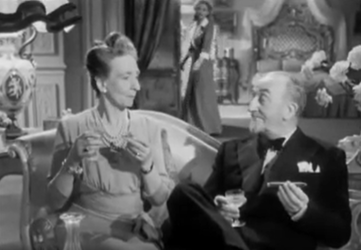
The man in question is a penurious nobleman, George (Nicholas Phipps), the Marquess of Borechester.
The scene shifts briefly to the country seat of the marquess, where we get a glimpse of just how impoverished the family is. George’s mother, Lady Borechester (Catherine Paul) is pottering about in the kitchen, and George comes in with a basketful of very limp lettuces: he’s been trying to grow them, with little success. There’s a brief conversation about the squatters who are waiting to enter the castle once the drawbridge has been let out (and yes, that should be done, says George generously; after all, the Borechesters are squatters too).
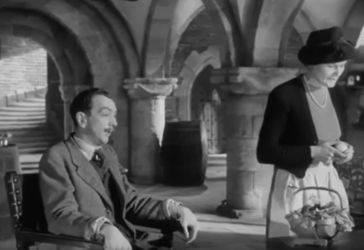
There is also a brief mention of George’s younger brother Richard, who has been missing these past ten days. George has hired a private detective to find the missing man.
A young aristocrat, missing? Named Richard?
Could it be…?
And Richard, the footman in Joshua Howard’s home, suddenly finds himself called upon to wait at table at a dinner where one of the two guests of honour is a very familiar face.
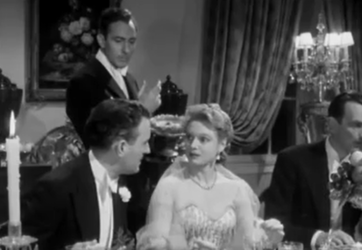
Why is Richard—obviously no footman to start with—working here at Joshua Howard’s? As Judy comments, while speculating about his identity and his need to keep it hidden, is it thanks to “vice, crime, or just poverty”?
Spring in Park Lane was Britain’s most popular film of 1948, and remains the most popular entirely British-made film (in terms of audience attendance) ever. The reason isn’t hard to see: it’s a delightfully escapist film, fun and frothy and charming.
What I liked about this film:
The somewhat Wodehousian tone to it. True, it isn’t as convoluted and as humorous as a Wodehouse novel would be, but there are elements—the noble man masquerading as a footman;the conman; the very nature of the romance (sweet, charming, often amusing, not terribly emotional or even sensual) that reminded me of Wodehouse.
The humour is more contained, and lies in the details: an expression here, a dialogue there, a small twist in a plot. The only somewhat longish scene that I found quite funny is when Lord Borechester, sitting over his port with the other men, begins to tell them a joke… and goes on and on and on, never getting to the point.
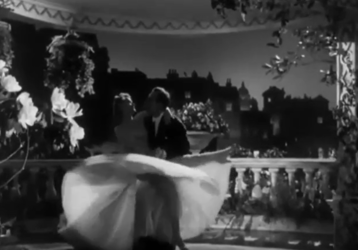
Then, there’s the general prettiness of it. Wilding is handsome, Anna Neagle is pretty (and her clothes are lovely). Plus, there are two wonderful sequences, one a dream sequence and the other a dance at the Lyceum, where the two of them showcase their dancing. How very, very good they are: like Fred and Ginger, though Wilding’s far better-looking than Astaire.

What I didn’t like:
The hurried winding up of it all in the last few minutes of the film. I would have preferred a more leisurely building up and explanation of how Richard came to be in the position he was in, and how it then gets resolved. But here, at the fag end of the film, director Herbert Wilcox seems to suddenly want to wrap it all up and get it over and done with. Too quick, as far as I am concerned.
Still, despite all that, a delightful and entertaining little film. I enjoyed this one a lot.


I read your well researched topics on films .Is it possible to through some light on Sanatan Dharma ,as related to environment ? jay Kumar India
LikeLike
Sorry, but I don’t understand… why do you think I would know about Sanatan Dharma and its relation to the environment?
LikeLiked by 1 person
Dear Madhulika Loved your article on the movie. I am a great admirer of yours. Love the lucid, impeccable style that you use in writing. It induces a beautiful virtual imagery in one’s mind. Thank you so much Regards Shakti Asthana
LikeLiked by 1 person
I am so glad you enjoyed this review. Thank you for the kind words.
LikeLike
I love delightful films and books. I have one book by Wodehouse: Joy in the Morning, but I haven’t read it. Will read it soon.
LikeLiked by 1 person
I don’t recall having read Joy in the Morning – one of the few Wodehouses I think I missed. Must amend that ASAP! Thank you for, even inadvertently, reminding me of it.
LikeLike
You are correct.
Almost no good Wodehouse movies.
There were a couple on Blandings Castle. Notably one on Lord Emsworth’s ‘girl friend’ for whose sake he deals with both Constance and his truculent Gardner.
LikeLiked by 1 person
I think there was a TV series, long back, named Wodehouse Playhouse? I have watched one episode of that, based on Uncle Fred Flits By, quite enjoyable. Were the Blandings Castle movies old ones, or new? I know there’s a recent – perhaps a couple of years old? – TV series on Blandings, but from all I’ve heard about it, it’s pretty horrible and does no justice to the books.
LikeLike
I have seen the TV series you are referring to. It is truly horrible.
I do not remember the details you are referring to but it featured Rupert Baxter, Lord Emsworths annoying Secretary.
LikeLiked by 1 person
I must look out for that, then. The stories with the Efficient Baxter are uniformly funny. And I must check the one of Lord Emsworth and the Girlfriend – I’d read it some time back, and loved it.
LikeLike
This movie must be a very funny one as is evident from your admirable narration. I have also read P.G. Wodehouse and I feel, the Indian scriptwriters of yesteryears must be reading and then borrowing heavily from PGW writings (for the rom-com parts of the scripts to be prepared by them). Shagird (1967) is clearly an adaptation of PGW’s novel ‘The Small Bachelor’. Hearty thanks for sharing your take on the movies.
LikeLiked by 1 person
I am glad you enjoyed this review, Jitendraji. Thank you for the kind words.
Yes, indeed: several Hindi film-makers seem to have been very influenced by Wodehouse. Hrishikesh Mukherjee and Roop Shorey were, I believe, admittedly big fans, and their films show the influence quite readily, even when the entire film may not be based on a Wodehouse story.
LikeLiked by 1 person
Madhu,
I watched this ‘Bollywood’ film after reading your review. Enjoyed it. The connection with PG Wodehouse is very tenuous. But a larger point, the essence of PGW is in his language. You enjoy reading the book, it is not adaptable to a visual medium.
Same is true to a large extent about Sherlock Holmes. The series starring Jeremy Brett and David Burke faithfully followed the Holmes canon, and they were brilliant. But many later and earlier productions were on different plots. This creative liberty fell flat for me. Arthur Conan Doyle is also delightful because of his language and descriptions. All these cannot be adapted on a film or TV series.
LikeLiked by 1 person
I agree completely about Wodehouse not being easy to translate to screen because of his language. Personally, I feel the problem of adapting Holmes to screen is less because of Conan Doyle’s language, and more because of the amazingly intricate plotting – trying to fit all of that into the standard film-length story is next to impossible (which is why I think a TV series, like the Jeremy Brett one, has a better chance of making a success of it). I really liked that series, but yes, like you said, all the others have failed to impress.
LikeLike
Compelling review. Must be an enjoyable film to watch. I like Wodehouse too but haven’t read a lot. It’s all to do with fluid language and intimate humour isn’t it. I have watched TV series with Stephen Fry and Hugh Laurie, it was good.
Anyway I will watch the movie soon.
LikeLiked by 1 person
Forgot to ask you, do you like Sherlock Holmes?
The power of description by Conon Doyle is amazing, don’t you think ?
LikeLiked by 1 person
Yes, I do like Holmes. As much as I like Conan Doyle’s other stories, especially his horror stories and his sports stories. While his descriptions are good, what I really admire about Conan Doyle is his amazing creativity – the intricate plots he builds up are amazing!
LikeLiked by 1 person
Yes, the Laurie-Fry series was good fun, especially the first season. After that it began to go a little off the rails. I am currently reading yet another Wodehouse (Joy in the Morning) and enjoying it a lot!
LikeLike
Plum( P.G.Wodehouse novels aremeant to be read for his great humour and command over language. They are not meant for fhe stage and film.
It is unfortunate that his great novels outside the Jeeves, Blandings castle and Ukrifge are not widely read and known.
Thee are about 25 of them like
Damsel in distress, Quick servicem Dr.Sally, whuch are uprorious.
LikeLike
I agree that Wodehouse’s language is the main point, but there are books of his that have excellent plots – Piccadilly Jim, for instance, or Leave it to Psmith. Both have been adapted to screen, but with the intricate plots hashed, so that the joy of the book is completely gone.
LikeLike