
Aka The Court Dancer.
When I was watching Amrapali some weeks back, I was reminded of another court dancer of Hindi cinema: Sadhona Bose’s character from this film, which claimed to be the first English language film to be made in India with an all-Indian cast and crew. I had made an attempt at watching Raj Nartaki a couple of years back, but I could not get into it, and abandoned it after a few minutes. I guess the concept of Indian actors speaking only English (and that back then) was sufficiently unusual to take time to get used to.
After Amrapali, though, I decided I had to give Raj Nartaki another try.
The film begins by laying the ground. This is the early 19th century, and the film is set in Manipur. Here, Prince Chandrakirti (Prithviraj Kapoor) is heir to the throne. He is also in love with the newly-appointed court dancer, the lovely Indrani (Sadhona Bose). When the story begins, Chandra (as Indrani affectionately addresses him) is at Indrani’s palace, where several of her fellow dancers are entertaining them.

Into this relaxing reverie comes Taaya, the Captain of the Guard (Tapan), to announce the impending arrival of a much-revered religieux, the High Priest Kashishwar. Kashishwar is bringing with him sacred dust from the holy feet of Sri Chaitanya, and the king has sent orders that Chandra should personally go to receive Kashishwar and escort him safely to the royal palace.

Chandra remarks that if Kashishwar is bearing the dust from Chaitanya’s feet he can be in no need of guarding; he is safe enough. Indrani, meanwhile, has lit up: the dust from Chaitanya’s feet! That will be wonderful. She would give anything to be blessed with some of that. Chandra assures her that once Kashishwar has arrived, Chandra will have him bless both of them with the sacred dust and preside over their wedding.
All is bliss.
Even as they speak, a group of monks arrive, singing songs in praise of Krishna. Indrani is deeply affected by their earnestness, and offers to present a raas leela dance.
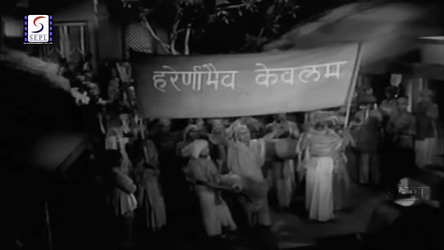
The monks sit down, and Indrani and her troupe dance for them. Indrani’s dancing, especially, is very good, and it’s obvious that her art is much appreciated.
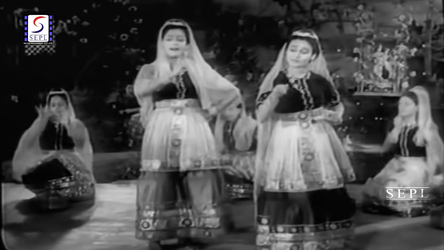
The dance is barely over when there is an interruption: Chandra’s father, the king (Nayyampalli) has arrived. He berates Chandra for not having gone to receive High Priest Kashishwar—but before he can proceed, one of the monks (Jal Khambata) rises to his feet, revealing himself as Kashishwar. He had found this group of mendicants coming this way and had joined them.

Kashishwar now comes forward and congratulates Indrani on the beauty and grace of her dance. He is so enthralled by her, and by how beautifully she has managed to convey her devotion for Krishna through her dance, he offers her the sacred dust he carries with him. He dips a finger in the sacred dust and is about to bless Indrani by putting a tilak of it on her forehead when he is interrupted.
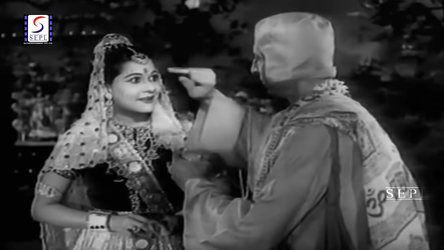
The incensed king has come forward, and he tells Kashishwar not to waste the sacred dust on Indrani: she is just a court dancer, to put the dust on her is to demean it. Kashishwar withdraws his hand, therefore, leaving Indrani feeling humiliated and hurt.

The next day, as part of a monthly ritual, Chandra and his father the King go to the temple to offer prayers. It’s a grand occasion, with hundreds of subjects flocking to the temple, while the royals go there on elephant-back.
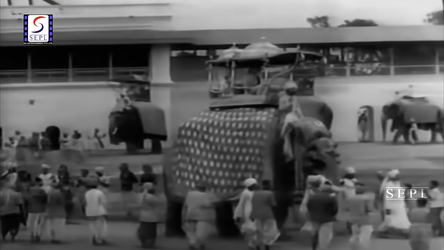
Amidst all of these is Indrani too, with her two dearest friends/companions/maids, Priya (Benita Gupta) and Riya (Protima Dasgupta). Indrani has brought offerings for the idol, and is about to go into the temple when she is stopped. No, says the priest; as a lowly dancer, she is not to go into the temple. Indrani, while taken aback, recovers her composure and says she has brought offerings for the deity. To this, the priest responds, saying that she can give him her thali of offerings and he will take them into the temple on her behalf.
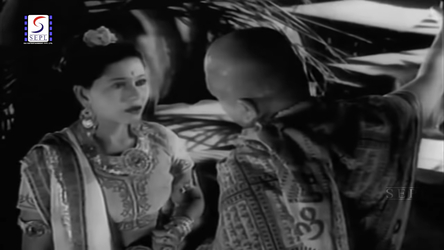
This conversation is being witnessed by a number of people; one small group of men, watching, comments on it too. One man wonders why the court dancer is being so presumptuous; does she not know her own status? Another man says that she’s very new to her job, her post; perhaps that is why she is so ignorant.
Bitterly upset, Indrani leaves without giving the offerings to the priest. Still anguished, she is returning to her home in her palanquin when she hears a hymn being sung at a broken-down old shrine. This shrine, now dilapidated and abandoned, is on a nearby hill, and Indrani is so moved by the hymn that she goes up to see. There, she is met by the hermit Khaipa (Simeons), who looks after the shrine.

To Indrani’s surprise, Khaipa is welcoming and sees no reason why a dancer need not pray at a temple. There are more surprises in store for her: Khaipa’s attitude is refreshingly open and unorthodox, a far cry from the restrictive ideas of the temple priests. When Indrani points out that there is no idol in this little shrine (just a misshapen bit of stone), he says that there is no need for an idol; the devotion is all there in the devotee’s heart. When she turns to go down to the palanquin and fetch her thali of offerings, Khaipa tells Indrani that offerings are not needed; all God needs are her prayers.

Indrani has just finished praying when a worried Chandra, who’s come here all the way from the main temple (where he had been witness to Indrani’s humiliation), arrives. He reassures Indrani of his love, and tells her that it doesn’t matter what everybody else thinks or says. He is going to marry her, and none other. She will be his queen. He will speak to his father about it. Indrani, naïve despite all that has happened recently (and perhaps trusting not just in Chandra’s love but also in his power to do as he will), is happy.

What neither of them knows, though, is that a visitor has arrived in Manipur. This man (Prabhat Sinha) is an envoy from the neighbouring kingdom of Tipara and he’s come bearing a proposal of marriage between Chandrakirti and the princess of Tipara. The alliance is crucial for the welfare and continued sovereignty of Manipur: if the proposal (which Chandra’s father has been anticipating and even looking forward to) is rejected, it will be considered a major insult. Tipara will attack Manipur and decimate it.
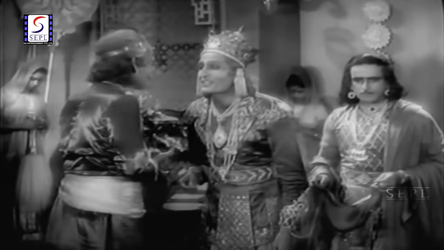
It’s a classic plot, seen again and again in love stories across the ages and across space. Two lovers, on opposite sides of a social divide, finding themselves being torn not just as a result of their differing social strata, but also because of the bonds of duty and honour that pull them in directions other than each other. This is nothing new, and I know of plenty of Hindi films that used this trope in varying ways. Of course, it may be that Raj Nartaki might have been one of the earliest Indian films to go down this road, but even if it wasn’t, it is still a film with a significance in the history of Indian cinema, and worth seeing for that.
What I liked about this film:
Sadhona Bose (whose husband, Modhu Bose, directed this film for Wadia Movietone). There is something luminescent about her face: the sweetness of her smile and the expressiveness of her eyes really grabbed my attention every time Sadhona Bose was onscreen. As a dancer, she is exquisite. While trained in Kathak and Manipuri, she gets to mostly show off her skills with the latter dance form, and she’s utterly graceful. Interestingly, while I was watching Sadhona Bose’s dances in Raj Nartaki, I could not help but remember Vyjyanthimala’s dances in Amrapali, and compare the two. Vjyanthimala’s dancing is exceptionally energetic and depends a lot on stunning footwork; with Sadhona Bose, it’s the grace and the general elegance of the dance that comes through. And her mudras, the hand gestures: wow.
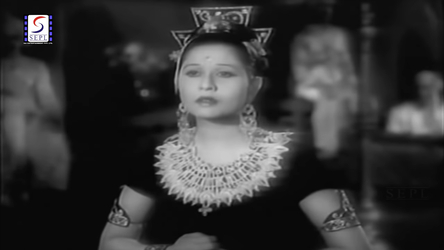
Incidentally, Sadhona Bose’s diction too stood out for me. She has a neutral accent, and is clear (Prithviraj Kapoor, in contrast, sometimes has an obviously Punjabi accent). Interestingly, Tapan (who played the Captain of the Guards, Taaya) might have passed off as British if you only heard him speak, didn’t see him.
I also liked the brief songs that dot the film. Timir Baran is credited with the music for Raj Nartaki, but no lyricist is listed. However, for the lyrics, Verrier Elwin is credited with the translation into English. Given that (as far as I am aware) Elwin was an anthropologist and ethnologist with no connection to the film world (excluding this, much later, appearance), I am guessing that these songs are all ‘traditional’ or folk: lyrics that have been in existence so long, nobody knows any longer who came up with them. Elwin perhaps translated them as a part of documentation exercises, rather than specifically for Raj Nartaki.
What I didn’t like:
There was nothing specifically that I did not like, but it was more that I was a little indifferent to this film, barring the few things I’ve mentioned before. It wasn’t really memorable for me, not standing out in the way a film like Roti does. Good, not excellent.
 Dustedoff
I recall having watched a portion of ‘Court Dancer’ on DD. Wasn’t exactly the kind of stuff to hold down the attentions of a restless twelve-year-old for very long, but Sadhona Bose’s diction, beauty, and personality had left me pretty much star-struck.
It’s sad to know just how tragic her later life was, and that she died utterly destitute. Do check out this link:
https://varmaindianclassics.blogspot.com/2020/07/sadhana-bose-20-april-1914-3-october.html
LikeLiked by 2 people
I hadn’t known about the tragedy of Sadhona Bose’s later life – that made for heartbreaking reading. But yes, how utterly luminous she was in this film! I can imagine a child being bored stiff by the film but star-struck by Sadhona Bose. :-)
LikeLiked by 1 person
Both the sisters , Sadhana and Nilina (Naina Devi) had such tumultuous lives…)
https://www.livemint.com/Leisure/ZTajZQOaNKjqCl1I2keFdN/Her-life-in-8216thumri8217.html
LikeLike
I shall read this another time. :-) Right now, I am not very kindly disposed towards Vidya Rao, so just seeing her name at the beginning of this article put me off.
LikeLike
The dance form in which Vyjayanthi learnt the basics of dance was Bharatanatyam. A vigorous dance form. This may explain the difference in dance styles between Amrapali and Raj Nartaki.
The review is really welcome. Had heard of but not seen many of these movies.
LikeLiked by 1 person
Yes, of course, they are two very different types of classical dance. What I found interesting was that though both these ladies are extremely graceful dancers, the intricate footwork dominates in one, the graceful mudras in the other – a reflection of the different dance forms.
LikeLiked by 1 person
Hearty thanks for the beautiful and curiosity arousing narration. Prithviraj Kapoor was very handsome in his youth and it must be a pleasure to watch him.playing a young hero on the screen. You have mentioned Verrier Elwin. He was an ardent disciple of Mahatma Gandhi, had spent sufficient time with him at the Sabarmati Ashram and was loved by him like his own son.
LikeLiked by 1 person
I hadn’t known that Verrier Elwin was a disciple of Gandhiji’s. Interesting! Thank you for that titbit.
To be honest, I think Sadhona Bose outshone Prithviraj Kapoor in this one. But in the same year as this, he also acted in Sikandar (which I have reviewed on this blog, several years ago), and he’s really handsome, really impressive in that:
https://madhulikaliddle.com/2016/07/15/sikandar-1941/
LikeLiked by 1 person