
Long-time readers of this blog probably know by now that I have a soft spot for suspense films, heist films, comedies, and—where these genres sometimes meet—films about bumbling crooks. The funny heist film, so to say, where everything goes wrong. Some months back, when I watched Gambit (which I enjoyed very much), a subsequent search for funny heist films threw up another suggestion that I’d heard of before: The Ladykillers. Like Gambit, this too starred Herbert Lom, an actor I like, and because I was fresh from watching Gambit, I thought why not give this one a try too.
The Ladykillers begins with the lady in question: sweet, somewhat scatter-brained old lady Mrs Wilberforce (Katie Johnson), who emerges from her house at the end of a lane and walks down the street nearby. Everybody around seems to know and like Mrs Wilberforce: people greet her, and when she reaches her destination—the local police station—the cops are indulgent. Mrs Wilberforce has come to clarify that her friend, another elderly lady who had informed the police station about spotting a spaceship, was actually misinformed… Mrs Wilberforce’s explanation is detailed and apologetic, and her earnestness shines through bright and clear.

It’s obvious that the cops have had many such prior dealings with the old lady, and having assured her, they send her on her way. She has to return to pick up her umbrella (which she’s always forgetting), but then she’s gone.
Mrs Wilberforce’s house is old and rather ramshackle, with most of the upper rooms too rickety to live in. But she can rent out two rooms at the back which are in sound condition, and she’s advertised for lodgers.
Her advertisement brings a lodger now: a man (Alec Guinness, looking far from his usually suave self) who introduces himself as Professor Marcus.
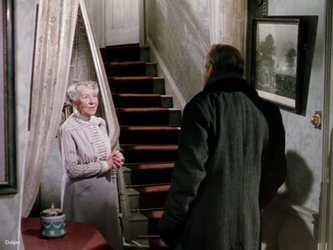
Mrs Wilberforce shows him the rooms and he appreciates the windows (which look out onto a very busy railway track: King’s Cross Station is not too far). Marcus tells Mrs Wilberforce that he and a small group of friends would like to use her rooms to practice music in. They’re an amateur group, and will spend most of their time indoors, rehearsing.

Mrs Wilberforce is happy to oblige. She likes music.
Shortly after, Marcus’s friends arrive, each bearing a violin case (and in one instance a cello case). Marcus introduces them to Mrs Wilberforce: they are Harry Robinson (Peter Sellers), Louis Harvey (Herbert Lom), Major Claude Courtney (Cecil Parker), and ‘One-Round’ Lawson (Danny Green). They are, to varying degrees, courteous to Mrs Wilberforce.
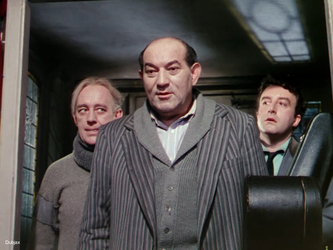
The only one who is very disdainful (and that behind her back), is Louis, a short-tempered sort who seems to be the only one of this group who has the ‘hardened criminal’ vibe about him.

Because criminals are what this quintet really are. The ‘practicing their music’ thing is really just a blind, so that they can keep an eye on the comings and goings of the trains and plan their heist accordingly. The plan, by the way, is to steal a large sum of money which they know will be transferred at the station soon after.
Their most vital bit of equipment right now is a record player, on which they play classical music to convince Mrs Wilberforce that they are indeed practicing—and she is very impressed.
So impressed, in fact, that she keeps coming upstairs every now and then to compliment them on their music (they sound so professional!), to bring them tea, etc etc. Louis, especially, is getting pretty sick of it all, though the others are rather more forgiving.

Mrs Wilberforce just seems to go from strength to strength when it comes to sweetly woolly-headed helplessness. She comes upstairs to ask for help giving her pet parrot his medicine (his name is General Gordon, and he is one of three parrots she inherited from her late husband). Harry goes to help, and what follows is a spate of ill-luck, as:
(a) Harry gets pecked; the parrot draws blood
(b) Lawson, coming to the rescue, ends up breaking a chair and falling rather indecorously
(c) The parrot flies off
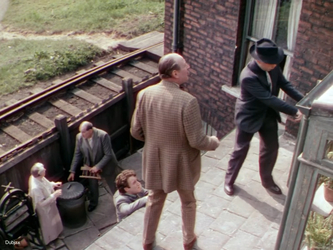
And much else, all frightfully chaotic, ensues. These men, if they were a little superstitious, might have changed tactics or abandoned their plan; but they carry on. Some of them are a little apprehensive, though: their plan depends on Mrs Wilberforce… can she be trusted? Marcus shoots down these doubts. Mrs Wilberforce is the best person to carry out that part of the plan. And, given that she will know nothing of what she’s really doing, nothing can go wrong.
Sure enough, on the day—when £60,000 is being transferred at the station, in a bank van—everything seems to go according to plan. Marcus and his men hold up the van, knock out the driver and guard, steal the boxes full of cash, and transfer them easily into a large case. Harry, disguised as a railway porter, sneaks these into the crowded, busy area of the lost luggage section.
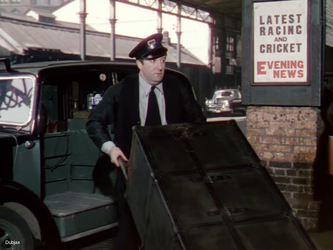
This is where Mrs Wilberforce arrives soon after, to collect the luggage for her lodger, Prof Marcus, who is leaving town today, and has asked her for this favour. Of course, the luggage this sweet and obviously innocent lady has to collect is right there. It’s handed over, and Mrs Wilberforce gets into the taxi with it. Just a short ride home, and the men (watching from a car they’re using to tail her) can breathe a sigh of relief and sit back.
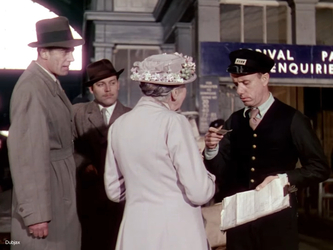
Not so soon, though. Because, barely after she’s out of the station than Mrs Wilberforce gets the taxi to turn back.
No. Just to get her umbrella, which she had forgotten again.
Then, closer home, she again gets the taxi to stop. A man selling fruit from a large cart on the roadside is getting very angry at a horse that’s nibbling his fruit, and animal-loving Mrs Wilberforce sees red. She gets out of the taxi and starts shouting at the man, telling him to desist. The man tries to shake her off, Mrs Wilberforce refuses to listen. The horse nabs another apple. The taxi driver gets out of his cab and comes to intervene, only ending up in fisticuffs with the fruit vendor.
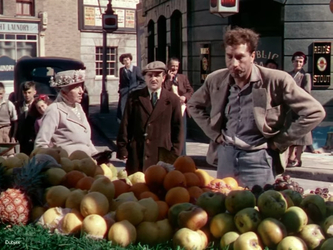
And this is only the start. Marcus & Co., looking on in horror from the car they’re in, have no idea what’s going to happen next.
A lot does happen, and the story takes the most outrageous turns as it progresses.
Directed by Alexander Mackendrick and written by William Rose, The Ladykillers proved a popular film: it has been ranked (by the British Film Institute) as the 13th greatest British film ever made; William Rose got an Oscar nomination for it (and won the BAFTA Award for Best Screenplay); and Katie Johnson won the BAFTA Award for Best British Actress.
The unusual thing about The Ladykillers as a funny heist film is that unlike films like Gambit, Charade, I Soliti Ignoti, etc, the humorous tone changes as the film progresses. Gambit et al remain (relatively) frothily funny: the sort of crime film where nobody ever gets badly hurt, for instance. In The Ladykillers, though, two-thirds through the film, the hilarity up till that point is replaced by a pretty macabre sort of dark humour. It’s still funny (well, I like dark humour…) but I can guess this might not be appealing to some viewers.
I enjoyed this film. The change in tone at the one-hour mark took some getting used to, but it was still wittily done. The plotting is superb, the dialogues delightful, and the acting top-notch, overall. Interestingly, this was Peter Sellers’s first major film. He and fellow star Herbert Lom would go on to work in the top-grossing (also similarly ‘funny crime’) Pink Panther films nearly a decade later.
Comparisons, comparisons:
Given modern cinema’s penchant for remaking successes (sadly, not always with equal success), it should come as no surprise that The Ladykillers was remade. In 2004, the Coen Brothers directed a Tom Hanks-starrer version of this film, though shifting all the action from London to the US.
How does the 2004 film compare to the 1955 one?
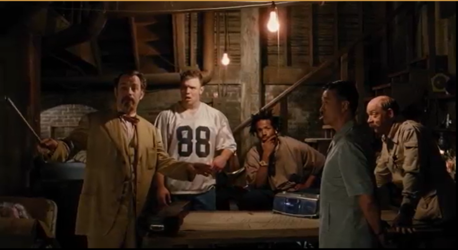
They’re similar in essence, even though the details differ. There is, for instance, the very independent but sweet old lady whom a group of criminals set out to use in order to pull off a big robbery—in this case, robbing a casino of $1.60 million. The men pose as musicians, and ‘practice’ in the lady’s root cellar, whereas all the while they’re using the cellar to dig a tunnel to the casino’s counting office. There are mishaps aplenty along the way.
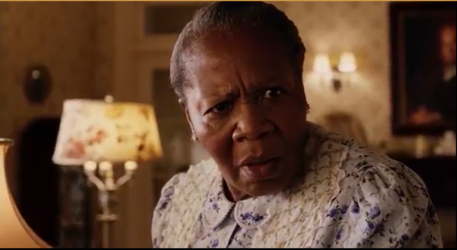
Where the Coen Brothers’ film differs from its British counterpart is mostly in the tone. This one is markedly brash and brutal, right from the start. There is a good bit of foul language, toilet humour, and over-the-top caricatures of all the main characters. ‘Lump’ (Ryan Hurst), for example, is an American version of Lawson, but while Lawson comes across merely as somewhat simple and dim-witted, Lump (who goes around with his mouth open) is just pure hard to believe. The plotting, the black humour, the way the story plays out, is all entertaining enough (and macabre, the way the 1955 film is), but there’s a polish to the earlier film that’s missing from this one.
 Dustedoff
As good a narration as any DustedOff review.
Will surely watch it not the least because the old lady reminds me of Miss Marple.
LikeLiked by 1 person
Indeed, Katie Johnson does remind me of Miss Marple too – except that Miss Marple is a lot more canny. She would have cottoned on much sooner that something was fishy here!
LikeLike
The word-press site is not opening at all. Was not able to read last few posts as couldn’t access.
Anubha
LikeLike
This is so weird. :-( But how did you get to this page? Or has the access returned? I really can’t understand how WordPress behaves…
LikeLike
I left a reply on the post notice (with great difficulty ) on my phone :(
LikeLike
:-( God knows what WordPress is up to!
LikeLike
I completely agree that the original was far better than the remake, even though the latter is by the Coen brother and stars Tom Hanks, all of whom are some of my favourites.
Since you like funny crime capers, the Dortmunder series of novels by Donald E Westlake should be right up your alley. John Dortmunder is a hapless and luckless crook who is a mastermind at conjuring up elaborate crime plans that somehow always manage to get more complicated and go wrong at the last minute. The novels are well plotted and are comedic.
The first in the series, The Hot Rock, is one of the funniest and most convoluted novels I have come across. It was adapted for the screen in early 70s, which inexplicably starred Robert Redford. Inexplicably because Dortmunder is written as a completely down on his luck character yet they chose one of the most dashing actors to play him.
LikeLiked by 1 person
Thank you so very much for the Dortmunder recommendation! I hadn’t heard of the series, much less read any of the books, so have already added it to my To-Be-Read shelf. Thanks a ton. I’m looking forward to reading.
LikeLike
I loved this movie.
It is so well-made.
A good friend of mine played the role of Prof. Marcus in a stage version of this film in an amateur theatre few years back.
This movie somehow reminds me of Sleuth (1972), although there are no similarities in the plot at all. It is nevertheless highly recommendable. Alec Guiness was superb in Kind Hearts and Coronets (1949), which I presume you’ve already seen, if not, lucky you, because you will get to see it completly new.
LikeLiked by 1 person
Reading your excellent review of The Ladykillers made me watch The Horse’s Mouth (1958), which I had been meaning to watch for such a long time. I absolutely loved it, now I wonder why I had been putting it off for such a long time. I think you will like it. It is on yt. Alec Guiness plays an eccentric but endearing painter like only he can.
LikeLiked by 1 person
I don’t think I’d ever even heard of The Horse’s Mouth. Have bookmarked it, and hope to watch it soon! Thank you. :-)
LikeLike
I actually haven’t seen Kind Hearts and Coronets so far, don’t know why. I will certainly watch it, now that you recommend it, Harvey! Thank you for for that.
LikeLike