
The first post in this series of song lists was posted as a tribute to Lata Mangeshkar when she passed away in early 2022. I had previously posted a song list featuring Lata in Ten Moods, so this time I wanted to be different: to showcase Lata’s work with different music directors. Naturally, given Lata’s oeuvre (even till just 1970, which is my self-imposed cut-off for this blog), that list, with just ten composers included, was far from enough. I ended up doing several more posts in the series, and every time, some reader or the other would comment: “What about so-and-so composer? How about this song?”
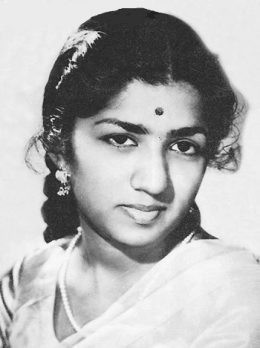
Therefore, yet another instalment of solo songs sung by Lata for various composers. As always, these are from Hindi films that I’ve seen, and all are from before the 1970s.
In no particular order:
1. Jyoti kalash chhalke (Bhabhi ki Chudiyaan, 1961): With Sudhir Phadke. Maharashtrian singer-composer Sudhir Phadke’s compositions for Marathi cinema far outnumbered his Hindi films; a trained classical singer, he often used raga-based tunes that found their niche in many mythological and devotional films. In Hindi cinema, while he did compose some very good music for films like Pehli Tareekh and Apradhi, the one song which really stands out—and which probably even endures more than the film in which it appeared is this one: a beautifully sensitive and gentle prayer. From the very beginning, with Lata’s voice soaring, so free and yet totally controlled, to the rest of the verses: this is one of the most melodious songs I’ve heard. Exquisite.

2. Apni ada par main hoon fida (Teen Batti Chaar Raasta, 1953): With Pandit Shivram Krishna. Pandit Shivram Krishna’s background was pretty impressive: learning music from the age of eight, Shivram had worked as a court musician for the Maharaja of Jodhpur until, at sixteen years of age, he migrated to Lahore to work in cinema under music stalwarts Pandit Amarnath and Ghulam Haider. Although Shivram Krishna, post-partition, got some good films with V Shantaram, he ended up later slotted into composing for mythologicals, which meant (as happened for several contemporaries) that some great tunes ended up in films that otherwise sank.
This, however, is a standout song from a Shantaram film: Lata sings for Sandhya’s character, a dark-skinned and poor young woman who has a beautiful voice. Shivram Krishna’s music has the resilience, the ebullience which characterizes this woman: she tells the world to go its way, she will be proud of herself. I love the sentiment, and the way Lata sings it, she manages to bring that emotion vividly to life.
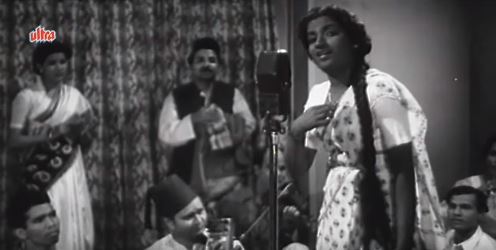
3. Yaad suhaani teri banke zindgaani meri (Banarasi Thug, 1962): With Iqbal Qureshi. Iqbal Qureshi is a stellar example of a composer whose fame (such as it ever was) is far outlived by that of the songs he composed. Qureshi, who debuted with Panchayat (1958) went on to compose exquisite tunes like Phir aane laga yaad wohi pyaar ka aalam, Ek chameli ke mandve tale, and Subah na aayi shaam na aayi. He seems to have favoured Asha for many of his songs, but there are some beautiful ones sung by Lata as well, including the wonderful duet Aaj mausam ki masti mein gaaye pawan, from Banarasi Thug (with Rafi). From the same film is this melodious solo, a woman singing for the lover who’s had to leave her, bereft and alone. Technically, this isn’t a solo (there’s a chorus here and there, especially in the beginning), but since the bulk of the song is sung by Lata, I’m taking that liberty. Beautifully rendered: dulcet, emotional but not shrill.
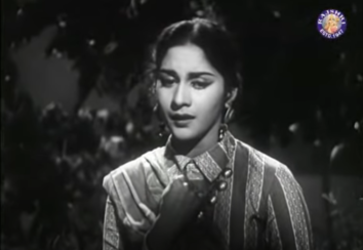
4. Pyaar ki nishaaniyaan guzri hui kahaaniyaan (Do Dulhe, 1955): With BS Kalla. Also credited as Balakrishna Kalla, BS Kalla worked primarily in the south, scoring music for Gemini Studios films like Chandralekha, Mangala, Bahut Din Hue and Mr Sampat, all directed by SS Vasan. Do Dulhe, directed byMadhavan KJ, had several good songs, of which several were sung playback by Geeta Dutt; Pyaar ki nishaaniyaan, with Lata singing playback for Shyama, is among the film’s standout songs. I like the restraint here; even though this is a pretty standard ‘Oh how miserable I am to be separated from you’ sad song, she manages to imbue it with pain while retaining the melody.
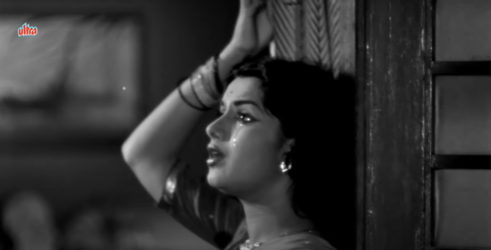
5. Bulaati hai bahaar (Begaana, 1963): With Sapan-Jagmohan. One of Hindi film music’s many composer duos, Sapan-Jagmohan (Sapan Sengupta and Jagmohan Bakshi, to give them their full names) had begun as singers in Salil Chowdhury’s Bombay Youth Choir, and had migrated from there into cinema playback and eventually composition. Sapan-Jagmohan composed through the 60s and 70s, but never quite managed to make it to the big league. They did, however, compose some good songs, with Begaana one of their best albums. Rafi’s Phir woh bhuli si yaad aayi hai was the stand-out song here, but there was also this joyful love song sung by Lata. There’s an exuberance to Bulaati hai bahaar that conveys the excitement and uninhibitedness of being in love very well.
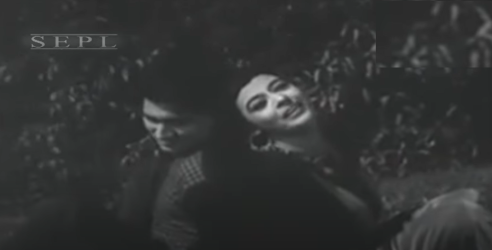
6. Nazar se door jaanewaale (Lahore, 1949): With Shyam Sunder. Shyam Sunder had begun his career as a composer of music under one of Lata’s first mentors, Ghulam Haider. Shyam Sunder had initially been an assistant to Ghulam Haider, and under his aegis, branched out as an independent composer too. Through the 40s, Shyam Sunder composed songs for many films, including for greats like KL Saigal. It’s worth noting that it was (in large part) thanks to Shyam Sunder that Mohammad Rafi got a break in Hindi film playback singing.
Lata sang pretty much all the songs for Lahore, and this song is one of her best: the control she has over her voice comes through so strikingly here. She goes very high, but manages to never lose a note.
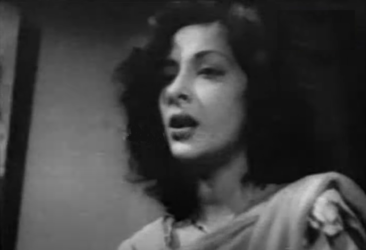
7. Armaanon ki nagri ujad gayi (Tamasha, 1952): With Manna De. Like Hemant and Kishore Kumar, Manna De was one of those singers who were also composers. His music for Hindi cinema was soon outstripped by his phenomenal voice, leading Manna De to be remembered more for his singing than anything else. However, he is known for some compositions, including for Tamasha, the comedy whose songs were initially assigned to Khemchand Prakash. After Khemchand Prakash’s death (he had composed the music for only two songs, Khaali-peeli kaahe ko akkha din and Thi jinse pal bhar ki), Manna De composed the rest of the songs. Of those, Armaanon ki nagri ujad gayi shows off a young Lata’s mastery of her voice superbly: the controlled restraint of it when she sings the opening, the sweetness throughout, the emotion she imbues it with. Beautiful.
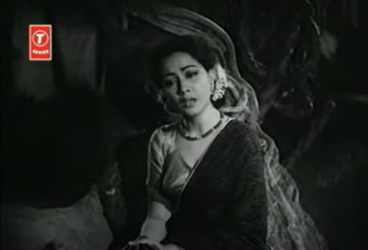
8. Na baaz aaya muqaddar (Sunehre Qadam, 1966): With Bulo C Rani. Born Bulo Chandiram Ramchandani, Bulo C Rani had music in his veins (his father, Chandiramani, was a composer too). Introduced to the world of film music while still in his teens, Bulo initially worked in Lahore. There, he was spotted by the lyricist DN Madhok, who took the young singer-composer to Bombay, where he worked as an assistant to composers like Khemchand Prakash and Gyan Dutt. Bulo C Rani composed music through the 40s and 50s and into the 60s as well, though by the third decade, his output had fallen considerably.
Sunehre Qadam was one of Bulo C Rani’s later scores (though the film, from what I can tell, was probably released several years after it was made); some of the songs were composed by S Mohinder. This one, though, composed by Bulo C Rani, is a gem, beautifully melodious. The music is subdued and gentle, allowing Lata’s voice—so sweet, pitch-perfect—to shine forth.

9. Baazuband khul-khul jaaye (Baazuband, 1954): With Mohammad Shafi. Mohammad Shafi is another instance of the many composers in Hindi cinema who were very talented but are now more or less forgotten. Shafi, who began as a very accomplished sitar player with New Theatres, soon branched out into composing and arranging. Through the 40s to the 60s, he assisted composers like Naushad (also for Mughal-e-Azam) while composing music for films independently. Among the scores credited to him are Deewaar, Tanhai, Mohabbat ki Jeet, and Baazuband; with other composers, he created the music for Hulchul (with Sajjad Hussain) and Aabsheer (with Ghulam Haider and Bhola Shrestha).
Baazuband, a Ramanand Sagar film about the evils of alcoholism, had Shafi compose this beautiful classical thumri in raga Bhairavi. Lata is stunning here, so controlled, her voice gliding so effortlessly over the notes. The song is an interesting showcase of just how skilled Lata was at classical music: “Kambakht kabhi besuri nahin hoti,” as Bade Ghulam Ali Khan had once famously said about her.
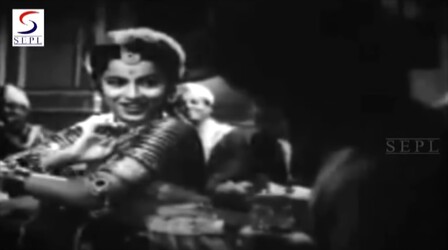
10. Aaja mere meet re (Jahaan Sati Wahaan Bhagwaan, 1965): With Lala-Asar-Sattar. I will admit that I haven’t been able to find much beyond the most rudimentary information online about this trio of composers, who seem to have worked on only a couple of films as a trio. Of these two, the main duo consisted of Lala Gangwane and Sattar Khan, who—besides being composers—were also percussionists. In 1965, they had teamed up with Asar Mohammad Khan for Jahaan Sati Wahaan Bhagwaan, a fairly standard mythological film.
Lata sang a couple of songs for this film, of which this romantic song is the one I prefer. The music has a rippling, melodious quality to it, and Lata’s voice captures and reflects that beautifully.
Thank you for the music, Lataji! May your voice never dim.
 Dustedoff
Oh God, apart from Jyoti Kalash Chhalke, every song seems unfamiliar to me. :(
LikeLike
They are, most of them, songs from fairly (very?!) obscure films, perhaps that’s why. But two songs, in particular, I would really recommend taking the time to listen to: Baazuband khul-khul jaaye, and Na baaz aata muqaddar. While from obscure films, they’re both excellent songs. :-)
LikeLike
Thank you. Will listen to these songs. And I agree with Jitendra Ji, your knowledge/research work is amazing! :)
LikeLiked by 1 person
Thank you so much! That’s really kind of you. :-)
LikeLike
Same here!
LikeLiked by 1 person
Let me candidly admit Madhulika Ji that barring a couple of songs, the songs in this list are unfamiliar to me. Your research work is really amazing. I will listen to all these songs now and enjoy the melody embedded in them in Lata’s voice. Hearty thanks. You have mentioned a song from Begaana (1963). If you haven’t seen this movie, then you can spare some time some day to watch it. It indeed is a very good movie.
LikeLiked by 2 people
Thank you for the appreciation, Jitendraji. Yes, most of these songs are quite obscure, but I do think they’re all, in their own ways, quite a tribute to the talent of Lata.
I have watched Begaana (I only post songs from films I’ve seen). I have to admit I was a little ambivalent about it – I didn’t like it enough to want to review it, though yes, I did not think it a bad film at all.
LikeLiked by 1 person
Madhu,
Nice curation of songs. We all know the famous music directors. But it is a good idea to present songs by lesser ones.
AK
LikeLiked by 1 person
Thank you, AK. The famous composers got covered in the first three posts – but then I realized there were many very good songs by composers who never did quite make it to the top, or have been since forgotten. They deserve the spotlight too, because it’s not as if they weren’t talented.
LikeLike
Lataji has composed marathi songs under the name ‘Anandghan’. These are considered classic till date.
Malyachya Malyamandi patache pani jaate
Shoor Amhi Sardar sung by Pt. Hridaynath Mangeshkar
Reshamachya Reghani sung by Aasha Bhosle. Do listen to Dholak piece at the start, perfect for the ‘lavani’ being sung.
Last one I might have mentioned in comments on one of your post.
Akheracha ha tula dandvat
LikeLike
Hridaynath Mangeshkar has composed many hindi and marathi albums but if I must choose a single album from his repertoire, it will be ‘Shiv Kalyan Raja’ – an album dedicated to Chhatrapati Shivaji Maharaj.
No Shiv Jayanti celebrations is complete without ‘He Hindu Nrusinha Prabho Shivaji Raja’ penned by Swatryaveer Savarkar.
Or Vedat Marath Veer based on Marathi Sarsenapati Prataprao Gurjar along with 6 of his compatriots taking on an entire camp on Behlol Khan.
Sarnar Kadhi Ran based on legendary fight of Pavankhind wherein Baji Prabhu Deshpande an elderly warrior along with his handful warriors fought with mighty Siddi Jauhar army till Maharaj safely reached Vishalgadh.
Last 2 penned by mighty Gyaanpeeth awardee Kusumagraj.
Recently 2 marathi movies released on these 2 incidences namely ‘Vedat Marathe Veer Daudle Saat’ and ‘Pawankhind’
‘
LikeLiked by 1 person
Thank you for the links to these songs. Listening to them now.
LikeLike