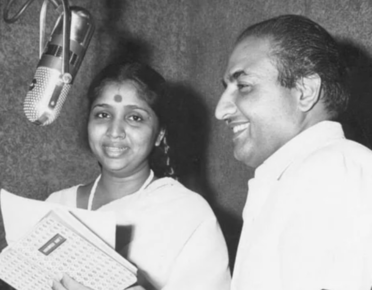
Asha Bhonsle: Ten Duets, Ten Co-Singers: Part 2

When I posted this list  of ten Asha duets last week, the plan had not been to post a follow-up list as well. But then, blog readers began commenting on the post, and several of them posted songs that I really like, with playback singers I hadn’t mentioned. After all, when you’re doing a list of just ten songs, the tendency—and I admit I succumbed to this temptation—is to include your favourite songs. All the duets with Rafi, Kishore, Mukesh, et al, featured there. And those songs with these singers that didn’t actually get listed, I at least made it a point to mention.

Even when I’d posted that list, I was ruing the fact that I had still not got around to writing about Asha’s songs with, say, her sister Usha Mangeshkar. There were, in addition, a few rare songs with relatively little-known singers, too, that I had had in mind, but hadn’t written about.

So many good songs on the back burner. I decided a Part 2 was in order. So here it is. Ten duets sung by Asha Bhonsle with a fellow singer who wasn’t listed in the earlier post. As always, these songs are all from pre-1970s Hindi films that I’ve seen. These are in no particular order.

Continue reading

Ten Singers, Ten Duets: The Timelessness of Asha Bhonsle

(Apologies for the hiatus, the result of a series of unavoidable circumstances). 

Last month, when I posted a solos list as a tribute to Asha Bhonsle, a couple of blog readers asked me if I would be posting one (or more) follow-up posts. After all when Lata Mangeshkar passed away, I ended up publishing five posts, a total of fifty songs showcasing the solos Lata had sung with fifty different music directors or music director pairs. Surely Asha merited something similar? Yes, indeed she does, but I personally think Asha’s most stunning solos were sung for a handful of composers like OP Nayyar and SD Burman during the 1950s and 60s. She did sing songs for a wide range of music directors, but I find a lot of those songs relatively forgettable.

I decided therefore to focus this post on another aspect of Asha’s career: her duets: Romantic, funny, flirtatious, poignant—and so much more. Songs where her voice merged with that of a co-singer to create magic.

Continue reading

Ten Composers, Ten Solos: The Magic of Asha Bhonsle

I know I am late. Asha Bhonsle passed away, at the age of 92, on April 12. Within a couple of hours of the news of her death, there were tributes cropping up all across the net. Song lists, essays, memories, some misplaced attempts to jump on the bandwagon even if one wasn’t too sure what the fuss was about.

I am late, yes. I have to admit I was a little benumbed—Asha has always been one of my very favourite singers (dare I be an iconoclast and admit that I liked her more than Lata?). But more than that, she symbolized for me an older, sweeter time: an era of kinder films, gentler films, of sublime music and innocence. Asha was the last of the stalwarts, the last one standing of those who had created the magic of the 50s and 60s.

Continue reading

Ten of my favourite ‘Housework Songs’

This needs some explaining. I don’t mean songs that extol the virtues of doing housework (as someone who does more housework than the average middle class Indian woman, I cannot imagine ever extolling the virtues or joys of housework—it’s possibly the most thankless, relentless and utterly monotonous job out there). But the monotony of housework, the fact that you can get nearly all of it done without really applying your mind or having to concentrate, means that you are free to do something else. Especially something musical.

My mother-in-law invariably turns on the radio and listens to songs as she goes about her work. But my mother, from as far back as I can remember, used to sing. As she went about dusting and the cooking and whatnot, I’d hear her singing. She still has a wonderful voice, and back in her heyday, it was stunning—and her repertoire was amazing, all the way from hymns to hits by Elvis and Jim Reeves (and some old Hindi songs: as lullabies, she sang O mere pyaar aaja to my sister, and Yehi woh jagah hai to me).  I too, when I’m doing housework—especially when I’m cooking—sometimes sing. All sorts of songs.

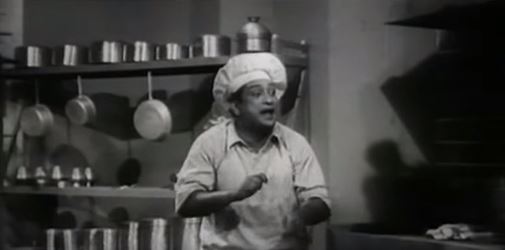
So, too, do a fair number of people onscreen. Here, then, are ten songs that feature people singing as they go about doing housework. Besides my usual criterion, about the film in question being a pre-70s one that I’ve seen—I’ve imposed one more rule: that the person should be doing some work in the course of the song (this is why Kismat ki hawa kabhi naram doesn’t feature on my list; while Bhagwan’s character is in a kitchen, surrounded by pots and pans and even wearing a chef’s cap, he never uses any of those for anything remotely connected to housework).

Continue reading

Ten of my Favourite Ravi Duets

Another birth centenary, and another list of favourite songs from the 1950s and 60s.

Today, March 3, 2026, marks the 100th birth anniversary of the composer mononymously known in Hindi cinema as Ravi, and in Malayalam cinema as Bombay Ravi. In the course of a long and illustrious career, Ravi composed music for a very wide range of films, first in the Hindi film industry and later mostly for Malayalam cinema. I will leave those who know his work in the latter to compile lists of his Malayalam songs; what I would like to focus on here are the songs he composed for Hindi films. For films like Gharana and Khandaan, yes (both of which won him Filmfare Best Music Direction Awards); but also for many other films—both hits like Waqt and Chaudhvin ka Chaand, and films that were otherwise duds but the songs of which have far outlived the films themselves.

Continue reading

Ten of my favourite Nalini Jaywant songs

Nalini Jaywant is one of those actresses about whom I’ve changed my opinion over the course of my watching of her films. I remember, as a child (which includes my early teens, which was a peak period when it came to Hindi film viewing), not especially liking her. I was a callow youngster, and as shallow as I was callow. To me women like Madhubala or Meena Kumari were the ultimate in beauty: Nalini Jaywant, with her heavy-lidded eyes and her pouting mouth, didn’t strike me as beautiful. Also, even if I put aside the purely superficial aspect of her looks, there was the fact that I didn’t think her a good actress. I found her voice affected and thin, nothing to write home about.

Thank goodness I grew up. Grew up, widened my horizons, and realized that there are different kinds of beauty. Realized, too, that one shouldn’t pass judgment on the worth of an actor without having watched a wide-ish spectrum of their work. Nalini Jaywant, when I had watched Munimji, seemed just another effervescent filmi female, no more than arm candy; it was through Shikast and Kaala Paani, through Hum Sab Chor Hain and Railway Platform (and many more), that I discovered just how versatile she could be. Goofy, flirtatious, tragic, long-suffering, feisty… Nalini Jaywant aced so many roles, brought so many of her characters vividly to life.

Continue reading

Ten of my favourite Salil Chowdhury songs

In the 17 years this blog has been in existence, I’ve created song lists for a large number of music directors: OP Nayyar, Madan Mohan, Naushad, Ravi, SD Burman… but somehow, I had never got around to creating a Salil Chowdhury song list. I realized this lacuna some years back, but then, realizing that Salil’s birth centenary was in 2025, I told myself I’d plan a list to mark that. I could not ignore Salil, who has long been one of my favourite music directors.

Continue reading

Metropolitan Cities in India: Ten Songs

Some months back, I published a song list on songs that mention a city/town, Tier 2 or below, in India: Bikaner, Bareilly, Nainital, Agra… and when I was going over that list, it struck me that there were also songs that focussed on India’s metropolises, the Tier 1 cities. India has six metropolitan cities: Mumbai, Delhi, Kolkata, Chennai, Hyderabad and Bengaluru, and every now and then, they find a mention in a song. Bombay, by virtue of being the hub of the Hindi film industry, probably leads the pack when it comes to metro city songs; but there are others too (though I must admit I haven’t found any songs, at least from old films, that mention Bengaluru/Bangalore).

Continue reading

It’s All About Context: Ten Songs

When I create song lists, I always include only songs form films that I’ve watched. This is a rule I’ve imposed on myself, and it’s something that’s drawn questions, sometimes even accusatory. Why would I do that? I am asked.

Besides the fact that this is my blog (and so I get to govern it!), I have usually responded to that question by saying that some songs are best known in context.

Some songs. In fact, not very many. Most Hindi film songs—whether romantic, or depressed, or philosophical (or whatever other emotion)—are almost invariably neatly stitched together with the picturization. What’s happening onscreen is what’s echoed in the song.

Not always, though. There are a few songs where the song’s lyrics, or the picturization, are deceptive. If you don’t know the context, you may well end up interpreting the song as something very different from how it appears in the film.

Continue reading

Ten of my favourite ship songs

Many years ago, on this blog, I’d posted a list of boat songs. Boats happen to be fairly popular ‘platforms’ (so to say) for songs. For philosophical songs, for romantic songs, for songs of everything from despair to hope. There are songs on motorboats, on rafts, on rowboats and shikaras and whatnot. Many of Hindi cinema’s most famous songs from before the 70s were boat songs.

Much rarer, though, have been ship songs. Ships, after all, aren’t usually a part of most narratives (they’re less easily accessible, plus of course require a greater outlay on the part of whoever’s financing the film). Shipboard songs, I’ve realized, fall into a few fairly specific brackets. Either the singer(s) is/are employed on board a ship (as naval officers, deck hands, even pirates), or they are wealthy people travelling overseas. The latter, especially, became a more common theme in the late 1960s, when several films had a cruise as an important part of the storyline, invariably as a setting for a blossoming romance.

Continue reading