
In English, ‘Give and Take’.
I read a review of this Uttam Kumar-Tanuja starrer many years ago, and, ever since, I’ve been wanting to watch Deya Neya. All this time, I had never been able to get a subtitled version of it, but now there’s one (thank you, Angel), and I wasted no time in watching it.
The story begins in Lucknow, where Proshanto Roy (Uttam Kumar) lives with his parents: his very successful and wealthy industrialist father BK Roy (Kamal Mitra) and doting mother (Chhaya Devi). Mr Roy has Proshanto working at the office, doing accounts; but Proshanto is never to be found at work, and it riles his father up no end.
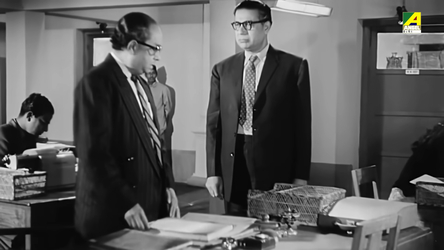
The reason for Proshanto’s absence is his interest in music. He’s a very good singer and composer, and has already made quite a name for himself, singing under a pseudonym: Abhijit Chowdhury. He is so popular that he’s just received an invitation from Kolkata, asking him to come to the city for a recording.

Proshanto goes home to pack a suitcase, and it is here that he comes face to face with his furious father. Mr Roy heaps scorn and anger on Proshanto’s plans to make a living from his singing (a profession, he says, for nautch girls), and eventually loses his temper to the extent of throwing Proshanto out. Proshanto, not to be outdone, storms off in a rage, not even listening to his mother’s pleas for him to calm down, not to go…

Before leaving Lucknow, Proshanto does two things. One, he arranges to sell his car, leaving it with a dealer and taking an advance of 2,000 rupees that will tide him over until he gets paid for the recording.
Two, he goes to visit his friend Shukanto (Premanghsu Bose). Shukanto is a poet, the man who writes the lyrics for all of Proshanto’s songs; but he’s ailing now, battling tuberculosis. Proshanto chats with his friend, consoles him, and does what he can to bolster Shukanto’s spirits.
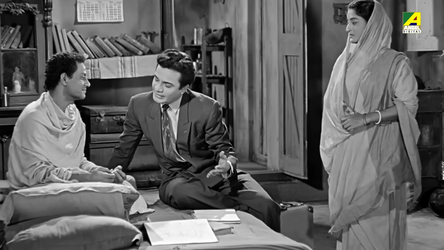
In Kolkata, Proshanto goes to stay with another friend. Ashim (Tarun Kumar Chatterjee) is, like Shukanto, an old and very dear friend of Proshanto’s; his wife (Lily Chakravarty) too treats Proshanto like a brother: they’re very comfortable together. It’s decided that Proshanto will stay with them while he’s in Kolkata, which, of course, might be for much of the foreseeable future, since Proshanto doesn’t intend to return to Lucknow.
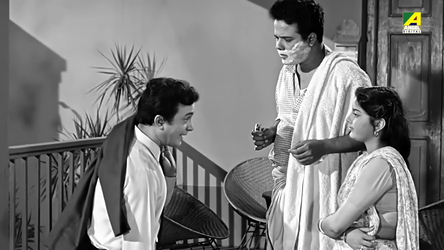
The next day, Proshanto is out, strolling along, when he bumps into someone, a confused and somewhat panicked man named Hanuman (Shyam Laha; we later learn that this character’s actual name is Anuman). Hanuman is a chauffeur at the home of the wealthy Mr Majumdar (Pahari Sanyal), but only chauffeur, not mechanic. Now, just as Mr Majumdar’s hot-headed niece Shucharita ‘Shuchi’ (Tanuja) is setting out, the car has conked out.
Hanuman is looking for a mechanic, and Proshanto—who knows something about cars—offers to have a look. Hanuman is more than relieved, but Shuchi is sceptical, and derisive. She sits up on the back of the car and passes remarks about this newcomer’s skills as a mechanic, even as Proshanto opens up the hood and has a peek.
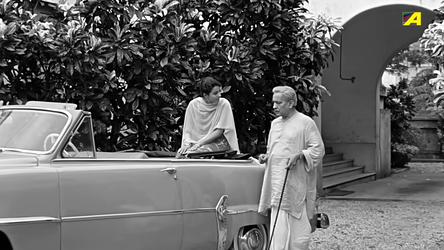
Proshanto sets the car right in a matter of moments, and climbing into the driver’s seat, drives off, catapulting an indignant and surprised Shuchi onto the seat. It’s just a test drive, of course; he turns round and brings her right back. Shuchi is so annoyed, she storms off into the house. Meanwhile, her uncle is very pleased; this is just the sort of man he wanted as driver, someone who can be mechanic as well.
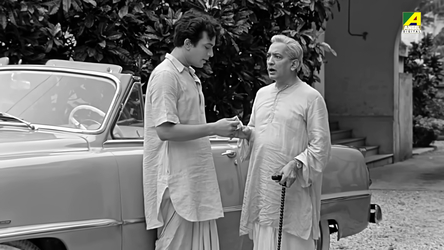
Things move swiftly now; Proshanto is offered a job as driver. Hanuman, worried that he will lose his job, talks to Proshanto, and Proshanto puts forward a condition with Mr Majumdar: he will accept the job only if Hanuman is kept on too. Not a problem, says Mr Majumdar: Proshanto will be the driver for the car that ferries Shuchi around.
As part of the conversation, naturally, Mr Majumdar wants to know a bit more about his new employee. Proshanto says that his name is ‘Hridoyhoron’ (“vanquisher of hearts”), and Mr Majumdar is quick to decide that that will be best shortened to Horon. Shuchi, listening in, caustically suggests shortening it further to Horu, but Horon it is. When Mr Majumdar tells Proshanto that he can stay in the servants’ quarters attached to the house, Proshanto refuses. His reason? He already has a home, with wife and two children: Taepa and Taepi.
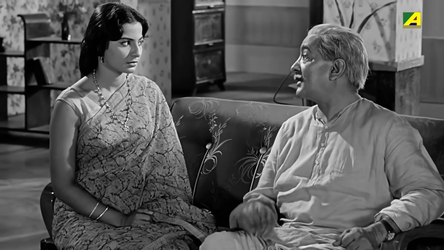
Very soon after, Shuchi and her friend Bishakha (Sumita Sanyal) are going in the car, being driven by ‘Horon’, when he overhears their conversation. Shuchi, it turns out, is a huge fan of Abhijit Chowdhury’s. She adores his voice, she is first in line whenever a new record of his is released, she will give anything to be able to meet him. A man with such a gorgeous voice: how handsome must he be!
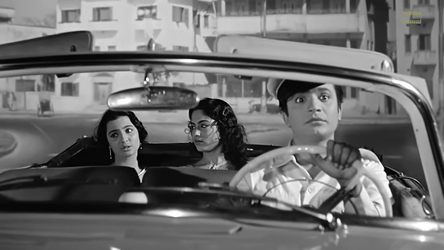
There’s that old adage, Walter Scott’s “Oh what a tangled web we weave when first we practice to deceive”, coming through loud and clear here. Proshanto, pretending to be the illiterate chauffeur Hridoyhoron for the Majumdars, finds he cannot, in that guise, hope to woo the girl he’s attracted to. Nor can he summon up the courage to tear off that mask and let her know he’s Abhijit. And Shuchi is hellbent on at least getting hold of a photograph of her idol, so she’s even found out Ashim’s address, and is now haunting the place…

Directed by Sunil Bandyopadhyay, Deya Neya is a light-hearted rom-com, with several threads of rather more weighty issues running through it: the generation gap between Proshanto and his father, and the corresponding clash between ideas of what is acceptable as an occupation; the tie between parents and offspring; friendship; sacrifice. It all comes together into a quietly enjoyable little film, charming and entertaining.
What I liked about this film:
The overall light-hearted charm of it. It does get mildly ‘serious’ near the end, but not enough to really matter. The core element, Proshanto/Abhijit/Horon and his deception of the pretty Shuchi, which causes further entanglements, is sweet. Plus, Uttam Kumar and Tanuja make for some serious eye candy.

The acting is all-round good, and the music (composed by Shyamal Mitra, with lyrics by Gauri Prasanna Mazumder) is wonderful. Among the songs I especially liked are Dole dodul dole jhulana, Madhobi modhupe holo mitali, and Ami cheye cheye dekhi saradin.
What I didn’t like:
The somewhat hurried, cursory ‘romance’, which left me feeling very unsatisfied. Proshanto is obviously somewhat attracted to Shuchi (I wouldn’t call it ‘love’; he doesn’t really know her); but in her case, it’s not even that. Shuchi is infatuated with Abhijit, with Abhijit’s voice, not even the man Abhijit is, since she has never met him. Towards Horon, while there does develop a certain level of comfort (there’s a scene at a picnic, and another from when they’re driving to the picnic spot), there’s nothing. To Shuchi, Horon is always the much-married, father-of-two driver. She might not mind him, but she’s not in love with him.
I would have liked this angle of the story to have been explored more deeply: for the bond between these two people to develop more intensely, for Shuchi to find herself torn between Abhijit and Horon, to realize that she loves this man and not that, even if this man is married. If there had been that dilemma, I would have enjoyed Deya Neya much more.
Comparisons, comparisons:
Deya Neya was remade in 1977 by Shakti Samanta, as Anurodh. It starred Rajesh Khanna in the lead role as Arun (the character’s real name)/Sanjay (his stage name)/Pritam Nath ‘Ghaayal’ (the name he assumes as a driver); Simple Kapadia as his love interest Sunita; and Vinod Mehra as Shrikant, the consumptive poet who is his best friend.
The basic storyline is similar, but, in typical Hindi film style, there is plenty of masala thrown in. Shrikant, unlike Shukanto, is unmarried, but has a mother (played by who else but Nirupa Roy), and there’s a sad backstory here: Shrikant’s widowed mother happens to be none other than the estranged daughter-in-law of Sunita’s grandfather (Ashok Kumar). This old gentleman had disowned his revolutionary son during the days of the British Raj, and though he relented after his son was killed by the British, his daughter-in-law, the daughter of another revolutionary, refused to come to him with her baby: now that baby has grown up to be Shrikant, and the old man doesn’t even know it.
Like Deya Neya, Anurodh too doesn’t do a good job of evoking a romance between the lead pair. There are more scenes here between Sunita and Arun, but they’re all basically about him fooling her, taking his deception further; there’s nothing that makes her seem even mildly attracted to the man. As in the Bengali version of the film, this young woman seems completely devoted to her ideal singer, for nothing more than his voice, until the end.
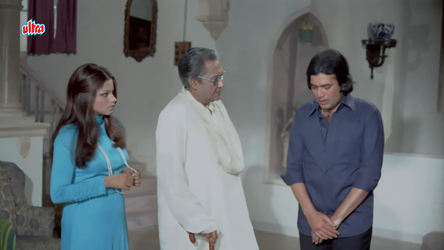
What’s worse, Anurodh stretches things, adding a silly ‘comic’ (I didn’t find it even slightly funny) caper in Darjeeling, with Arun in disguise. It also takes the ill Shrikant/Shukanto element, and makes a terribly melancholy, melodramatic story out of it, which really wrecked the film for me. As it was, I felt nothing for the lead pair: Simple Kapadia is a dud, and Rajesh Khanna, hair over his ears, was past his prime (what a short prime he had…). If there’s anything good about this film, it’s the wonderful music, composed by Laxmikant-Pyarelal: with songs like Tum besahara ho toh, Aate-jaate khoobsoorat awara sadkon pe, Aapke anurodh pe, Jab dard nahin thha seene mein, and Mere dil ne tadapke, this film is worth watching only for its songs.
You can watch Deya Neya, with English subtitles, here.
 Dustedoff
Yet again a lovely review! I’m especially thrilled because Deya Neya‘s been one of my favourite Bengali films of all times. Largely because it dares to flow against the tide, no the tsunami, of mediocrity so characteristic of Bengali cinema then, and more so now.
Agreed the romance angle was sketchily depicted. But as against this I found it a pretty well-made film, tautly directed and with a crisp script (otherwise the bane of so many other Bengali and Hindi films). Even the illness-related sequences have been treated with a sparseness that saves it from lurching into melodrama.
The acting’s pretty natural too. Lily Chakraborty’s a treat! I think the acting more than anything else is what sets it apart from Anurodh (which also I’ve had the misfortune to watch). In Anurodh I found the actors were too busy playing their own selves and not their characters. Which is why their performances stuck out like so many sore thumbs. In Deya Neya, the actors slide naturally into their characters. The banter in Ashim’s household is exactly the kind of banter one encounters in middle-class households, or at least the contented ones. It’s the kind of banter I grew up in, which makes it so relatable. Likewise Kamal Mitra is uncannily accurate in his depiction of the strict but loving father. And when he relents at the end without stepping out of persona (spoiler alert, sorry!), yet again that’s just the way strict Bengali fathers do conduct themselves when they choose to unbend a little.
That’s the thing I cherish about Deya Neya. More than the plot, more than anything else, it’s the way the story’s been narrated. The naturalness that pervades through the movie makes it so easy to relate to.
LikeLiked by 1 person
Largely because it dares to flow against the tide, no the tsunami, of mediocrity so characteristic of Bengali cinema then, and more so now.
Was most Bengali cinema back then actually that mediocre? Genuinely asking, not trying to pick a fight, since I really don’t know very much about Bengali cinema – either back then or now. Was wondering, given that the handful of old Bengali films, from the 50s and 60s, that I’ve seen, have been mostly enjoyable – I’ve not come across anything that I thought of as really terrible. But then, too, I suppose, there’s the fact that the films one comes across, as an outsider to whom films are recommended, are invariably the good films…
I did not get the nuance of the naturalness of it all, of course, but I did like the interactions of the characters: they did seem nuanced, and not forced.
LikeLiked by 1 person
Genuinely asking, not trying to pick a fight
Would I ever pick a fight with you? Would I even dream of it?
But then, too, I suppose, there’s the fact that the films one comes across, as an outsider to whom films are recommended, are invariably the good films
Right, there you have it. What you’ve encountered so far rank among the few that really stand out (another romcom I’d recommend is Nayika Sangbad). The rest are shrines to schmaltz and playing nyakā (a quintessentially Bengali word that defies translation – ‘coy’,’simpering’, ‘affected’ come close, but not quite close enough).
Oh, I forgot to share this anecdote. It comes from a TV interview of singer Manabendra Mukhopadhyay. Shyamal Mitra, in addition to composing the music track and playing back for Uttam Kumar, had also produced the movie. He asked his good friend Manabendra to join him for Dole dodul dole (I notice you’ve marked it as one of your favourites; it’s one of mine too). Except that when Manabendra began to sing, the director curtly interrupted to say he was singing too well, he needed to sing badly. It seems the protagonist’s friend was supposed to be terrible singer, and that’s how he was to sing for him.
An incensed Manabendra was on the verge walking out, when Uttam Kumar himself walked in through the main door saying, ‘Manab, you stay where you are’ – apparently he had chanced by the studio and overheard the conversation. Then he explained to the director, ‘Every artiste desires to give of his best. You got me this role because you wanted the best out of me, didn’t you? So why can’t we tweak the story a little so that an artiste like Manab may also give of his best?’ And that’s how the two great singers nailed that rollicking duet.
LikeLiked by 1 person
What a delightful anecdote that was! Thank you, Abhik. BTW, you know what that song reminded me of? Geet pehle bana thha, from Chupke Chupke – the scenario was so similar, two friends (one of whom ends up masquerading as a driver, coincidentally) sing together in a madcap sort of song, but still very tunefully, in front of the wife of one of them. The vibe was very similar.
Nyaka – ah. :-) I hadn’t known that word, but I am glad you added to my vocabulary. A useful word to know, and it conjured up scenes from so many films (Hindi, not Bengali) that I’ve seen. Thank you, too, for the Nayika Sangbad recommendation – am putting it on my list, though I haven’t been able to find a subtitled version. Someday, hopefully!
LikeLiked by 1 person
The tsunami of mediocrity, holds rather true for Bangla cinema post 1980’s, but not before that. Especially in the period between 1955-75, it hardly holds true. Even otherwise, in relation to other Indian film industries, the mediocrity in Bangla cinema isn’t in anyway, much more magnified than any other Indian film industry in particular.
Coming back to the golden age of Bangla cinema circa 1955-75, mediocrity in Bangla cinema was at best a ripple in the pond. Like in 1963 itself (the year Deya Neya released), there were atleast ten Bengali pictures, which were and are artistically and qualitatively better than Deya Neya. Another 7-8 pictures were at par with Deya Neya. In contrast, precisely 4 Hindi films and 1 South Indian film from Andhra Pradesh that year were better than Deya Neya from rest of the country. This gives one the idea how far superior Bangla films industry was back then to other fellow Indian film industries. And such excellence holds true for almost all the years in the period of 1955-75!!
LikeLike
Madhudi, the resemblance to Geet Pehle Baba Tha isn’t coincidental. Infact, back in the day, many Bengali film scenes, shots and ideas were referenced in Hindi films by the likes of Hrishikesh Mukherjee, Raj Kapoor, Guru Dutt, Bimal Roy, Ramesh Sippy, Vijay Anand, Raj Khosla, Satyen Bose, Basu Chatterjee, Basu Bhattacharya, BR Chopra and many others. Same Bengali referencing was present in Southern films too. But the media has never covered this aspect with due respect, and hence today many aren’t aware about this all pervading influence of Bengali cinema on the films of entire India.
LikeLike
Wonderful review as usual. “Deya Neya” is kind of special to me. My rather laconic dad rarely talked about his likes dislikes. One of the things he seemed to like was Shyamal Mitra’s voice, particularly his songs from this movie. Now that dad is no longer here, anything that he even remotely seemed to like is kind of special for me. On a related note, my dad resembled Uttam Kumar to such a great extent that seeing Uttam Kumar’s image often feels a bit uncanny to me. 😅 Both were Bengalis so the resemblance kind of makes sense.
LikeLiked by 1 person
Wow! Your father must have been a very handsome man. :-) This, in a way, reminds me of my mother – she used to look uncannily like Sadhana, so whenever I see a Sadhana film, I end up being reminded of her, and then end up phoning her to say hello, even if I’ve talked to her very recently!
Thank you for sharing that sweet little anecdote.
LikeLiked by 2 people
Your father must have been a very handsome man. :-)
Yes, he was. Though he himself never totally believed it, I think. 😅
I miss him so much but when I read about, listen to, or watch some of his favorites I remember the good times, for instance the songs of “Deya Neya”. So, thank you for reviewing such movies. 😊
LikeLiked by 1 person
You’re very welcome! And, hugs. I can understand.
LikeLiked by 1 person
Wonderful review. And I agree with what you said about their ‘bond developing slowly and intensely’. I really like your idea ―the dilemma thing would have been more interesting. I find insta-love thing boring and kind of annoying.
This film somehow reminds me of Saajan even though that film is different.
And I was wondering why he needed to sell his car (plus take up a driver’s job with another fake name) to survive in Calcutta for a few days when he was such a popular and prolific singer.
LikeLiked by 1 person
Thank you, Tarang! I’m glad you enjoyed this post. Yes, that insta-love thing is so annoying, boring – and just plain unbelievable. Which is why I especially appreciate films which have a believable relationship arc: not this fascination-cloaked-as-love, and not, either, that old worn-out trope of people going hammer and tongs at each other, quarrelling for no rhyme or reason, but it all turning out to be ‘love’ after all. :-(
Yes, him having to sell his car seemed a bit odd. It seemed to me that his taking up the job was mostly because he’s quite intrigued by Shuchi, though. Not because he really needed the money.
LikeLike
With hearty Diwali wishes, I sincerely thank you for introducing me to Deya Neya. I have seen Anurodh and liked it. In my view, Vinod Mehra has delivered a highly admirable performance as a TB patient in Anurodh. Your assessment tells that Deya Neya is a better movie. Would like to watch it some day. I am a great admirer of Uttam Kumar. Thanks again.
LikeLike
Thank you, and belated greetings for Diwali to you and your family.
If you like Uttam Kumar – and if you liked Anurodh – I would certainly recommend watching Deya Neya. And if you do, I’d like to know what you think of it, especially with regard to how it stands up in comparison to Anurodh.
LikeLiked by 1 person
Hello Ma’am! I have been following your blog for quite some time now, but didn’t really think of leaving a comment. However, after today’s post reviewing one of my favourite films ever, I couldn’t leave without acknowledging it.
But first I’d love to let you know a few thoughts on the blog. What makes it extremely special is that I learned from your previous post that your blog is as old as me! I too was born in 2008, though not on the same date. Being a cinephile, discovering this blog was really a treat. Thanks a lot for your amazing lists and reviews. I have already watched quite a few films on your suggestion, and needless to say, its been a great experience.
Coming back to this review, it honestly couldn’t have been more similar to my thoughts. The overall light hearted charm truly is a best thing about the film. Plus, being a bengali myself, this film is very close to my heart. Didn’t know about ‘Anurodh’, would love to give it a try someday.
Thank you, again, for the great review, I look forward to your upcoming posts!
LikeLike
Hi Suditi, thank you so much for that lovely comment – I am always especially happy to see someone young enjoying old cinema. I am so glad you enjoy my blog, and do keep reading!
Honestly, I wouldn’t recommend Anurodh. You could, of course, watch it just to see how poorly it compares to Deya Neya, but don’t go in expecting much. The songs are fabulous, though.
LikeLike
Lovely review. I laughed out loud at ‘who else but Nirupa Roy’ and ‘Simple is a dud’…
I took a quick look at the songs… Uttam Kumar was so dishy!!!
LikeLiked by 1 person
Uttam Kumar was seriously dishy. :-) I agree totally with that!
LikeLike
very well written. I love this film, the ideal film when you want a light hearted romance with not much thinking needed. Another wonderful song is Jibon Khatar Prati Patay, wonderful lyrics. I don’t know if you understand Bengali but a very nice comment on life.
LikeLike
Unfortunately, my Bengali is extremely rudimentary, but the songs in the version I watched are also subtitled, so yes, I was able to appreciate that. Indeed a wonderful song.
LikeLike
Good film. Good review.
LikeLiked by 1 person
I don’t know if you have watched Nayak starring Uttam Kumar directed by Satyajit Ray. There was a scene where Sharmila Tagore asks for the signature of Uttam Kumar who is a superstar. He starts to sign, it doesn’t write, shakes and then dips in water and signs. Satyajit Ray said that wasn’t in the script and Uttam did on the spur of the moment. It was so natural that Ray decided to keep it in the film. Link below.
LikeLiked by 1 person
This is so interesting. Thank you for sharing. Nayak is one of the few major Ray films of that period which I haven’t seen yet, must watch it soon.
LikeLike
Nice review. May I suggest that you add the link to this page in youtube that you have cited? It will be a great help to non-bengalis like me.
Yesterday, I happened to stumble upon full film upload of very early Suchithra Sen film titled, Bhagwan Krushna Chaithanya. No description. No subtitles. May I request you to review the film as you know Bengali language? It will be a great service. I wiii give the link in my next comment.
LikeLike
LikeLike
I don’t know Bengali well enough to be able to watch a film without subtitles, so I can’t watch the film you’ve linked to, sorry. Also, if you will read my review, you will see that I have already provided a link to the film. It’s right at the end of the review.
LikeLike
Delightfjl fjlm. Very neat.
LikeLiked by 1 person
As a tamilian, I am not familiar with the real names of actors. So i did a search, as i felt that the actress,( wife of Ashim) was so very nice and natural. Perhaps, the cast info may be hejpful to readers.
Uttam Kumar as Prasanta Roy
.
Tanuja as Sucharita Majumdar
.
.Pahari Sanyal as Amritalal Majumdar
.
Kamal Mitra as BK Roy
,
Chhaya Devi as Prasanta’s mother
.
Tarun Kumar as Asim Chatterjee
.
Lily Chakravarty as Asim’s wife
.
Sumita Sanyal as Bishakha, Sucharita’s friend
.
Nripati Chattopadhyay
.
Shyam Laha as Anumaan, Driver of Amritalal
.
Premangshu Bose as Sukanta, Prasanta’s friend
LikeLike
I have mentioned the names of most of the actors within the review itself…
LikeLike
Yes. Inoticed now.
LikeLiked by 1 person