
This little-known British film was recommended to me by YouTube, and given that I am a fan of train films (The Lady Vanishes is a favourite, as are Murder on the Orient Express and North-West Frontier), I decided I had to watch.
The story starts off with a bang (actually, almost literally: there’s a fatal gunshot in the very first scene). In an unnamed embassy in Paris, a party is in progress, when one of the guests, a Captain Zurta (Albert Lieven) slips out of the ballroom, makes his way to one of the more secluded rooms in the embassy, and having broken into a safe there, purloins a diary. He is caught red-handed by a footman who enters just then.
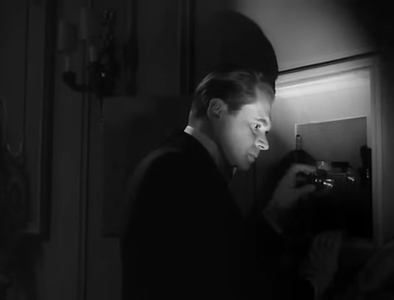
Zurta shoots the man dead, then slips out onto a terrace. Down below, an accomplice, Karl (Alan Wheatley) is waiting. Zurta places diary and pistol in a bag and throws it down to Karl; Karl runs off into the night, and Zurta returns to the party, where he dances with Valya (Jean Kent). From their surreptitious conversation, it soon becomes apparent that Valya, though she may not have been present at the recent crime, is very much part of this plot.
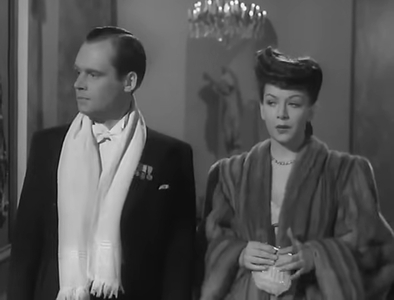
After the party, Zurta and Valya go to Karl’s, to recover the diary, but from Karl’s servant, they discover that Karl has left. Decamped with the diary. Valya uses a hefty bribe on the servant, and he tells them all…
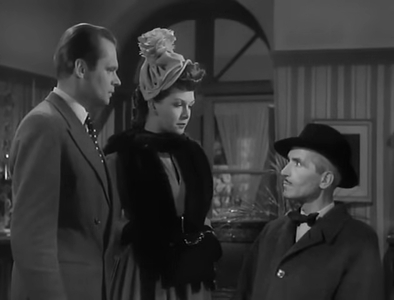
… which we discover only a little later, when Valya and Zurta arrive at the train station, ready to board the Orient Express. They have been told by Karl’s servant that Karl will be on the train, going to Trieste. Valya and Zurta are certain they will be able to find him and get the diary out of him before the train reaches Trieste the following day.
The train sets off from Paris soon after, with a motley group of people on board. There are Valya and Zurta, of course; but there is also another couple. George Grant (Derrick De Marney) and Joan Maxted (Rona Anderson) look all dreamy-eyed and very much in love, but there’s a clandestine quality to their romance, a suspicion that theirs is not quite the dewy innocence of sweet love.

George, it turns out later in the film, is a divorce lawyer, the very best in the field. And he’s a married man. This jaunt with Joan is George, cheating. Also, since George has a reputation to protect, it is also George, jittery and worried about who might see him with Joan. He will go to any lengths to make sure their relationship isn’t revealed to anyone who might know him.
Also on the train is Tom Bishop (David Tomlinson), who, unfortunately for George, does happen to know George, and that too pretty well. Bishop is a sociable sort, always wanting to rope people into a game of cards. On the train, with nothing else much to do, Bishop is on the lookout for people who can help him pass the time—and who better than an old friend?

There is a keen ornithologist, Elvin (Michael Ward), who is on a lecture tour, talking about birds. Sharing his compartment is an American, Sergeant West (Bonar Colleano), who really couldn’t be bothered with birds.
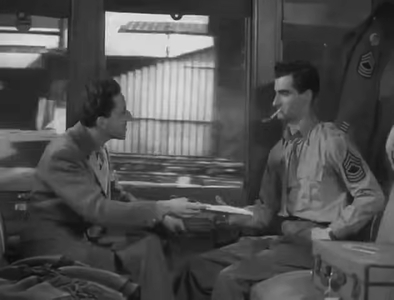
Instead, he’d much rather make friends with the young Frenchwoman Andrée (Claude Larue) who comes to their compartment, asking if the two men would be so kind as to keep two hat boxes for her and her sister—they’ll collect them when they get off the train. This, of course, is a ploy to get out of declaring the hats at the French-Italian border, and everybody knows it; but everybody, also, calmly pretends that it’s all very innocent. Andrée, in fact, goes around to most of the men travelling in this section of the train, offloading hat boxes on them.
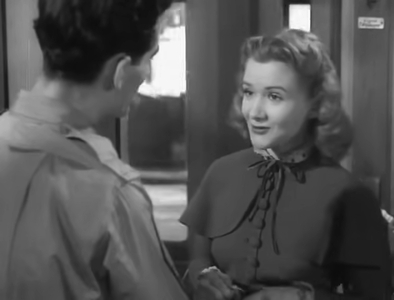
Among the men who don’t get saddled with one is Karl himself. Karl is, as Valya and Zurta had discovered, on the train; but he’s passing himself off as a Charles Poole, ‘brought up in England’ (he doesn’t offer any further explanations when asked). Karl has booked a compartment all to himself, but shortly after he’s settled in, another passenger (Paul Dupuis) arrives. Karl tries to persuade him to leave, but the man insists, always suavely and gently, that he too is booked in here. A train staff member to whom Karl appeals agrees that the other man does have a valid booking; Karl is not supposed to be here alone.
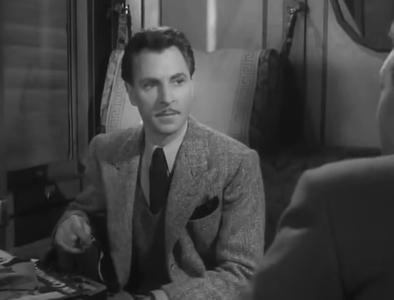
What’s more, Karl discovers who his new co-passenger is: Detective-Inspector Jolife, of the Sûreté.

Karl cannot possibly stay in close proximity to a cop, not with that incriminating diary on him. He’ll be found out. But where can he go? The man in charge of this particular carriage, having accepted a small ‘incentive’, finds an alternate compartment for him, and Karl is taken there. Karl hasn’t even settled in before the manager of the train comes bustling along, shooing him out. His subordinate has mistakenly given this berth to Karl; it’s already booked. At Dijon, which will be coming up soon, the passenger who’s booked this will get on.
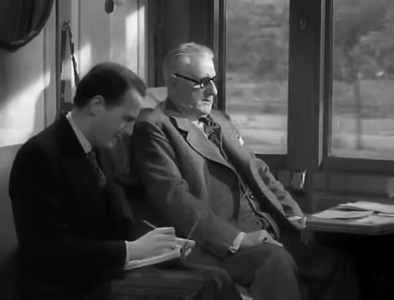
The man in question happens to be the pompous writer Alastair MacBain (Finlay Currie), accompanied by his much put-upon secretary, Mills (Hugh Burden). MacBain is too full of himself, too certain of his own consequence (which, it begins to transpire, isn’t that much), and too wont to take out all his frustrations and angst on Mills. Mills simmers and seethes, but cannot summon up the courage to rebel.
The stage, thus, is set. A train, crowded with interesting characters, several of whose paths intersect in more intense ways than is normal in a train journey. One of them a traitor, running with stolen goods. Two others, those he’s betrayed—of whom one is a murderer, and will not flinch from committing yet another murder.
I had never heard of Sleeping Car to Trieste before. Now, I wonder why it’s not better known (as much, for instance, as The Lady Vanishes). It’s very much in the same league, even if it’s not Hitchcock (Sleeping Car to Trieste was directed by John Paddy Carstairs): it’s interesting, it’s fast-paced, and the viewer gets to see a suspenseful bit of the cat-and-mouse game as Karl tries to stay a step ahead of Valya and Zurta.
What I liked about this film:
The pace and the story. Scripted by Allan MacKinnon, Sleeping Car to Trieste was based on a story by Clifford Grey. As in The Lady Vanishes and Murder on the Orient Express (plus, of course, a large number of other ‘journey’ films—Lifeboat, Stagecoach, and so on), the premise here is that there’s a group of disparate people, strangers (mostly) to each other, thrown together in an enclosed space for a longish duration, and the resulting tensions, the dynamics of the relationships that develop between them. The scenes switch between the various characters, with Valya, Zurta, Karl/Charles Poole, Joliffe and MacBain being the ones with the most scenes, with less time and space being allocated to the peripheral characters: the ornithologist Elvin; Sergeant West; the two Frenchwomen; and a very chatty man, scion of a train company-owning family, who has managed to get the opportunity to spend most of the journey in the company of the train’s chef… and takes full advantage of it, much to the harried (and terribly bored) chef’s disgust.
(Minor spoilers ahead)
My first impression of these peripheral characters was that, like George Grant, Joan, etc they too have a bearing on the central event, which Joliffe ends up investigating. They don’t, however; Elvin, West, the French girls, the chef and his blasé tormentor are all just there to provide comic relief. This was not something that I initially appreciated; I kept wishing the action would get back to the main focus of the film, the people who really mattered. But in the final analysis, I think the little detours, followed by the subsequent circling back, actually works to make the film more rounded, more entertaining.
(Spoilers end)
There wasn’t anything I outright disliked. I do wish the set-up regarding the diary was a little clearer: I might have been more invested in the Valya-Zurta-Karl tussle if I knew exactly what that diary contained. Ultimately, though, this is a minor quibble. Overall, I found this a delightful film, and one I’d happily recommend to anyone who enjoys train films as much as I do.
You can watch Sleeping Car to Trieste here, on YouTube.
 Dustedoff
You have said it so well, “… a group of disparate people, strangers (mostly) to each other, thrown together in an enclosed space for a longish duration, and the resulting tensions, the dynamics of the relationships that develop between them…” Perhaps all that makes train journeys so fascinating for some people. If it wasn’t for their substandard washrooms, I’d take a train most of the time. Entertaining read 😊
LikeLiked by 1 person
Glad you liked this, thank you!
And, I completely agree with you about train travel but for the washrooms. I am somewhat paranoid about cleanliness, which is why train toilets put me off even more than they might the average Indian. :-( A shame, because the entire experience of train travel otherwise can be so interesting and memorable.
LikeLiked by 1 person
Intriguing to the extent that I stopped at the Spoilers. It is a sure indication that I will see it soon. Then may be I will come back and share my feelings.
This is a real unknown movie dredged out by you !
LikeLike
I’ll look forward to seeing what your reactions to the film were! I hope you enjoy it.
LikeLike
Oh I forgot to keep my promise and post my reaction to the movie. That in itself is an indication.
While the movie wasn’t bad and the acting was good , it had few twists and turns and as I found now you have also mentioned that many of the characters are more of a comic relief. You find these to make the film rounded but I could not get the point beyond a point! The diary want that big a problem. It is only a Macguffin ( hope spelling is right) as such and is par for the course. The resolution is too facile.
All in all an okayish movie .I don’t regret spending time on it but a recommendation from you -may be- made my expectations more.
LikeLiked by 1 person
I am sorry you didn’t like this much! (or that I got your hopes up). I agree, the diary is a McGuffin – it is there just to set the whole thing up.
LikeLike
Have never heard of this film! Shall definitely put it on my watch list after your delightful review. Thanks, Madhu.
LikeLike
Yes, do watch, Anu! It’s an interesting, entertaining film. I hope you enjoy it.
LikeLike
Glad to read your review and that you too liked the film.
Sleeping Car to Trieste is an enjoyable film. well-pace and intriguing. One does actually look forward to the meeting of Zurta and Karl (Poole).
For me, Jean Kent really stood out while I thought David Tomlinson was a bit irritating as Bishop.
Though I thought the hat boxes sub-plot was unnecessary, I guess, it helped to highlight the custom evasion on the borders.
Have you seen Rome Express, the original movie based on the same story?
In the original, a valuable painting is stolen by Zurta. This is more convincing than the diary. We only know that the diary was capable of starting a revolution.
Also, Zurta has a male accomplice, who meets his old flame on the train and Jolife is elderly. No Valya and no hat boxes!
LikeLike
Oh, thank you so much for telling me about Rome Express! I hadn’t known of its existence, but it sounds definitely like something I’d like to see ASAP. I hope I can find it online… going off to search. Thanks again.
LikeLike
I had seen it on YouTube nearly two years back. It should be still there.
LikeLiked by 1 person
Yes, I found it yesterday and have already bookmarked it. Looking forward to watching it!
LikeLike