
This is a film that’s been on my radar for a while now. Dilip Kumar, Vyjyanthimala. A cast also boasting of Motilal and Johnny Walker. Some good songs. Paigham, I thought, might be worth a watch.
I will admit, though, that my heart sank a bit when I saw the opening credits and discovered that this is a Gemini Studios release. Like AVM, I now approach Gemini with trepidation: while their films often had great casts and excellent music, they were invariably just too melodramatic for my liking.
But I persevered.
Paigham begins by introducing us to Manju (Vyjyanthimala) who, along with her best friend Malti (B Saroja Devi), has just finished college: Manju at the top of her class, Malti at the bottom. Malti isn’t fazed by this; she’s a wealthy girl, her father Seth Sewakram (Motilal) a prosperous cotton mill-owner. Malti, in fact, has promised Manju that she will ask her father to give Manju (who’s done a course in shorthand and secretarial work) a job at the cotton mill, which is in a town named Rangpur.
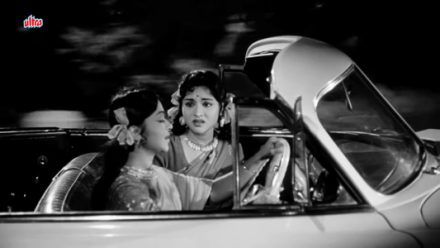
Malti drops Manju off at her home, and Manju introduces Malti to her mother (Vasundhara Devi). Manju’s mother looks very shaken when she discovers that Malti is Sewakram’s daughter; once Malti has gone, she collapses, and a distressed Manju hurries off to try and find a doctor.

In the course of the next few minutes, Manju meets a somewhat unusual rickshaw-wallah named Ratan (Dilip Kumar). He’s reading Gandhiji’s autobiography when she first sees him. Later, when the doctor he takes her to makes a fuss about coming, Ratan not only chastises him (in English, moreover), he also gives the doctor the additional fee the man is demanding in order to make a house call at this hour.

In all the confusion, Manju forgets to pay Ratan for the rickshaw ride—but doesn’t forget him. In fact, she is very pleasantly surprised to meet him again, a few days later, at Sewakram’s cotton mill, where (despite her mother’s protests), Manju has taken up a job in the office. (There is something about Sewakram that bothers Manju’s mother, but she isn’t telling).

Here, Ratan has come, too, having returned home to Rangpur after completing college in the big city. Ratan’s elder brother Ram Lal (Raaj Kumar), their mother (Pratima Devi), Ram Lal’s wife (Pandari Bai) and their children are all delighted to see Ratan back home. Ram Lal’s daughter Kamla’s marriage has been arranged, and the engagement is to take place soon; everybody’s very excited.

Now that Ratan is in Rangpur, Ram Lal takes him along to the cotton mill (where Ram Lal works) to show Ratan the sights, so to say. Here, while Ratan is having a look around, one of the machines clatters to a halt. The mechanic is called, and discovers that an important part has gone kaput. Sewakram, who has come on the scene along with the manager (SN Bannerjee) is told that the replacement for the part will have to be imported; it will take at least a fortnight to arrive, and the mill will have to stop work until that happens.

Ratan has been watching this, and comes forward (Manju, looking on, is delighted to see him) and says that he is a trained engineer, and can make that part. They don’t need to import it. Much arguing happens; the mechanic doubts Ratan’s abilities and tries to dissuade Sewakram from letting Ratan take this on. But Malti, who is also there (and, like Manju, also rather fascinated by Ratan) intervenes and begs her father to let Ratan do what he can.
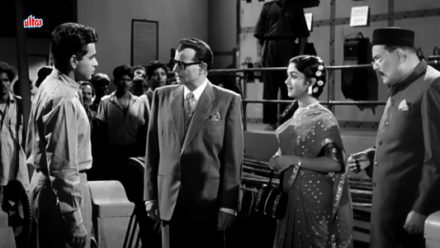
So Ratan is allowed to do his work, and has managed to turn out the part by the end of that day (I like that he is actually shown working on the processes to craft something like this: from pouring the molten metal into a mould to working in the grooves and so on). Sewakram is very pleased, and gives Ratan a job at the mill.
Everybody is happy. Ratan, of course, and all his family; but also Manju, who now has the opportunity to spend time with him. Over the next few days, the two of them fall in love…

… much to the annoyance of Malti, who has also fallen for Ratan.
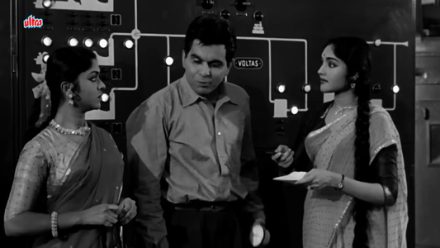
Malti’s increasing jealousy of Manju is one of the reasons for the swift disintegration of what seems, at least superficially, a fairly satisfactory sort of set-up. The other reason is something that Ratan soon comes to realize: that Sewakram is poorly named. This man is no sewak (servitor) at all; he’s the quintessential capitalist, out to feather his own nest.
Ratan realizes this when, at Diwali, all the mill workers are given a Diwali bonus: they are made to sign for three months’ bonus, but what they’re given is only a month’s bonus. And they’re all so grateful to Sethji for that, it makes Ratan furious. So furious that he sets up a trade union and gets the labourers together to protest against this exploitation. In this endeavour, Ratan is joined by both Manju as well as Nandu (Johnny Walker), who is a household servant in Sewakram’s home.

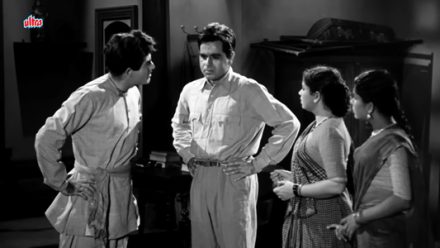
Ratan is being hailed as the leader of the unionists, but his standing at home has plummeted. Ram Lal is livid, his sense of loyalty to Sewakram blinding him to everything else. In his anger, he lashes out at Ratan, hitting him and throwing him out of the house. His anger has been exacerbated also by the fact that his daughter Kamla’s future in-laws have heard about Ratan’s association with Manju—who knows who her father is?—and are getting uppity about it. They don’t want to connect themselves to a family like this.
I was right about being a little nervous about getting into a Gemini Studios film. This one, despite the cast, ended up being melodramatic and overwrought. It had its heart in the right place (more or less) in its story of equality and workers’ rights, but eventually it’s all a bit boring.
What I liked about this film:
Vyjyanthimala, who is—as always—lovely. And Dilip Kumar, who can make any role believable. Here, while he’s earnest as the trade unionist, where he really excels is in his playful interactions with Vyjyanthimala’s character, in the early stages of their romance: delightfully romantic.
The songs, written by Kavi Pradeep and with music by C Ramachandra. They’re not outstanding, but passable enough; and one song in particular I like a lot: Jawaani mein akelepan ki ghadiyaan.
What I didn’t like:
Oh, so much, sadly. For one, the utter waste of so much talent. There are plenty of good actors in this film, but most of them (even Motilal himself, a stalwart if I ever saw one) get too little screen time. In any case, Motilal is called upon to do nothing very much in the way of acting.
Then, the melodrama. By the second half, Paigham had begun to degenerate into a sad morass of people screeching, being self-sacrificing, blaming each other, and getting ready to murder, commit suicide, commit arson and whatnot. It’s all very highly-strung and overwrought. And tiresome.
Plus: the unbelievability of the way Motilal’s character pans out. The sudden flip in personality, and the extreme consequences of that flip are so odd and so hard to swallow. Also, while on the subject of Sewakram: where does his wife, Malti’s mother, vanish midway through the film? She is definitely there in the initial scenes, played by Radha. But once things hot up, both on the trade unionism front and on Sewakram’s past with Manju’s mother, she simply disappears, whereas (at least in this case) she ought to have had some say.
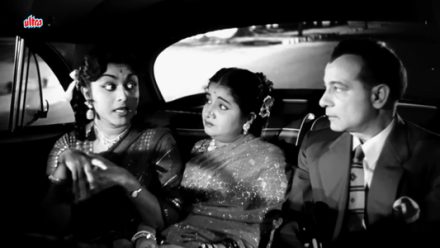
Overall, then, not really worth it. Even though there were so many people here whom I like, I ended up not enjoying this. It’s not as terrible as films like Bhabhi or Chhoti Bahen, but it’s quite ho-hum.
 Dustedoff
Incidentally Vasundhra Devi was Vyjayanthimala’s mother.
LikeLiked by 1 person
I hadn’t known that! Thank you for the information.
LikeLike
Saw it at Veena in the 3rd qtr of 1978. Noon show. Or was it morning show? Could be. Went to see Kasme Vade from there, at Apsara, after walking 2-3 kms. Both the films were bad btw.
After seeing the film, I thought DIlip Kumar was terribly overrated. He would keep on mumbling – as if talking to himself – and people who rate that as great acting. Raj Kumar, as usual, overacted. Motilal was the only natural in that film.
Hindi films made in the south have tons of melodrama and gallons of tears. The trend continued in the 1980s too, with those Maang Bharo Sajna types.
LikeLiked by 1 person
typo – people would rate that
LikeLike
Those Maang Bharo Sajna type of film also really got my goat. :-( This high melodrama, everybody going around overacting, so much screeching and self-sacrifice and over the top behaviour gets on my nerves.
LikeLike
You bet. I stopped seeing Hindi films in the 1980s because these films were there everywhere. Stupid, asinine, inane stuff peddling in the name of “wholesome” and “family” entertainment.
LikeLiked by 1 person
Same here. From the 80s onwards, I have seen very few films – just couldn’t stomach them.
LikeLike
There was a time when we decided to get stoned before going to see a film of the Padmalaya variety (never really happened though). This I think was around 1986-87 when I saw a Mithun-Meenakshi film called Dilwala… I should have actually had some grass ;), would have given me some relief from the torture.
LikeLiked by 1 person
:-D Mithun and Meenakshi – oh, Lord. Those two worked in some truly frightful films. Just the memory of the songs, even (I didn’t have the courage to sit through any of Mithun’s films by then) gives me the shivers.
LikeLiked by 1 person
Madhuji, I have not watched Paigham and after your reading your review I will definitely not watch it.
Coming to Mithun’s movies, I recently saw a Basu Chatterji movie called Prem-Vivaah (1979) starring Mithun, Bindiya Goswami, Utpal Dutt and Asha Parekh. It was really different and very enjoyable too!
LikeLiked by 1 person
I will look for Prem Vivah, thank you for the recommendation! If I remember correctly there was a Mithun film (I’ve forgotten the name) which had a theme similar to Saajan, in which a poor girl tries to impress a rich man by spinning a yarn about actually being wealthy – not realizing that he is the actual owner of the bungalow, car, etc which she’s trying to pass off as her own. I have very hazy memories of the film, but enjoyed it.
LikeLike
Madhulika, details of both Prem Vivah and Pasand Apni Apni (the film name you forgot) are there in my Basu da book.
For anyone interested, some shameless self publicity. Here is the link
https://www.amazon.in/gp/product/0670096253/ref=ppx_yo_dt_b_asin_title_o01_s00?ie=UTF8&psc=1
LikeLiked by 1 person
Thank you for that! I was wondering whether I was barking up the wrong tree.
LikeLiked by 1 person
Oh. :(Vyjayanthimala, as you said, looks really lovely.
And this film can be included in the ‘Movie Characters with Books’ series. :)
(I am planning a bookish-filmy post).
LikeLiked by 1 person
I am looking forward to your bookish-filmy post! :-)
And yes, this one was in my latest list of characters with books.
LikeLiked by 1 person
I seemed to have liked this film also much more than you did. :)
https://anuradhawarrier.blogspot.com/2012/04/paigham.html
LikeLiked by 1 person
But I think both of us agreed on Dilip Kumar acting very well as the romantic hero!
He has neither RK’s intensity, or Devsaab’s sophistication, but he was real and believable, humorous and self-deprecating, and oh, so melt-into-a-puddle earnest. (I fell in love.)
Oh, yes. :-)
LikeLike
But I think both of us agreed on Dilip Kumar acting very well as the romantic hero!
Of course we did! :)
LikeLiked by 1 person
paigham crossed my mind recently when one day at 7 am vivdh bharati played ” insaan ka insaan se ho bhaichara”, and just 3 days after that came your review.
in this film vaijayantiamala is a disaster, and dilip kumar a wasted talent, it looses trackbefore it clocks 40 minutes and when once i tried it watching on tv( we have a cable one which airs b/w films), and deserted it soon idk why gemini studios made it, yes, there few good songs though.
LikeLiked by 1 person
Yes, the songs are nice, some of them, but the rest is really such a waste. :-(
LikeLike