
Years ago, when I first watched Wait Until Dark, I was blown away by the ingenuity of the idea: a blind woman trapped inside a house with a murderer on the loose. Audrey Hepburn was superb as the woman who must use all her wits to keep one step ahead of her pursuer, and if possible, to turn the tables on him.
That was the film I kept remembering when I was watching The Spiral Staircase, a story about a mute girl who is caught in a large mansion with a murderer coming after her.
The story begins, not at the mansion, but at a small hotel in the nearby town. On the ground floor of the hotel, a film (silent, shown with an accompanying pianist providing the music) is being projected. A small but engrossed audience is in attendance, and this includes Helen (Dorothy McGuire), who is mute.

While the film is being shown downstairs, in an upstairs room of the hotel, a young woman is murdered. We see her murderer’s eye, crazed and staring, but that’s all there is, nothing more.
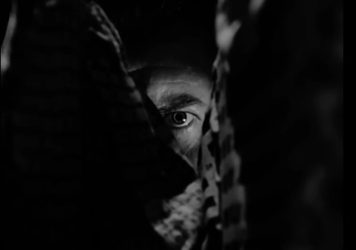
The woman is discovered soon after, dead as a doornail, but nobody knows who killed her, or how. Dr Parry (Kent Smith), a relative newcomer to town, arrives shortly after at the hotel and offers to go and have a look at the body. To the police officer who’s already arrived, he mentions that he was passing by and overheard the news. The cop tells Dr Parry that the town’s resident old doctor, Dr Harvey, is already upstairs with the body, but Parry is welcome to go have a look.

Parry does so, and Dr Harvey (Erville Alderson) is bitter about it. As it is, Dr Harvey resents Parry and suspects the new doctor of trying to muscle in on his (Harvey’s) territory. Parry defends himself (and his patients): there was a patient who urgently needed help in the night, and Harvey had refused to call at that time. Parry could not, in all conscience, refuse too.
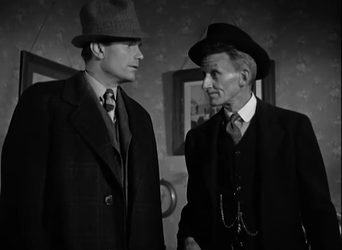
When Parry emerges from the hotel, he finds Helen on her way home. Helen lives and works at the Warren mansion, where she is companion to old Mrs Warren (Ethel Barrymore). Helen and Parry are in love, and he offers her a lift to the mansion, especially since a storm is brewing.
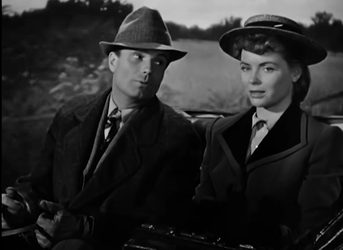
They go peacefully along in the pony-cart, Parry talking, until a worried teenager comes running and stops Parry: his father is very ill and needs Parry right now.
Parry is reluctant: the boy’s father is Dr Harvey’s patient; they should send for Harvey. But the boy is adamant (and desperate): his father is calling for Parry, there’s no time to waste. Somewhat reluctantly, therefore, Parry is obliged to take the boy up into the cart and set off towards his home, while Helen gets off and hurries on her own towards the Warren mansion. The storm breaks even as she does so, the wind picking up, the rain beginning to pour down.

… and someone, a someone in a rain-slick raincoat, watches from the shadows as Helen drops the key, and fumbles about for it. All we see of the person looking on is the raincoat, the shoes, and that eye.
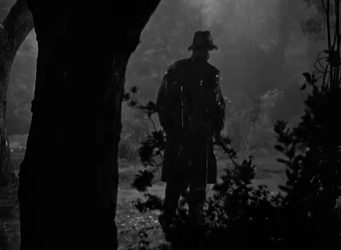
Helen eventually does manage to make it into the house, all without realizing that she might have been all the time in danger.
The Warrens of this house consist of Professor Warren (George Brent), who lives here with his stepbrother Steve (Gordon Oliver), and Steve’s mother, the invalid Mrs Warren to whom Helen is companion. Steve does not always live here; he seems to come and go now and then, and is portrayed as a somewhat footloose and fancy-free character, not really the serious, studious sort that his stepbrother the professor comes across as.
Steve’s flippant attitude to life seems evident in his pursuit of Blanche (Rhonda Fleming), Professor Warren’s secretary.
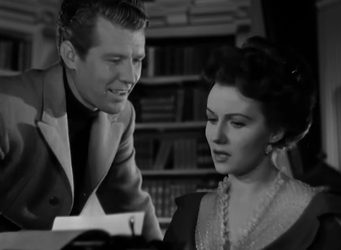
Blanche is in love with Steve, but she finds his careless attitude distressing: Steve has no compunctions about kissing Blanche wherever and whenever he might find her, even if it happens that Professor Warren may barge in on them—as he does, every now and then. Blanche, on the other hand, finds this extremely embarrassing.
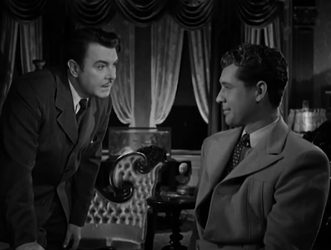
There is no love lost between Steve and his stepbrother. This comes through even more powerfully later in the film, when it becomes clear that these two men don’t just not like each other; they were even a disappointment to their father. The late Mr Warren was a great believer in what seems to have been a rather patriarchal idea of what being ‘manly’ is all about, and neither of his two sons lived up to his standards.
The two servants at home are Oates (Rhys Williams) and his wife Mrs Oates (Elsa Lanchester). We see little of Oates in the course of the film, though his entrance is a little dramatic: when he arrives, coming in out of the rain, he’s wearing a dripping raincoat that looks uncannily like what the man who was following Helen wore… but then, the policeman who comes by that evening to meet Professor Warren to talk about the latest murder victim also wears a similar raincoat.

Mrs Oates, however, is a little more in evidence. She is cook and housekeeper, and Helen gets along fairly well with her. In fact, when Helen returns to the house in the storm, it is Mrs Oates who welcomes her in and informs her that Mrs Warren has been asking for her. Helen should go up at once.
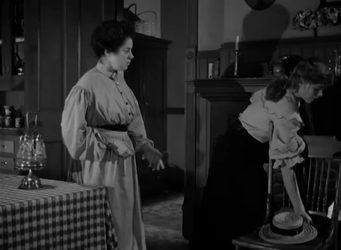
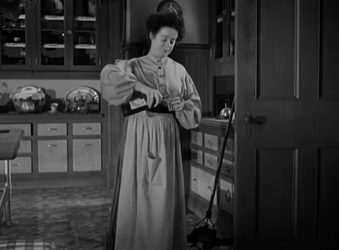
A little later in the film, we discover that Mrs Oates is a bit of a tippler: in fact, so fond of the bottle that she even steals a bottle of fine brandy from the cellar while accompanying Professor Warren down to fetch a bottle for Mrs Warren to be dosed.
… and that brings us to Mrs Warren. This old lady is bedridden, but her condition does not appear to have dampened her spirit: she is sharp-tongued, sharp-witted, and ruthless. One person who is at the receiving end of most of Mrs Warren’s cantankerous viciousness is Nurse Barker (Sara Allgood), whom Mrs Warren despises so intensely, she insists that Nurse Barker sit outside the room, and that Helen do all the nursing the nurse should actually be doing.

Fortunately for Helen, Mrs Warren is genuinely fond of her. To the extent that when the two women are alone together, she urges Helen to leave the house, to go away with Dr Parry (Mrs Warren is perceptive enough to realize the doctor and Helen love each other). Tonight, go away tonight, because there is danger in this house.

Danger, too, which Helen has been warned about before. She knows that the woman who was murdered at the hotel earlier that evening was crippled; and that this isn’t the first murder. There have been other murders over the past weeks, women killed. Women, too, who were in some way imperfect: disabled, mentally challenged. And Helen, mute that she is, might well be in danger too…
Directed by Robert Siodmak (who was known for the noir films and suspense thrillers he made, including The Killers, The Rats, and The Devil Strikes at Night), The Spiral Staircase takes place over the space of one evening, and is also mostly confined to one space, the mansion of the Warrens. This limited-time-and-space style of film has been done very effectively by many other directors, including Frank Capra and Alfred Hitchcock, and Siodmak too does it justice, weaving together a fairly taut script with a manageably limited cast to create a fast-paced, engrossing film.
What I liked about this film:
The way even small details are woven into the narrative, and play their part in it. For instance, there’s the fact that Mrs Oates is very fond of her drink. This isn’t just a case of a character portrayal that is interesting; her propensity to drink, and her ability to quickly drink herself under the table (so to say) plays a vital role in what happens at the climax.
Similarly, there are other details: for example, the affair between Steve and Blanche, about which Steve is blasé but Blanche is uncomfortable and embarrassed, especially when it comes to Professor Warren knowing about them. Or, as another example, the fact that Mrs Warren despises Nurse Barker so much, shouts at her and refuses to co-operate.
All of these, and more, lead up to the climax and make it what it is. A good script, in that sense.
The acting is consistently good (though I will admit to a long-standing fondness for Elsa Lanchester in particular).
What I didn’t like:
Some minor gaps, which—when the identity of the killer is discovered—show up as possible plot holes.
Spoiler ahead:
For one, twice during the evening, Mrs Oates admits to having found a window open, which she’s had to close both times. This suggests, from very early on in the film, that there is an intruder—and that, given what we know about the serial killings, points to someone having broken into the mansion to kill Helen. Once you know who is responsible, you realize that there is no need to break in, and it’s never explained that the killer might have deliberately opened the windows to give the impression that someone did break in.
Then, there’s the eye. The murderer’s eye is shown several times in the course of the film (it was actually Robert Siodmak’s eye, not that of the actor who played the murderer), and it’s an eerie sort of element. However, near the climax of the film, when the obvious suspect is zeroed in on, I thought it rather obvious that the suspect was not actually the murderer, because this actor’s eyes were not the same colour as the murderer’s eye.
End of spoiler.
Still, despite those (admittedly minor) hiccups, an overall enjoyable, suspenseful film. It’s available on YouTube, here.
 Dustedoff
This and Wait Until Dark sound so intriguing and mysterious. Even the titles are so interesting. Adding them to my to-watch list (I didn’t read the spoiler).
‘A Woman trapped inside a house’ reminded me of a Hindi movie titled Trapped (starring Rajkumar Rao). There were certain loopholes but overall an interesting movie.
LikeLiked by 1 person
Thank you for the Trapped recommendation, Tarang! I have enjoyed some of the other newer Hindi films you’ve recommended, so this goes on my watchlist right now.
LikeLiked by 1 person
This sounds interesting.
Thanks for the descriptive review. I am looking forward to watching this someday. Thanks for the link.
Some day I should re-watch Wait Until Dark too.The last time was on DD sometime in the late 80s.
LikeLiked by 1 person
The first time I watched Wait Until Dark was also that time on DD. They did show some very good films back then. But I watched it later again, once I began this blog, and found that I enjoyed it just as much!
LikeLike
Wow, whatte review! I need to go watch this film as soon as I can.
LikeLiked by 1 person
Tell me what you think of it, when you watch. :-)
LikeLike
Thanks for reviewing the film, Madhu. I had never heard of it before. I watched it yesterday and found it delightful. Wait Until Dark was better since the space is extremely confined. Here the girl, although confined, has a huge mansion to wander about and she is not really pursued the way Audrey Hepburn was. But the film is well-directed and the acting is very good. And, as you mentioned, there are a lot of details. Sometimes, a little too much, in my opinion, for, after all, this is a thriller. For example, I could not see the point of the rivalry between the two doctors. Thanks again for bringing it to our attention.
LikeLike
I am glad you enjoyed this, Soumya – I completely agree that Wait Until Dark is better. More taut, because of the extremely confined space. And you’re right, I hadn’t even noticed that the rivalry between the two doctors actually didn’t have anything to really add to the plot.
LikeLike