
And also, to some extent, My Man Godfrey (1957).
My Man Godfrey—the original one, starring William Powell—is one film that I’ve been meaning to watch for a long time now, mostly because so many people have told me what a lot of fun it is, and how it seems to have shades of PG Wodehouse in it (an author in whose pursuit I have watched several films, not always with the most satisfying of results).
It did seem to me, within the first few minutes of My Man Godfrey, that there were shades of a Wodehousian sense of humour here.
The film begins at a riverside dump, where a rather ragged, unshaven and tattered Godfrey (William Powell) is among several homeless men standing about when a fashionable high society lady, Cornelia Bullock (Gail Patrick) comes flouncing along, with a formally-dressed man in tow. Cornelia takes one look at Godfrey and tries to get him to come with her. She’s participating in a ‘scavenger hunt’ at a posh hotel, and the first person to bring along a ‘forgotten man’ to the hunt stands to win the prize.
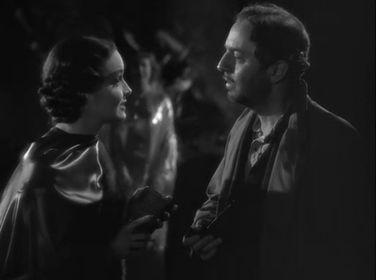
Godfrey would rather not, thank you. He tries to say no, but Cornelia—who’s both a spoiled brat as well as right now perhaps inebriated, insists. Godfrey, getting annoyed, backs her straight into an ash-pile. A furious and now somewhat soiled Cornelia is spewing curses and threats when her sister Irene (Carole Lombard) arrives.

Irene discovers what has happened, and instead of showing any sort of sisterly loyalty, congratulates Godfrey on having done a good deed: Cornelia should have been pushed into an ash-pile long before. Irene goes on to explain rather more fully to Godfrey what the scavenger hunt is all about, and Godfrey realizes that Irene too is participating in it. Irene’s excitement at him having put Cornelia in her place is so endearing that when she offers Godfrey $5 to come along with her to the hotel as her scavenger hunt entry, Godfrey agrees.

Thus it is that Irene arrives at the hotel with her ‘forgotten man’ Godfrey in tow. The glittering, noisy crowd of socialites at the hotel has brought along a very motley lot of items for the scavenger hunt. Cornelia and Irene’s mother Angelica Bullock (Alice Brady), for instance, is extremely proud of her own resourcefulness at having managed to bring a goat, though her very wealthy husband Mr Bullock (Eugene Pallette) thinks this whole idea is extremely stupid.
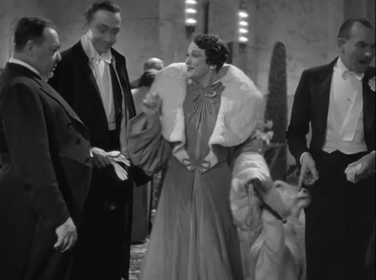
[This scene, with so many pampered and wealthy people with nothing better to do jostling about, presenting for the judges all the items, creatures, and people they’ve been able to scavenge, reminded me of The Seekers, the club Bertie Wooster’s disreputable cousins Claude and Eustace aspire to join, by seeking out and submitting all manner of mad objects, including various cats, a hat, and a large fish].
Unlike Cornelia, who thought of Godfrey as a mere object, to enable her to get a prize, Irene is rather sweeter: she is touchingly grateful to him for having come along with her. And, when she realizes just how destitute Godfrey seems to be, she offers him a job. The butler at the Bullock home has just quit, so if Godfrey wishes, the job is his. Godfrey accepts.
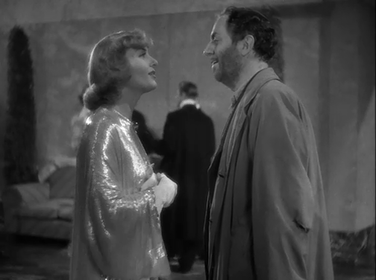
The next morning, having hired a formal suit, and having shaved and cleaned up, Godfrey arrives at the Bullocks’ home. Here, the maid Molly (Jean Dixon) seems to be the only one up and about: the denizens of the house are too tired and hungover to have yet emerged from their rooms. Molly, cynical and with an air of longsuffering, tells Godfrey that butlers come and go in this house. He will be gone pretty soon too.

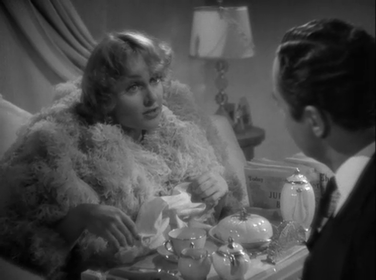
In fact, as she’s giving Godfrey this rather dismal view of life as Bullock staff, Mrs Bullock’s room bell rings, and then again, stridently: she needs her tomato juice, now, to help ease her hangover. Godfrey takes over, adding a splash of Worcester sauce to the tomato juice, because that is what will really help. [And that’s also shades of Wodehouse: it echoes, a bit, Jeeves’s hangover cure].
Molly is certain that Godfrey will find himself fired by Mrs Bullock (who can be extremely testy when hungover). In preparation, she places Godfrey’s hat and coat beside the staircase: he can pick them up on his way out.
But Godfrey, by dint of sheer patience, good humour, and an unflappable suavity, is able to soothe Mrs Bullock into a good mood. Within minutes, too, he has achieved various other things.

For one, he’s been to Irene’s room to give her breakfast. Irene, seeing Godfrey cleaned up, becomes all starry-eyed, and is eager to have him sit beside her on her bed and spend time chatting with her.
Then, downstairs from Irene’s room, Godfrey bumps into Mr Bullock, who first mistakes him for one of Irene’s socialite friends. Mr Bullock is getting ready to challenge this man (who, emerging from Irene’s room in the morning, could only have been up to no good), but Godfrey clears things up.
… in time to discover that Cornelia had ridden up the front steps on a horse the previous night, and the horse is now tied up in Mr Bullock’s library.
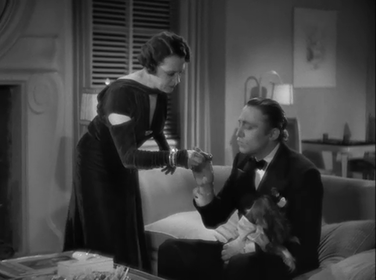
This household is an odd one. Not merely very wealthy; also quite eccentric. Before Godfrey has quite realized it, he finds that Irene has decided to make herself responsible for Godfrey. He is her very first protégé, she says. Just as Mother has a protégé, so will she. (Mrs Bullock’s protégé is an eternally-sponging musician-cum-gorilla impersonator named Carlo [played by Mischa Auer], who is busy eating Mr Bullock out of house and home).
Also:
-Irene has fallen head over heels in love with Godfrey and when he refuses to reciprocate in any way, she goes moaning and griping and generally [as Wodehouse might describe it] making an ass of herself.
– and, Cornelia has made vengeance her primary purpose in life. The humiliation of being backed into an ash-pile by Godfrey has been exacerbated by Irene’s championing of the man. So Cornelia will make sure she pulls him down a few pegs.
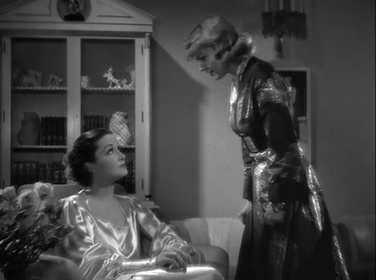
And at the centre of all this hectic emotion, whether pro- or anti-Godfrey, is the man himself. Who, really, is Godfrey? His speech and his manner are not quite like those of the other ‘forgotten men’ of the dump. But then, one day, when the Bullocks are hosting a party at their home, one of their wealthy friends, Tommy Gray (Alan Mowbray) spots Godfrey passing around the hors d’oeuvres, and he sits up, recognition written all over his face.
My Man Godfrey eventually didn’t turn out to be as Wodehousian as I’d hoped it might be. The idea of an upper class, wealthy man pretending to be a butler and working in a home where love blossoms between him and a young lady in the house is something I’ve seen elsewhere too (in Spring in Park Lane), but in neither of these films is the ‘butler’ really Jeevesian. No knotty problems that they solve with laudable ingenuity; no convoluted plots; and not quite the type of humour that Wodehouse was known for.
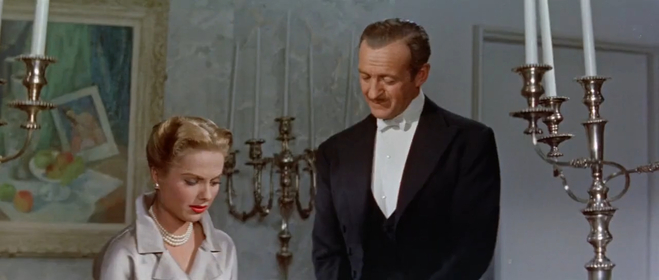
The story, however (based on a novel, 1101 Park Avenue, by Eric S Hatch) seems to have been popular enough to merit a remake: in 1957, a colour version was made, starring David Niven as Godfrey and June Allyson as Irene. The original, 1936, version, however, is the one that stands out: it has been listed as one of the hundred ‘funniest comedies’ by the American Film Institute, and in 1999, was selected for preservation in the USA’s National Film Registry.
What I liked, what I didn’t, and some comparisons:
I watched both the 1936 and 1957 versions, and while superficially the two films may seem pretty much alike, there’s actually a fair difference between them in tone. There are differences in the details, of course: for instance, the Tommy Gray character from the 1936 film is replaced by a Francesca Grea in 1957, with whom Godfrey, it’s obvious, has a history. Then, the back stories of the two Godfreys couldn’t be more different; and beyond a point, the way the two films play out are very different too.
The 1936 film is primarily a funny film, a satire about the rich and eccentric, and the pampered (but essentially good-hearted) young woman who won’t take no for an answer—even from the man she loves. It’s light-hearted and the dialogues are delightfully witty.
The 1957 film has similar scenes (up to a point; it veers off into its own territory near the end) but while that satire and the humour are there, it’s also somewhat more sentimental. The dialogues, the expressions, the moments: as the film progresses, a distinct touch of sentimentality creeps in. It’s not irritating or off-putting, but it’s different.

Still, though, both films are in their own way, worth a watch. The 1936 film, directed by Gregory La Cava, is the funnier; the 1957 one, directed by Henry Koster, is the one to watch if you’re keener on the romance.
But yes, some things I didn’t like. In the 1936 version, Carlo’s really silly slapstick mimicry of a gorilla (though, frankly, I think he resembles a chimpanzee more than a gorilla). And, in both the films, the somewhat unclear character of Cornelia (Cordelia in the 1957 version). She comes across as a petty-minded female who’s just trying to get even with Godfrey, but after a certain climactic moment, she begins to appear to have fallen in love with him. I couldn’t make up my mind whether I was imagining things, or whether that was actually meant to be so—and it frustrated me to not know for certain.

Both films are available on YouTube; 1936, here. And 1957, here.
 Dustedoff
You finally watched the film! :) l seem to have liked it a little more than you did. But I did enjoy revisiting the film through your excellent review.
LikeLike
Ah, it was you who recommended this (though I’m quite sure others did too). Thank you for that, Anu: I enjoyed this.
LikeLike
This sounds, with a few differences here and there, quite like apna Bawarchi, doesn’t it?
LikeLike
It is! I hadn’t known, but after I posted about this film on Facebook, Sidharth Bhatia told me that it was it was the inspiration for Bawarchi. It hadn’t even occurred to me. It is different, though – in Bawarchi, I thought the do-good-to-all and make-things-better is more pronounced. Also, of course, there’s no romance between him and the female lead there. But yes, it is recognizably the same story.
LikeLike
No matter what our respected and esteemed critic Siddharth Bhatia Sir says, it is rather difficult to say that My Man Godfrey was an inspiration for Bawarchi on basis of facts. Bawarchi was an almost frame-by-frame remake of Tapan Sinha’s Bangla blockbuster Galpo Holeo Satyi. Of course Sinha’s original was much superior, but then that’s not surprising considering that Sinha, from an unbiased perspective, is quite easily the 4th greatest Indian filmmaker ever till date (only behind Ray, Ghatak and Mrinal Sen in that order). Nobody in Bollywood- be it Bimal Roy, V.Shantaram, Vijay Anand, Guru Dutt or Hrishikesh Mukherjee can be put at par with him, provided an objective assessment is done- which of course is rather impossible in a country which is ostensibly divided into two major blocks of higher population in North and South. All others, are rather pushed to the periphery, if not outright ignored.
Coming back to My Man Godfrey vis-a-vis Bawarchi, I have never heard either Tapan Sinha or Hrishikesh Mukherjee say anything about My Man Godfrey being an inspiration for them. This, when they usually were very open about their inspirations.
And there is a good reason for that because other than thematic similarity of a man-servant and his adventures in the house of his employer, there isn’t really much that’s similar. And such thematic similarities abound by the dozens (actually millions!!).
To call something ‘a recognisably same story’ on the basis of merely such thematic similarities , is taking it a little too far, I guess. Because by this logic, all films- A) Showing A superhero’s struggle to save the world. B) Struggle of man in face of an impending natural disaster C.) Alien attack D.) Gang wars (which existed on the silver screen before and after West Side Story) E.) Poor Lover- Rich Lover F.) An underdog becoming a sports champion G.) A wrestler/Boxer/any retired or injured sportsman, written off by everyone, making a comeback to the top again H.) Reincarnation stories I.) A superstar in any field whose fortunes are falling J.) A young man with great observation skills and analytical powers solving mysteries by being a detective K.) The aftermath of an ecological or man- made disaster/natural accident L.) Love triangles M.) Trying to forget one’s past true love N.) A prostitute falling in love with a middle class or rich educated guy O.) Lost siblings P.) Revenge stories where the protagonist comes back to avenge an earlier wrong done to his/her family Q.) Dacoit stories R.) Brothers on two sides of the fences S.) The protagonist coming to terms with a loss of a dear one in child, spouse, friend, parent or anyone other close enough person. T.) Twin stories U.) Humshakals! V.) War for the throne between different family members W.) Protagonist overcoming a physical disability or a mental disability to come out victorious X.) Childhood lovers being separated Y.) Inter- religious love stories Z.) Inter- caste love stories- are all essentially the same story, which once being made first, should never be made again, because on doing so, one will invariably be called inspired, or even worse accused of copying/adapting/plagiarising etc. etc. !! This is I feel, isn’t quite the right stance to take.
As far as critics’ takes are concerned, I usually take their statements with a pinch of a salt, especially when one reads statements from them like that the likes of S.U. Sunny and Nitin Bose became famous due to Dilip Kumar. S.U. Sunny one can still understand, but to allege the same about a Dadasaheb Phalke winner like Nitin Bose, was, sorry to say, height of ignorance. Because when Dilip Kumar was a little kid and a young teenager roaming in half pants, Nitin Bose was teaching entire film industry what is real cinematography, craftsmanship and celluloid romance by making films which were not only superhits, but also winning awards. Indeed some of them even went to International festivals back in the 30’s! And not to forget he invented (alongwith his brother sound recordist Mukul Bose, and composers RC Boral and Pankaj Mullick) playback for the first time in the entire world back then! So, to make such statements about such a luminary was hurting for a film lover like me. And so, I take statements like Bawarchi being inspired from My Man Godfrey or Mary Poppins (according to another great critic!) with as much seriousness as I take the allegation of Do Bigha Zameen’s story being inspired from Bicycle thieves, especially when one knows that DBZ was based on a 1905 poem written by Tagore, some 40 years before De Sica’s masterpiece was ever made.
LikeLike
It may sound like that, but the dissimilarities and differences far outnumber the similarities that the two films share. Infact, apart from the thematic similarity of a man-servant of doubtful origins serving in a family and his adventures there, there is hardly anything that’s similar between the two films. And anyways, I don’t think there exists such a rule that once a picture about a man- servant and his relationships with the family members of his employer is made, no one else can make a film on that theme on the grounds of being inspired! Artistic story themes and ideas (especially when they are of this general nature) aren’t copyrightable, scripts are. And there is hardly even a single scene which is same in both the films.
My Man Godfrey is essentially about two things- A.) The class divide where the rich and their insensitivity towards the poor makes a world a tougher place to live and love. Indeed, if only the rich could be more sensitive towards the poor, they could learn a lot from them, and in doing so, realise how lucky they are, how trivial their problems are in relative measures, and by the dint of this realisation and their own hardwork, they can actually help the poor too, to lead a better life. This idea was all the more important as My Man Godfrey was made just some years after the Great Depression. But it’s an universal idea, which holds good for any era, depression or no depression. Otherwise, also economic repressions are a recurring phenomenon, which will keep occuring in different disguises from time to time. So, the idea of MMG holds high.
B.) It’s a love story at its heart, with all the feelings of longing, desire, hurt and jealousy that form such an integral part of any romance thrown in for good measure.
Bawarchi, or its original Bangla film Galpo Holeo Satyi by Tapan Sinha (which is one of the greatest films ever made in India and is much superior to Bawarchi) is neither of these.
Bawarchi (or GHS) is a terrific allegory at two levels- A) The saving of the great Indian institution of the joint family, which is largely being eroded in the face of changing values, where members find it difficult to get along with each other and end up squabbling, which often ultimately results in the fissure of this institution. All this can be saved though, if we focus more on the positive aspects of each other than on the negatives, for this will bring in the much needed harmony and ensure the development of the family in a bigger and better way, for their is strength in numbers. And when such numbers are bound by heart, that strength magnifies manifold times.
B.) For the nation itself, which is a unique country of being “United in Diversity”. Yes, with so much of this diversity in place, there will be squabbles and often one won’t get along with each other- at times even gyrating on each others’ nerves! But if the leader (who is essentially supposed to be a “servant” with all the luxury of knowledge and resources at his disposal- remember Raghu is master of all trades unlike Godfrey!) can make the people of diverse religion, ethnicities, castes, states etc., the importance of appreciating each other’s strengths- and thus gaining mutually by it, the modern nation of India will rise to greater glories.
This is the message and theme of Bawarchi/Galpo Holeo Satyi, that being positive of each other and finding positivity and love in each other, will only make the world a better place to live. This isn’t what My Man Godfrey is about. What it is about, I have already mentioned above.
So, while the theme of the doubtful servant serving a family is the same, the movies are as different as chalk and cheese, with both being great and original in their own ways.
LikeLike
I think Bawarchi was based mostly on Tapan Sinha’s 1966 Bangla film Golpo Holeo Shotti.
LikeLiked by 1 person
Ah. Now I’m a little confused… do you think Golpo Holeo Shotti (which I’ve not seen) could have been inspired by My Man Godfrey?
LikeLike
No, Galpo Holeo satyi wasn’t inspired by My Man Godfrey. This is more like those cases where critics with their fertile imaginations come up with such comparisons of inspirations rather than any actual existence of such inspiration.
An inspiration can be sure shot alleged, in either of these two cases- 1.) The makers themselves say so. Cases in point being Gulzar inspired by Japanese film Happiness of Us Together for his Koshish or Tapan Sinha/Saradindu Bandopadhyay being inspired by Prisoner of Zenda for their Jhinder Bondi.
2.) The makers deny any such inspiration (for humans have a tendency for denial), but the films themselves give away the inspiration quite openly. But for that to happen, the plotting, characterisation and screenplay (or atleast one of them) should be same or highly similar for both the films. But in case of Bawarchi/GHS vis-a-vis My Man Godfrey, this is hardly the case. Neither is plotting the same and the screenplays of both pictures have not a single scene in common to themselves. As far as characterisation is concerned, there is almost zero similarity. Irene, Her Sister, Mr. Bullock, Mrs. Bullock, Her Protege, Godfrey ‘s friend- none of them appear even remotely in Bawarchi. In such a scenario, where there is soo much dissimilarity, to alleged any inspiration is stretching it a bit too far.
But, our critics have always done that. Because, critics worldwide- and especially in India, have a marked propensity towards drawing comparisons where none exists and ignoring comparisons where many exists! Indian critics, in particular, always try to find a Western equivalent of any of our art (or artist). And thus this artist becomes Welles of India, this Kaye, This Garbo- and such film or that film is inspired by such Western classic or so.
But, I don’t blame Indian critics for doing so, as after all they are more Indians than critics. 98% of us, Indians have this fascination for the West and its glories. And, our critics are no exception to the same.
LikeLiked by 1 person
I agree. Perhaps that was why I was surprised when I was told that this film inspired Bawarchi: because, having seen Bawarchi (and recently too) I could see only the barest similarity, and that too just in the fact that a servant of ambiguous origins enters a household and helps them out. How he helps, what his relationships with the family members are, and so on – none of it matches. One might as well say Bawarchi was inspired by Mary Poppins.
LikeLike
I have not seen My Man Godfrey nor read the book. But your review of the film did not remind me of Bawarchi even in the least so I searched Wikipedia as well as all reviews, synopses of My Man Godfrey. The films do not sound at all similar in either plot or tone. The only point which could be called similar is a servant/ butler coming without any references and the servant/ butler being a paragon of perfection. Even here, there are some differences. In Golpo holeo shotti as well as Bawarchi, the servant appears out of nowhere and comes of his own volition whereas whereas the butler in My Man Godfrey is brought in/ dragged in by the younger girl of the family. Also in both the Bengali as well as the Hindi film there is an aspect of how even domestic chores can become a pleasure instead of drudgery if we focus on the joy of the work/ craft itself and the pleasure the final result will bring to those we care for. The feeling of dedication or offering that we bring while doing worship. It is seen in the scene when Robi Ghosh is dancing while cooking and is something I have observed in South Indian temple complexes where devotees make joyful dancing movements while performing tasks related to the temple such as grinding chandan or haldi etc.
Sorry for the lengthy reply.
LikeLiked by 1 person
No need to apologise, lengthy replies are welcome, especially when you’re trying to make a point. And yes, I agree with you: the films are actually very unlike each other beyond the fact of a servant of ambiguous origins coming into the film and helping set things right for them. It’s only that very rudimentary gist of the film that is common (at least to both My Man Godfrey and Bawarchi); beyond that the two films take very different routes and are very different in tone. Perhaps that was why I was astonished to discover people telling me that this film was the basis for Bawarchi!
LikeLike