
I came to this film quite by chance. Back in April, when I reviewed Jhansi ki Rani, blog reader Maitreyee Mishra, commenting on that review, asked if I’d watched any other films featuring its lead actress, Mehtab. I had had to admit that I hadn’t; in fact, it seemed that most of Mehtab’s films were nowhere to be found—at least not online. I did find one film, though: AR Kardar’s Sanjog (1943), which starred, alongside Mehtab, Noor Mohammad ‘Charlie’.
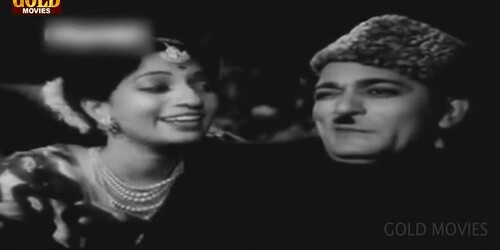
Now that might have been overlooked by me if I hadn’t happened to read Manek Premchand’s Director’s Chair: Hindi Cinema’s Golden Age a couple of months before that. In that book, Premchand had mentioned Noor Mohammad: the first major comedian of Hindi cinema, a man who was so influenced by Charlie Chaplin, he even adopted the famous British actor’s name as his own screen name. Noor Mohammad migrated to Pakistan in the wake of the Partition, but ended up feeling so stifled in the cinema industry there that he eventually returned to India and worked in several films here (including Akeli Mat Jaiyo).
So: I decided I had to give this one a try. Risky business, yes; but I wouldn’t know unless I’d tried, would I?
The film’s hero is Deepak ‘Deepu’ (Charlie), whose best friend is Jugal Kishore Handa ‘Jaggu’ (Wasti). Neither of them works for a living; and Deepu’s mother (Chanda) is at the end of her tether. She is getting so annoyed that Jaggu suggests taking out an ad in the newspaper, praising Deepu’s abilities and worth, in the hope that someone will offer him a job.
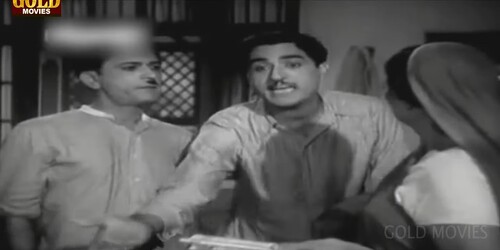
This is duly done, but misfires badly. In response to the ad (which praised Deepu’s looks [!], family, prospects and so on), many people come visiting—all of them, interestingly enough, wanting to make a match. These are the fathers, uncles, brothers and so on of eligible young women, and they’re flocking to offer proposals to Deepu.
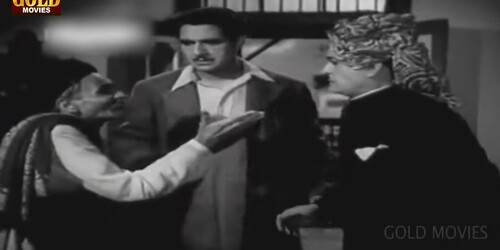
It takes a while of talking at cross-purposes for the truth to emerge.
Fortunately for Deepak, he soon after sees an ad in the newspaper, which is more clear, and more what he needs: the maharaja of Paharganj (A Shah Shikarpuri) needs a private secretary, and interested parties may come to Paharganj to be interviewed. Deepu, with Jaggu in tow, decides to try his luck. They therefore set off for Paharganj, travelling there by train.
In the meantime, the maharaja of Paharganj has been negotiating for the marriage of his daughter Veena (Mehtab) with Surendra (Anwar Hussain, in what seems to have been his debut role; if he was indeed born in 1925 as most websites claim, he’d have been only 18 when this film was released, which sounds a bit hard to believe). Surendra is the son of Colonel Girija Shankar (Ulhas) who is extremely proud of his warrior-like abilities and demeanour, as well as the titles the British have bestowed on him: OBE, CIE (‘Companion of the Indian Empire’, in case this was as new to you as it was to me), Bahadur.
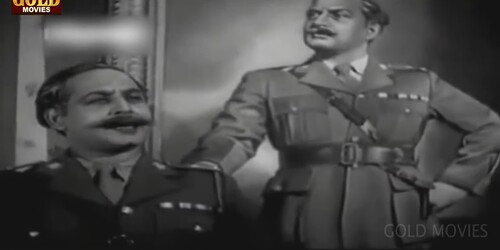
The colonel looks down his nose at the maharaja, whom he regards as an upstart: this man was a zamindar till very recently; it’s only the British who have suddenly elevated him to maharaja. As such, Surendra is sent off not with blessings but with instructions to make sure he keeps the maharaja, Veena, and Co. in their respective places. Surendra too goes to Paharganj by train.
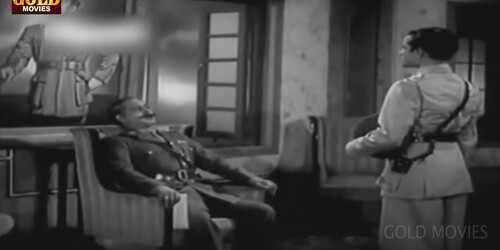
… and the maharaja has sent a group of his minions to the railway station to welcome his prospective son-in-law. They know nothing about Surendra or what he looks like (neither does the maharaja, nor anybody in Paharganj, it seems), and thus it is that Deepak finds himself welcomed and feted and much pampered. He and Jaggu think that the maharaja has somehow got wind of the fact that Deepak wants to apply for the post of private secretary and has therefore sent his men to welcome Deepak.
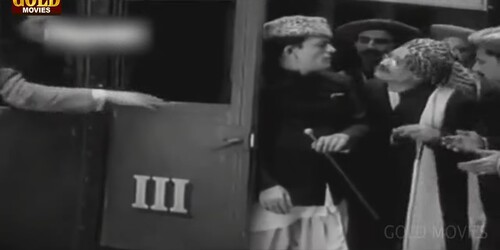
Much cross-talk ensues. Deepak and the minions each speak in a way that’s open to interpretation, and both sides interpret the other’s words to imply that their respective suppositions—Deepak is Colonel Sahib’s son, come to see Veena; the maharaja wants to employ Deepak as a secretary—are correct. This gets more and more tangled when Deepak and Jaggu are taken to the maharaja’s palace, to be warmly welcomed by the maharaja himself.

Meanwhile, Surendra has arrived at the station and then made his way to the palace, where he is given a lukewarm welcome: the sort of greeting accorded to a possible future private secretary. Various other men have also turned up, applying for the post. Surendra isn’t told in so many words what he’s been presumed to have come for; he ends up thinking that this ragtag group—white-haired men, other men obviously fairly down-at-heel—have all come to try for Veena’s hand. He is horrified, and rather contemptuous.

This won’t do, he decides. He hadn’t come here to be thus humiliated. So Surendra goes off back to where he came from. Before he departs, though, he happens to have bumped into Jaggu and got talking. Surendra befriends Jaggu and over the course of their conversation tells Jaggu that he (Jaggu) will have to bear witness in front of the dictatorial Colonel Sahib that Surendra actually did come here, and left only after discovering that he’d been duped. Jaggu happily agrees.

Meanwhile, too, Deepak and Jaggu are basking in all the adulation they’re getting. Jaggu is relaxing, while Deepak has met Veena. He gets very nervous in her presence (more so because Veena, by way of welcoming her ‘bridegroom’, has garlanded him), and to make him feel more at ease, Veena takes him for a riverside stroll, pours ‘cologne water’ on his head, and sings romantic songs with him.
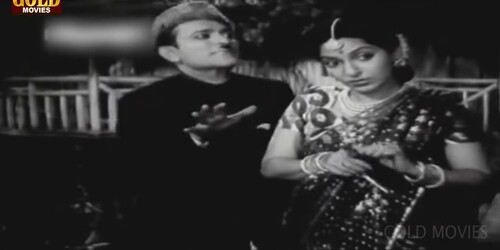
Finally (you’d have thought these two men would have cottoned on to this earlier), it dawns on Deepak and Jaggu that Deepak has been mistaken for someone else. They’d better get out of here, though the thought of being separated from Veena breaks Deepak’s heart.
Pretty complicated, you see. And this is only the start of it.
What I liked, and what I didn’t:
To be honest, I hadn’t had very high hopes of Sanjog. But I did want to see Charlie in action, and the music—composed by Naushad, with lyrics by DN Madhok—might be worth listening to. Plus, this is an AR Kardar film: a director I have a fair amount of respect for.
Was it worth it? Somewhat. This was not a case of the whole being greater than the sum of its parts. Naushad hadn’t yet scored with Rattan (that was in the following year, and there was no looking back after it); and DN Madhok, who also wrote the screenplay and dialogues (besides the lyrics) of Sanjog, in this instance at least seems to have been better at the songs than the script. The story itself is amusing enough, but the screenplay drags. Every ‘funny’ episode seems to just go on and on until all the humour has been sucked out of it.
That said, overall, this wasn’t a bad film. It didn’t go off the rails and suddenly become grim or melodramatic; the light-hearted tone of it was maintained throughout.
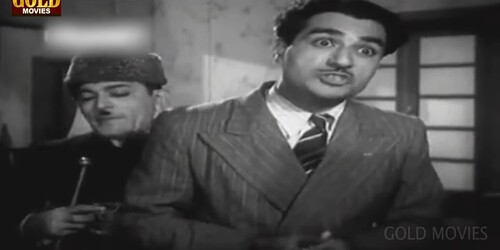
Charlie is amusing at times, but then again there were many instances when he just went on and on making idiotic faces, until I didn’t find him funny anymore. Mehtab wasn’t exceptional, either way: not great, not horribly irritating. What I did find a little surprising was that she didn’t look any different here from how she looked in Jhansi ki Rani, which was nine years down the line.
The two people who stood out for me here were Wasti and Anwar Hussain. Anwar Hussain because I hadn’t seen any of his really early films, and it was a pleasure to see him here.
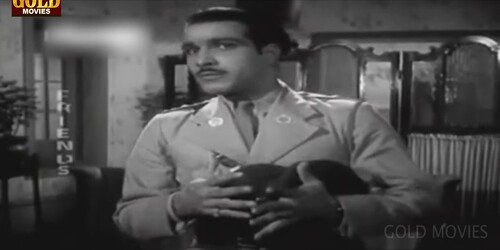
Wasti because, though I have seen him in several other films (as the villain in films like Dil Deke Dekho; as the hero in films like Ek Din ka Sultan), I’ve never seen him in a comic role. And Wasti, like Ajit in Dholak, proves that he could do comedy very well indeed. Enough to make you wish he had been given many more comic roles. In fact, he lip-syncs to one of my favourite songs from the film, the amusing Jaan bachi aur laakhon paaye (sung by Shyam Kumar).
In fact, I liked Wasti so much more than I did Charlie, I wished Wasti had played the central character.
On the whole, decent enough time-pass. I wouldn’t go out of my way to recommend Sanjog, but if you like 40s Hindi cinema, give this one a try.
 Dustedoff
This seems to be an amusing story of mistaken identities. The story can only be that good as what the director and screenplay writer make out of it.
Wasti does look good and even better when he is not making funny faces. Anwar Hussain looks at least for my eyes much older than his 17-18 years. I would have thought he was around 30 in this film. I checked on imdb and it says he was born in 1928 and passed away in 1988, which would make him 60 when he died. He looked like in his 60s or late 50s in the 1970s films, so I too wonder if 1925 is his real birth year. Let us say if he was born in 1915, he would be 28 when Sanjog released and 73 when he died. That is what I would suppose be the true time line. That would be my hypothesis.
LikeLiked by 1 person
Yes, Anwar Hussain does look at least in his mid- to late-twenties, doesn’t he? Definitely much older than 18 (or probably even 17, which he might have been when the film was made, if he was born in 1925). I am inclined to agree with your hypothesis.
LikeLike
I watched most of this film even though I couldn’t get English subtitles (although I still certainly needed them) because I knew about the music and dance scenes. It was certainly fun seeing Mehtab sing in the voice of a 13-year-old Suraiya. Mehtab looked very charming here, too, and Suraiya’s voice was already great. I think the music is fine, too – Naushad’s music here was a pleasure to listen to, even if he was just warming up for Rattan. And there was the dance scene starring Azurie and Krishna Kumar – not quite as great as the one they do in Rattan, but still very nice to watch.
Charlie seemed amusing enough to me, and though I didn’t get much of the dialogue, I thought that the scenes with him and Mehtab must have been funny enough. But, who knows, maybe it’s because I missed so much of the dialogue that the film seemed like more of a classic to me than it really was. :)
LikeLiked by 1 person
Thank you for reading, and for watching – even if you didn’t watch all of it! I have to admit the only films I’ve watched without subtitles where I’m not completely familiar with the language are a couple of Punjabi films, and I get a bit frustrated if there’s stuff I don’t get totally and have to make guesses about, so I can imagine how it must be for you. I hope someday Tom Daniel is able to rope someone in to subtitling this!
The scenes between Charlie and Mehtab are all right – not exceptionally funny, but not terribly mushy and romantic either. It’s Wasti here, at least for me, who steals the show. :-)
LikeLike
You’re welcome, Madhu – and thank you for reviewing this film (with a well-done synopsis, as always). But just to clarify here, I didn’t watch the film because of your post :) . It’s possible that if I hadn’t seen it before, I might have been inspired to watch it for the first time after reading your review, but actually, I watched this movie without subs quite a few years ago, mostly based on my desire to see the film that showed Mehtab “singing” with playback from 13-year-old Suraiya. (I think this was only the second year that Suriaya sang in films and possibly only the second film that featured her singing voice – though she’d acted in some things earlier.) And also, I did enjoy the clips that I had seen on YouTube – including, especially, that dance. So, I actually knew very little about the details of the plot – which probably wouldn’t have impressed me much one way or the other anyway. :)
I don’t watch Hindi films without subs all that often. I faintly remember some American bloggers who used to watch some Hindi films without subtitles and have fun posting dialogue or pieces of plot that they completely made up based on what they saw. (Or maybe it was just one blogger… I think maybe Greta/Memsaab used to do that once in a while? I’m not sure – it was a long time ago.)
I don’t know if Tom Daniel will ever work on this film (have not corresponded with him for a while now). From what I see, he seems to like veering into Bengali films a little more these days rather than hunting down so many vintage Hindi films.
LikeLiked by 1 person
I misunderstood that! :-) And yes, it was Greta (possibly even Beth to some extent? Not sure) who would watch films without subtitles and with only a very rudimentary knowledge of Hindi and try to figure out was happening! I always admired Greta’s patience in that sense – I would get very frustrated if I wasn’t absolutely sure what was going on. Though I suppose in a lot of the “so-bad-that-it’s-good” films Greta did watch (and reviewed with such aplomb) subtitles would not have done very much to make the plot clearer.
I did see a couple of non-Hindi films that Tom cleaned up and got subbed – the Bengali Lukochuri and the Tamil Penn, and given that both are languages for which I need subs, I’m very happy for him to veer away into cinema from languages other than Hindi!
LikeLike
tons of thanks for this madhuji
I have been off from your blog since a while as I began with an entirely new life In delhi, but yeah on Sundays returning to my old habits of watching films, those songs, fiction and ofc your blog comes as a breath of fresh air
thankyou for this again!
LikeLiked by 1 person
You’re very welcome, and thank you for reading!
LikeLike
Coming late to this one. I initially assumed this was the Sanjog with the lovely Woh bhooli daastaan song. I hadn’t realized there was an earlier one. Your review was interesting as always, but it doesn’t inspire me to watch the movie. :)
LikeLiked by 1 person
but it doesn’t inspire me to watch the movie. :)
LOL! Yes, it’s certainly not in the category of (say) Dholak. :-) And, frankly, I found Charlie just too irritating. He has this habit of screwing up his face, which annoyed me no end.
LikeLike