
Or, to give it its original Czech name, Dobrý voják Švejk.
I had stumbled across this film, highly rated as a satirical anti-war comedy set during World War I, and given that I enjoyed an earlier Czech comedy I’d seen (The Firemen’s Ball), I decided I should give this one a try as well. The film is based on an unfinished novel by the Czech humorist Jaroslav Hašek, who intended this as a collection of vignettes and incidents centering round a World War I soldier. The novel, despite being incomplete, has since been translated into more than sixty languages, making it the most-translated Czech novel ever. It has been adapted for screen several times, including once in German, and more recently, in 2018, in English.
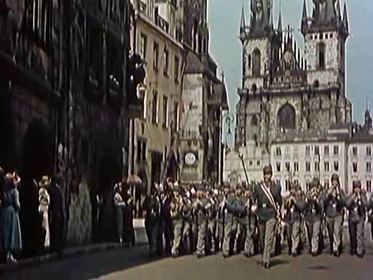
The film begins in Sarajevo in 1914 with a dramatic event: the assassination of Archduke Franz Ferdinand. There’s the gun firing, the troops parading down the street, the band playing as they march—and the archduke crumpling over in his carriage.
In a cozy little flat, the protagonist, Josef Shweik (Rudolf Hrušínský) is chatting with his landlady Mrs Muller (Eva Svobodová): about his rheumatic knee (which he has been assiduously massaging), about the assassination and what it could lead to. Mrs Muller is nervous; Shweik shouldn’t comment about politics; who knows who will be eavesdropping…

… and just then, the door opens gently and someone peeps in. A dog, and one Shweik knows very well. Shweik keeps selling off this hound, and every time it finds its way back home all over.

Anyway, Shweik goes off to the local pub to have a beer. The owner-cum-bartender insists that he will absolutely not talk about the assassination or anything related to politics because any sort of involvement in politics is bad for business.
Shweik has no such compunctions, and is happily going about chatting to the bartender as well as another customer, a man named Bretschneider (František Filipovský) about the possible consequences of the killing of the archduke. There is bound to be war, says Shweik.
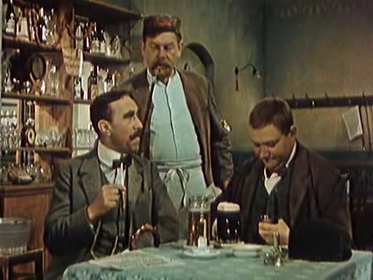
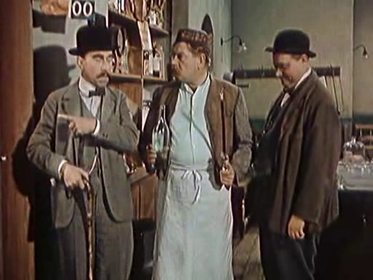
It is at this point that Bretschneider unmasks himself, so to say. It turns out this man is a police agent, and he arrests Shweik on charges of criticizing the regime (remember, this is all part of the Austro-Hungarian empire, and the Austrians are the rulers). The bartender, who had admitted in passing that he had taken down a portrait of the emperor which used to hang in the pub (taken down because the flies were dirtying it) is also arrested because he allowed the flies to dirty the portrait of the emperor.
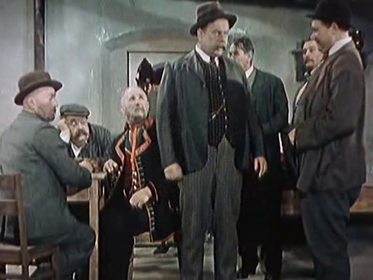
Shweik is bunged into a prison cell which is pretty crowded, with various other locals who have been arrested on similar charges of being anti-establishment. Note the ‘similar charges’: none of these appear to have what might be termed solid reasons for being arrested. What is considered sedition in Sarajevo of 1914 seems to be very odd indeed.
Anyway, Shweik is sent off to be interrogated, and is straightforward in his responses to the questioning officer’s questions. In fact, Shweik seems to be very calm and collected about it all; he doesn’t even seem to realize that he might be in some sort of danger. Perhaps this is because, as he admits, he is certified to be feeble-minded. He had been in the army, but was chucked out because he was feeble-minded. Officially feeble-minded.

Shweik, then, is examined by a group of doctors, who ask him all sorts of questions and come to the conclusion that yes, he is indeed feeble-minded.
He is returned to the police with the endorsement of his ‘complete insanity’. In the meantime, though (just as Shweik had predicted) war has been declared, and men are being called up to enlist. Shweik has been allowed to go by the police, but he decides he can’t let this opportunity pass of serving the emperor.
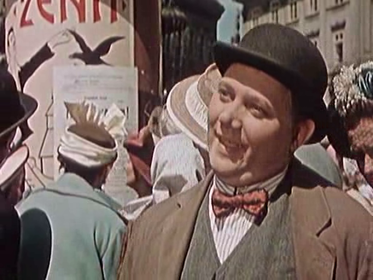
After some more adventures along the way (including having to evict a substitute tenant Mrs Muller has given his room to) Shweik ends up again under the iron boot of the authorities: the military authorities this time. After the medical examination that precedes his acceptance into the army, he is bundled off to the hospital, where he finds himself among a group of other men, all of them labelled ‘malingerers’ by the doctor, who visits every now and then.
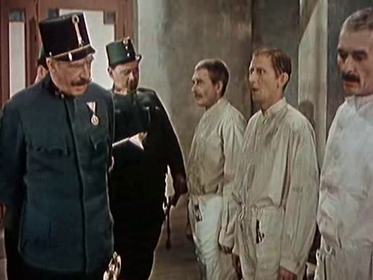
The doctor’s style of examining his patients is to have them line up in the ward, and to ask each of them what’s wrong. For whatever malady the patient is suffering from—whether tuberculosis, or a case of being deaf and mute, or (as in Shweik’s case) rheumatism and feeble-mindedness—the doctor’s prescription is pretty much standard. Enemas, glassfuls of quinine, and so on.

This seems to jolt most of the men out of their disorders, and whatever cannot be healed by enemas and quinine must be addressed through sermons. The patients troop in every Sunday for mass, which is conducted by the obviously very tipsy Chaplain Otto Katz (Miloš Kopecký). He is bleary-eyed, he keeps blundering about, slapping the top of the pulpit hard enough to make the sculpted cherub statues decorating its front swing wildly about.

But he’s not really drunk, it seems: because when we see him later, behind the scenes, he seems perfectly sober, perfectly in control.
Is the Revd. Katz somewhat like Shweik, then? Is Shweik, like Katz, donning a façade? Because there is definitely something about this ‘feeble-minded’ former soldier that smacks of blitheness, of a calm insouciance. He admits to great stupidity without batting an eyelid, and all his foolishness, and the many mistakes (are they?) he makes because of it, ends up getting overlooked because Shweik is officially feeble-minded.
Joseph Heller, writer of the highly acclaimed anti-war, farcical classic Catch-22, is said to have admitted that he would never have been able to write Catch-22 if he had not read The Good Soldier Shweik. Though it’s been donkey’s years since I read Catch-22, I can see the resemblance, even if fleeting: there is the subtle (sometimes not so very subtle) poking of fun at those in power: the police in Austrian-ruled Sarajevo, for instance, or the military. How seriously they seem to take themselves, but how ludicrous they really are. Maintaining love-nests, stealing dogs, having someone court-martialled for the most trivial of reasons.
And, if one stops to think, how true that is, not just of military or police, but of undemocratic regimes everywhere.
Written and directed by Karel Steklý, The Good Soldier Shweik is the first of a two-part film about Shweik’s adventures during the Great War. The sequel to this was I Dutifully Report (1958), in which Rudolf Hrušínský reprised his role of Shweik.
What I didn’t like about this film:
The sometimes-too-muted humour of it, which (I am guessing) perhaps needs annotations to understand. There were places here where I wondered if there was a cultural reference I was missing, and which (had I known it) might have made the film that much more entertaining for me. Also, paradoxically, there were times when the humour became almost too over-the-top slapstick to appeal to me. The scene, for instance, where the doctor is making his way through the ward prescribing enemas left, right and centre, is farcical to the point of being tiresome.
That said,
What I did like:
A good bit of the humour, and—especially—Shweik (and Hrušínský’s portrayal of him). This character has this clear-eyed, innocent naïveté which makes one wonder whether he really is so very stupid, or if it’s just a smart way to cock a snook at all those in power. It actually played with my mind a little: if Shweik is really so innocent, really so naïve and dim-witted, then the frustration of all the high and mighty people around him, driven round the bend by Shweik’s nuttiness, is laughable. But if Shweik isn’t as innocent as he appears, the joke is that much more heightened. And the joke is on them, not on Shweik at all. It’s an interesting puzzle.

But, on the whole, I didn’t find this film engrossing enough to want to really find out whether Shweik was faffing or not. It’s not interesting enough to make me want to search for its sequel, I Dutifully Report. Not now, at any rate.


This is a nice story. I haven’t seen the Czech movie. But I have seen “Der brave Soldat Schwejk” (1960) with the famous German actor Heinz Rühmann, which was very good. At least I remember liking it when I saw it some 24 years ago.
Then there was the film “Schwejk’s Flegeljahre” (1964) with the Austrian actor Peter Alexander. He was more famous for his musical films. He was a famous singer. He was more like Shammi Kapoor, a singing Shammi Kapoor and a comedian too. But I didn’t like this movie much. It was more of slapstick.
I think more true to the original was the Austrian TV Series of the 1970s “Die Abenteuer des braven Soldaten Schwejk” with the legendary actor Fritz Muliar. He was not only a good actor but also anti-Nazi activist. I loved this series, when I saw it some time in the 1990s. But unfortunately I have forgotten most parts of it.
REading your review has made me want to watch all the three again.
LikeLiked by 1 person
One thing I forgot to mention is that, that part of the humour is in the way Schwejk speaks German in these films. He uses the Czech syntax for the Austrian dialect, which was quite common for the migrants from Bohemia working in Vienna in the pre-WWI and later era. Fritz Muliar could do that very well. Rühmann and Alexander sounded to sophisticated for that.
LikeLiked by 1 person
I think, long ago, you had mentioned Peter Alexander as being a sort of Austrian Shammi Kapoor. Which, of course, makes me want to watch something starring him! I will see if I can find anything with English subtitles… not Schwejk’s Flegeljahre. Frankly, I think a story of this kind is not suited to being adapted into slapstick: its humour (as you will agree, I think) lies in the subtlety of its satire.
Thank you for the comment, Harvey, and the interesting insights you had to offer.
LikeLike
didn’t realise there was a film but I did read the book years ago, in translation of course, and that was fun. There’s a whole set of satirical pieces by central European authors criticising the old empire or the communists or even the post-communist period of unbridled capitalism (remember that German film a few years ago about a woman who falls into coma in the 1980s and when she recovers, the iron curtain has fallen and her son and neighbours have to rally around pretending nothing’s changed so as not to shock her back into a coma?) it’s all good!
LikeLiked by 1 person
I have to see this German film, I have never come across it! Do you happen to remember what it was called? It sounds very interesting. (By the way, some years ago I had met a German writer who had vivid recollections of the collapse of the Berlin Wall – he said it was suddenly surreal to be able to go even anywhere near the Wall without coming into the crosshairs (even figuratively) of the soldiers.
LikeLike
I think you mean Good Bye Lenin (2003). That was a very good film. It was a very big hit here. Here is the movie. You will have to turn on the automatic English subtitles. Berlin has changed so much in the last few years.
https://youtu.be/7n-81XhwUQg?si=P76B-2haID0OC09G
LikeLiked by 1 person
Thank you so much, Harvey! I will definitely watch this, hopefully sometime soon. Looking forward to it.
LikeLike
yup, that’s the one! there was a whole trend for a bit of ‘ostalgie’ in germany, wasn’t there? a kind of nostalgia for the GDR? i’m watching a spy series called ‘kleo’ on netflix that’s set in that time immediately after the wall fell, quite a bit of fun and mayhem.
LikeLiked by 1 person