
Some days ago, in this delightful post about chai in Hindi cinema, I came across a mention of Kundan. Aao hamaare hotal mein chai peeyoji garam-garam sounded so interesting that I bookmarked the film without even really checking to see what it was all about (though the cast, barring Nimmi—whom I often find very irritating—appealed to me). Then, just a couple of days later, Anu posted this wonderful tribute to Sohrab Modi, in which she listed Kundan as one of her favourite ten films directed by Modi. Adapted from Victor Hugo’s classic Les Miserables.
That sealed it. I had read Les Miserables a couple of years ago, and had been blown away by it: by the depth and width of it, the characterization, the sheer scope of it all. And now, it looked as if the universe was pushing me towards Kundan. I had to watch this one.
The story gets off to a flying start. Kundan (Sohrab Modi) is a very poor man who lives with his very ill sister and her little daughter Radha. Unable to earn [it’s not clear why, given that he looks able-bodied enough], a desperate Kundan finally steals a loaf of bread from a bakery and runs home to give it to Radha. Since he’s made no attempt to commit this theft in secrecy, the alarm has been raised and Kundan is arrested even as Radha is eating the loaf.
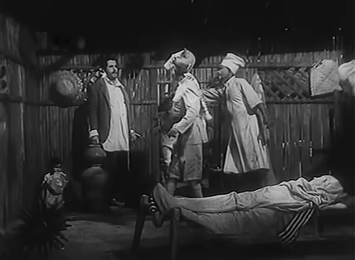
Kundan is sentenced to two years’ imprisonment for the theft, and Radha [how does she manage this?] comes to visit. She cries, begging him to come home because Ma is now not even opening her eyes, not speaking, nothing, and Radha is hungry. Once Radha has gone, Kundan goes to the jailor, Sher Singh (Ulhas, in what I regard as one of his finest roles) and asks to be given two days away, so that he might attend to his family. Sher Singh refuses.
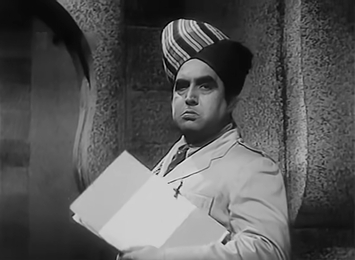
Kundan, therefore, escapes and tries to go home—but is caught before he can get there. This is a pattern that repeats itself: he tries to get free, he is caught; and each time his jail sentence is drastically increased. Kundan ends up spending fourteen years in jail. While in jail, though, one day, Sher Singh is witness to Kundan’s prodigious strength. The prisoners are working at a quarry and dynamite is being used to blow up rocks. One of these boulders, rolling downhill, pins one of the prisoners under it. All by himself, Kundan lifts the rock, supporting it with his back long enough for the others to drag the injured man from underneath.
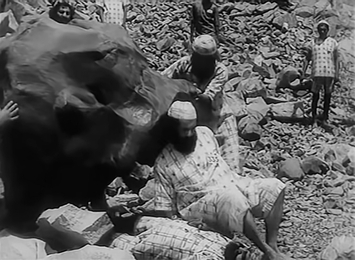
Sher Singh congratulates Kundan on a job well done, and that’s the end of the episode.
Anyway, fourteen years from when he was first arrested, Kundan finds himself finally free. He has strict instructions: for the first year after his release, he must report everyday to the local police station.
Kundan, by now, has little regard for the law, and little intention of following this order. He goes home, but discovers there that his sister had died many years ago and nobody knows where Radha has gone. And everybody regards him as a thief, a dangerous criminal. Kundan ends up ostracized wherever he goes: he sits down for a meal at a dhaba, but a passing cop warns the dhaba owner, who refuses Kundan a meal because he doesn’t want to be paid in money earned at the jail.

Kundan tries to find work, but his reputation has spread and nobody will give him work. When, tired and hungry, he tries to seek shelter, he is turned away wherever he goes. Eventually, however, a bit of advice from a kind passerby leads him to the doorstep of a saintly monk (Murad). This monk doesn’t just let Kundan in; he welcomes Kundan, he makes sure Kundan is fed on a silver platter, with silver diya-stands lit in front of him. When a ravenous Kundan, having stuffed himself, asks that he be allowed to sleep in the cowshed, the monk refuses and takes him to a comfortable room.

The man is saintly, but he’s also obviously quite wealthy, and Kundan has taken note of this.
The next morning, the maidservant raises the alarm: Kundan has decamped, with all the silverware (barring the diya-stands)! Before this can even be discussed, Kundan returns—dragged home by the cops, who have arrested him, along with the silverware they’ve confiscated from him. The monk spikes the cops’ guns (and Kundan’s) by saying that he was the one who handed over the silver to Kundan; Kundan is no thief.
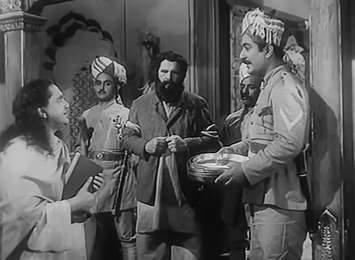
A shaken Kundan is set free, and he is so repentant, so much a changed man that the monk gifts him the diya-stands when Kundan finally bids him farewell and leaves.
Some days later, Kundan arrives at a faraway town, where he sees potters at work in a large workshop. He is so entranced that he decides this is what he wants to do for a living: run this place, see mere clay being transformed into useful things, beautiful things [you see the metaphor here, of course]. Fortunately, the current owner wants to sell, so Kundan hands over his savings from all the work he did all those years in jail, and becomes the owner…
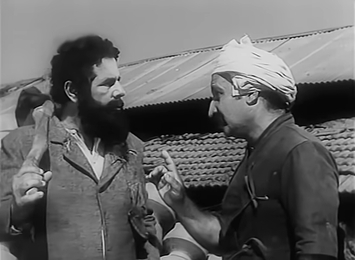
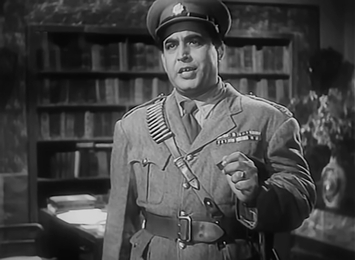
… and makes a huge success of it. Many years later, we catch up with Kundan, now the wealthy Seth Din Dayal, who owns the extremely successful Din Dayal Crockery and lives in a huge mansion. He is not only very well-off, he’s also well-respected: he is the mayor, and has just also been appointed magistrate. This status means that a newly arrived police officer comes to Seth Din Dayal’s home to offer his congratulations. Who should it be but Kundan’s old nemesis, Sher Singh? Kundan recognizes him, but Sher Singh remains, for the time being, unaware.
In the meantime, Kundan’s long-lost niece Radha has grown up (now Nimmi) and is married to Gopal (Pran), who, unknown to her, is a baddie. Gopal gets some of his unscrupulous friends to come to his home pretending to be creditors clamouring for their debts to be paid. Gopal and these fellows pretend to fight, with one of them threatening Gopal: if he has nothing else, he should pawn his wife’s jewellery.
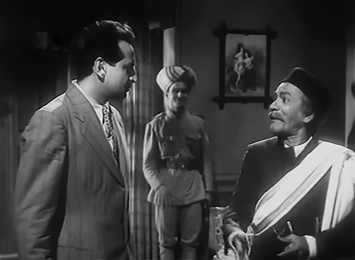
Radha, gullible soul that she is, overhears all of this and quickly gathers together every last ornament and takes them outside, to the ‘creditor’.
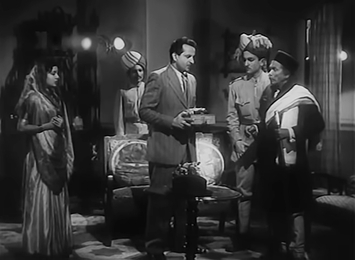
Of course, this basically allows Gopal and his cronies to take off with all of Radha’s jewels. Poor, stupid Radha realizes too late that she has been conned, and that too in a big way. [It’s never explained how Radha, who was really poor and an orphan, ends up wealthy enough to own a fair bit of jewellery which seems to belong to her]. Along with her baby Uma, Radha sets out into the big bad world to try and manage on her own.
She lands up at a small ‘hotel’ (a sort of eatery, really, which is nowhere as wonderful as its owners claim) run by Jokhu Ram (Om Prakash) and his wife Sukhiya (Manorama). Radha sees several children playing there, and learns that of them, only one little girl is Jokhu and Sukhiya’s; Sukhiya is looking after the rest, in what seems like a crèche-like arrangement. Radha asks if Sukhiya will also foster Uma; that will leave Radha free to earn money. She will pay Sukhiya Rs 20 for it. Sukhiya and Jokhu, a greedy pair, haggle with Radha and bring the rate up considerably. Because she’s so desperate, Radha agrees.
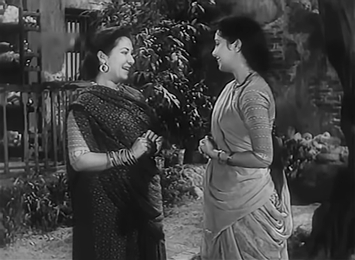
She ends up taking up a job in—such a coincidence—Din Dayal Crockery. Every month, she slogs to send to Sukhiya the amount she’d promised, little realizing that poor Uma’s life has become hell in Sukhiya’s ‘care’. Sukhiya treats Uma (now Baby Naaz) like a slave, making her do all the work, pushing and shoving her around, and generally being a complete menace.
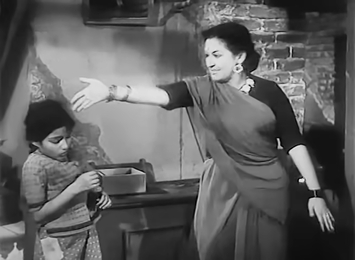
In the meantime, Radha’s fellow-workers on the assembly line at Din Dayal Crockery have discovered that she—who had joined the place claiming to be unmarried—has a daughter. They label her a fallen woman and give the manager an ultimatum: get rid of Radha or they will leave, en masse. He has no choice, and Radha ends up having to leave.
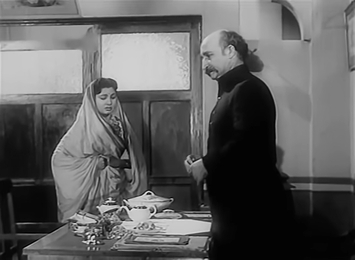
She goes to Jokhu and Sukhiya’s to collect Uma; but these two nasties, seeing their unpaid servant in danger of being taken away, get belligerent. Sukhiya tells Radha that they’ve spent a good Rs 500 on Uma in this time, clothing her, feeding her, on medicines, etc. Pay the 500 bucks, and then you can take Uma.
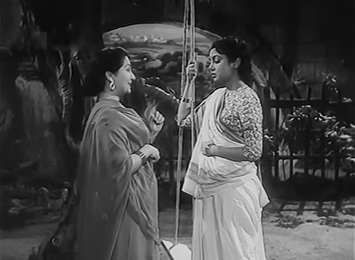
Radha, all weepy and distraught, doesn’t have that much money, of course, and has to leave empty-handed. She ends up broke and homeless, and [like everybody else in dire straits] sings a song of woe. Fortunately for her, her ex-landlord, who doesn’t seem so very hard-hearted after all [even though he asked her to vacate when she couldn’t pay rent] suggests she try her hand at singing in a club: she has a good voice.
Radha gatecrashes a club, and her song does attract attention—not just the unwanted kind, from the club owner who wants more than just her voice—but also from two people who are connected to Radha. One is Kundan, silently watching her, unaware of her identity. Another is Gopal, whom Radha stumbles upon and pleads with to take her back [so that he can swindle her again? This woman has neither sense nor self-respect].

Gopal refuses to acknowledge Radha. Sher Singh arrests her, and Din Dayal, as magistrate, goes along to the police station to hear her case. Radha, when she discovers that this man is Seth Din Dayal, raves and rants at him: for no fault of her own, she was thrown out of his factory; because of him, she’s been in such misery. Sher Singh throws her into the lockup, but Din Dayal intervenes and rescues Radha. Takes her home, and discovers there who this is. There is a tearful reunion between uncle and niece…
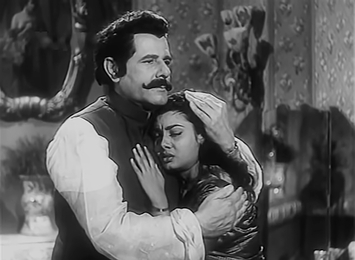
But the story is actually only just beginning. Because there’s Uma, being mistreated by Jokhu and Sukhiya. There’s Sher Singh, who doesn’t yet know who Din Dayal really is. And there is the country at large, still under British rule but with the freedom movement hotting up…
Like Do Phool and Sangdil, Kundan happens to be one of the few Hindi film adaptations from Western literature that are recognizably similar to the source material. In the case of Kundan, Sohrab Modi actually credits Les Miserables as the source. Which, to me, is not just the way it should be (give credit where it’s due), but also ends up being a tribute to a classic. This isn’t a distorted version of the book (like some others I’ve seen, Dil Diya Dard Liya coming readily to mind) but one that has been carefully tweaked, not just to make it more suitable for the screen, but also more in keeping with the norms of Hindi cinema and its audiences.
What I liked about this film:
The story, of a man’s life being changed forever because of the goodness of another person. The monk’s kindness, and his ability to see Kundan as a human being worthy of respect, turns Kundan away from a path that might have ended in a life of crime. How this kindness radiates, how Kundan in turn is able to influence others and spread that goodness, is what the story is about. Hugo’s novel is a classic, and one can see why: its message is so universal.
… and Pandit Sudershan (who wrote the screenplay) does an excellent job of adapting it. Of paring away the long and detailed descriptions, the long dialogues, the extended scenes, to bring it down to the essentials. The story remains resoundingly the same; it’s only in the details that it differs. I must point out one particular bit of adaptation that I particularly liked: the Paris Uprising/the June Rebellion, which forms the climactic part of Les Miserables, is neatly turned into the Quit India movement of 1942, with Sunil Dutt’s character Amrit being the firebrand revolutionary Kundan’s grandniece Uma (played by Nimmi) falls in love with.
The cast is good, with Ulhas (who received a Filmfare nomination for Best Supporting Actor) being especially good. Nimmi, too, surprised me. I am used to seeing her in the weepy sort of role that she plays as Radha here, but as Radha’s daughter Uma, she is (generally) vivacious, happy, a lovely young woman in love.

The music (composed by Ghulam Mohammad, to lyrics by Shakeel Badayuni) is good. Among my favourite songs here are Yeh bahaaron ke din yeh suhaana samaa; Aao hamaare hotal mein; and Matwaale o matwaale nainon ke teer khaale.
One of the most memorable scenes (and a very long scene it is too, stretching over many, many pages) from the book is the climax in the sewers of Paris. I had wondered how Kundan would interpret that, but to my surprise, the sewers are actually here. Sohrab Modi got art director Rusi K Banker to design sets for the sewer scene, and there’s a delightful photo on IMDB that shows part of the crew (no-one’s identified, sadly) on set.
There’s nothing I didn’t like about this film, barring Radha’s irritating dependence on that rotter Gopal. Yes, it’s a off-beat, very different from the run-of-the-mill Hindi film, but in a good way.
Note: You can watch Kundan here, at Tom Daniel’s YouTube channel, where he’s uploaded a well-restored version which also has English subtitles for those who need them.
 Dustedoff
A very comprehensive review. The quality of print also seems good. Although I do not like Sohrab Modi’s dramatic acting much ( not do I like Nimmi for the reason mentioned by you ), I will see this one as you liked it and for a stroll down the memory lane.
Film’s Lata Gazal ‘ Shikayat kya karun dono taraf gham ka fasana hai ‘ also is excellent!
LikeLiked by 1 person
Yes, Sohrab Modi – especially in the historicals – does tend to ‘declaim to the skies‘ (as my father puts it)! But he’s not so declamatory in this one. I hope you enjoy it.
LikeLike
So glad you caught this, Madhu, and gladder still that you liked it. Sohrab Modi’s films are not for everyone; it takes some getting used to, and some (like Jailer) are a drag to sit through, but they all had something interesting to say.
LikeLiked by 1 person
Thank you for recommending this one, Anu. I enjoyed it, despite Nimmi’s rather irritating Radha! :-) I suppose I may not have liked it as much if I hadn’t already read Les Miserables (and liked it), but that made a difference.
LikeLike
Yeah. Poor Nimmi. By all accounts, she was a cheery madcap who was always laughing. But, heavens! She was always so down-in-the-mouth in her films, wasn’t she? All she did was weep!
At least, in this, she got to be happy as Uma. Small mercies!
LikeLiked by 1 person
“she was a cheery madcap who was always laughing.”
You’d never think it, no, looking at all the roles she played! Offhand, I think Uma is about the only more or less cheerful character I have seen her play. Such injustice.
LikeLike
A trip down memory lane!
LikeLiked by 1 person
Thank you for the inspiration!
LikeLiked by 1 person
I had watched this movie few months ago or probably last year. I liked this movie so much that I asked my mother also to watch and sent her a youtube link. she too liked it. Without doubt, It was an awesome movie with good music.
LikeLiked by 1 person
Yes. I wonder why it doesn’t seem to be much known. It certainly deserves a lot more recognition.
LikeLike
Î watched this ages ago on DD and once while I was reading its synopsis, I realised, it sounded very much Les Miserables. Thanks for the pic of the studio sewage system. It was interesting to see that in the earlier posters Sunil Dutt is not even mentioned.
LikeLike
That photo of the studio sewage system is very good, no? I was quite amazed that they actually managed to do it (and fairly well, though of course the average Indian sewer would be too filthy for most people to even survive a few hours in one).
I guess Sunil Dutt was too new at this stage to merit a mention!
LikeLike
This is a good film. Sohrab Modi, delivered both as an actor and director here. And Sunil Dutt, I am very fond off anyways. In my opinion, he is one of the only truly six great actor-heroes Hindi cinema has seen till date, the other five being Ashok Kumar, Motilal, Dilip Kumar, Sanjeev Kumar & Mithun Chakraborty.
That also makes Dutt saab, one of the only three male Punjabi artists who are underrated and under-talked about till date, in my view. The other two such artists are Omprakash and Akshaye Khanna. Rest, are all aptly talked about- and dare I say even over-talked about often, which makes me feel sad for these three artists!
Because, in general, being underrated and unsung is the jagir of Bengali, Marathi & Parsi artists, few exceptions here and there notwithstanding!
Talking about Parsis, brings me back to Sohrab Modi- a very pivotal figure of Indian cinema, whose contributions, though well recognised during his time, have largely been obliterated today. Which is unfortunate, because without Modi and his brand of cinema, two very defining traits of Indian cinema in form of epic grandeur and ”dialoguebaazi” would not have achieved the importance that they have been able to do in our films. Honestly and truthfully speaking, the likes of Bahubali, Bajirao Mastani, Mughal-e-Azam would not have been possible if not for Modi’s Pukar & co. Similarly, Modi laid down a path that was followed by the likes of Rajkumar, Feroz Khan, Shatrughan Sinha & Amitabh Bachchan ( and even many down South!) when it came to the arena of dialoguebaazi!!
But, I guess coming not from the two powerful blocks of Punjabi- Pathan or South, has worked against Modi saab in the long run. Because Parsis, while being economically rich, are too much a minority when it comes to demographics, to adeptly play the trumpet of self- promotion! Consequently. Sohrab Modi has lost out in the race of being duly remembered- a fate that has also befallen the likes of such legendary figures like Debaki Bose, PC Barua, V.Shantaram, Nitin Bose, Phani Majumdar, S.Mukherjee, Chandulal Shah and B.Pendharkar!!
LikeLiked by 1 person
True, Punjabis do seem to be thoroughly overrated in Hindi cinema. I do feel there are plenty both behind the scenes and onscreen who deserved the credit they got (I can think of the Kapoors, Mohammad Rafi, Balraj Sahni, Sahir Ludhianvi, etc…) but there was a much larger number that had little talent but still managed to make it big.
The Punjabi dominance of Hindi cinema shows in a lot of other ways – in Punjabi lyrics making their way into songs, for instance; or the number of lead characters who are obviously Punjabi (the comic characters tend to be from other equally obviously ‘other’ communities – ‘Madrasis’ or Pathans with exaggerated accents, for instance, or Christians speaking really bad Bambaiyya Hindi).
LikeLike