
I am not a one for mythologicals or devotionals.
If you go through the list of Hindi films I’ve reviewed in the sixteen years this blog has been in existence, you’ll probably only find a handful of films that fit the bill (offhand, I can only think of Mahabharat, though in Telugu, I’ve also reviewed the excellent Maya Bazaar and in Tamil, Karnan). I have watched more than that, but nearly all I have found to be so ho-hum, I couldn’t be bothered to review them.
The story of Krishnabhakt Meera, wife of Bhojraj, was not one I expected to be any different. A woman, so completely devoted to the deity she has chosen to worship that she gives up everything, down to her husband and the kingdom of which she is queen, in order to go to Vrindavan to fall at Krishna’s feet… I was quite certain this film would be a hard slog. There was only one reason I wanted to watch it, and that was MS Subbulakshmi, who played Meera. I knew that Meera had originally been made in Tamil (in 1945), and was later (in 1947) dubbed in Hindi, with some scenes being reshot. MS Subbulakshmi, of course, given her stature as one of the greatest vocalists the Indian subcontinent has ever produced, sang all the songs.
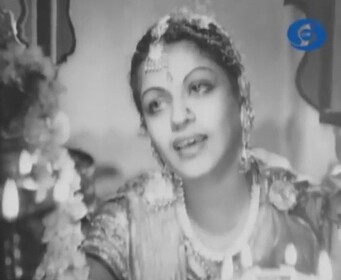
Just for the songs, then, I thought.
The story begins when Meerabai (Radha, MS Subbulakshmi’s step-daughter) is a little girl. Her father had died when she was a baby, and Meera is being brought up in her grandfather’s home, where she is much loved and doted upon. Meera is quite the Krishna devotee, so she is especially excited when there is a guest at the family home: Rupa Goswami (Serukalathur Sama) is a famous philosopher and sage, who is en route from his home in Vrindavan to the pilgrimage spot of Dwarka. He will stay with them for the night.
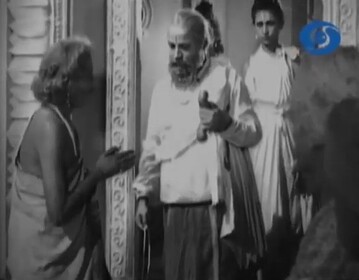
Goswamiji has brought along a fine statue of Krishna with him, and Meera is entranced by it. During pooja, she gazes, enraptured, at the statue and imagines that Krishna has come alive and is smiling at her.
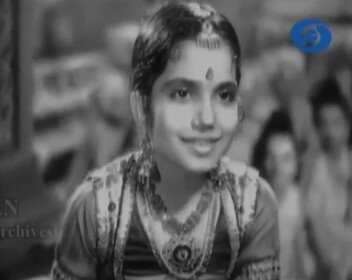

So entranced is Meera that she finds it difficult to get over her excitement and go to sleep. Her doting mother (?) tells Meera a bedtime story—about Krishna and Radha, no surprises there—but Meera falls asleep in the middle of her story.
Falls asleep, dreams she is Radha to Krishna (Kamala Kumari, stunningly graceful) and that they are dancing…

When Meera wakes, she quietly sneaks off to the pooja room, where the Krishna statue brought by Rupa Goswami has been installed. She takes the statue and brings it away to her own room. This is where, next morning, her grandfather and Rupa Goswami discover the missing Krishna. Meera’s grandfather is embarrassed and apt to scold Meera, but Goswamiji, impressed by Meera’s devotion, stops him.

After Goswamiji has gone, one day Meera and her mother are standing on a balcony of their home, looking out onto the street when they see a grand procession passing by. Meera wants to know what it’s all about, and her mother explains: it’s a wedding. Look: there, all dressed in finery and with his face veiled with the flowers of the sehra, is the bridegroom. Someday, Meera too will grow up and be married.
But Meera contradicts her mother; she is already married. To Krishna. She will marry no-one else. Her mother laughs, is indulgent.
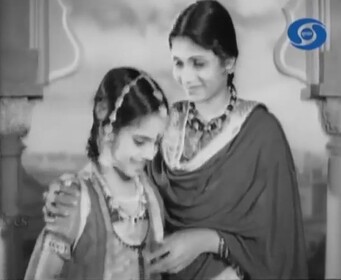
Who knows what might have happened if Meera’s mother had lived on; but she died soon after. We come to know of this only some years later, when Meera (now MS Subbulakshmi) receives the news from her grandfather that a marriage proposal has been received from her, from the Maharana of Chittaur. Meera baulks at this, and tells Grandpa that she had, years earlier, accepted Krishna as her husband. How can she marry anybody else?
Her grandfather reasons with her, mostly by using emotional blackmail. When Meera’s mother was dying, she had made him promise that he would look after Meera and have her married into a good household. Would Meera, by her obstinacy, be the cause of Grandpa not being able to keep his promise to his dying daughter-in-law?
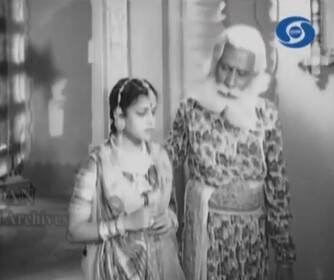
Thus, Meera is gently coerced into marrying the Maharana (Chittoor Nagayya), and follows him to his fort at Chittaur.
Here, it doesn’t take Meera long to establish herself as a Krishna devotee, singing his bhajans everywhere she goes. Soon, she is the talk of the town, attracting other devotees too, all of them singing the praises of Krishna.
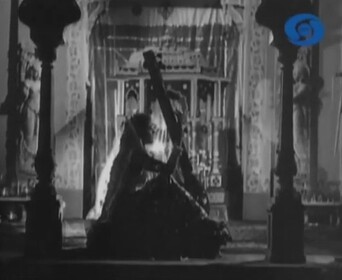
While Meera may have become popular among the Krishna bhakts of Chittaur, in the palace itself, there is disapproval, even contempt. Three people, in particular, do not hesitate to express their unhappiness at what they consider inappropriate behaviour on the part of Meera. One is Jaimal (TS Mani), an important minister. Another is the Maharana’s brother, Vikram (TS Balaiah); and their sister Uda (KR Chellam).
Fortunately for our heroine, the Maharana’s friend Uttam (K Saranagapani) is more kindly disposed towards her. When word of Meera’s recalcitrant ways (in other words, she’s a disgrace to the royal family) reaches the Maharana and he is apt to take punitive action, Uttam is the one to soothe him and to encourage the Maharana to reason with his wife, cajole her into acquiescence, into a realization of her duties towards the royal household and towards the Maharana’s subjects.

Meera is all wide-eyed innocence; she cannot understand why the Maharana might be upset with her. To her, it is perfectly natural that she is devoted to Krishna, and she sees no reason to hide this devotion or to let it be overridden by other considerations. For the time being, though, the Maharana and his bride get along fairly well. She is demure (and of course she’s very beautiful), and before he knows it, the Maharana has granted Meera’s wish that a Krishna temple be built in Chittaur.
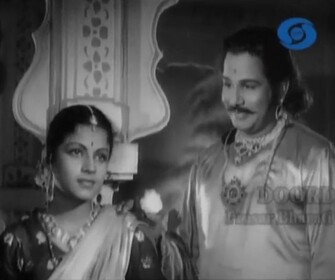
As he later tells Uttam, by agreeing to this wish, he is only sweetening Meera up, preparing to wheedle her into switching loyalties, perhaps, from Krishna to the Maharana.
But if the Maharana thinks that by agreeing to the temple, he will please Meera enough to turn her away from Krishna, he has another think coming. The temple is built, and now Meera spends even more time away from the palace. She is at the temple day in, day out, and all the more pious citizens of Chittaur seem to follow in her wake.
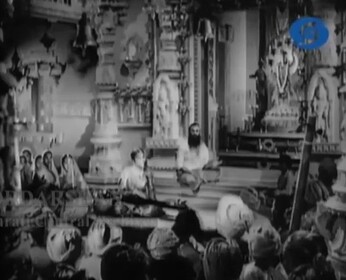
The Maharana, agitated, goes to Meera one day to remind her that Vijaydashami is coming up. There will be a special ceremony and celebration at court; she must be there beside him. Meera’s face falls; she cannot be there at the palace—the Vijaydashami celebrations at the Krishna temple need her to be there. When the Maharana insists, Meera gives in, though reluctantly.
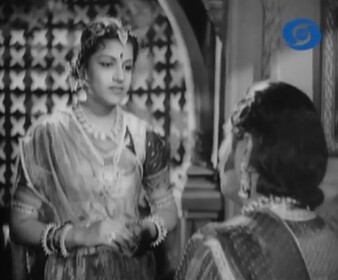
On Vijayadashami, a suitably bedecked Meera makes her way to the court accompanied by her ladies in waiting. She is looking disturbed and unhappy, but everybody’s so excited and distracted by the celebrations, nobody notices… until Meera, about to take her seat beside the Maharana, suddenly cannot bear it anymore. She whirls around and races off—straight to the Krishna temple.
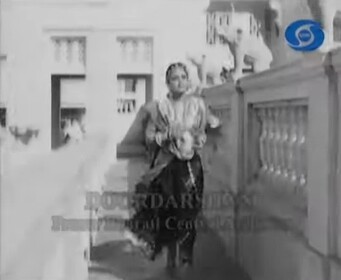
This is the last straw. By making it obvious that Krishna is more precious to her than the Maharana, Meera has humiliated her husband in full view of his subjects. He has lost face, utterly and completely; and with him, too, his entire clan. His brother and sister, Vikram and Uda, are livid. This has gone on long enough.
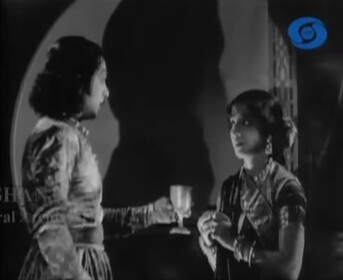
Vikram, in particular, is thoroughly incensed. He decides something must be done about Meera, and Uda should be the one to do it. He hands his sister a goblet of poison and bullies her into taking it to Meera…
Meera was the last film in which MS Subbulakshmi acted (after this she focused on nurturing her singing). Ironically enough, it was also to be the film that made her a household name her across India. The film, as I mentioned above, had initially been made in Tamil, directed by the American director Ellis R Dungan (who made a slew of Tamil films between 1936 and 1950, and who was the subject of a 2013 documentary, An American in Madras). Meera had proved to be such a runaway hit in Tamil Nadu that Kalki Sadasivam (MS Subbulakshmi’s husband), the producer of the film, along with Dungan, decided that it deserved a wider audience: a Hindi version was in order. Some scenes, featuring MS Subbulakshmi, were reshot; the songs were sung all in Hindi, and the entire film was dubbed in Hindi.
And MS Subbulakshmi burst on the firmament, as far as Hindi-speaking audiences were concerned.
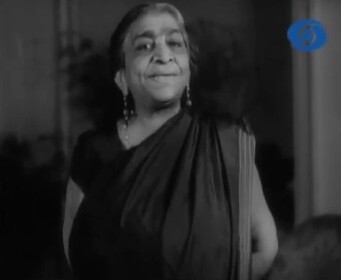
So much so that this Hindi version of the film begins with an introduction by none other than Sarojini Naidu herself. Mrs Naidu—the first time I’ve seen her on camera—addresses the camera (in English; she explains that she does so in English because she hopes this film will go further afield than the boundaries of India, because MS Subbulakshmi needs to be known far and wide). The ‘Nightingale of India’ is full of praise of MS Subbulakshmi, who stands beside her, looking rather shy and embarrassed. (There is, though not in the film, a sweet candid photo of Sarojini Naidu, with MS Subbulakshmi and Radha).
What I liked about this film:
MS Subbulakshmi.
My goodness.
If you’ve been following this blog for a while, you would have probably realized that I don’t go overboard about praising people. But MS Subbulakshmi is exceptional. Not her acting, which is average; but her singing, which is simply sublime. Meera, really, is all about the songs. Unlike most old Indian films, where the story was punctuated by occasional songs, in Meera it’s the opposite: the singing is interrupted for a scene or two here and there. A few of the songs have a chorus; one (Ghanshyam aaya re) is a duet; but the others are all MS Subbulakshmi by herself. Her voice blew me away: so pitch-perfect, so brilliantly in control, so divine.
It’s not as if the rest of the film is a complete dud. The story moves logically enough, the other characters have their own personalities, their own nuances (though I will admit that the script focusses so completely on Meerabai that the other characters get far too little screen time to allow much character development to take place). What I especially liked were the settings: Meera was actually shot on location across Chittaur, Udaipur, Vrindavan etc, and the grandeur of these Rajput palaces and forts is impressive.
What I didn’t like:
As I mentioned above, the story is fairly sparse; this is not a film you should be watching if you’re looking for a solid storyline, great acting, excellent characterization and the like. This is a film you should watch only for MS Subbulakshmi’s singing.
A copy of the film, from the Doordarshan Archives, is available on YouTube here (this is part 1; the film is divided into four parts of differing durations). While the quality of the video is fairly good, Doordarshan has pasted a running watermark across the picture, which seriously impacted the viewing experience for me.
 Dustedoff
Lovely review. I’d watched the Tamil original years ago, and like you was blown away by MS’s singing. Perhaps time for a revisit. Even if I don’t watch, I can at least listen to the songs.
LikeLiked by 1 person
Actually, listening to the songs means that you’ve pretty much covered most of the film! :-)
LikeLike
There’s MGR in a small role as TS Balaiah’s sidekick especially in the scene where the cannon is fired at the temple. Yes, you watch this film only for the songs. Apparently, Dungan modeled her face in clay and used that to test the lighting and camera angles. Then he used the best angles to enhance her looks on screen. BTW, she acted in one more film as Narada – Savitri, with Shanta Apte in the title role. This was to finance the weekly Kalki for which Sadasivam became the publisher. It’s now a digital only Tamil magazine available at kalkiweekly.com.
LikeLiked by 1 person
I had noticed that MGR was credited in IMDB, but for the life of me, I couldn’t spot him among the cast – thank you for telling me whom he played (I suppose he was so young here that I didn’t recognize him). I had read that Dungan had spent a lot of time and effort highlighting MS Subbulakshmi’s face (especially her eyes) but hadn’t known that he’d modelled her face in clay in order to experiment. That’s dedication!
LikeLike
Madhu,
Thanks a lot for this excellent review. This comes in for unqualified praise. YT link seems to be of reasonble quality. Enough inspiration to watch it.
AK
LikeLiked by 1 person
Even to my untrained ear, MS Subbulakshmi sounds sublime here. Do watch, AK, and tell me what you think.
LikeLike
Madhuji,
I recently watched the film Meera made with Hema Malini. It was actually good…..But there is a lot written about this film that you have reviewed in T.J.S George’s biography of M.S. Subbulakshmi ( M.S.Subbulakshmi – The Definitive Biography. One may not take the entire account at face value but why and how she acted in Meera is discussed at length.
Anita
LikeLike
Madhuji,
I am not sure whether my comment went into spam!?
LikeLike
This is very odd, Anitaji. I checked the spam folder, and there’s nothing there. :-( WordPress seems to be acting up again. If it’s not too much of a bother, could you please repost? I really do want to read what you had to say.
LikeLike
This was the comment that I had posted, which shows when I see the comments on your post.
I recently watched the film Meera made with Hema Malini. It was actually good…..But there is a lot written about this film that you have reviewed in T.J.S George’s biography of M.S. Subbulakshmi ( M.S.Subbulakshmi – The Definitive Biography). One may not take the entire account at face value but why and how she acted in Meera is discussed at length.
Anita
LikeLike
Oh, I thought you meant another comment. Or were you gently trying to draw my attention to the fact that I hadn’t replied to it?
I doubt if I will ever get around to reading MS Subbulakshmi’s biography, but I would certainly like to know how and why she ended up doing this role.
LikeLike
Madhuji,
It was a bit of both… WordPress behaves funnily at times.
Well, to answer your question about why and how she did this film, the film was made by her husband Sadasivam because he wanted to create a particular image of MS – one of saintliness and he wanted her to be famous in North India as well. The subject of Meera was perfect because, it would be dominated by music and MS would not have to mouth dialogues like in a normal film on a social/mythical/historical film. Anyway, her acting skills were not great. All MS had to do was be herself.
TJS George says -….It represented Sadasivam’s carefully orchestrated plan to give MS a name and a habitation beyond the south…..(pg.144)
LikeLiked by 1 person
Thank you for explaining that. Sadasivam certainly succeeded in his plan!
LikeLike