
I can safely say that Richard Burton was the first English actor I could identify (Charlie Chaplin excluded: that man’s facial hair and other distinct elements of style made him impossible to mistake for anyone else, at least as far as onscreen appearances went; even a ten-year-old me knew that was Charlie Chaplin).
But Burton. Burton I first saw in Where Eagles Dare, and though at first viewing a callow me pegged Clint Eastwood as the star worth crushing on, I eventually ended up acknowledging the impressive presence of Richard Burton as Major Smith. He who, unlike other people [who have a sixth sense] … ‘has a sixth, a seventh, and an eighth.’ Who can be suave and sleek enough to play the double agent convincingly enough, yet whistles Lorelei perfectly. And has the most brilliant repartee in his dialogues with Lt Schaeffer.
Oddly enough, though I liked Burton a lot, Where Eagles Dare remained, for a long time, the only film in which I’d seen him. It was only much later, over several decades, that I saw Cleopatra; The Taming of the Shrew; Zulu; The Longest Day; Hamlet… and I realized just what a powerhouse of a talent was Burton’s.
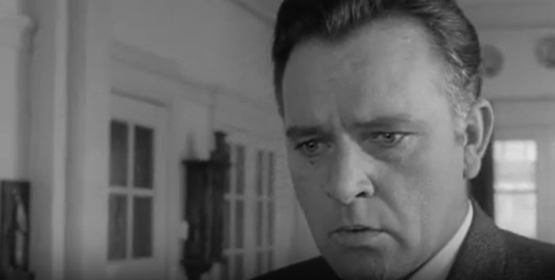
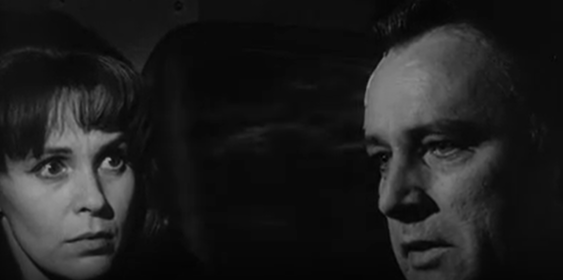
Today, in celebration of Burton’s 100th birth anniversary (he was born in the Welsh village of Pontrhydyfen on November 10, 1925), I decided I had to review a film I’d long meant to watch. Based on John Le Carré’s iconic Cold War spy thriller, The Spy Who Came in From the Cold was directed by Martin Ritt and starred Richard Burton as a far less glamorous spy than he went on to play in Where Eagles Dare.
The story begins at Checkpoint Charlie, the American/Allied border check post in Berlin, marking the border between East Germany and West. It is night, and while the area—on either side of the line that marks the border—is not really bristling with soldiers, they’re there. The air is thick with tension.
There, inside a sentry box, is Alec Leamus (Burton). He’s the station head for Berlin—basically, Britain’s top secret agent in Germany—and he’s waiting for a man named Karl Riemeck. Riemeck is Leamas’s man in East Germany. From a brief conversation (with a man who brings Leamas some coffee), it’s obvious that Leamas is worried about Riemeck; a vicious East German named Mundt may be on to him.
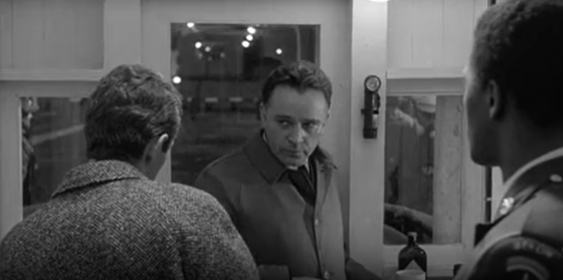
Riemeck, as it is, is late for the rendezvous; Leamas was expecting him the previous night. Now, too, Leamas is on tenterhooks, squinting into the night at the border, pacing about restlessly, going right up to the line.
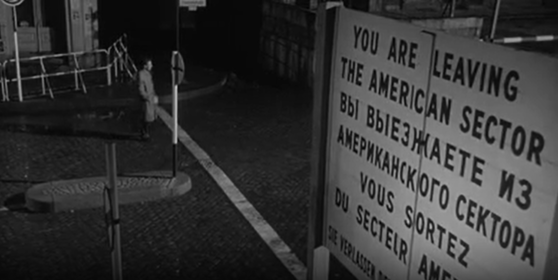
Finally, Riemeck appears across the border. His papers are examined by the East German border police; he is then allowed to climb back onto the bicycle he’s riding and go across the border. Even as he’s pedalling across, and Leamas’s face lights up with relief, a sudden siren starts blaring, shots are fired—and Reimeck drops dead from his cycle, killed in plain sight. Mundt has struck.
The scene shifts to London, where Leamas goes to meet his boss, known only as Control (Cyril Cusack). Control has a somewhat obtuse sort of conversation with Leamas, who is looking not just depressed but exhausted, too. It’s time Leamas hung up his boots, time he ‘came in from the cold’, says Control. But not yet, either; one last job is needed. Control implies that their enemies behave in brutal ways, and the times are such, the only way they have of winning is by giving up any scruples regarding behaviour.
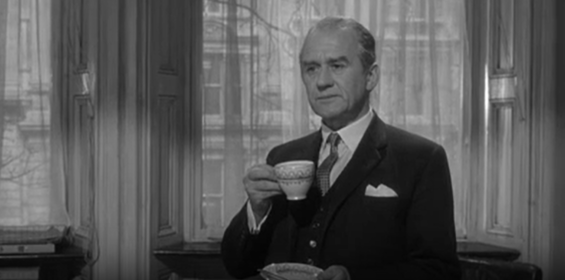
It’s all a bit ambiguous, and we never see the end of that ambiguity—or of the conversation.
Instead, the next we see, Leamas goes to an employment exchange, where he’s able to get a job as a library assistant at a small library which specializes in books of parapsychology. Leamas soon makes friends with Nancy ‘Nan’ Perry (Claire Bloom), who also assists at the library.
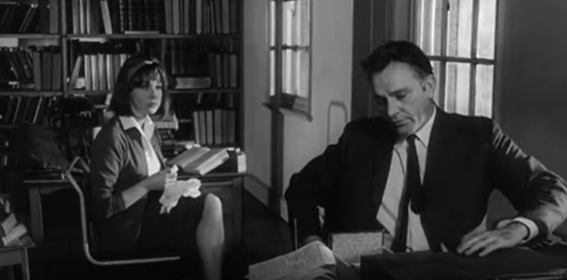
Leamas, it seems, has really fallen on hard times. When Nan offers him one of her sandwiches, he refuses. To his question—are there any pubs nearby?—Nan replies that yes, there are; but they won’t serve food, and Leamas says that’s fine with him. He seems to be perfectly happy just drinking, not eating.
But he does eat, after all. And to pick up supplies, he stops by at a grocer (Bernard Lee) who knows him. This man is reluctant to give Leamas credit, but Leamas assures him that he now has a job.
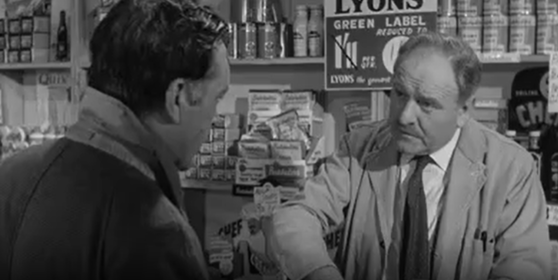
Is Leamas, looking down-at-heel, and to all appearances drowning his frustration in drink, actually on the road to recovery?
Just possibly. And for that Nan might be responsible, because she is warm and generous. She invites Leamas over for dinner, makes stew for him, offers him wine and friendship. While at her home, Leamas learns that Nan is a member of the Communist Party of Britain. She’s very earnest about their work to push for a world without nuclear weapons, and Leamas shakes his head, laughing cynically [this is the world-weary reaction I sometimes see from those who regard modern-day activists in a similar light].
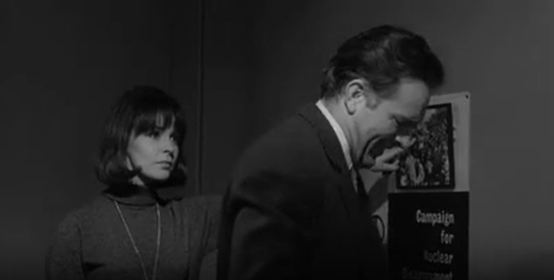
The friendship between Leamas and Nan quickly blossoms into a full-fledged romance…
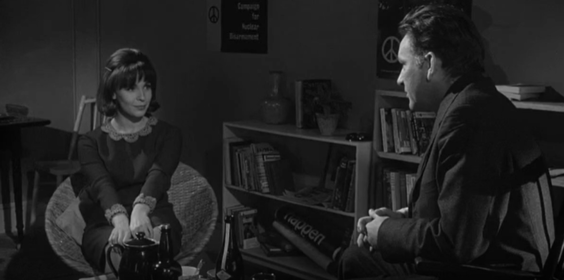
… but before that, something happens that turns everything topsy-turvy. On a visit to the grocer’s, an obviously tipsy (and belligerent) Leamas overhears an Italian emigrant asking the grocer for credit. The man extends credit to her readily, and Leamas blows his top: the grocer will give credit to an Italian, but kicked up such a fuss about giving credit to him, an Irishman! Leamas bashes up the stunned grocer, as a result of which he is arrested and sent to prison to serve a brief sentence.
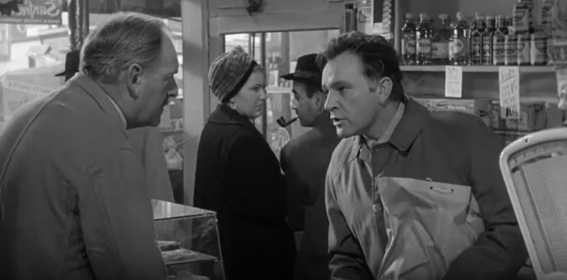
When Leamas emerges from prison, he is met by a stranger (Michael Hordern), who introduces himself as Ashe, and explains that he works for a not-for-profit organization which helps rehabilitate ex-convicts. Keeping in mind Leamas’s qualifications—he is fluent in German, and has been a businessman in Berlin for several years—the organization may be able to get Leamas a job working for some people who need information on Germany. On the economy, the society, business; even tourism: all sorts of information.
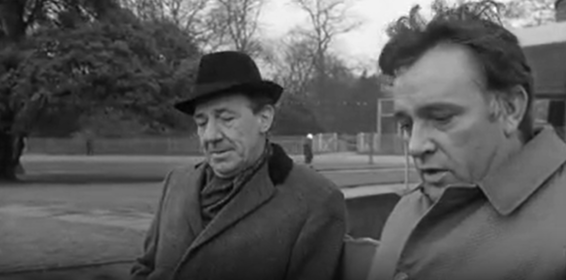
Leamas shows a cautious sort of interest in what he’s being offered, and finally agrees to meet someone Ashe suggests. A friend of Ashe’s named Dick Carlton, who will arrange for Leamas to meet the people to whom he will have to offload the information that’s needed. Ghostwriters, so to say.
His meeting with Ashe over, Leamas takes a taxi to Chelsea, where he goes to a house and is let in by a man named Smiley (Rupert Davies). This is Smiley’s house, and Smiley leads Leamas in—to a room where someone is waiting: Control.
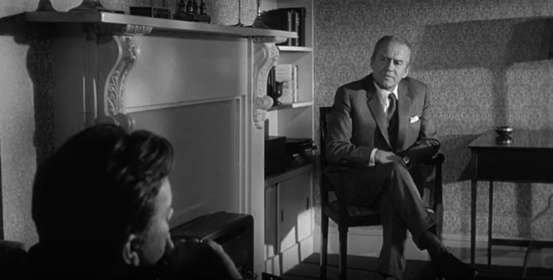
This has all been carefully planned. Leamas’s drinking, Leamas’s embitterment and anger, his frustration at having been called back from Berlin: this has been all a farce, calculated to deceive the East Germans into thinking that Leamas is ready to defect. Because that is what Control wants Leamas to do: go to East Germany, and there toconvince them that Mundt is actually a British secret agent. So that the East Germans will kill Mundt.
And the man Control has in mind for Leamas to convince is Fiedler (Oskar Werner). Fiedler is a Jew. Mundt was a Nazi. They hate each other; Fiedler will pounce on any evidence that Mundt is a traitor.
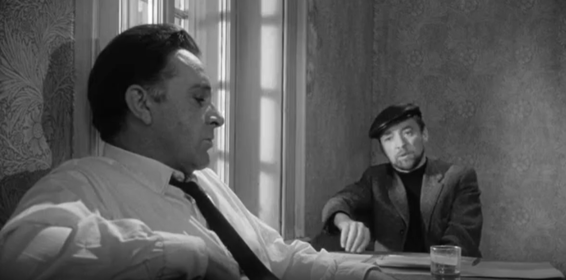
But how far can Leamas go with this? It is dangerous business, extremely dangerous, because it will mean Leamas going right into the heart of enemy territory. Will he succeed? And what, after all, is actually happening?
At the beginning of this blog post, I wrote of my introduction to Richard Burton: as Major John Smith in Where Eagles Dare. When I began watching The Spy Who Came in From the Cold, I had not the faintest clue that the character Burton plays here would be, in so many ways, similar to Smith. Not exactly, of course; Leamas is a more harried man, a more cynical, serious-minded man (and it comes out, all of it, in a memorable soliloquy near the end). It’s hard to imagine Leamas whistling Lorelei, or romancing a Bavarian barmaid; but the ability to think on one’s feet, to be able to ‘keep one’s head while all about are losing theirs’, to be utterly and completely convincing: that is true of both Smith and Leamas.
What I liked about this film:
The twists and turns, the tight plotting. I must confess I haven’t read John Le Carré’s novel, but the screenplay (by Paul Dehn and Guy Trosper) is excellent: taut and suspenseful. There were moments when I was lulled into a sense of complacency—I knew where this was going, I could guess it—only to sit up with a jerk because it didn’t play out anything like the way I’d thought it would.
Also, while on the topic of the story (and of the comparison between Smith and Leamas): the grimness that emerges. This isn’t the high-adrenaline adventure that is Where Eagles Dare, where you know that no matter how many Nazis Smith comes up against, no matter if he’s hurt, it will all come right at the end. This is hardcore, it’s serious, and that soliloquy, where Leamas says it like it is, is profound. Espionage isn’t a game. (Or is it, because the people who are on the chessboard are merely pawns?)
And, Richard Burton. There are others, too, whose acting is excellent here, especially Oskar Werner. But Burton. Oh, what acting. The weariness, the cynicism, yet the tenderness when he’s with Nan, the look in his face at the end… his eyes say it all. What a brilliant actor.
The Spy Who Came in From the Cold is available to rent on Amazon Prime Video, here.
 Dustedoff
I have heard so much about this movie and I still haven’t seen it. In Austria it is famous particularly for Oskar Werner’s performance. But I am sure Burton was good in it too. Many a times one has a feeling Burton is playing himself, which can be very deceiving.
Am very busy nowadays and thus no time for film-watching.
Thanks for the review, Madhu
LikeLiked by 1 person
Oskar Werner was very good in this! I’ve seen Oskar Werner before (in Fahrenheit 451), and liked him in that too, but he’s especially good here.
I hope the work eases up a bit soon! :-)
LikeLike
One of Burton’s best films. He was superb in Who’s Afraid of Virginia Woolf too but it was Elizabeth Taylor’s film. He is wonderful as the spy and, as you said, his eyes have the cynicism and weariness for the role. The only quibble I have is that the spy in the novel was supposed to be very nondescript but Burton is handsome. I would have preferred someone like Gary Oldman.
LikeLiked by 1 person
I have to admit I’ve never got around to watching Who’s Afraid of Virginia Woolf, though I have heard that that – as you mention too – was Elizabeth Taylor’s film. I think that was pretty much the case with Cleopatra too. This one is more squarely his. I hadn’t realized Leamas is supposed to be nondescript – Burton definitely isn’t! (I was surprised, though, that the synopsis of the film – on Wikipedia, I think – referred to him as ‘ageing’, which was odd. Burton looks middle-aged, not ‘ageing’ at all).
LikeLike
I’ve seen Richard Buton here and there. I remember how good he looked in Amy Cousin Rachel. I really must get down to reading this book and watching the movie based on it, I love doing that.
LikeLiked by 1 person
I haven’t seen My Cousin Rachel (though I’ve heard about it), and now you have made me curious! Adding it to my list. :-)
LikeLiked by 1 person