
This is a film I first heard about many years ago, when Memsaab reviewed it on her blog. It’s been in the back of my mind to watch it sometime, but it kept getting put on the back burner. Then, some months back, when I was watching Baaz (1953) as part of my tribute on Guru Dutt’s 100th birth anniversary, I was reminded of Amar Jyoti. If Geeta Bali’s woman pirate in Baaz seemed a surprisingly progressive character for 1953, Durga Khote’s pirate queen Saudamini, playing the lead in V Shantaram’s Amar Jyoti in 1936, was even more progressive.

And not just because of the seventeen years that separate these two characters and these two films, because to me Saudamini is perhaps even more of a feminist icon than Nisha is. Like Nisha, Saudamini too has become a pirate in order to wreak vengeance; but a patriotic fervour and a desire to expel a tyrannical colonist is not part of Saudamini’s motivation. Her bitterness and sense of vengeance impart to her character a hardness that borders on the cruel: where Nisha has to be egged on to mete out punishment to her enemies, Saudamini has to be reined in, urged to be merciful. Nisha has a romance; Saudamini—though she is certainly capable of being loving—that emotion does not necessarily translate into romantic love.
But I am getting ahead of myself. Let me circle back to the beginning of this film. On the high seas, Saudamini commands her pirate vessel, with a large band of pirates at her beck and call. Two people here are special to Saudamini: one is a man named Shekhar (K Narayan Kale); the other is Shekhar’s daughter (I think; it’s not very clear), Rekha (Vasanti). Saudamini is obviously grooming Rekha to be a pirate queen like her, and the precocious child is just as obviously eager to take on the mantle.
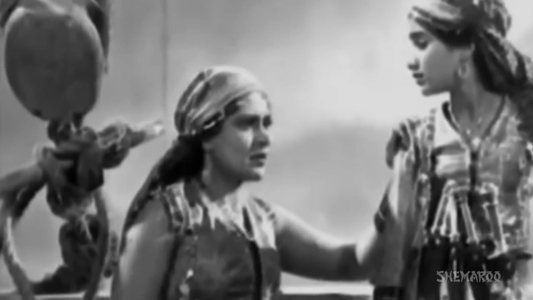
Shekhar, on the other hand, is more in the position of the voice of conscience for Saudamini. He tries to temper her anger; when she is enraged and baying for the blood of her enemies, it is Shekhar who talks to Saudamini and soothes her, makes her see reason.
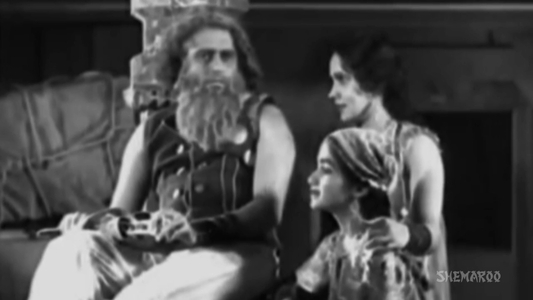
Shortly after the story begins, Saudamini’s ship comes up against a ship of Swarndwipa (Sri Lanka, I’m guessing, though since there are no other signs in support of this, it may just be a fictitious land with the same name). Saudamini flies into a rage at the sight of the ship: the queen of Swarndwipa was the one who, many years ago, wrecked Saudamini and separated her from her (Saudamini’s) little son. Now Saudamini will show her.
Saudamini’s pirates capture the ship and take everybody on board captive. As the captured prisoners are being herded onto the pirate ship, Saudamini overhears one of them ask a companion a muffled question about the princess who is also on board. Saudamini sends her men to search for the princess—the daughter of Saudamini’s arch-enemy, the queen of Swarndwipa—but it’s a fruitless search. The princess is nowhere to be found.
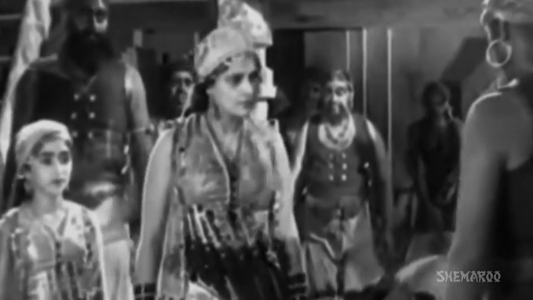
Saudamini, however, discovers another old enemy on board: Durjaya (Chandramohan), an important minister at the court of Swarndwipa is there too. Saudamini orders her men to cripple Durjaya in one leg (from what we see later, they seem to have amputated his leg, but this, thankfully, is never shown). The other leg is chained, so that a frustrated and furious Durjaya cannot even hope to escape.
Meanwhile, Saudamini’s men have looted the captive ship and transported all its chests full of treasure onto Saudamini’s own ship. Saudamini gives orders for the Swarndwipa ship to be burnt, and watches gleefully as the ship, wrapped in flames, sinks.

Saudamini and her pirates go back to shore, where all the captured treasure is carefully stored in their hideout, a very large and maze-like warren of what looks like limestone caves. Saudamini had taken captive some people who had been on board the Swarndwipa ship; she decrees that the men will join her band of pirates. As for the women, Saudamini decides to recruit them to carry on her crusade of doing away with the tyranny of people like the Swarndwipa queen. For this purpose, the women will be sent into nearby villages to spread the word.
Durjaya is imprisoned within the limestone caves, his leg chained to a huge rock, though since the chain isn’t very short, he is able to move around a bit. This is how it happens that, in the night, he sees one of the captured treasure chests open, its lid carefully pushed up and back… and a young woman climbs out. This is the princess of Swarndwipa, Nandini (Shanta Apte).
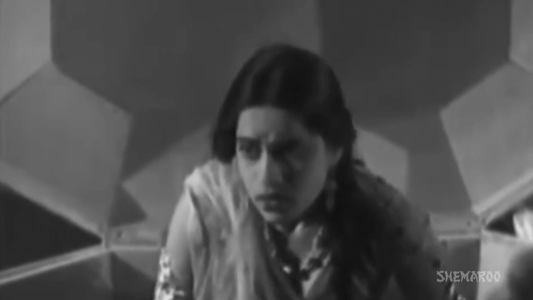
It doesn’t take Durjaya, canny as he is, long to figure out how to play this. He cautions Nandini: Saudamini is extremely cruel and will have her (Nandini) killed if she discovers that the princess has survived. It’s best that Nandini stay hidden in the chest and emerge only when Durjaya has confirmed that the coast is clear.
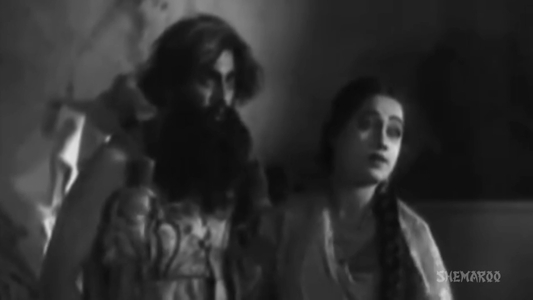
It seems nobody from Saudamini’s band of pirates comes by here (or perhaps they are complacent, thinking that Durjaya cannot possibly escape?). Soon Nandini is able to wander around the limestone cave, or sit there without fear. Durjaya brings her food—he gives her most of his portion of the food that Saudamini’s men hand out—but makes it clear that he is giving her from his share. He is going hungry for her sake.
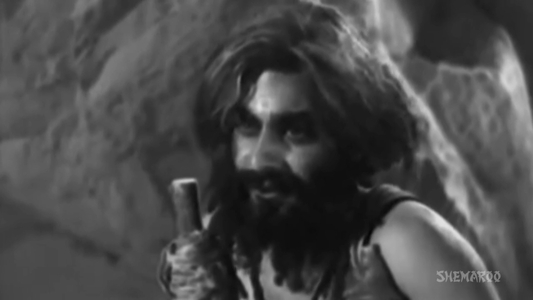
Nandini ought to have caught the undercurrents here, but perhaps this (spoilt?) princess cannot see beyond her own needs. She doesn’t realize that Durjaya has his eye on her: not, I am sure, an eye of love, but definitely an eye that sees the wealth and the power that can come from a possible alliance with a princess.
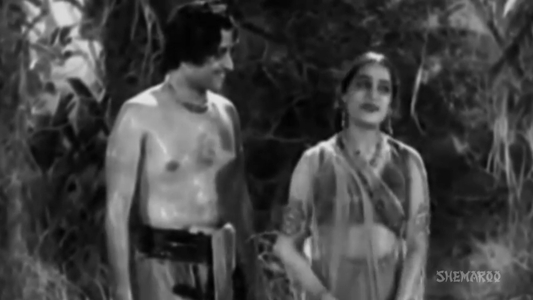
He is therefore eager to please. When Nandini complains of boredom, he allows her to step out, through an aperture in the cave wall, into the jungle beyond. Nandini goes out and there, in the sylvan surrounds of the forest, happens to make the acquaintance of a shepherd named Sudhir (B Nandrekar).
It doesn’t take long for Sudhir and Nandini to fall in love. In a short while, they’re singing romantic songs and she’s slipping out of the caves everyday to meet him.
But. What’s going to happen when:
- Durjaya discovers that Nandini, on whom he has bestowed so many favours (as he sees it) has fallen in love with another;
- Saudamini realizes that Nandini is alive, not long-dead in that burnt, sunk ship;
- And Sudhir (who is all alone in the world, having been separated from his mother twelve years earlier) discovers that Nandini is a princess.
Not quite literally all hell breaking loose, but close enough.
I tend to approach very old Hindi films with tempered expectations. The technical aspects of film-making weren’t that evolved, acting was often (especially in the case of extras and minor actors) quite theatrical, and there were often elements of the plot that were fairly regressive. In the case of Amar Jyoti, the fact that this film was directed by none other than V Shantaram gave me hope, and I am glad to say that he didn’t disappoint.
What I liked about this film:
The overall story is fairly interesting: a good blend of adventure, angst, romance, and more. What appealed to me especially was the emphasis on strong female characters: Saudamini, Nandini, even little Rekha—each have a will of their own, and aren’t afraid of asserting themselves, of showing resourcefulness, of even taking what might be an unpopular decision, if that is what it means to stay true to themselves and what they believe in.
In this regard, Saudamini needs special mention. Not only is she a powerful character, she is also a singularly nuanced character. She is a pirate, and not above looting and pillage—but she is also against the tyranny of people like the queen of Swarndwipa. She can be cruel (the way she calmly has Durjaya’s leg broken, and the Swarndwipa ship set aflame), but deep within her—deliberately suppressed, perhaps, to avoid causing herself further pain?—is a conscience, a heart capable of love, a sense of belonging. This same ‘hard-hearted Saudamini’ is the one who puts herself in serious danger trying to rescue Rekha, for instance, when Rekha is taken captive by the Swarndwipa soldiers.
And how well Durga Khote plays Saudamini. All the shades of this interesting character come vividly through in this portrayal (which, by the way, is the youngest I’ve seen Durga Khote): so strong, yet also so vulnerable, so fragile. Wonderful.
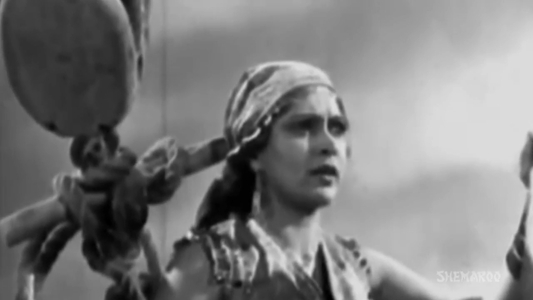
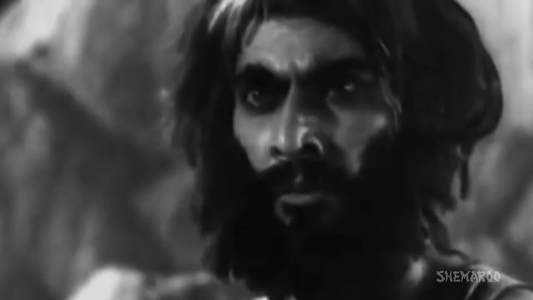
Another person whose acting stands out is Chandramohan. I’ve seen him before in a couple of films (Roti, Humayun) and have always been impressed by his acting. Here, too, as Durjaya, Chandramohan is mesmerizing. Seeing him, I couldn’t help but wonder what his career might have been like if he hadn’t died so young (just 42 when he died in 1949): would he have been as familiar to later generations of film-goers as acclaimed thespians like Dilip Kumar and Sanjeev Kumar?
What I didn’t like:
The acting of several of the cast besides Durga Khote and Chandramohan. It’s not so much that the facial expressions are off; it’s the diction. Most of the actors, including Shanta Apte (in some scenes) and B Nandrekar, would be fine if this was a silent film; but because it isn’t, the flat and often emotionless voices really detract from the effectiveness of their acting.
Other than that, the one thing that I felt the lack of was Saudamini’s back story. A brief flashback, or at least a longer explanation from her was needed to understand what exactly had happened. Why had the queen of Swarnadwipa separated Saudamini from her little son? Did Saudamini have a husband, and if so, what happened to him? How did Saudamini make the journey from married woman-and-mother to pirate queen? How did her son get to where he is now?
Questions which, if answered, could have helped me appreciate Saudamini more.
Still, despite that, a film I enjoyed. The songs, by the way (composed by Master Krishnarao, lyrics by Pandit Narottam Vyas) are very pleasant, and one—repeated throughout the film, in snatches (it’s the signature song of the pirates) is Karte rehna masmaar, which I found quite catchy.
Amar Jyoti is available for viewing on YouTube. The copy I watched is this one, on the Shemaroo channel.
 Dustedoff
Madhooo… it’s been ten long years(Gosh! How time flies!) since I reviewed Amar Jyoti here. And you bookmarked it to watch then as well. Tom has a cleaned up print of this film on his channel.
And I’m so glad that you liked this film just as much as I did. Like I said earlier on your review of Shiraz, silent films are not my usual cup of tea. Neither are films from the 30s and early 40s – the acting always tended to be very theatrical. But this film really opened my eyes to how a well-told story can overcome its theatricality and touch you deeply.
Thank you for this review. It helped bring this film back to mind.
LikeLiked by 1 person
Agh! My memory is the pits. :-( I’d forgotten you’d reviewed it too, though of course when you mention it, now I remember.
You’re right, the often too-theatrical acting of 30s and 40s films always tends to put me off too. But this one (much more than another 1936 Shantaram film, Dr Kotnis ki Amar Kahaani) is really very well-made. And of course the acting of Durga Khote and Chandramohan is actually ahead of the times – both of them are excellent.
LikeLike
The review made a good reading, dear Madhu. Thank you.
It makes me want to watch it. Durga Khote also mentions Amar Jyoti in her autobiography. Interestingly enough, although she desribes the shooting of her other Prabhat films, she doesn’t mention anything at all about the shooting. She does describe the success of the film and praises her co-stars but hardly anything about V. Shataram’s direction.
LikeLike
Thank you for reading, Harvey. I am glad you enjoyed this.
I do wish Durga Khote had written about the making of this film. The shipboard scenes, in particular, were pretty realistic, so I’d have liked to know how Shantaram did that (was it just a very well-made set? Or a proper – if small scale – ship)? And more.
LikeLike