
This needs some explaining. I don’t mean songs that extol the virtues of doing housework (as someone who does more housework than the average middle class Indian woman, I cannot imagine ever extolling the virtues or joys of housework—it’s possibly the most thankless, relentless and utterly monotonous job out there). But the monotony of housework, the fact that you can get nearly all of it done without really applying your mind or having to concentrate, means that you are free to do something else. Especially something musical.
My mother-in-law invariably turns on the radio and listens to songs as she goes about her work. But my mother, from as far back as I can remember, used to sing. As she went about dusting and the cooking and whatnot, I’d hear her singing. She still has a wonderful voice, and back in her heyday, it was stunning—and her repertoire was amazing, all the way from hymns to hits by Elvis and Jim Reeves (and some old Hindi songs: as lullabies, she sang O mere pyaar aaja to my sister, and Yehi woh jagah hai to me). I too, when I’m doing housework—especially when I’m cooking—sometimes sing. All sorts of songs.
So, too, do a fair number of people onscreen. Here, then, are ten songs that feature people singing as they go about doing housework. Besides my usual criterion, about the film in question being a pre-70s one that I’ve seen—I’ve imposed one more rule: that the person should be doing some work in the course of the song (this is why Kismat ki hawa kabhi naram doesn’t feature on my list; while Bhagwan’s character is in a kitchen, surrounded by pots and pans and even wearing a chef’s cap, he never uses any of those for anything remotely connected to housework).
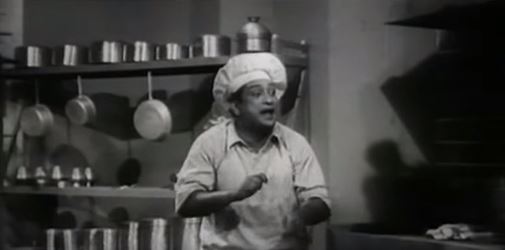
Here we go then, in no particular order.
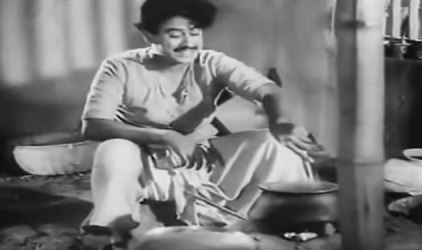
1. Ek roz hamaari bhi daal galegi (Bandi, 1957): To begin, one of my favourite comic songs, sung by (and picturized on) the inimitable Kishore Kumar. As the younger brother of an MA-BA Pass (whose degrees aren’t doing him much good when it comes to employment), Kishore’s character finds himself obliged to do all the housework for himself and his brother. And do it on a terribly tight budget, what’s more. Do it he does, but he consoles himself: someday they too will rise in this world. His brother will do well, our lad will go about dressed in his finery, doing git-pit in English and with cannon booming salutes for him. This being Kishore onscreen, he doesn’t just sound funny, he looks hilarious too, as he prances about, stirring things, handing out roti and nimboo ka achar to neighbourhood children, brandishing a broom, and more.
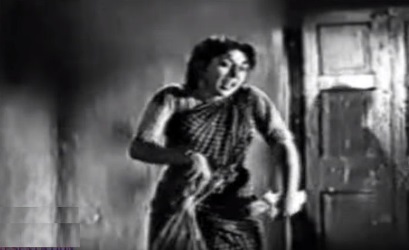
2. Kaana-kubdaa langda-loola (Ek Gaon ki Kahaani, 1957): Mala Sinha does what I’m certain is a pretty bad job of cleaning up a room (a room, too, which seems horrifically dirty, with reams of waste paper, an old shoe, and tons of dust lying all around). She goes about picking up stuff, throwing it about with gay abandon, and carelessly wielding a broom which throws up dust instead of actually sweeping it away.
And she sings. She sings of the deaf, lame, mute old fogey of a doctor who’s coming to the village and for whom she’s obliged to get this room ready. She sings of his predecessors, each of whom seems to have been more demanding and useless than the last. This one will be no better than the rest, she’s sure: he won’t dispense any medicines; instead, ‘rog lagaa jaayega’ (literally, ‘he will pass on a disease’—except that that also is a lyrical filmi way of saying that he’ll make one pine away out of love). Singularly appropriate, since the expected doctor, a young and handsome Talat Mahmood, has just arrived and is making his way upstairs…
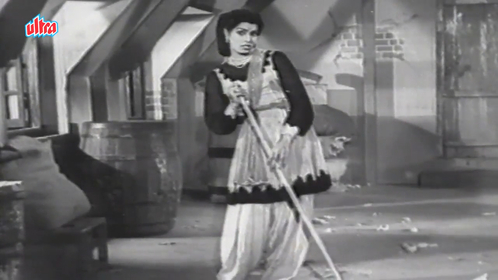
3. Lipstick lagaanewaale (Shrimatiji, 1952): A lot of the people doing housework tend to sing humorous songs (is that a way of keeping up one’s spirits? Housework is horribly dispiriting). Here’s another of the lot, and this time, there’s not just one singer, but a bevy of them. Shyama and her three co-actresses play friends who share a flat and are so broke that they don’t even have money to pay the rent.
Naturally, this means they can’t afford domestic help, and all the housework—the cooking, the cleaning, everything—has to be done by these beauties. As they go about their work, they crib cheerfully about how the ‘dil ko jalaanewaale’ are now reduced to jalaaoing choolhas and the teer chalaanewaale are now chalaaoing chamchas. Hilarious song from a delightful film. They don’t really get much work done, but yes, there is some form of cooking going on over at the choolha, and a couple of them do a perfunctory job of sweeping a few inches of floor.
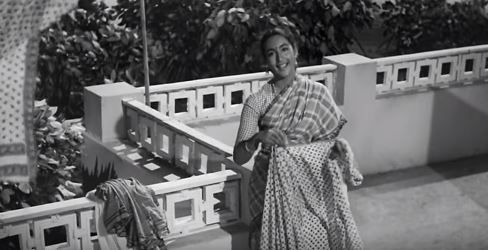
4. Bachpan ke din bhi kya din thhe (Sujata, 1959): I find this song ironic, in a way. Because the person who sings most of this song (Shashikala’s character) has a life, even as an adult, that is probably about as carefree and unburdened as what she enjoyed when a child. So she sits at the piano and plays, reminiscing about her childhood, while her foster sister (Nutan, as the eponymous Sujata), on the terrace gathering the laundry from the clotheslines, sings along.
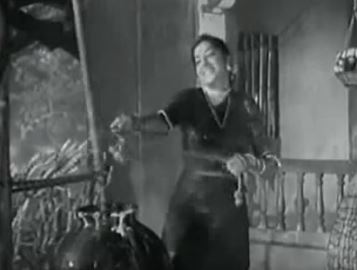
5. Rimijhimi barse paani (Pardesi, 1957): A wonderful monsoon song from the classic Indo-Russian joint venture starring Oleg Strizhenov as the traveller Afanasy Nikitin, along with Nargis, Balraj Sahni, and Padmini. Nargis’s character starts off doing one of those household chores that require stepping out of the house: going to the village well to draw water. When she’s back, there’s more work to be done. Weaving thread on a charkha, churning butter… her singing is interspersed with the singing of other villagers, all of them hard at work (though most of them—the potters, the crowds of women pounding something in giant mortars, etc—are almost certainly doing professional work, not housework). But Nargis’s character is at home and doing her own work, and (surprisingly for someone onscreen), pretty demanding physical work too—that butter-churning and the water-hauling requires a good bit of strength.
6. Aa thha jab janam liya thha (Biwi aur Makaan, 1966): More housework in the ‘physically demanding labour’ category: Keshto Mukherjee, in drag, washes clothes (and pretty vigorously too), before joining fellow sufferer and friend, Biswajeet, in a song that laments the necessity for these two men to pretend to be women. And, since they’re men pretending to be women, the amount of housework they’re saddled with is obviously not enough to make them stick to the job. Because once the clothes have been scrubbed and rinsed and hung out to dry, they devote themselves totally to the song—and to being cajoled and coaxed and even bullied a bit by friends who need them to stay in drag. Delightful song, and I maintain that Keshto Mukherjee probably makes for the most convincing man in drag I’ve ever seen.
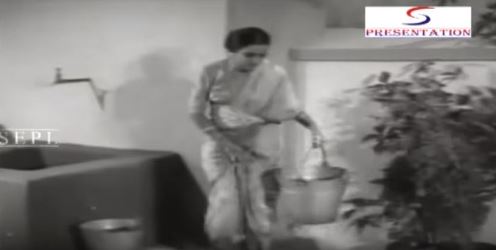
7. Ghar ki raani hoon ji (Abhimaan, 1957): Abhimaan was a film about two sisters (played by Ameeta and Chand Usmani), both BA Pass, who get married and have to make different adjustments to married life and housework. The more homebound Kiran (Chand Usmani), after some initial hiccups, shows off just how proficient she is at housework—even how much she enjoys it. She mops the floor, she makes a rangoli; she hangs up laundry. She cooks and cleans and puts up a photograph of her mother-in-law. She really does a lot of work.
… and, personally, she sickens me. Seriously, this glorification of drudgery gets my goat. But it ticks the main criteria for this list, at any rate.
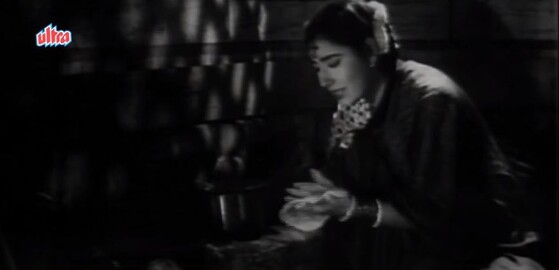
8. Jaane kaahe jiya mora dole (Godaan, 1963): Back to the village, and to women doing housework. While the film didn’t do total justice to Munshi Premchand’s brilliant novel (Godaan was too wide in scope, too broad in its spectrum, for a film to capture every nuance of it), it actually was a far better film than I had thought it would be. For me, it’s one of those rare films where I’ve actually liked Raj Kumar.
But, on to this song. Shubha Khote, as the spoilt and headstrong girl who falls in love with Mehmood’s character, sings a song (not that she really does much work, other than gathering a few flowers) and two other women—sitting nearby and actually doing quite a bit of work—join in. These two keep working all through the song, beating grain, threshing it, picking out bits of chaff. A good amount of work accomplished in the course of one song.
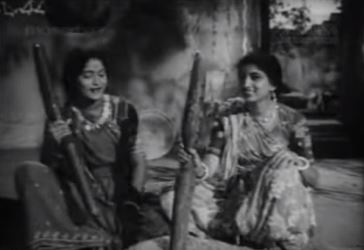
9. Kaune rang mungwa (Heera Moti, 1959): Shubha Khote again, and again in a film based on a story by Munshi Premchand. Unlike the tragic Godaan, Heera Moti was about two bullocks, and though it had its moments of anguish and despair, eventually everything worked out well for Heera and Moti, the two bullocks dearer than children to the small-time farmer played by Balraj Sahni, his wife (Nirupa Roy) and his sister (Shubha Khote).
Kaune rang mungwa is one of those rare songs where one woman is consistently working (and hard, too: look at the speed with which Nirupa Roy turns that chakki). Shubha Khote’s character gives feed to the bullocks and waters them, then prances aimlessly around for a while, before finally joining her bhabhi at the mill. And, privileged man that Balraj Sahni’s character is, he sits and smokes his hookah while the women work.
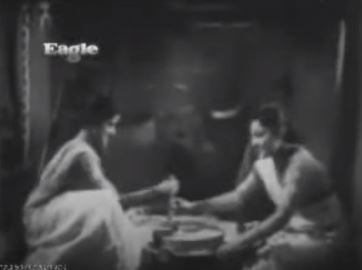
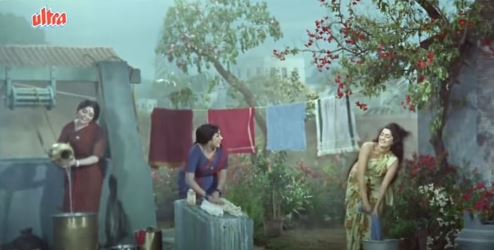
10. Humre aangaan bagiya bagiya mein do panchhi (Teen Bahuraniyaan, 1968): Sowkar Janki, Jayanthi and Vaishali play three women married to three brothers, all of them living in a joint family presided over by the patriarch played by Prithviraj Kapoor. In this song, at the beginning of the film, the ‘idyllic’ household is introduced: a household where the three daughters-in-law spend most of their day neck-deep in housework. They water the plants, they draw water from the well, do the laundry, cook food and serve their brood of children… they get a few moments in between to dance, but otherwise, all the singing happens while they’re doing housework.
Which other songs can you add to the list? Please share!
 Dustedoff