
My go-to expert for opinions on old Malayalam and Tamil cinema is Anu. Some years back, I’d been complaining to Anu about how so few old films from the South are available with English subtitles, but then I found a bunch of them on Jio HotStar. Anu asked which ones I’d found, and then was kind enough to give me her opinion on the films. About Ashwamedham, she wrote: “Ashwamedham deals with the social attitudes towards leprosy patients. Fabulous performances, especially from Sathyan. If you want to see the then-reigning triad of Malayalam actors from that age – Sathyan, Prem Nazir and Madhu – this is the film to watch.”
That sounded good, so why not watch (finally!)?
The film begins in the home of Keshavan (PJ Antony), whose wife Laxmi (Santha Devi) is expecting her tenth child. She’s quite sick of the whole thing and had been wanting to get surgery done to prevent her getting pregnant again, but Keshavan had refused. Now she’s pregnant again, and very upset about it. Already they have lost three children; already they have four daughters whom they need to marry off… the strain, both financial as well as emotional (not to mention physical, on Laxmi) is tremendous.
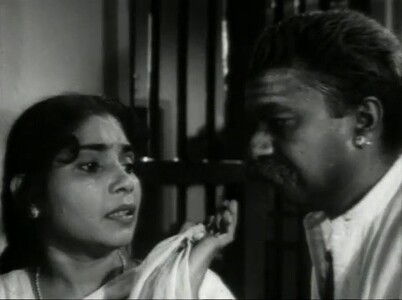
Keshavan and Laxmi’s elder son Sadanandan lives in Bombay, and most of his earnings go in saving up to pay for his sisters’ weddings. The four girls, along with their younger brother Sathyan (?) live with their parents.
Of the daughters, the eldest, Sarojam (Sheela), is in love with Mohanan ‘Mohan’ (Prem Nazir). Their romance is hardly a hidden thing: he visits her frequently, her sisters and parents know about them. But Mohan’s parents aren’t happy about the match and have forbidden it. Mohan, however, is adamant: he will marry Sarojam, and none other.
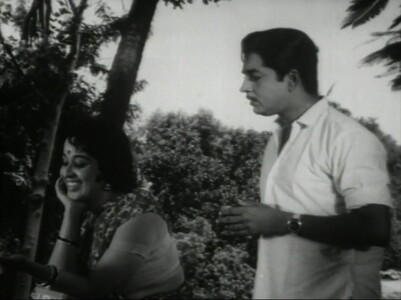
To the extent that he even has wedding invitation cards printed, and is writing them out when his father (GK Pillai) stops him. Mohan’s commitment and his devotion for Sarojam has melted even his heart; he will no longer come in the way of their match.
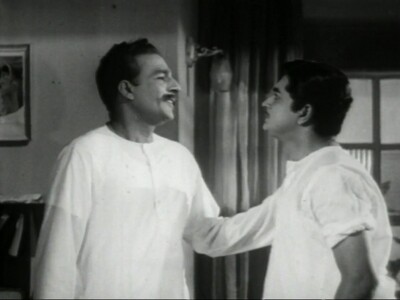
Mohan’s mother (TR Omana) is relieved, and the family goes to Keshavan’s home to announce the happy news.
All is bliss and warmth. Laxmi is very relieved that Sarojam will be getting married (one daughter married, three to go!), and Mohan’s mother is quite approving of Sarojam. Such a pretty girl; she will not let her do any housework. Sarojam, all shy smiles, is looking forward to finally being married to her sweetheart.
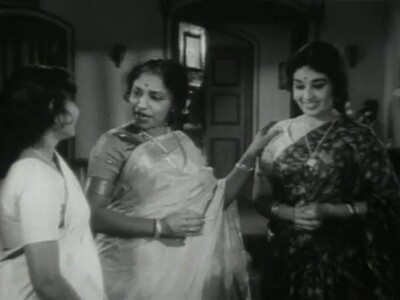
Sarojam’s elder brother Sadanandan is informed; he writes back to congratulate his little sister, and tells her that when he comes, he will bring along her wedding sari.
But fate has something else in store for Sarojam. For soon after, a ‘health visitor’ (as he describes himself) named Krishnanandan (Bahadoor) turns up at their home. Krishnanandan is part of a survey effort named SET, and part of his job is to go around surveying the households in this area for signs of leprosy among the inhabitants. Krishnanandan refers to his notes and asks who Sarojam is. You? He asks. You had gone to the hospital to be examined? You had a smear test done? And here is the report: Sarojam has leprosy.
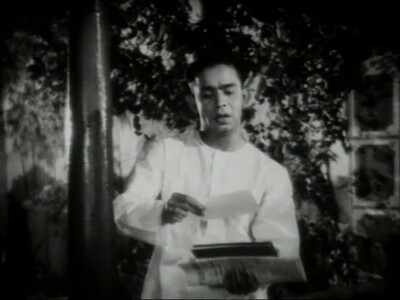
Within the space of a few minutes, Sarojam’s world falls apart. When her younger sister Sarala (Indira Thampi) tries to come close, she pushes her away, crying all the while. Eventually unable to stay still any more, Sarojam runs out of the house and is walking along the road when she comes across a man, badly afflicted with leprosy, who’s begging as he goes, singing and asking for alms.
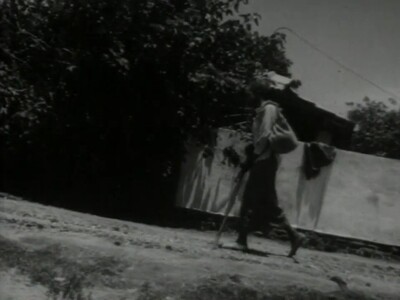
Sarojam’s anguish is heightened by her encounter with the leprous beggar. But the beggar’s presence sparks off other, related, problems. The local doctor, Dr Thomas (Sathyan) calls for him to be caught and taken back to the sanatorium from which he’s escaped. And the local witch doctor or manthravaadi (Adoor Bhasi) sees red: the doctor is Christian; he doesn’t see the importance of the spells and incantations the manthravaadi practises to heal people. Thomas agrees. Yes, he has no truck with superstition.
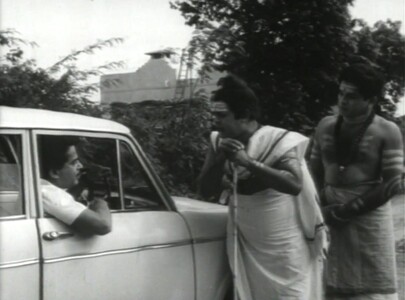
Both the doctor and the manthravaadi soon come to play an important part in Sarojam’s life. A distraught Sarojam goes to Dr Thomas, and he, having examined her, confirms that yes, indeed she has leprosy. But he reassures her; there is a new medicine she can be given, and she should be well soon.
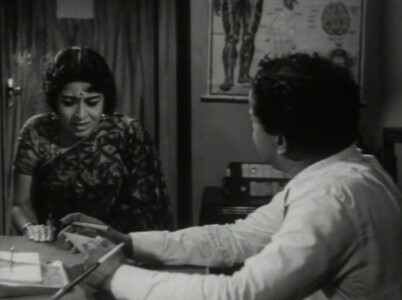
As it happens, Mohan is a friend of Dr Thomas’s, and has given an invitation card for the wedding to the doctor. Sarojam notices it on the doctor’s desk, grows agitated, and tells him not to tell Mohan of her condition. But Dr Thomas reminds her gently that if she goes ahead with the wedding, she could end up passing on the leprosy to Mohan.
In the midst of this conversation, who should turn up but Mohan? He is ushered in by Dr Thomas’s wife, the flighty socialite Galy (Sukumari), who is impatient with her husband’s single-minded devotion to his research into leprosy. Mohan, on learning of Sarojam’s condition, is of course shocked. And he immediately agrees that yes, the wedding must be put off until she is well.
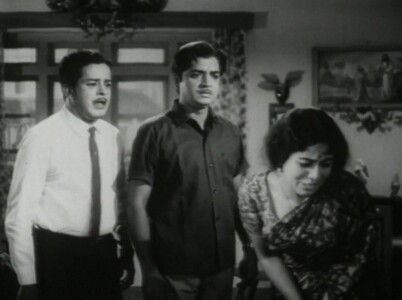
The discovery of Sarojam’s disease has many repercussions. She comes to live in the leprosy patients’ colony, which is fenced in with barbed wire, and the gloomy despair of which is enough to drive Sarojam to despair too. Meanwhile, her brother Sadanandan (Madhu) has arrived in town, all unaware of this latest development. When he discovers what has happened, Sadanandan comes to the colony, bringing Sarojam’s wedding sari with him…
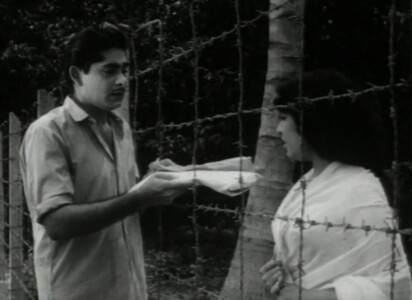
And Sarojam tearfully returns it to him. He should give it to Sarala, she says; Sarala likes wearing saris. Just as tearfully, Sadanandan goes back home, but only after leaving the sari with Sarojam.
What next? Is there any hope for Sarojam? Can she get cured, can she find happiness again, back in a world outside the leprosy patients’ colony? Can she marry Mohan and can things go back to what they were?
Directed by A Vincent, Ashwamedham was based on a play written by Thoppil Bhasi (who, as far as I can tell, wrote the screenplay for the film as well). It’s a film which doesn’t believe in subtlety when it comes to its message, but even then, it works.
What I liked about this film:
The many ways in which a prejudice against leprosy (or, I suppose, another lethal, highly visible, disease?) works. Even while Dr Thomas is going blue in the face trying to convince people that leprosy is curable, that science has medicines to treat it—nobody’s listening. The leprosy patients, caged in their colony (and well and truly caged: the tall fence is barbed wire; the wall which the beggar scaled to escape has barbed wire across the top; and there’s a guard at the gate), despair of ever leaving the place. They will die here, unloved by anyone, says the beggar when Sarojam befriends him.
Then, there are the people on the outside. Sarojam’s family, who love her but think of her diagnosis as the slamming of a door on her life. There is one disturbing scene where Sarojam’s mother Laxmi, on learning what has happened, is most distressed about what will now happen to the younger girls, to Sarala and her two sisters. Will anyone, knowing that Sarojam has leprosy, agree to marry them?
There is the manthravaadi, who convinces Sarojam’s gullible father Keshavan that it will all be well: he will cast some spells, work his magic… all the while unaware that it is Keshavan himself who is actually leprous. This is a piece of news that the health visitor Krishnandan has shared with Sarala, who tells Sadanandan, and they try in their own inept way to keep it under wraps while shielding their littlest brother from possible infection. [I don’t know whether the writer/director was making a comment here on gender discrimination: Sarojam is diagnosed and is ostracized; her father stays at home, quietly leprous].
There is, interestingly enough, the attitude of Dr Thomas himself. He’s committed to treating his patients, to the extent that he neglects his wife Galy as a result, but he lacks compassion. His dictum, when a patient escapes the colony, is to have the man arrested and brought back. This man is all science.
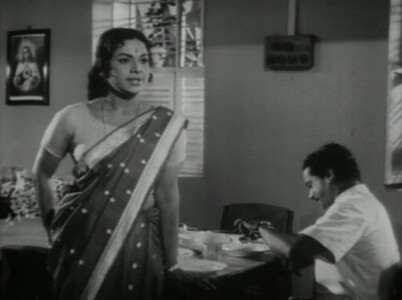
And, ironically enough, he’s Christian—and the attitude of Jesus towards those suffering from leprosy is touched upon several times in the course of the film. In a pivotal scene, a local padre even talks at length about the work of Fr. Damien. The compassion of Christ and of Damien, versus the science of Dr Thomas.
Lastly, the music, by G Devarajan, with lyrics by Vayalar. I really liked Karutha chakravaalamathilukal, in particular.
There is really nothing I didn’t like about the film. It was well-made, the acting was excellent, the story held together well, and it put forward its message in a way that combined entertainment with sentiment and awareness.
Good film, and worth a viewing. I watched an English-subtitled version here, on Jio HotStar.
 Dustedoff
intersting subject , will watch , what other films your friend Anu suggested which are there with subtitles ? Please let me know .great detailed post as usual .thanks
LikeLiked by 1 person
Thank you, I’m glad you enjoyed this post. Anu didn’t actually suggest any films, she just gave her comments on the list of films I’d found. Here is what she wrote (besides Ashwamedham):
Kuttikuppayam is set in the Muslim community in Kerala, based on a story written by a Muslim – it deals with infertility, and how the woman is always to blame. Definitely worth a watch, and the songs are fantastic.
Kavyamela is somewhat similar to Pyaasa in its storyline of a poet whom the fates conspire against. Fabulous songs, and Adoor Bhasi cast against type as the villain.
Odayil Ninnu has a fantastic performance by Sathyan. I would say it’s a must watch. The interesting fact is that the novel on which this film is based was written in 1940. (You will understand why I emphasise this when you watch the film.)
Agni Pareeksha was an adaptation of Nauka Dubi, while Bharyamaar Sookshikkuka is again, a regulation commercial film but very well directed. (Anything by KS Sethumadhavan is generally a decent watch.) Great songs, by the way.
LikeLike
thanks
LikeLiked by 1 person
Lovely recall and write-up on Ashwamedham. The misconceptions and superstitions related to leprosy were highlighted very well in the movie.
There was sequel to “Ashwamedham” that was released in 1971. The sequel, “Sarasayya”, was also based on a Thoppil Bhasi play of the same name. While A.Vincent directed “Ashwamedham” Thoppil Bhasi himself directed the sequel. G.Devarajan and Vayalar Ramavarma were retained as the music composer and lyricist respectively.
Sathyan and Sheela reprised their roles as Dr. Thomas and Sarojam respectively.
The artistes playing some of the other key roles in “Ashwamedham” were replaced by a few others. Examples:
“Sarasayya” was critically acclaimed and won the Best Film Award (1971) in the Kerala State Film Awards.
LikeLiked by 1 person
Thank you for the well-written review dear Madhu.
It sounds to be quite interesting movie and unfortunately still relevant in our times. I remember that leprosy was oft-touched upon topic on Bombay DD’s Marathi skits of the 80s. I wonder what’s the situation now in India.
LikeLiked by 1 person
From a (very cursory) search I did shortly before I uploaded this post, it seems India is still sadly one of the countries where leprosy is still quite prevalent. I do know that several churches in Delhi (including the one we used to go to years ago – the cathedral) have major support systems to help educate and look after the children of leprosy patients, so it’s apparently still a big concern.
I’m glad you liked this post, Harvey. Thank you for reading.
LikeLike
Thank you. I did read about the sequel and that it won several awards, but thank you for writing extensively about it. By the way, Prem Nazir (and not Madhu) played Mohanan in Ashwamedham – Madhu played Sarojam’s elder brother Sadanandan.
LikeLike
You are welcome.
Yes, you are correct. Prem Nazir played Mohanan in Ashwamedham while Madhu played Sadanandan.
LikeLiked by 1 person
Ooh, what a lovely review of a great film, Madhu. I’m so glad you watched this and liked it. KS Sethumadhavan’s films were always pretty decent – they dealt with social issues in a manner that was palatable to the average cinegoer. Ashwamedham was both a critical and a commercial success.
LikeLiked by 1 person
Thank you for recommending this one, Anu! As you can see, I liked it a lot. :-)
LikeLike