Khamoshi (1969)

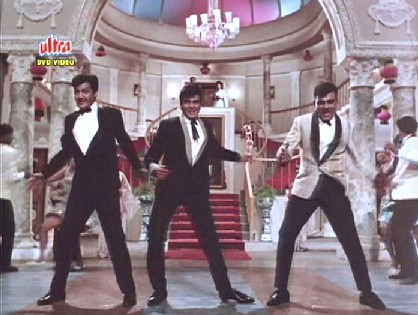
I first watched Khamoshi when I was a child (and too immature to really understand it). I last watched it as a teenager, more able to appreciate the film—which left a handful of clear, sharp images burnt into my memory: Dharmendra, looking out over a balcony and singing Tum pukaar lo; Dharmendra flinging a glass of water at Waheeda Rehman and then watching, half-bemused, half-shy, as she laughingly wipes her face against the front of his shirt. Waheeda Rehman, clinging to Rajesh Khanna but thinking of Dharmendra.
So, considering that this last week saw Dharmendra’s 74th birthday (on December 8th), and having read some very enjoyable posts by fellow bloggers: I decided it was time to re-view and review Khamoshi. It came as a bit of a surprise to realise that Dharmendra actually appears onscreen for just over 5 minutes (and that includes a song). The male lead is Rajesh Khanna. And the film belongs to Waheeda Rehman.

Continue reading

Hold Back the Dawn (1941)

A few preliminaries before I launch into a synopsis of this little-known but lovely little film.

This is the third film of Charles Boyer’s that I’ve reviewed on this blog (the other two are Gaslight and Love Affair). As in Gaslight, in Hold Back the Dawn too Boyer plays a less-than-scrupulous man who marries not for love but for less savoury reasons—after having convinced the woman in question that he’s deeply in love with her.
Now for the coincidence. This is also the third film of Olivia de Havilland’s that I’ve reviewed on this blog (the other two are The Charge of the Light Brigade and Not as a Stranger). As in Not as a Stranger, in Hold Back the Dawn too de Havilland plays a gullible woman duped into marrying a man she’s convinced loves her—though his motives for the marriage are very mercenary.

Continue reading

Mujrim (1958)

Right now, I’m on a five-day visit to my parents. They’re not Beiges, but I’d probably label them Greys—the salt far surpasses the pepper in their hair. We’ve been spending quality time together, eating the best chhola bhaturas in town, catching up on the latest gossip, and watching films. We started with Living it Up and Bells are Ringing, and then my father (who generally prefers Bollywood to Hollywood, unless it’s the Marx Brothers-Laurel and Hardy-Chaplin brands of comedy) put his foot down. Let’s see something Hindi, he said. So we settled on this one, because my father likes its music a lot, and Mummy and I like Shammi Kapoor a lot.

Continue reading

The Maltese Falcon (1941)

This probably sounds really weird, but The Maltese Falcon (based on a novel by Dashiell Hammett) reminds me of a landed fish. Fresh out of the water and flapping about like mad, its tail swishing from side to side at breakneck speed. One twist here, another twist there, one turn here and another there, never still for a moment. Possibly not the best simile for a film, but I can’t help it: the speed of this film is just so frenetic. I saw it again last night, and found myself struggling to keep pace.

The Maltese Falcon begins with a quick introduction, a paragraph scrolling down the screen to the effect that in 1539, the Knight Templars of Malta paid tribute to Charles V of Spain by sending him a golden falcon encrusted from beak to claw with jewels—but pirates seized the galley carrying it, and the Maltese Falcon was lost, its fate a mystery.

Continue reading

Akeli Mat Jaiyo (1963)

Akeli Mat Jaiyo (‘Don’t Go Alone’—specifically addressed to a female) is, if nothing else, very aptly titled. Because if you gallivant where you’re not supposed to, you run the risk of being pursued by a moron whose best friend is a ventriloquist’s dummy. You may end up betrothed to somebody whose family includes a father with a loony sense of humour. Worst of all, you may have to stake your all on saving the ‘life’ of that ventriloquist’s dummy. So yes, akeli mat jaiyo. No way.

Continue reading

Ocean’s Eleven (1960)

Sabrina Mathew’s latest post is an interesting one that compares the two (1968 and 1999) versions of The Thomas Crown Affair. A couple of things from Sabrina’s review struck me: “The remake is keenly aware that the original got away with a lame robbery only because Steve McQueen planned it. So the remake fixes the problem with a daring art heist…”. And, ”The film is not just content with redoing the heist bit; it also wants to fix the romance by giving it a happy ending.” That reminded me of another film, again with two versions, for which I could quote Sabrina verbatim. Ocean’s Eleven, both the 1960 and 2001 versions, are also about robberies. And in this case too, the remake features a much sleeker robbery than the original—and a happier end.

Continue reading

Ten of my favourite Johnny Walker songs

When I first began blogging about old cinema, my husband asked me, “So will you do a list of Johnny Walker’s songs sometime?” I thought about it (not long; I didn’t need to) and decided yes. Badruddin Jamaluddin Qazi, aka Johnny Walker, definitely deserves a ‘top ten’ list all his own. This, therefore, on what would have been his 83rd birthday, is a list of songs through which he frolics and flirts, teeters and tumbles—just, generally, keeps me glued to the screen. These are all from films of the 50’s and 60’s that I’ve seen, in no particular order.

Johnny Walker (ne Badruddin Jamaluddin Qazi)

Continue reading

Bells are Ringing (1960)

I so, so adore this film.

And that, mind you, keeping in mind the fact that I generally don’t think very highly of Hollywood musicals. I have nothing against the music, usually—most of the films had excellent songs—but what really gets my goat is that other than sounding and looking good, few of Hollywood’s musicals have anything substantial to back them up. Look at Oklahoma! or South Pacific (or even Singin’ in the Rain, for that matter): great music, nice looking leads, superb dancing—and that’s it. I can count, on my fingers, musicals that also have worthwhile plots. The Sound of Music. Fiddler on the Roof. And this, a gloriously funny and romantic story about a loony telephone operator and the man she falls in love with.

Dean Martin and Judy Holliday in Bells are Ringing

Continue reading

Anmol Ghadi (1946)

Ghadi, in Hindi, can mean either a watch (as in a wristwatch or a pocket watch), or a brief length of time. I went through a good bit of life thinking this film was about a moment in time—romantic, most probably.
So this is where I own up: enlightenment dawns, buddhoo becomes Buddha. The ghadi in Anmol Ghadi is actually a watch: a pocket watch with a fob and chain. And it plays an important part in the story of Chandra and Lata, Prakash and Basanti, the protagonists of this tale.

Noor Jehan in Anmol Ghadi

Continue reading

In celebration of being 1

November 4, 2008: I succumb to a combination of ennui and an all-encompassing love for old cinema. The result: a blog named Dustedoff.

Yes, Dustedoff today celebrates a year of being in existence. This was inspired largely by the superb Memsaabstory, though I’d decided from the beginning that I’d prattle on equally about Hindi and English cinema. Then, along the way came Bawa, who gifted me a DVD—the unforgettable Bienvenido Mister Marshall!—and made me decide I should perhaps increase the scope of this blog to cinema in other languages as well.

Continue reading