Great Expectations (1946)

Charles Dickens was one of those authors whose books, I think, might be very difficult to adapt to cinema. Most of his works have a plethora of characters, and characters, too, who are described in great detail: people who play an important part in the proceedings. The books are long and involved, and there’s a style to them that would be more suited, I’ve always thought, to a television series rather than a film.

But every now and then, there comes along a fine adaptation of a Dickens novel that manages to retain the essence of the original, and translate it effectively to screen. Adapted for the screen (along with several other people) by David Lean, and directed by him, Great Expectations was a film I’d approached with some trepidation, wondering how it would work as a film.

The story begins with orphaned Philip Pirrip ‘Pip’ (Tony Wager) running along near the marshes that border the village he lives in. Pip’s parents died years ago, and Pip has been brought up by his very hot-tempered, sharp-tongued sister, Mrs Joe Gargery (Freda Jackson) and her husband, the blacksmith (Bernard Miles). What Mrs Gargery lacks by way of human kindness, Joe makes up for: he’s a sweet, gentle, wise man, who is very fond of Pip.

Continue reading

The Ladykillers (1955)

Long-time readers of this blog probably know by now that I have a soft spot for suspense films, heist films, comedies, and—where these genres sometimes meet—films about bumbling crooks. The funny heist film, so to say, where everything goes wrong. Some months back, when I watched Gambit (which I enjoyed very much), a subsequent search for funny heist films threw up another suggestion that I’d heard of before: The Ladykillers. Like Gambit, this too starred Herbert Lom, an actor I like, and because I was fresh from watching Gambit, I thought why not give this one a try too.

The Ladykillers begins with the lady in question: sweet, somewhat scatter-brained old lady Mrs Wilberforce (Katie Johnson), who emerges from her house at the end of a lane and walks down the street nearby. Everybody around seems to know and like Mrs Wilberforce: people greet her, and when she reaches her destination—the local police station—the cops are indulgent. Mrs Wilberforce has come to clarify that her friend, another elderly lady who had informed the police station about spotting a spaceship, was actually misinformed… Mrs Wilberforce’s explanation is detailed and apologetic, and her earnestness shines through bright and clear.

Continue reading

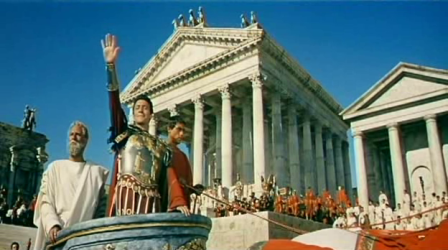
The Fall of the Roman Empire (1964)

History fascinates me. Not the dates, not so much the politics (though that can be often very interesting, too), but society, culture. How people lived, and how—if you really think about it—mankind hasn’t, fundamentally, changed too much over the past few millennia.

Look at The Fall of the Roman Empire, for instance: a tale of a dying emperor, realizing that his own son—the heir to the throne—is too debauched, too fond of gladiators and wine, to ever be able to fulfill the dying man’s dream of a united Roman Empire. What ensues—as a seeming upstart is nominated successor, as jealousy and hatred arise where there had been camaraderie and boisterous affection—could be true of anything happening today.

Christopher Plummer as Commodus in The Fall of the Roman Empire

Continue reading