Kabuliwala (1957)

This is a film I’ve been meaning to watch for a long time now—ever since someone told me that the 1961 Balraj Sahni Kabuliwala (in Hindi) wasn’t a patch on the Bengali version, directed by Tapan Sinha and starring Chhabi Biswas as the eponymous Afghan. I was reminded of it again last year when, for Tapan Sinha’s birth centenary celebrations, Anu (from Conversations over Chai) wrote this wonderful review of the film.

Then, some time back, I began reading 100 Indian Stories (edited by AJ Thomas, published by Aleph Book Company, 2025)—and one of the very first stories in the collection was Rabindranath Tagore’s classic The Kabuliwala.

I figured it was about time I watched Tapan Sinha’s take on the story.

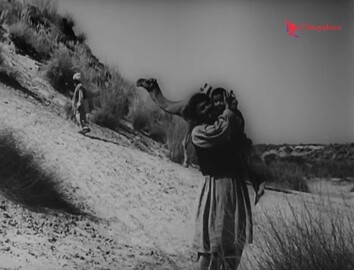
The story begins with scenes (no dialogue, only somewhat sonorous singing in what seems to be Pashto) in rural Afghanistan. Peaks loom high above the valley, a train of camels moves rhythmically along a narrow mountain, and we see Rahmat (Chhabi Biswas) hard at work, but taking out time now and then to play with his little daughter, whom he’s obviously deeply devoted to.
Continue reading

Devi (1960)

When I posted on Twitter about the person who’d advised me to not ‘waste my time’ watching ‘silly Indian films’, a Twitter follower pointed out that Satyajit Ray was also Indian. And I had to concur: Ray, in fact, was the first person who came to my mind as a refutation of that ‘silly Indian films’ generalization. His films are works of art. Occasionally ‘silly’ (Goopy Gyne Baagha Byne fits there), but that silliness is on genius level. It takes brains and creativity to be silly in the way Ray was with that film.

But Devi, ‘The Goddess‘, is nothing like that. There is no silliness here, unless you interpret toxic superstition as silliness.

Continue reading

Jalsaghar (1958)

There is a scene well into Satyajit Ray’s Jalsaghar (The Music Room) in which the protagonist, a reclusive and close-to-bankrupt zamindar named Bishwambar Roy (Chhabi Biswas) stands outside his crumbling palace and looks out towards the riverbank, where his elephant Moti—his only asset worth anything—is standing. Bishwambar Roy’s stance, the squared shoulders, the raised chin, shows his pride: his pride in the elephant, his pride in the many generations of wealthy aristocracy that he can lay claim to, his pride—as he tells someone in another scene—in his blood.

Even as he looks out at his elephant, a truck, with the name of Ganguli (Roy’s wealthy, ‘self-made man’ neighbour) on it comes along. It’s heading towards the riverbank too, and as it proceeds, it raises clouds of dust, obscuring the river, the land, and the elephant. Blocking out Bishwambar Roy’s view of that last vestige of his wealth, and prompting him to take what turns out to be a decision that will prove a turning point in the story.

Bishwambar Roy looks out at his elephant Continue reading

Chaowa-Pawa (1959)

Serendipity: noun. plural: serendipities. The faculty of making fortunate discoveries by accident; the occurrence of such a discovery. Coined by Horace Walpole in 1754, based on a fairy tale called The Three Princes of Serendib (‘Serendib’ being present-day Sri Lanka)—the three princes in question often making such lucky discoveries.

And what does this have to do with Chaowa-Pawa (‘To Want and To Have’)? Simply that, while I had set about watching this film because I really, really like the lead pair—Uttam Kumar and Suchitra Sen—I realized, within the first half hour of the film, that it was a remake of one of my favourite old Hindi films, Chori-Chori (which, as many of you would know, was a remake of It Happened One Night). Serendipity? Absolutely.

Uttam Kumar and Suchitra Sen in Chaowa-Pawa

Continue reading