Ten Little Indians (1965)

I was reminded of this film the other day, because I was lecturing at a Delhi college on historical detective fiction, and ended up mentioning And Then There Were None/Ten Little Indians (no, it’s not historical detective fiction, but I wanted to check how many people in the audience had read this book). The novel, first published in 1939, is Agatha Christie’s most popular book (also, the world’s top-selling mystery book), and one which Christie described as being the most difficult one to write. It has been adapted to screen multiple times, in different languages (in Hindi, as Gumnaam, which sadly did not credit Christie even though the film was very obviously based on the book).

I have reviewed—many years ago—an earlier film adaptation, And Then There Were None (1945), directed by René Clair, and I’ve reviewed Gumnaam too, but decided it was high time I watched a later version. This one, directed by George Pollock.

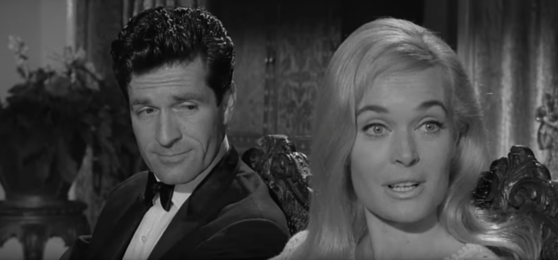
Ten Little Indians gets off to a flying start, the credits rolling as eight guests arrive by train at a snowy, deserted-looking railway station. They proceed, first by horse-drawn carts and then by cable car, up to a grand (but forbidding-looking) mansion situated high up on a rocky, lonely mountain. There, they are met by a couple of servants: Grohmann (Mario Adorf) and his wife (Marianne Hoppe).

The Grohmanns show the guests to their rooms. None of these guests have ever met each other, though from the curious looks some of them bestow on the others, it’s obvious they’re at least interested. The American Hugh Lombard (Hugh O’Brian) and the host’s newly-appointed secretary, Ann Clyde (Shirley Eaton) seem, for instance, to like what they see.
Continue reading

The Hound of the Baskervilles (1959)

The Hound of the Baskervilles was the first Sherlock Holmes mystery I read: an abridged version of the book was there in our home when I was a child, and since I was a voracious reader, always looking for ‘new’ books, I read it fairly early on. Later, I slowly made my way through whichever other Holmes stories I came across, and finally, in my twenties, I bought the complete Sherlock Holmes, the omnibus edition. There are many Holmes stories that I like a lot, but this one, I must admit to a special fondness for.

When Popka Superstar mentioned this film the other day (as part of a list of favourite Christopher Lee films), I decided it was high time I watched it.

The film begins with a voiceover, a narrator describing a scene set many years earlier. Near Dartmoor, abutting the Great Grimpen Mire, lives the dissolute, debauched Sir Hugo Baskerville (David Oxley). On a dark night, he and his equally evil friends are whooping it up at Baskerville Hall; they’re drunk and in the mood for cruelty. Baskerville has forced his butler’s daughter upstairs and locked her in a room; when the butler protests, Baskerville thrashes him…

Continue reading

A Tale of Two Cities (1958)

Happy birthday, Mr Dickens!

Yes, Charles Dickens was born exactly 200 years ago today – on February 7, 1812, in Portsea. In his lifetime, he wrote a number of short stories and non-fictional works, besides about a dozen major novels. He was recognised as one of Britain’s greatest writers within his lifetime – and cinema took to his stories like a duck to water. Have a look at his filmography, and you’ll see what I mean. Dozens of adaptations, feature films, short films and TV series, have been made of Dickens’s work.

So, as a tribute to Charles Dickens, here’s one of them: a story of love and hate set against the backdrop of the French Revolution. A Tale of Two Cities.


Continue reading