The Bishop’s Wife (1947)

For the first few years of blogging, I marked each Christmas with a review of a Christmas-themed film: The Shop Around the Corner, A Christmas Carol, Christmas in Connecticut, The Holly and the Ivy, and so on. Then, somewhere along the way, I fell out of the habit (I am, in some ways, not a creature of habit: I get bored too easily).

But this year, wondering what I should post next—after a slew of tributes—I decided that since Christmas was coming up, and there were several Christmas films I hadn’t yet watched, why not? Therefore, this: a film starring Cary Grant as an angel. Yes, you read that right. Cary Grant as an angel sent down on Earth at Christmastime to help out a beleaguered bishop.

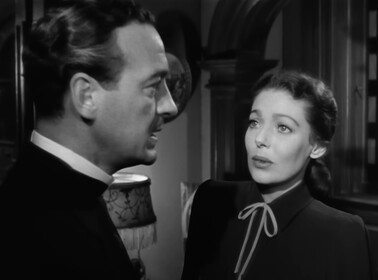
The bishop in question is Henry Brougham (David Niven), a harried man because he’s trying to raise funds for the construction of a new cathedral. As the story progresses, we learn that Henry used to once be a kinder, gentler man, the sort of man who had time to go out for walks and meals with his wife Julia (Loretta Young), who could take time to visit his old parish and listen to the boys’ choir. A man less obsessed with the grandeur of a new cathedral…
Continue reading

The Spiral Staircase (1946)

Years ago, when I first watched Wait Until Dark, I was blown away by the ingenuity of the idea: a blind woman trapped inside a house with a murderer on the loose. Audrey Hepburn was superb as the woman who must use all her wits to keep one step ahead of her pursuer, and if possible, to turn the tables on him.

That was the film I kept remembering when I was watching The Spiral Staircase, a story about a mute girl who is caught in a large mansion with a murderer coming after her.

The story begins, not at the mansion, but at a small hotel in the nearby town. On the ground floor of the hotel, a film (silent, shown with an accompanying pianist providing the music) is being projected. A small but engrossed audience is in attendance, and this includes Helen (Dorothy McGuire), who is mute.

Continue reading

The Big Clock (1948)

For someone who loves books with as much passion as she does old cinema, it’s hardly surprising, perhaps, that I get especially excited when I discover a screen adaptation of a book I like—or vice-versa.

Earlier this year, I stumbled upon Kenneth Fearing’s novel The Big Clock. I had never heard of it before, and the first couple of chapters of the book didn’t endear me to it: too dry, too full of journalistic jargon, too business-y. But I persevered, and suddenly, the story took a turn that caught me by surprise. And then it became such a gripping, unputdownable book that I ended up racing through it, eager to see where it would go.

… which was why, when I found it had been also made into a film, I approached the cinematic The Big Clock with some trepidation: would they have been able to do justice to it?

As it turned out, yes. More than justice.

The Big Clock centres round a mammoth publication company, named Janoth Publications, after its owner, Earl Janoth (Charles Laughton). Janoth Publications is housed in a multistory building, each floor being devoted to one publication churned out by the behemoth: Styleways, Sportways, Newsways, and so on—and, the publication which becomes the focus of this story, Crimeways. As its name suggests, Crimeways is devoted to crime reporting, and is headed by George Stroud (Ray Milland).

Continue reading

Witness for the Prosecution (1957)

“The trial of of Leonard Vole for the murder of Emily French aroused widespread interest. In the first place the prisoner was young and good-looking, then he was accused of a particularly dastardly crime, and there was the further interest of Romaine Heilger, the principal witness for the prosecution…” — Agatha Christie, The Witness for the Prosecution

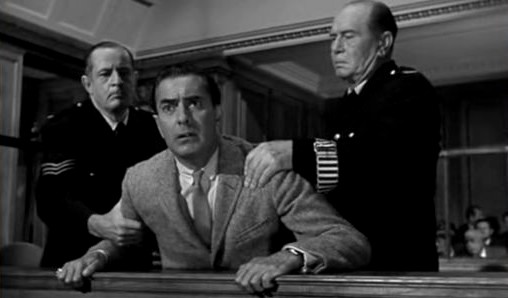
Tyrone Power’s last full-length appearance on screen (he died while filming Solomon and Sheba a year later), Witness for the Prosecution is also one of his most famous films. Surprisingly, not mainly because of Power—his role in it, though pivotal, is actually quite small—but because of the overall brilliance of the film: the excellent acting, Billy Wilder’s direction, and a very good adaptation of one of Agatha Christie’s best-known short stories.

Continue reading