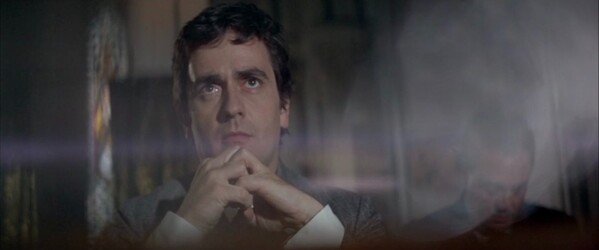
Bunny Lake is Missing (1965)

A little girl, an American newly arrived in England, goes missing from the nursery school she’s just joined. The police come to investigate, but things begin to get very puzzling soon after and the superintendent in charge of the case ends up wondering: Is Bunny Lake really missing? Does Bunny Lake even exist?

This film, produced and directed by Otto Preminger, was nominated for several BAFTA awards, and having seen it, I wonder why it didn’t win even a single award. It’s a gripping story, and moves swiftly from the very start.

It begins at a home in London, where Steven Lake (Keir Dullea) goes about picking up stuff, making sure everything is draped in covers, before he locks up the house and has a word with a couple of workmen who are there to help shift some stuff to another home. Much later in the film, when Steven and his sister Ann are talking to the police, it transpires that Steven, who is a journalist, has been working in London for some time and was staying in Frogmore End (which is the house shown in the opening frames).

Continue reading

The Three Worlds of Gulliver (1960)

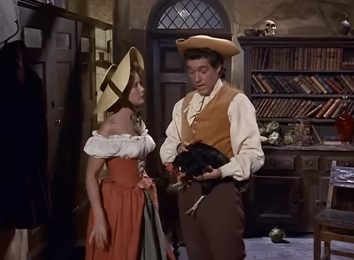
A few weeks back, after years of telling myself I must read more of the classics, I finally got around to reading Jonathan Swift’s highly-acclaimed satirical novel, Gulliver’s Travels. Over a period of time, I’ve realized that books of this sort—extremely popular, appearing on just about every list of ‘must-read English novels’—are popular, too, among film-makers looking for material for screen adaptations. Of course, given that Gulliver’s Travels would require (I guessed) a fair bit of special effects, I had little hope that I’d come across anything from before the 70s; but guess what? It’s there: The Three Worlds of Gulliver, directed by Jack Sher and with special effects by Ray Harryhausen.

The story begins in Wapping, England, in 1699, where a physician, Lemuel Gulliver (Kerwin Mathews) is torn between his fiancée Elizabeth (June Thorburn) and his profession. It all actually boils down to his love for Elizabeth: she deserves more than to live in a hovel and subsist on next to nothing, because Gulliver is such a sweet welcome mat that he goes around treating people left, right and centre, often for free, or for payment in kind. Like cabbages and hens that run away.

Continue reading

Characters with Books: In English-language cinema

Six years ago, to commemorate World Book Day, I published a post about characters in Hindi cinema shown with books (not necessarily reading books, but sometimes even just holding a book). My main criterion there was that the book should be identifiable, and (preferably) a real book, not just a fictitious prop bunged into the film. The idea was to celebrate books, even in cinema. After all, the connection between books and cinema goes far beyond the fact that books are often adapted to the screen. Both the page and the screen are media used to tell a story; both can entertain, both can provoke thought, both can be incendiary. And just as characters in books may watch films, characters in films may read books. To underline their own personalities and interests, by way of making an oblique reference to a thematic element of the film itself, or simply to have something to do.

This year around, with World Book Day coming up again (today in the UK, for much of the rest of the world on April 23), I decided it was high time to do another iteration of that ‘characters with books’ idea. This time, it’s characters in English-language cinema: mostly either Hollywood or British cinema. As for my earlier post, the criterion here is that the book should be identifiable: its title should be readable. Also, preferably, it should be a real book, not a fictitious one. And, of course, as for all my posts on this blog, these are all from pre-70s films that I’ve watched.

Continue reading

The General (1926)

I have a confession to make: I’ve never actually got around to watching, as far as I can remember, any of Buster Keaton’s films. The great American comedian, a contemporary of Charlie Chaplin’s, is often regarded on par with (if not better than) Chaplin. His The General, about an engine driver who accidentally becomes a Civil War hero, is considered by many to be a masterpiece, with Orson Welles calling it the ‘greatest comedy ever made’ (and ‘possibly the greatest movie ever made’).

It was about time I watched The General. Especially since it’s easily available (it’s in the public domain, you can even watch it on YouTube, here).

The story begins in Marietta, Georgia, in 1861. Engine driver Johnnie Gray (Buster Keaton) has just come into town, driving his beloved engine, which is named The General. The General is Johnnie’s great love, along with the pretty Annabelle Lee (Marion Mack). Johnnie attends to his beloved engine, then goes off to meet Annabelle.

Continue reading

The Bad Seed (1956)

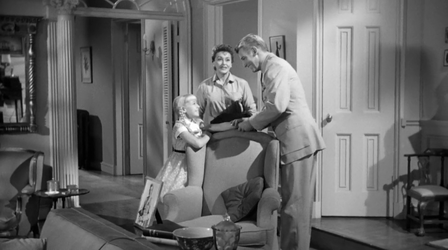
I am always intrigued by films that have children in important roles, films like The Search or The Four Hundred Blows, which call for children to really show off their acting skills. The Bad Seed is another for the list, and an unusual film, in that it has the child (Patty McCormack) in what might have been an unsettling experience for a child actor.

The Bad Seed begins in the home of Colonel Kenneth Penmark (William Hopper), who has been transferred to Washington, DC and is just about to leave. His farewell to his wife Christine (Nancy Kelly) and their eight-year-old daughter Rhoda (Patty McCormack) is touching: these three are obviously a loving, happy family. Rhoda, in particular, comes across as an affectionate child, adored by her father.

Continue reading

All About Eve (1950)

I am always a little intrigued by films about cinema: the inward-looking eye, the self-criticism (more often than not). From The Artist to Kaagaz ke Phool, there’s something about films like this that I usually find appealing: perhaps because they offer a glimpse, even if unsavoury, into what lies beyond what one is currently viewing.

All About Eve isn’t about cinema; it’s about a related art, theatre (but there are nods here, aplenty, to cinema: there’s a passing reference to Zanuck—who produced All About Eve; and there are instances of people vying for a role, possibly even a career, in Hollywood). It’s about the ambition, the cut-throat competition, the fiercely burning desire to stay in the limelight—or to claw one’s way up there, in the first place.

The story begins at a glittering but exclusive awards night. This is the annual awards ceremony of the fictitious Sarah Siddons Society, and the who’s who of the theatre world is gathered here. While a boring veteran actor gives his speech, we are introduced, through a voiceover, to some of the characters attending this function. Characters, too, who play an important part in the story.

To begin with, there is Addison DeWitt (George Sanders), an influential journalist.

Continue reading

Island in the Sun (1957)

RIP, Harry Belafonte.

I have an admission to make: Harry Belafonte was the first singer I ever crushed on.

When I was a child, my parents had a large collection of LPs, and among the many singers we heard on those, the ones who stood out for me were Connie Francis, Pat Boone, Jim Reeves—and Harry Belafonte. I still remember a Belafonte album (Belafonte Sings of the Caribbean) we had, which was one of my favourites. This one was also present among the LPs at my maternal grandparents’ home in Kolkata, which we visited sometimes for Christmas. My mother’s father had worked for the Indian music giant HMV, so their home had a massive collection of LPs, with Belafonte front and centre. We didn’t just listen to his carols and hymns at Christmas; we listened to every song he’d made popular, from the soulful Jamaica Farewell (one of the first English language songs I learnt to sing) to hilarious ones like Matilda, Man Smart Woman Smarter, and the classic There’s a Hole in the Bucket (which, by the way, is also a favourite with my daughter: she and I sing it together and always end up having a good laugh).

I loved his voice. I thought the photo of him, smiling and so handsome, on the LP cover, showed that he didn’t just have the most fantastic voice, he was also easily the best-looking of all the singers.

Continue reading

Guess Who’s Coming to Dinner? (1967)

This is a film that’s been on my watchlist for a long time. It was recommended to me all over again last year when Sidney Poitier passed away, and since then, I’ve been meaning to watch it. So, finally.

Guess Who’s Coming to Dinner? is a film that can be easily summed up in one sentence: a young white woman and an African American man fall in love, and their shocked families have to learn to cope with their feelings. This is a story not so much of plot—very little actually happens, and most of the nearly two hours of the film consists of dialogue, of people discussing this frighteningly new development that has hit all of them—but in that time, the film manages to make several very pertinent points, not just on racism (which is, naturally, the most obvious) but other issues as well.

Continue reading

The Thin Man (1934)

I guess a lot of people would think this an odd film to be reviewing on Christmas. But the fact of the matter is that over many years of reviewing rather more standard and predictable ‘Christmas films’, the sort that stress on the joy and goodwill of the festival, I’ve become a bit jaded to the whole idea—at least onscreen, where it more often than not tends to become a little too syrupy for my liking.

Therefore, for a change: a film that’s set around Christmas, and has lots of props, scenes, and more that reference the celebration of the festival—but is actually a murder mystery. The Thin Man is one I’ve been meaning to watch for many years now, since lots of people have recommended this to me, so it was high time anyway.

Based on the novel of the same name by Dashiell Hammett, the film begins at the shop of an inventor named Clyde Wynant (Edward Ennant). Wynant is crotchety and impatient with his assistant, but a more affectionate side of him is revealed when his daughter Dorothy (Maureen O’Sullivan) arrives, bringing with her her fiancé Tommy (Henry Wadsworth) and the news that they’re going to be married shortly after Christmas, a few days from now.

Continue reading

The Adventures of Huckleberry Finn (1960)

I got introduced to Mark Twain’s books about the rambunctious, adventure-seeking Tom Sawyer and his best friend, Huckleberry Finn in my early teens. I read a lot of Twain in those days, and—as tends to happen with me when I’ve read a lot of one author’s works—over a period of time, they started to blur. I forgot which books I’d read, and which I hadn’t.

The Adventures of Huckleberry Finn is one such: I couldn’t recall whether this was among the books I’d read. But, while making my very sporadic way through The Daily Telegraph’s list of 100 Great Novels Everyone Should Read, I found this book on it, and decided I may as well read it. And, as often happens when I read a book that’s fairly popular (in this case, an acknowledged classic), I followed that up with seeing if it had been made into a film. Sure enough, it had: a 1960 adaptation starring Tony Randall was what I chanced upon.

Continue reading