Kundan (1955)

Some days ago, in this delightful post about chai in Hindi cinema, I came across a mention of Kundan. Aao hamaare hotal mein chai peeyoji garam-garam sounded so interesting that I bookmarked the film without even really checking to see what it was all about (though the cast, barring Nimmi—whom I often find very irritating—appealed to me). Then, just a couple of days later, Anu posted this wonderful tribute to Sohrab Modi, in which she listed Kundan as one of her favourite ten films directed by Modi. Adapted from Victor Hugo’s classic Les Miserables.

That sealed it. I had read Les Miserables a couple of years ago, and had been blown away by it: by the depth and width of it, the characterization, the sheer scope of it all. And now, it looked as if the universe was pushing me towards Kundan. I had to watch this one.

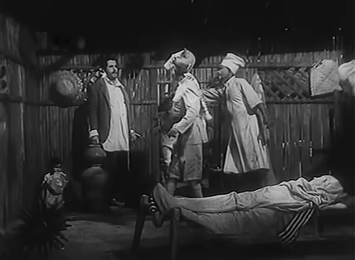
The story gets off to a flying start. Kundan (Sohrab Modi) is a very poor man who lives with his very ill sister and her little daughter Radha. Unable to earn [it’s not clear why, given that he looks able-bodied enough], a desperate Kundan finally steals a loaf of bread from a bakery and runs home to give it to Radha. Since he’s made no attempt to commit this theft in secrecy, the alarm has been raised and Kundan is arrested even as Radha is eating the loaf.
Continue reading

Jhansi ki Rani (1953)

Given my penchant for history, it’s hardly surprising that I would, sooner or later, end up watching this film. It’s been on my radar for a while, though it was only last month that I was reminded of Jhansi ki Rani, because it showed up in my list of YouTube’s suggested videos. Oddly enough, what YouTube suggested wasn’t exactly this film but its English-language counterpart, The Tiger and the Flame, which was released in 1956. Sohrab Modi, who produced and directed (besides acting in) both versions of the film, went all out on creating a spectacular production, bringing in technicians and other crew from Hollywood, including Oscar-winning cinematographer Ernest Haller, who was responsible for the cinematography of Gone with the Wind.

This film was not just made in two languages, but with other differences between them too. The Tiger and the Flame is in Technicolor (the first India-made film in Technicolor) while Jhansi ki Rani is in black and white. Jhansi ki Rani has songs (composed by Vasant Desai with lyrics by Pandit Radheshyam), The Tiger and the Flame is minus the songs. Other than that, though, the films were much the same: the same cast, the same script.

Continue reading

Sikandar (1941)

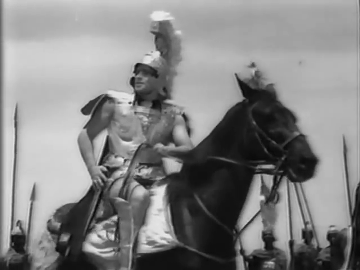
I remember my very first glimpse of a scene from Sikandar. It was years ago, probably sometime in the mid-80s, and in some Doordarshan programme or the other, a snippet appeared from Sikandar. All I recall is a closeup of Prithviraj Kapoor, dressed as an ancient Greek, plumes flowing from a gleaming helmet as he led his troops into battle. He looked startlingly like Shashi Kapoor, though with the build of Shammi. This film, I thought back then, I must see.

Prithviraj Kapoor in and as Sikandar

Continue reading

Noorjehan (1967)

Give me a period film, and I’m willing to give it a shot. If it happens to be set in Mughal India, so much the better. If the cast features people like Meena Kumari, Pradeep Kumar, Rehman, Veena, Lalita Pawar and Nighar Sultana: well, there’s hope that the acting will be passable. And when I realize that the music composer is Roshan: then I’m certainly on for it.

Noorjehan, of course (though Richard would probably question that ‘of course) is about the noblewoman who married the fourth of the Great Mughals, Jahangir. Born in May 1577 and named Mehrunissa, she was the daughter of a man who rose to great prominence in the Mughal court: Itmad-ud-Daulah (‘Pillar of the State’) was the title given to him, and the marriage of Mehrunissa to Jahangir made of Mehrunissa a powerful woman, too. Initially given the title Noormahal (‘Light of the Palace’) by her doting husband, she was subsequently given the title of Noorjehan (‘Light of the World’) and went on to become probably the most influential of imperial consorts in the Mughal dynasty, a wealthy woman in her own right, as well as a woman who exercised a good deal of power from beyond the purdah.

pic1

Continue reading

Raj Hath (1956)

Despite my love for historicals and Madhubala, I was surprised when Ava mentioned this film on her blog. A historical (and a Sohrab Modi one, too), with Madhubala, and I’d never heard of it? Ava recommended it, so I decided to keep an eye out for it. Fortunately, I discovered Raj Hath on Youtube—therefore, this post. Ava, thank you. This was an enjoyable film.

Madhubala and Pradeep Kumar in Raj Hath Continue reading

Waaris (1954)

As frequent visitors to this blog would know by now, one of my weaknesses is good music—and there have been, over the years, dozens of films that I’ve watched primarily because they had good scores. In some instances, just one song that I really liked. More often than not, my luck’s been pretty shoddy and I’ve ended up sitting through frightful films like Akashdeep, Saaranga, and Akeli Mat Jaiyo.

With Waaris, which I watched mostly because of Raahi matwaale, I had hopes [cautious, considering my track record, but hopes nevertheless]. It stars Suraiya and Talat Mahmood, both favourites of mine, and it was produced by Sohrab Modi, who even if (when acting) had a penchant for ‘declaiming to the skies’, did make some good films.

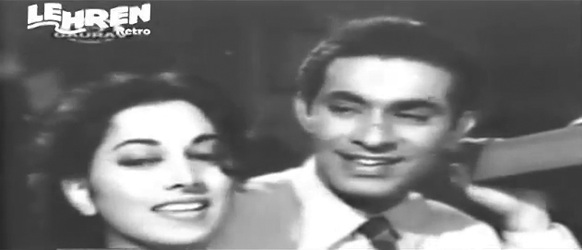
Talat Mahmood and Suraiya in Waaris Continue reading

Nausherwan-e-Adil (1957)

Today, November 11, is the birthday of Mala Sinha, so I decided to finally watch this film—not because it’s one of her best, but because it has three elements I’m partial to: it has music by C Ramachandra, it’s a historical, and it stars Mala Sinha.

I have to admit my love for Mala Sinha sees ups and downs, based on which film I’m watching. In a film like Pyaasa or Gumraah, where she has good roles (and good directors), she shows just how good an actress she is. And in an all-out entertainer like Aankhen, she’s equally unforgettable as the feisty, glamorous spy. These are the films I prefer to stuff like Anpadh, Hariyali aur Raasta, or even Baharein Phir Bhi Aayengi—because the melodrama is kept in check.

But one thing I’ll happily admit: I think Mala Sinha is lovely, and I’ll watch most films just to see her.

Continue reading

Ek Nari Ek Brahmachari (1971)

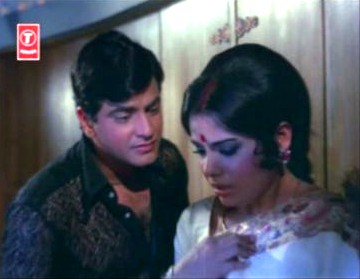
Though I usually restrict this blog to films up to about 1970, I occasionally make exceptions for films that have a 60’s feel to them—Fiddler on the Roof, for instance. And this one, which despite the bell bottoms, the unbelievably gaudy outfits of the supporting cast and the horrendous decor, has a definitely 60’s feel about it. Another reason (and one which I’m not ashamed to admit is probably the main reason) that I’ve decided to make an exception for Ek Nari Ek Brahmachari is that it stars the lovely and vivacious Mumtaz, one of my very favourite actresses.

Continue reading

Mirza Ghalib (1954)

Okaaay. I’m finally back from a whirlwind book tour. I gave endless interviews (I can now answer questions in my sleep); was wined and dined—great ilish in Kolkata and awesome Chettinad food in Chennai—and even ended up on youtube. I met some likeable and interesting people, including crime writer Zac O’Yeah (in conversation with me at the Bangalore do) and blogger-cum-bestselling writer Amit Varma, author of the delightful My Friend Sancho—he was in conversation with me in Mumbai and had some nice things to say about my book. And yes (I can’t resist the temptation to blow my own trumpet!), others have said good things about The Englishman’s Cameo, too: Pradeep Sebastian, writing in BusinessWorld, for instance; and Vivek Tejuja on http://www.goodreads.com.

So, having done my bit of shameless self-promotion—and wound up at exactly the place I wanted this post to go—I’ll begin with this review. Like me, the Urdu poet Mirza Ghalib was a Dilliwala. Like me, he too was a writer (and before I have Ghalib fans leaping at my throat for daring to lump the two of us together: no, I do not compare myself to the man. He was pure genius. Not so with me). And like me, Ghalib loved to hear his writing being praised.

Bharat Bhushan in and as Mirza Ghalib

Continue reading