“Life is a banquet and most poor suckers are starving to death!” says the eponymous Auntie Mame (Rosalind Russell) on more than one occasion in this delightful film about an eccentric woman who is obliged to look after her orphaned nephew. Mame Dennis, indeed, is not one of the ‘poor suckers’ she so derides; this is a woman who lives life to the full (and a little beyond), grabbing happiness with both hands and not giving a damn, mostly, for what the world thinks.
Towns and cities. Not countryside, not rural hinterland.
As a family, we’re very fond of travelling. At least once a year, we make sure we go on a road trip (usually) that would take us through several towns, spending a couple of days here, a couple there. Exploring places beyond what we’re familiar with.
Of course, with the pandemic, that’s on hold for the time being. Though my husband and I are vaccinated, the LO (the ‘Little One’, our seven year old daughter) isn’t, and we don’t want to run any risks. So, we’re stuck at home, and I confine myself (and occasionally the LO, who is also fond of old Hindi film songs) to watching videos that take us places. Songs that are filmed in places far and wide, songs that go beyond the usual tourist attractions. Songs which make you feel you were, for those brief few minutes, in another town.
I am always keen to watch regional films starring people I’m familiar with from Hindi cinema. With (say) Bengali cinema, it’s not too difficult—so many Bengalis (Sharmila Tagore, Kishore Kumar, Biswajeet, Suchitra Sen, Mala Sinha, etc) were big names in Hindi cinema, and managed to do quite a bit of work in Bengali films too, many of which are subtitled. With Punjabi (which I understand enough of to be able to get the gist without having to rely on subtitles) it’s also satisfying, because Punjabi cinema seems to be pretty much completely populated by the same names one keeps running into in Hindi cinema: Nishi Kohli, IS Johar, Balraj Sahni, Prithviraj Kapoor, Indira Billi…
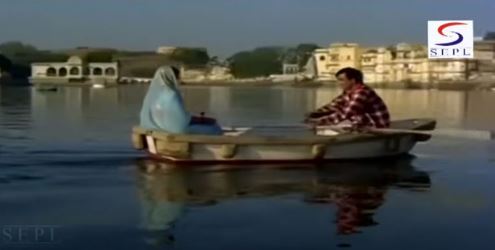
But to come to this: I stumbled upon Kalapi completely by accident, and immediately bookmarked it. Because a subtitled version is available on YouTube, here (though I must warn you, the subtitles are pretty bad), and because of Sanjeev Kumar, one of the greatest actors of Hindi cinema. Also, I am on an eternal quest to find old regional language films that are subtitled, and since I’d never watched a Gujarati film before, this would be a first for my blog.
The world of Hindi cinema is peppered with names that anyone familiar with the industry (at least the industry of the 50s and 60s) can quickly slot into categories. Star. Villain. Comedian. Character actor. There are many, many names that automatically fall into (almost exclusively) one of these categories. Those that have shifted from one category to another—like Pran, for instance, once the quintessential villain but in later years the more interesting ‘good man’, or Ajit and Premnath, both initially hero and later villain—have again usually not done too many shifts.
Abhi Bhattacharya is one of those relatively rare individuals who seem to have appeared in a wide variety of roles, a wide variety of films. He was the idealistic school teacher of Jagriti, the ‘other man’ of Anuradha. The kind-hearted, principled example of the bhadralok in films like Amar Prem, and the straying older brother of Dev Anand in Love Marriage. He played Krishna and Arjun and Vishnu (the latter in a slew of mythologicals). He even played the villain, in the Vinod Khanna-Yogita Bali starrer, Memsaab.
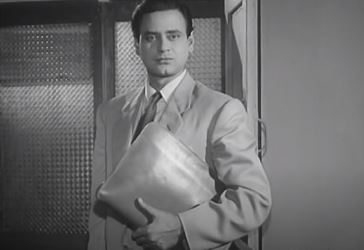
This year marks the birth centenary of Abhi Bhattacharya (as far as I’ve been able to find out, he was born in 1921, though I’ve not been able to discover exactly when in 1921). To commemorate his career, I wanted to watch a Bhattacharya film, but a dilemma presented itself: which one? Hindi or Bengali? (since Bhattacharya had what seems to have been a very successful career in Bengali cinema as well). Eventually, I homed in on this film, a rare whodunit in Hindi cinema that’s pretty well made too.
Many years ago, when I was a teenager, a cousin who was much older than me lent me a favourite book of hers: Edward Rutherfurd’s Sarum. Sarum was the ancient name of the city of Salisbury in Wiltshire, England, a place of great antiquity; and Rutherfurd’s Sarum is a novel about interconnected families, their stories playing out against a backdrop of history being created. Beginning with the Ice Age, these characters live their lives as Stonehenge is built, as the Romans invade and then establish a colony in England; as Salisbury Cathedral is erected, as the Black Death grips England… going right up to 1984, this was an epic book that made a huge impression on me. I couldn’t help wondering: given India’s long and fascinating history, wouldn’t it be satisfying to read a book similar to Sarum, but set in India?
Back then, I had no plans to someday become a writer. But finally, a few years back, when I’d written the Muzaffar Jang series and had learnt a good deal about the history of Delhi, Sarum came to mind again, and with it, that long-ago wish that someone would write an Indian equivalent.
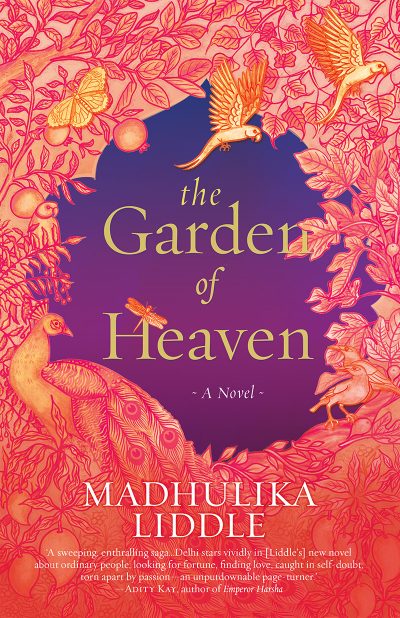
Here it is: The Garden of Heaven, the first book in the Delhi Quartet. The Delhi Quartet will span 800 years of Delhi’s history, beginning shortly before the invasion of Mohammad Ghuri, and extending till just after Partition; the first 200 years of that stretch are covered in The Garden of Heaven.



 Dustedoff