
I’d been meaning to watch this film for a while now, because there’s a family history related to Lahore.
My uncle David Vernon Liddle ‘Verni’, as some of you may know, was a guitarist in Hindi cinema (this guest post, written by my father, Verni’s younger brother, is all about him). In 1947, Verni—then very young, no more than 16 years of age, but already an accomplished musician and making inroads into the Hindi film industry—was in Lahore and recording the songs for Lahore. Partition happened, and of course, there was so much violence and chaos that Verni had to flee Lahore and head eastwards into India. En route, during his travels, he ended up losing his sole pair of chappals and for quite a few days wandered about barefoot. Once he landed up in Punjab, he was able to make his way to some relatives in Ludhiana, and an aunt finally gave him a new pair of slippers! Verni also spent some time right after he came into Indian Punjab, working at a langar in a camp. The camp included Muslims and Sikhs, and Verni, being a Christian, was one of the few who was therefore not regarded with suspicion by anyone. This was what got him a job (sort of) serving food at the camp.
I am not sure about the story behind how Lahore came to be made. Since the music of most films back then used to be recorded before the film itself was completed, it’s possible that the songs of Lahore (written by Rajinder Krishan and composed by Shyam Sundar) had been readied even before filming began. As it is, it’s not as if the songs are very specific to this film or any particular scenarios; they are ‘generic’ love songs and sad songs, which could be fitted in pretty much anywhere in the average 50s or 60s film. It may just be that the real story of Lahore, of Partition disrupting a romance and a family, evolved somewhere in the course of time before, during and just after Partition.
So, this was a film I wanted to watch.
Sadly, I could find only one copy online (on the SEPL YouTube channel, never one I am happy to view films on because they have zero QA). This version turned out to be a mess: not only were there scenes arbitrarily chopped off, midway through the film, the sequence of the reels went for a toss too, so the chronology was all haywire.
This review, therefore, will be a little different from my usual style. What follows is not as detailed a synopsis as I usually provide, and it includes most of the film, so be aware that there are
Some spoilers ahead.
The story is set in Lahore, where Chaman (Karan Dewan) and Leelo (Nargis) are neighbours as well as collegemates, and sweethearts. Their love story is known and approved by their respective families. Leelo only has her mother (?), but Chaman lives with a fairly large family.

There’s his mother (Pratima Devi), father (?) and younger brother Kishan (?), who is disabled and quite frail. Chaman is the middle brother; the eldest brother is Dev (Om Prakash, looking the youngest I’ve ever seen him, not yet tubby, and with a more-or-less full head of hair). Dev is a rotter; he spends most of his day at a local tavern, and is not above stealing his mother’s jewellery and selling it off to finance his drinking.
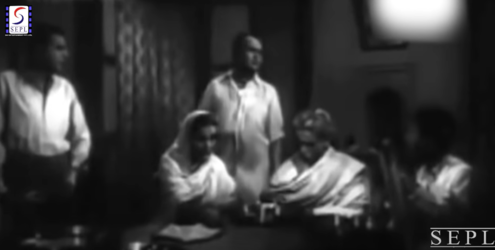
The family is in dire straits because of Dev’s joblessness and profligate ways, Kishan’s being an invalid, and Chaman still in college. Their father, who was once wealthy but has fallen on evil days, seems to be able to get some money every now and then, even though he doesn’t have a job…
And one day, it’s discovered how this is happening: the father is a thief. Driven to desperation, he’s been stealing money all this while. There is some confusion, with Chaman taking the blame for the most recent theft; a courtroom trial begins too, but Chaman’s father, wracked by guilt, springs up, confesses his guilt, and dies of a heart attack.
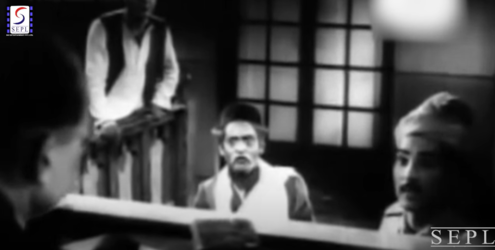
Not only is Chaman’s family shattered by this, they soon find themselves ostracized: the father was a thief, how horrible. Leelo’s mother, swayed by the words of a friend, decides that Leelo must not meet Chaman any more, and agrees to her friend’s proposal that her (the friend’s) nephew will be a good match for Leelo.

While this is happening, Chaman has got a scholarship to study in Bombay. He will be paid Rs 100 per month as part of the scholarship. Chaman leaps at this chance: he will be able to manage on far less, and will send the rest to Lahore for his mother. His parting with Leelo (who still meets him, on the sly) is fraught with pain, but Chaman is optimistic: things will look up, he will be back soon.

Chaman keeps sending money orders of the entire hundred rupees per month to his mother, but the evil Dev intercepts all the letters and all the money orders, fooling everybody—postman, mother, Chaman and Kishan—in the process. Chaman only comes to know when he suddenly comes home to Lahore, summoned by a desperate Leelo, who’s been told by her mother that she’s now going to be marrying the friend’s nephew.
And just as Dev’s perfidy is discovered, the country is partitioned and riots break out in Lahore. There is panic. Chaman manages to flee with his family, but Dev doesn’t leave Lahore. Kishan dies en route. When they arrive in Amritsar and settle into a refugee camp, Chaman goes looking for Leelo and her mother. He finds her mother, and she tells him the heart-breaking news: Leelo got left behind in Lahore.
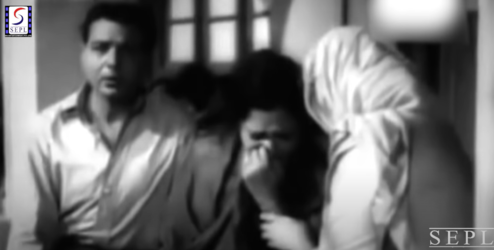
In the meantime, Chaman’s college friend, Ramesh (Ram Avtar, like Om Prakash, looking much younger: not bald, not too tubby) is also in Amritsar. All through college days, Ramesh has been telling Chaman about his sweetheart, Radha. Now Radha (Kuldeep Kaur) turns up, and it emerges that she had got left behind (it’s not clear where) when the rest of her family fled. She was raped and is now pregnant.
Ramesh is furious with Radha, rejecting her outright and sneering at her for the ‘paap ki gathri’ (literally, ‘bundle of sin’) that she’s carrying around. Radha tries reasoning with him: she is the victim here, not the sinner—but Ramesh refuses to listen, and throws her out.

When Chaman happens to run into Ramesh, Ramesh takes Chaman to his own home, where Chaman is horrified to discover that Ramesh has caught hold of a Muslim girl named Salma, who got left behind when her family fled Amritsar. Now Ramesh intends to have his way with her: why not?

As I’ve mentioned earlier in this review, I am puzzled about the beginnings of this film: how did it come about? If it was already in the pipeline when Partition happened, did they change the second half of the film to accommodate the story of the Partition? Or was no real story already in place? The film’s credits don’t list any scriptwriters (Rajinder Krishan, who also wrote the lyrics, is credited with the dialogues, and ML Anand directed the film), so to me this is still an enigma.
What I liked about this film:
Whatever it is, this film surprised me, pleasantly. I had not been expecting something so refreshingly progressive, as well as humane. While Lahore does not depict the general chaos and violence that shook India and Pakistan at Partition, it shows the immediate aftermath, in the form of what happens to three women, two Hindu and one Muslim, who get separated from their families/menfolk. Leelo, Radha and Salma are all victims, and though there are those who will spurn them and label them ‘fallen women’, it’s obvious that the film-makers are rooting strongly for these women, seeing them as the victims they are, and all for their being supported and loved to help them recover from their ordeal.
In this instance, Leelo is of special note. This is the heroine, mind you; and we all know how Hindi film heroines are depicted: their sati Savitri-ness must be beyond even any breath of reproach. They cannot be ‘soiled’, so to say. But Leelo doesn’t just get left behind in Lahore; her home and she are taken over by a Muslim man, who moves in with his mother. Leelo is therefore ‘married’ (or presumably? No ceremony of any kind is ever shown, though her ‘mother-in-law’ addresses Leelo as Laila). Whatever the legality or not of this relationship, it’s obvious that Leelo is treated as a servant in what was once her home. And is probably raped repeatedly by her ‘husband’ as well.
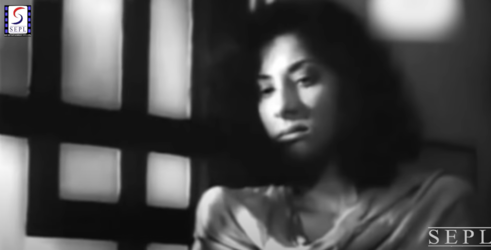
And yet, it is not held against Leelo. This is not her fault, and Chaman’s love for her does not falter even once; her being ‘tainted’, as so many other films would put it, does not even occur to him.
Interestingly, just a few days after I watched Lahore, I watched Panchayat (1958). As a contrast to the tone of the two films, let me quote a brief dialogue from Panchayat. Here, Jabeen Jalil’s character, Rupa, is abducted by a lecherous wrestler, but has been rescued by a relative, played by Raj Kumar. He leaves her at her home, where her father (Nazir Hussain), who is lying in bed nursing wounds received while trying to save Rupa from being dragged off, looks up and says, “Alag hat, alag hat!” (Get away, get away)
Rupa sniffs tearfully.
Father : “Pehle bata, tu devi hai na?” (First, tell me: are you still chaste?—‘devi’ literally meaning ‘goddess’)
Rupa : “Haan, babuji. Agar devi na rehti toh aapko kabhi moonh na dikhaati.” (Yes, Father. If I were not chaste, I would not have shown you my face.)
In an age when the Panchayat idea of morality—that a woman’s sexual purity is her responsibility, and if she is raped, that is her fault—Lahore comes across as a film before its time.
Among the other elements that I liked, there’s Shyam Sunder’s music, with some lovely songs: Duniya hamaare pyaar ki yoon hi (a duet between Lata and Karan Dewan; I have to admit I hadn’t known Karan Dewan sang playback too); Bahaarein phir bhi aayengi; and Bedard zamaana kya teri among them.
What I didn’t like:
Karan Dewan, for one. I’ve never been fond of Karan Dewan, and he’s not much good here either.
The somewhat sketchy story, in places. While some of this may be a result of poor editing (either at the level of the film, or by SEPL), some seems to be intentional. For instance, there are a lot of gaps in the narration when Partition happens: how does Dev get left behind in Lahore? How does Kishan die? How does Leelo get left at her home in Lahore (this one, especially, needed more explanation: a scene showing this might have helped). I can understand that possibly because of the times, a more graphic visualization of Partition might have been unacceptable, but the terror and the distress needed a more impactful, dramatic place in the film.
Was Lahore the first Hindi film to tackle the subject of Partition? I don’t know, but I liked this one a fair bit.
 Dustedoff
Lahore the movie holds a strange and funny connect in my brain. In the 1970s, Pragati Maidan in Delhi used to hold industrial and other fairs and exhibitions. As part of those, and sometimes separate from them, it would have sporadic screenings of older movies. So once day, there was a notice in the newspaper about the movie Adhikar (starring Ashok Kumar) that would be screened there. We duly turned up there in the evening, and saw a large crowd there already. Did I mention these screenings were free? 🙂
So then the house full crowd settles down in their seats and a hush descends. The projectionist starts the reel, and then realisation dawns that this is not the Hindi movie but a Bengali movie Odhikar! As expected, the North Indian crowd erupts in shouts and jeers and boos.
Hurrwidly, the projectionist consults some higher authorities, and puts on the movie Lahore. It was an inspired choice, because the crowds immediately settles down for a musical evening.
What I still remember from the movie is the lovely song बहारें फिर भी आएंगीं and also a comedic sequence where the hero and his pal go looking for Leelo, with an innovative street vendor cry (No spoilers here! 😊).
LikeLiked by 1 person
I remember those Pragati Maidan screenings!
LikeLike
What a delightful anecdote! Thank you for that – it made good reading. I never did go for those Pragati Maidan screenings, but I knew about them. There was a time, in the late 80s I think, when all those ‘hi-fi’ films (as we called them: lot of arthouse, but also lots that were more commercial but very well-made) were screened there, and I did wish I could watch some.
LikeLike
this was a short writeup.
well i agree with you on the SEPL stance, havoc is the quality of thier films, I think best ones are at ultraclassic( they have begum colorising many songs, and bro, how realistic and absorbed the colors are! i absolutely love the thing. Moreover that isn’t technicolor, its AI based, thanks to technology.)
and shemaroo versions are good enough. Also, Tommydan has teh best prints.
Also your mention of admiring women on the basis of thier chastity, sometimes i start hating vintage films for their outlook on the issue, Well, times change, so do thing.
lahore can be called a typical B-grade drama, because of actors and the crew(mind, nargis was not a big star then, ’49!). Subject matter of the film is though thought provoking.
I can watch it, beacuse of just nargis, i love the lady and her roles. Also, if you want good drama and yell on patition, i think modern things are bette
like Mr. benegal’s films and the evergreen deol classic, gadar.
thankyou for the review madhuji.
LikeLiked by 1 person
SPOILERS!
Please tell me the fate of Leelo/ Laila and Salma.
LikeLiked by 1 person
Here you go:
Spoilers:
Chaman pleads with Ramesh to let Salma go, and finally prevails. Since he is anyway going to Lahore to find Leelo, he offers to take Salma there. Chaman escorts Salma back to Lahore, and then goes to Leelo’s home – which has been taken over by her ‘husband’ and his mother. Chaman is also surprised to discover that his nasty older brother Dev, who is still in Lahore, has turned over a new leaf. Dev comes up with an idea to contact Leelo: both he and Chaman disguise themselves as as vegetable vendors, and sell their wares on Leelo’s street. Chaman thus is finally able to talk to Leelo and get her to agree to run away from there. Salma pitches in to help Leelo sneak out of her home and away with Chaman… to Amritsar. Happy end. :-)
Spoilers end.
LikeLike
Thank you, I’m so glad you enjoyed this review. Nargis is invariably very watchable. I like her a lot too.
Yes, Ultra does have some very good prints of films. Personally, I can’t bear the colourised versions, but to each their own! :-)
LikeLike
Hello Madhu Ji,
Glad to read a review of Lahore.
I am well familiar with the songs of this movie, but never watched it and never had any idea about the storyline.
Thanks to your review, I finally got to know the plot.
I have a comment regarding your observation about Karan Dewan’s acting and singing skills.
For those of us used to the acting performances of the likes of Dilip Kumar, Raj Kapoor, Dev Anand and their contemporaries from the 1950s and 1960s, the acting skills of the actors from the 1940s may appear passe (especially, the male actors).
Karan Dewan’s skills are fairly typical of the singing actors of the 1940s.
I would put Shyam and Surendra also in the same category, although Surendra’s singing skills were definitely superior to both Shyam and Dewan.
That said, Karan Dewan delivered his career best singing performance in the legendary musical Rattan from 1944.
I am certain you are familiar with the songs of this movie.
My parents tell me that it was a super hit back in the day and the movie played in the theatres for over a year.
Pretty much every song from that movie is a classic gem, however, Karan Dewan delivered the 24-carat diamond of this movie – the song titled:
“Sawan Ke Baadlon”
It is a duet with the great Zohra Ambala, but Dewan holds his own in this song.
The contrast of his voice in lower octaves vs. Ambalawali’s is soul-stirring.
Here is a HD quality version of the song:
Another good Dewan solo from the movie is:
“Jab Tum Hi Chale Pardes”
Link:
Unfortunately, many of Dewan’s performances from the 1940s have been lost in the annals of history.
Hardly any of his movies are on YouTube, other than Rattan.
He is seldom remembered by Indian movie channels like Zee Cinema, Sony Classic etc.
The only outlet that routinely pays homage to him on his birth and death anniversaries is Radio Ceylon.
Some of his later movies from the 1950s, where he played supporting roles, are still on YouTube (of varying quality, though).
Once again, thanks for the review – I enjoyed it.
Please do listen to the songs of Rattan, if you haven’t already.
LikeLiked by 1 person
Thank you, and I’m so glad you enjoyed this review. I must admit it’s not Karan Dewan’s acting which irritates me (as you mention, he’s pretty much on par with his contemporaries), it’s his looks. ;-) He’s not bad in Rattan, but after he started putting on weight – it’s obvious in Lahore, and also grew that toothbrush moustache, as can be seen in his 50s films, he simply wasn’t hero material any more. He looked just too tubby and comic for me to take him seriously as a leading man! But of course that’s subjective – I’m sure other people would differ.
I agree, the songs of Rattan are lovely. I reviewed the film many years back, here:
https://madhulikaliddle.com/2011/04/19/rattan-1944/
LikeLike
A very sensible and sensitive narration with a n objective assessment of a seemingly very good movie. I had seen Panchayat when it was telecast on Doordarshan during the eighties and the scene involving Jabin Jalil with the dialogue of Nazir Hussain is still well-remembered by me. The approach of the makers of Lahore is highly progressive in this context and it’s definitely much ahead of its time when seen in this perspective. Despite the poor quality of the version available on internet, it’s a movie which should be watched by all and sundry. Hearty thanks for introducing your readers to this gem (your narration has made me feel that it’s no less than a gem).
LikeLiked by 1 person
Thank you for the appreciation, Jitendraji. I am glad you liked the review. Interestingly, after I’d posted this review, the well-known film historian Karan Bali mentioned on Facebook that the only version of Lahore that exists is on a VCD that has the reels all mixed up and substantial chunks of the film missing – which is where this copy has come from. My father remembered seeing the film as a boy, and says there was a scene where a wedding was happening in Lahore, with the band playing Aayega aanewaala!
LikeLiked by 1 person
Your father is definitely fortunate to have seen the original version of this movie which appears to be very good. I remember watching Padosi (1941) by V. Shantaram on Doordarshan more than four decades back as a kid and was moved deep within. Such movies are required in today’s India whereas that movie had been made much before the partition of India. Sometimes I wonder how sensible and foresighted were the filmmakers of yesteryears who took interest in guiding the masses to the right path. The only other movie based on the partition of India (and the associated cruel deeds) which comes to my mind is Dharmputra (1961) which (in my view) lost its way in Bollywoodish formulas while adapting the extraordinary novel of Acharya Chatursen.
LikeLiked by 1 person
Ah, yes. Dharmputra is another one. I personally like that film a lot. Yes, it does have a definite commercialism to it, but I still like it. Perhaps I should read the novel to compare.
LikeLiked by 1 person
There are two versions available of Hindi novel Dharmputra by Acharya Chatursen – 1. Concise, 2. Lengthy. I have read both of them. If you can read Hindi and decide to read the Hindi version of the novel, then my humble advice to you is to read the concise one which is free from many unnecessary episodes included in the longer one. Perhaps the legendary author had edited his work later on, removing the superfluous things from the narrative.
LikeLiked by 1 person
I just checked my library, and at 151 pages, I think I have the concise version. Very good story though. The writing styles of the older generation of authors can be rather quaint by the standards of modern readers. However their grasp of the plot and characters is rock solid.
I was rather amused by the author’s foreword to the novel, written in August 1954. I don’t think it’s possible to paste photos in these comments. Would have loved to share it with the column readers.
LikeLiked by 1 person
If you like, you can send me an e-mail at my contact page (https://madhulikaliddle.com/contact/) and I can reply on that, giving you my mail address. Then you can e-mail me the photos and I will be glad to upload them. Note, though, that I am just about to leave on a week’s vacation and may not have access to mail in that time, so this will happen only later.
LikeLike
Alok, thank you for sending me that delightful foreword by Acharya Chatursen! Indeed a joy to read.
Here are the links to the image files you so kindly sent me.
LikeLike
Thank you so much, Jitendraji, for that tip. I will keep it in mind. Looking forward to reading this.
LikeLiked by 1 person
Glad to read the review, Madhuji.
Due to the title and its release year, I was always curious to know if it included the partition angle in the storyline or not. And of course, the songs, specially, baharein
phir bhi aayengi.
But, now will see it, despite your warning about the quality of the online version.
Interesting to note that Kuldip Kaur is not playing her usual vamp role here.
I have never liked Karan Dewan, mainly due to his personality and voice.
The only film in which I found him tolerable was Pardes (1950). He appeared to complement Rehman’s angry character very well. with even some comic moments.
I believe, I like the character that he played.
Despite learning that his wife and his best friend were lovers before his marriage, he doesn’t let it affect his friendship and marriage. Doesn’t make any stupid plan of sacrifice. In fact, he teams up with his wife to get his friend married to the second heroine.
Definitely different than what we saw in many latter social melodramas.
LikeLiked by 1 person
Thank you for telling me about Pardes. I haven’t seen that, but now that you recommend it, I will keep it in mind. Hopefully that will make it the first film in which I too will like Karan Dewan! I didn’t mind him in Rattan – he had a delicate sort of handsomeness there, which was appealing – but the film itself was too depressing for my taste. Fabulous music, though.
LikeLike
Madhu,
I enjoyed your review, especially the last bit about the film’s progressive approach to the depiction of the ‘fallen woman’. If I contrast it with some later films, I am not judgemental about the way they show a contrasting situation in ‘Pinjar’ or ‘Umrao Jaan’. I guess it is the empathy of the director how he shows the plight of the woman in the prevalent mores of the society.
In one well-acclaimed film, ‘Andaz’ (1949), I am really critical of Mehboob Khan’s vision at the way he blames the ‘modern’ woman, her dress, and finally she is responsible for her fate though the husband was obnoxious and vengeful. I am not able to accept that he was just showing the societal views of those days.
AK
LikeLiked by 1 person
I was travelling, AK, and so went offline. Just got back into the online world and saw your comment. Thank you for your kind words, I am glad you enjoyed this review. I agree with what you say about the way Nargis’s character is depicted in Andaz – it’s been a long time since I watched it, but from what I remember, the ‘plight’ of the modern woman is treated in a fairly snide way, as if her modernity and progressiveness are the reason for how she is ‘misunderstood’ by her husband and ‘friend’.
LikeLike
‘Lahore’ seems to be fairly progressive to root for cause of women caught in partition. Much I would like to see Nargis to portray character of Leelo, I would rather not watch movie.
I would highly recommend ‘Pinjar’ though. Movie is true to the book.
Not completely based on partition, it does show horrors in effective manner without being very graphic.
LikeLiked by 1 person
Thank you for reading. I have heard of Pinjar but never watched it. Will make a note of your recommendation, thank you!
LikeLike