
Zabak is a film I’ve been wanting to watch for a while, mostly for Shyama. I like Shyama a lot, and as far as I know, this is one of the rare colour films in which she acted as a lead. Plus, given my penchant for raja-rani films, I thought this might be worth a try.
Zabak (Mahipal) is the son of a healer and hamaam owner named Hassan Shah Isfahani (?). Hassan Shah is much acclaimed as a man who knows his medicine, and everybody around, from the Haakim (the Lord) of Isfahan to the man in the street, comes to him for relief from a variety of ailments. Zabak is a happy-go-lucky sort, spending his time joking around town, and romancing Zainab (Shyama), the daughter of the Lord of Isfahan.

This is a secret that is quickly revealed when Zabak comes to Zainab’s rescue after the local Sipahsalar (Commander-in-Chief) of Isfahan, Qasim Begh (Raj Adeeb?), tries to get fresh with her in the marketplace. The Sipahsalar is very annoyed when Zabak throws a spanner in the works.

Nobody, actually, is happy about this. Zainab’s father, the Lord of Isfahan (?) is not at all approving of his daughter’s love for a commoner. Zabak’s parents (WM Khan and Achla Sachdev) are equally appalled; Zabak should know not to aim for the stars. Zainab is out of his reach.
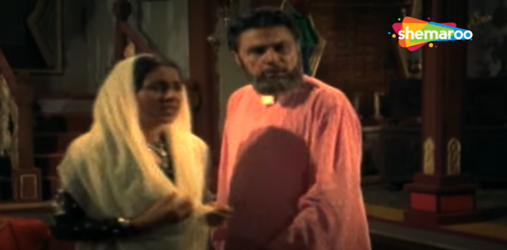
Finally convinced, Zabak meets Zainab for one last farewell meeting. They’ve just about reached the end of their soulful song when the Sipahsalar attacks. Zabak is taken prisoner and dragged off; the next we see him, he’s in chains in the public square; his father too has been chained to keep him from trying to help Zabak.
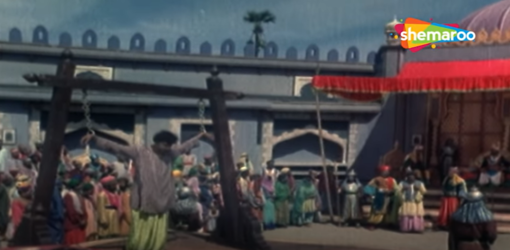
Zabak’s father is a highly-strung character, and when he sees that no amount of pleading or emotional blackmail is working on the Lord of Isfahan, he flings himself onto the upright sword of a nearby soldier, and that’s it: curtains for Dad. Zabak and his mother shed many tears and scream a lot, but the Sipahsalar and Zainab’s father aren’t listening. They, anyway, have made a pact: the Lord of Isfahan has promised to give Zainab in marriage to the Sipahsalar if he will rid the city of Zabak, even though (this is rather undiplomatic, addressed to a future son-in-law) he regards the Sipahsalar as a tattle-tale (“chugalkhor” is the exact word used, which somehow always makes me giggle).
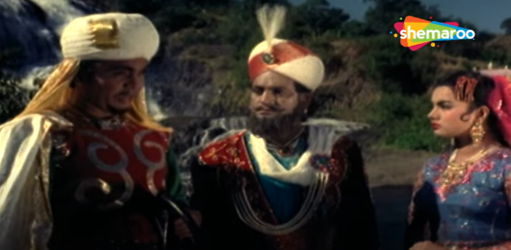
Zabak, having been whipped thoroughly, is flung out of Isfahan and the city gates closed in his face. He is now an exile. Soon after, wandering through the wilderness, Zabak sees a woman (Sahira) being abducted by a villain. Gallant Zabak, of course, comes to her rescue, and (equally ‘of course’) the woman, whose name is Samina, immediately begins to make eyes at him.
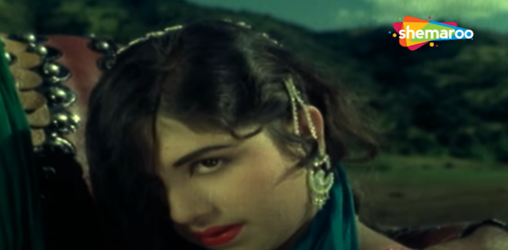
Samina’s father turns up right after with a gang of his cronies. This man (BM Vyas) is someone Zabak has met briefly before in Isfahan, and whom he knows as a merchant, Usman Shah Saudagar. Usman Shah Saudagar now reveals his true colours: he’s no merchant, he’s the chief of a gang of bandits, and now they have their eyes set on Isfahan as a prize. Usman Shah invites Zabak to join them, but Zabak is reluctant: Isfahan is his hometown, his birthplace: how can he join in plundering it?
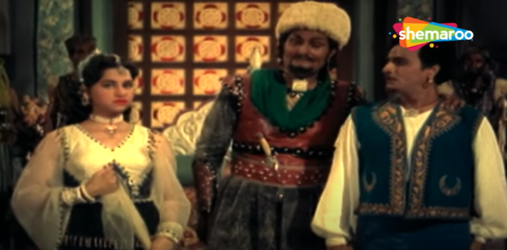
Just then, though, one of Usman Shah’s scouts arrives, bringing the news that the following evening, the Sipahsalar of Isfahan will be marrying Zainab: many festivities are planned, all of Isfahan will be partying. If Usman Shah’s bandits attack then, they will catch Isfahan with its pants down, so to say.
The realization that by joining Usman Shah’s troops he might save Zainab from a fate worse than death spurs Zabak to throw in his lot with Usman Shah.
So Usman Shah and Co, including Zabak, attack Isfahan. There is much turmoil, and (as they’d imagined) Isfahan is caught unawares. Zabak manages to stab the Sipahsalar, seemingly to death, but the wily Sipahsalar is far more cunning than Zabak had imagined: he plays possum, springing up and revealing a breastplate under his tunic once Zabak has gone (how Zabak didn’t feel that under his blade, going in, isn’t explained).
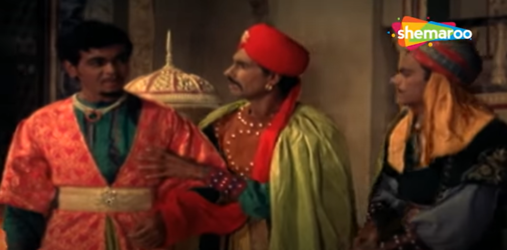
Other stuff happens. Zabak, hurrying to a mosque nearby, sees his mother there, now looking really ravaged. It emerges that she put out her own eyes after the death of her husband and the banishment of Zabak. What is there to see in Isfahan now, is her reasoning (which, to me, smacks of cutting off one’s nose to spite one’s face). Thus, she can’t see Zabak and is only told by an old fakir nearby that there’s one of the bandits here, with a message from her son.
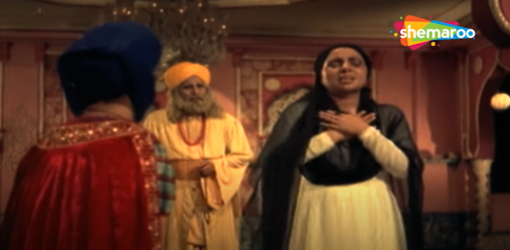
But Mummy flies into a fit of indignant self-righteousness at this: she wants nothing to do with any bandits who have pillaged her Isfahan, and if her son has joined hands with the bandits, she doesn’t want to have anything to do with him either. She absolutely refuses to hear anything, and Zabak is most disheartened. Also beginning to feel rather guilty that he joined Usman Shah in attacking Isfahan, even if from Zabak’s point of view, it was in a good cause.
Unfortunately for Zabak, it’s not as if he’s been able to rescue Zainab, either. One of Usman Shah’s minions, a one-eyed man with a peg leg, has managed to kidnap her and whisk her away back to Usman Shah’s hideout…
… where, as it happens, there is great stress, because in the violence at Isfahan, Usman Shah has been badly injured: an arrow has pierced his chest, and his hakims are too jittery about removing it. A little here and there, and bye-bye, boss. But Zabak, having trained under his father, steps forward to help. And, naturally (given he’s the hero) he succeeds, to the relief of all concerned. Usman Shah is very grateful and offers Zabak whatever he wishes.
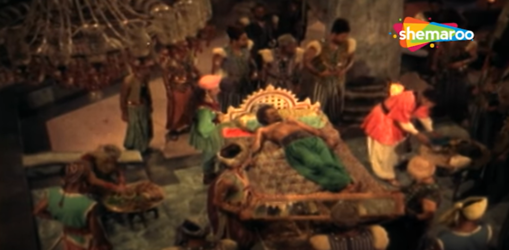
Zabak gets to call in this debt soon after: because the chap who carried away Zainab now brings her to Usman Shah’s court and asks to be allowed to marry her. Usman Shah is very amused that this man has claimed a beauty like Zainab, and agrees to let him have her. Zabak, however, intervenes and says Zainab is his fiancée, so…
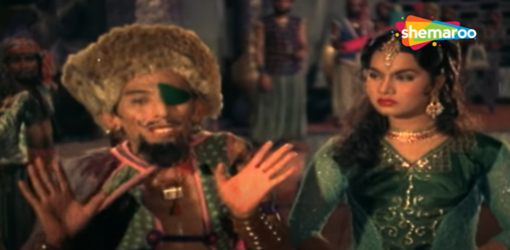
Usman Shah has a good laugh at this and decides to leave the choice to Zainab. Very enlightened, but I wish he’d decided this long before and Zainab hadn’t been treated like a chattel all this while. Anyway, Zainab gives Zabak a shock by saying that the man she had loved hadn’t been a traitor who happily betrayed his own hometown: so she will have the one-eyed, one-legged bandit, thank you.
And this, mind you, isn’t even anywhere close to halfway through the film. There is lots more to come: adventure, angst, romantic songs, some rather pointless slapstick comedy on the part of Zainab’s friend/maid Salma (Krishna Kumari) and the bandit (?) who carries her off and whom she falls for.
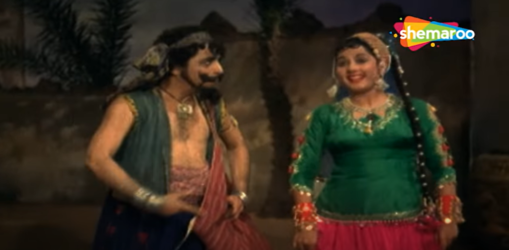
There are boots of all colours.
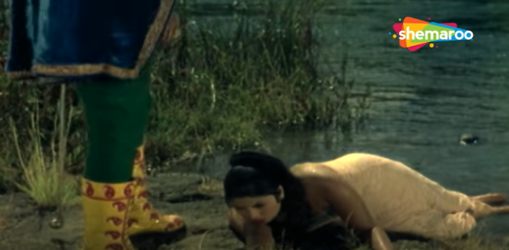
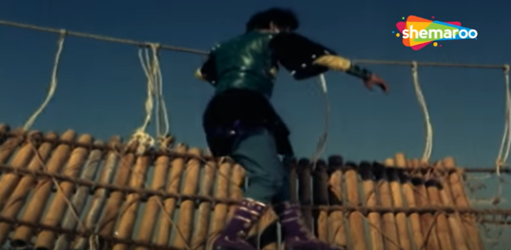

There are two songs, not even just one, that accompany medical procedures. Or one medical procedure and one quasi-medical mumbo-jumbo in which Zabak channels lightning into a metal helmet, with phuljhadis (sparklers) going off all around in an attempt to restore the memory of an amnesiac prince (Manhar Desai).
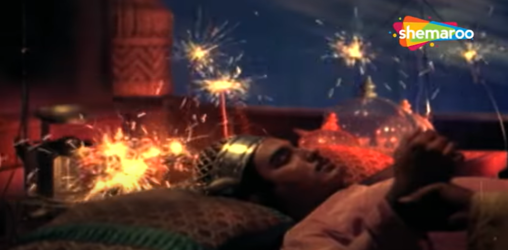
Zabak isn’t the sort of film, à la Ab-e-Hayat or Parasmani or Hatim Tai, that were pretty standard fantasy adventure fare in the 50s and 60s. There are no flying carpets, no pretty fairies and no demons, water-of-life or other fantasy elements (though that amnesia treatment, mentioned in the previous paragraph, probably does edge close to fantasy). It is, instead, a story about love, enmity, ambition, greed, lust, and much more, all in a world of very fast-paced adventure.
What I liked about this film:
The overall ‘let’s enjoy ourselves’ feel of it. Everything’s going at a hectic pace, there are twists and turns aplenty, and it’s all very complicated, but all the actors and actresses seem to be enjoying themselves a good deal. Homi Wadia, who directed Zabak, had a long track record of these action-packed, frantic-pace films (all the Fearless Nadia films, which starred his wife, plus others like Ali Baba aur Chaalees Chor, Hatim Tai, Aladdin aur Jaadui Chiragh, etc) and this one is a fairly enjoyable offering in that category.
The music, by Chitragupta (to lyrics by Prem Dhawan), is of special note. The most famous song from Zabak is Teri duniya se door chale hoke majboor but there were others here too that I liked, including Jaane kaise chhaane laga nasha yeh pyaar ka, Mahalon ne chheen liya bachpan ka pyaar mera, and the beautiful naat, Humko bhi de de sahaara do jahaan ke baadshah.
What I didn’t like:
The low production values, which really pulls this one down. The sets are cardboardy, the plants and flowers patently false. The clothes are all rather gaudy velvet and satin with plenty of tinsel, and the makeup is just too loud. The overall effect is not of grandeur (as in, say, many of the Mughal period dramas of the 50s and 60s) but of a loud garishness that is more reminiscent of theatre than anything else.
Still, entertaining.


Madhu,
I had mixed feelings about the film as I read your review. I started with some curiosity to look up the film: I can stand gaudy colours and cardboard sets, but I am bugged by bad print. Then I came to the mother gouging out her eyes, and Shyama choosing the bandit. In spite of your good review and very good songs, my desire dissipated.
The Daddy, WM Khan, I believe is the person who has the credit of singing the first ever Hindi film song in ‘Alam Ara’ (1931) – ‘De de khuda ke naam par de de’. The full print of that history-making film is not available, but short clips of that song are available on the net. WM Khan later played character roles in several film. I think ‘Ae mere pyare watan, ae mere bichhde chaman’ was picturised on him. He reprised ‘De de khuda ke naam par’ in a 50s film, also named ‘Alam Ara’.
AK
LikeLiked by 1 person
I do recall that WM Khan sang for the first Alam Ara, but I hadn’t known about the remake or his reprisal of the song there. I must look for that, thank you for telling me about it. And yes, he did lip-synch to Ae mere pyaare watan: such a wonderful song.
LikeLike
The film seems like it is quite over-the-top based on your description :-) I have come to see the bad sets and garish outfits as par for the course with a lot of Hindi (and Tamil) films of that period. So this still seems interesting – and the music is nice.
But my big question – you watched the film for Shyama – who I like quite a bit as well (Mahipal not as much). So how does she fare in this film? Or is she relegated purely to being eye-candy?
LikeLiked by 1 person
Sadly, Shyama does get relegated to mere eye candy. A pity, given that she actually acted in several films that were very heroine-centric, like Do Behnen and <IShrimatiji. This one was really Mahipal’s film more than hers.
LikeLike
If not for anything else, I am thinking of watching it for songs, which I like a lot!
:-)
LikeLiked by 1 person
Yes, the songs are really good!
LikeLike
back in Lockdown days, I heard on FM one of its songs, dont remeber the name, but as i browsed it the name of the film popped up!, i recognised the film from there.
so this is a typical costume drama with shallow intrigue and fighting and singing??’
hope so.
LikeLiked by 1 person
Yes, exactly what you’ve described, shallow intrigue, fighting, singing. All very fast-paced, so it’s fun, really.
LikeLike
Zabak is an iconic film from an age when even I was in elementary school.
We enjoyed it immensely because the film was a costume drama and Nagpur had the most delicious mid-movie snacks.
Dare I confess in the form of Beef Chops.
Zabak was on the Classic channel recently. A decent copy.
Happy to report that it was equally enjoyable. Partly nostalgia but mostly due to an uncomplicated script and really funny special effects, not to speak of Mahipal’s acting.
All speaking of less exacting times and a more civilised society.
Thanks DustedOff.
LikeLiked by 1 person
Thank you for sharing your memories of this film! Yes, it’s definitely an enjoyable film. Not perfect, but perhaps that’s part of the charm.
And, those beef chops – oooh. :-) I am envious. All we ever got in movie halls was popcorn, and not that great either.
LikeLike
I had watched the songs of Zabak in Chitrahaar on Doordarshan (during the eighties) and listened to them on Akashvani but never could understand the meaning of the title of the movie. Your description is wonderful and if it’s entertaining, I don’t see any reason not to watch it. Will catch it soon. Thanks for familiarizing me and others with this gem from the bygone era.
LikeLiked by 1 person
I hope you enjoy it, Jitendraji! It’s pretty entertaining. Do let me know what you think of it.
LikeLiked by 1 person