
In its category for Fewest actors in a narrative film, the Guinness Book of World Records begins the list with this:
“Excluding monologues, the only narrative films with a single cast member have been Yaadein (India, 1964), written, directed and produced by Sunil Dutt (India), who was also its only actor….”
(Only two other films are listed in this category; one is the 2002 French-American production Lettre; the other is the 2004 Kannada film Shanthi).
I have known about Yaadein for a long time now; it was aired on Doordarshan when I was a child, and I remember my parents watching it. I wasn’t allowed, because this is one of those rare Hindi films from that era which had an A certificate. I do recall, though, my parents telling me that it was a unique film, with only Sunil Dutt in it.

The film has not just one actor, it is also set in an enclosed time and space. Everything happens over the period of one night; and pretty much all of it takes place within the confines of a single home, that of the protagonist Anil (Sunil Dutt). Some scenes, as you’ll see from this review, are placed in other settings, but because of the way those settings are evoked, they may as well be just another room in Anil’s home.
Yaadein begins with Anil returning home late one night. Outside, a storm is brewing; this is reflected in Anil’s own temper, brimming over as he comes in, calling out for his wife Priya and their children Pawan and Geeta.

Nobody is at home. Anil checks every room, and comes to the conclusion that Priya has left home with the children and gone away. He’s beginning to rave and rant, when the phone rings. It’s a friend named Kuldeep (I can recognize Rajendranath’s voice; he is credited, along with several other people, including Nargis, Sanjay Dutt, and Shammi, in Yaadein). Kuldeep wants to talk to Priya Bhabhi, because he has good news to share: he is getting married, and all the credit for that must go to Priya. Priya has made home such a haven for Anil that Kuldeep, long averse to getting hitched, has decided that married life is worth a shot.
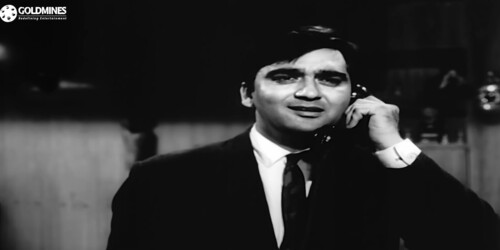
Anil tells Kuldeep of Priya’s having left home with the children, and Kuldeep laughs it off. She’s probably taken Pawan and Geeta to the cinema. They’ll have a good time and be home soon.
Kuldeep’s phone call lightens Anil’s mood somewhat. He convinces himself that yes, that’s what has happened; there’s a perfectly innocuous reason for the house being empty…
And then, there’s another phone call, this time from a woman named Shyama. From the conversation that follows (Anil admonishes Shyama, telling her she shouldn’t call home, because Priya is getting suspicious; call only at his office), it’s obvious that Anil is having an affair with Shyama. Exactly what the nature of this extramarital relationship is, isn’t clear; but Shyama rings off soon enough, and Anil takes himself to the bar counter, to have a drink.

This evening drink is clearly a habit with which Priya is familiar: tucked away behind a bottle, Anil finds a short note from her. It’s as he suspected: she’s had enough of him, she can’t take it anymore. So she’s taken Pawan and Geeta and gone away.
Priya’s note becomes the trigger for Anil’s yaadein—his memories—over the rest of the evening. It initially makes him blow his top: who on earth does Priya think she is?! Anil fumes, throws things about, gets furious and goes into the kitchen to make himself some tea… and then, forgetting to turn off the tap, allows the water to overflow out of the sink while he sits at the table and shouts out his rage. The kettle boils over, the kitchen floor is awash in water, and Anil is just sitting there, remembering all the past hurts.

How he and Priya had an argument that morning, how they accused each other of unfaithfulness and generally failing at being a good spouse.
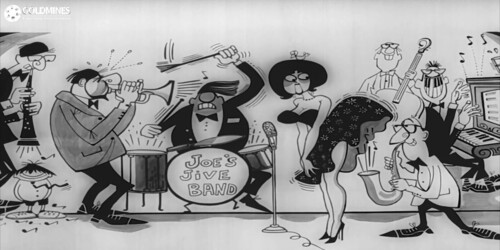
And, gradually, into memories further back. Their first meeting, at a restaurant with the band playing in the background and the only vacant chair available being one at the table where Priya was sitting…

From here, Yaadein traverses the years, telling the story of Priya and Anil: the first flush of heady love, the aching desire, the romance. The marriage and the coming of children. Anil’s first meeting, at a party, with Shyama. Then, over time, the way the marriage develops cracks.
All of it is shown through not just the soliloquy of Anil, but through the creative use of backdrops to indicate various settings, various moods, even other people. For instance, the party where Anil first meets Shyama is evoked through the abundance of large balloons, most of them with human caricatures painted on to them:

When Anil first becomes a father, his joy at receiving the news is shown against a backdrop of what may be a hospital ward.
Nobody else is shown (except Nargis, as Priya, in a very brief silhouette at one point). But their voices are there, from Priya’s to Pawan’s, Kuldeep’s to Shyama’s, the doctor who congratulates Anil on his baby’s birth, various guests at the party where Anil first meets Shyama…
And there is Priya, not just an important voice, heard frequently in flashback conversations, but glimpsed in other ways too: through her jewellery, which she’s left behind. Her wedding sari, still hung up in her cupboard. Her house coat, lying on the bed. Her comb, with a great big knot of tangled hair caught in its teeth (very untidy).
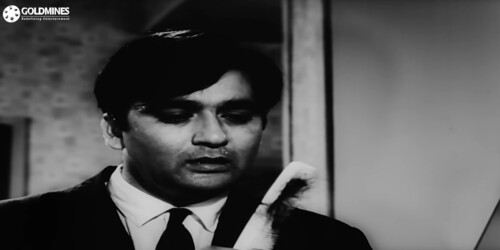
Almost each of these objects evokes a memory for Anil: they remind him of specific instances, of conversations with Priya, ranging from a suggestive bit of pillow talk (on their anniversary, which Anil has forgotten) to a heated argument, with Anil accusing Priya of neglecting him, and his needs, because she’s too busy being mother to Pawan and Geeta.
Yaadein ends up not just being a trip down memory lane for Anil, but more: a memory of what once was, of how he has changed, how their circumstances have changed, and more. There is a change in emotion as the night progresses, from Anil’s sense of self-pity and anger, to a dawning realization of his own culpability, his guilt and remorse.
What I liked about this film:
The creativity of it. All said and done, this is for me the main highlight of Yaadein. When one is so used to seeing a huge cast of characters, sprawling narratives and multiple plot threads, a film that has only one actor, that takes place within the confines of a single space and spread over just one night, with everything coming together as the memories of just one person—that film does stand out. It’s different. In an odd sort of way, this reminded me of some of the very creative European films: the experimentation, the creativity, the pushing of boundaries.
The most interesting aspect of it all is how the director (Sunil Dutt himself) manages to convey different settings and different characters without ever showing them. The backdrops (some delightful Mario Miranda cartoons included), the balloons, an array of props—from toys to jewellery, clothing to an empty photo frame—are all well-selected and thoughtfully used to represent people, emotions and more.
And Sunil Dutt, while slightly hammy in places, is generally able to pull it off as an actor.
Lastly: one song, which I liked a lot. Radha tu hai deewaani is one of two songs sung by Lata Mangeshkar for Yaadein. Anand Bakshi wrote the lyrics for Vasant Desai’s tunes for this film; there’s also a brief bhajan (I think?) sung by Mahendra Kapoor without any supporting musical instruments, but that’s it.
What I didn’t like:
The way the film builds up to a melodramatic climax. I can see how that proposed end to the film would work: why and how Anil’s character would be driven to do what he does—but I wish it had been less melodramatic.
And, the end.
Spoilers follow:
The end, to me, seemed like Sunil Dutt chickened out and decided to conform to the predictability of commercial Hindi cinema and its norms. A husband and wife, torn apart by conflicts of interest (her primary focus is now her children; he demands her attention and is huffy at not getting it) and by infidelity, come together again, repentant and loving once more.
All very sweet and happy, but this just didn’t seem convincing to me. For one, Anil is the only one who’s gone through all these revelations, has had these realizations as a result of his night-long musings; what has gone through Priya’s mind in all this while, we do not know. Oddly enough (and predictably enough, in most mainstream commercial Hindi cinema), Priya blames herself for Anil trying to commit suicide. She weeps and tries to take all the responsibility for her husband behaving like the entitled man-child he is.
Also, the problems between them—especially Anil’s affair with Shyama—still remain. We can only assume Anil is repentant about his infidelity; we do not know it. And Priya, missing all this while and not privy to his inmost thoughts and his soliloquy, absolutely does not.
How can there be any sort of resolution, really, until all issues (infidelity, conflicting demands, fairly hidebound patriarchal ideas of husband and wife, father and mother) are talked over? At the point where The End is splashed across the screen, one can only wonder if that is what will come next.
Watch this because it’s different, very off-beat.
 Dustedoff
I have watched a feature film without any dialogues (Pushpak), and a film with only 3 actors―single setting (Kaun?), but this one is so creative (must have been very challenging for Sunil Dutt to pull it off. I didn’t even know about this film.
(Didn’t read the spoiler section, in case I get to watch it). :))
LikeLiked by 1 person
I have watched both Pushpak as well as Kaun, and found them both intriguing. I actually think both of them are in their way better done than Yaadein. As someone on my Facebook network commented, Yaadein ends up being ‘gimmicky’, which I think both Kaun and Pushpak manage to avoid by just being so good. Plus, this one (I’ve mentioned this in the spoilers) has lots of problems around the end.
LikeLiked by 1 person
Advance apologies for beginning a comment with a quibble, but as a quizzer and quizmaster, I can’t let the claim by the Guinness Book of Records go unchallenged. 😊
There are at least 3 movies off the top of my head I can reel off that have just one actor throughout the movie.
All Is Lost, starring Robert Redford is one which has hardly any dialogue at all. It’s a marvellous survival tale.
Then there’s Buried, with Ryan Reynolds. If one has claustrophobia, this movie must be avoided.
Danny Boyle’s 127 Hours is yet another survival tale with James Franco.
And yes , how can one forget Castaway with Tom Hanks? And ‘Wilson’. 😁
Having said all that, Yaadein is definitely unique in the sense that it’s a proper cinematic story, narrated cleverly and imaginatively, and not a survival tale like the above movies.
LikeLike
All is Lost certainly seems to fit, but Castaway, 127 Hours, and Buried – from the credits I can see on IMDB – all have quite substantial casts, though I assume the bulk of the film is taken up only by one character. A somewhat different – but still survival – film would be The Martian, which also has one character trying to somehow survive adverse circumstances. Not a single-character film, though Matt Damon is the only one there for a good bit of the film.
LikeLiked by 1 person
Ahem, in case of certain movies, the credits deliberately give a misleading number of false character names in order to conceal the suspense and the twist from the viewer at the start of the movie, and those are reflected in IMDb listings as well.
I will have to check if the movies listed above are examples of this. That would be a enjoyable exercise which I wouldn’t mind at all!
As an aside, I know a couple of really REALLY famous examples of this case of deliberate credits (apart from the ‘solo’ movies listed above) , but I won’t reveal which movies they are from, so as not to spoil it for the other readers. 😊
LikeLike
That’s interesting – I hadn’t known. Frankly, if I were a huge fan of one of the people credited in the film and then discovered that it was there just as a gimmick and they weren’t really in the film, I’d be very annoyed! :D
LikeLike
Nice review. Saw the film many years ago on Doordarshan and remember having found the ending unsatisfactory.
Castaway definitely has more than one actor) character. So has 127 hours even though the primary focus of the film and major share of time is on James Franco.
LikeLike
I’m glad you agree the ending is unsatisfactory – it’s otherwise an interestingly creative film, but could have been so much better.
Thank you for the appreciation. I’m glad you enjoyed this review.
LikeLike
Nice and objective review. I have seen Yaadein and liked it very much. Your citicism is well-taken but the plus points are no less to categorize it as a good movie.
LikeLike
Thank you for reading, and for the appreciation, Jitendraji.
LikeLiked by 1 person
confused,muddled, questions!
I must admit that in my dreams even,i’d never have imagined such a film existed on the earth, that too, a national award winner, that too sunil dutt!
The plot is novel, and execution looks fair from your screenshots, and the shadow concept to wind up is also pretty nice, but i have alot of questions in my head, multiple doubts popped up while reading the article, o that in fear that i may forget them, i jotted them down :))
thankyou for the blog lovin’ it as always
LikeLiked by 2 people
There are indeed other films like this – I’ve mentioned two others from the Guinness Book listings in the introduction. Also, if you read the comments, another reader has mentioned a few others.
There’s no vulgarity, but there are somewhat ‘mature’ themes, for instance there’s the suggestion of frustrated sexual desire, when – on their wedding anniversary, Anil ends up alone in bed while his wife is attending to household chores and looking after the children. It’s not vulgar, but children may not grasp the idea. Overall, too, I think the gist of the film – with adultery, dynamics in a marriage, and so on – may be too mature for children to understand.
This, as I’ve mentioned, is a film that I knew about since I was a child: it was aired on Doordarshan years ago.
The Gujarat trip was very nice, thank you! I wrote three posts about it. The latest one, about the Little Rann of Kutch, is here (and there are links in it to the earlier two posts):
https://madhulikaliddle.com/2024/02/05/the-lo-goes-to-the-little-rann-of-kutch/
LikeLike
Thanks for the links!
LikeLiked by 1 person
You’re welcome! Happy reading, I hope. :-)
LikeLike
I remember liking <i>Yaadein</i> when I had initially watched it. It was quite a risk for Sunil Dutt to take at the time, so I can only assume that the ending was meant to placate box office concerns. Nice review, Madhu.
LikeLiked by 1 person
Yes, I thought the same too, that the ending was meant to ‘placate box office concerns’ (well put!) It still tanked, though, I think – probably too outre, anyway. Thank you for reading, Anu: I’m glad you enjoyed the review.
LikeLike
Madhuji, thanks for this review! I hadn’t known of this one. But it seems quite serious. Must watch it only when one is in the doldrums, perhaps.
LikeLike
Thank you for reading, Anitaji. No, I wouldn’t recommend watching this when you’re in the doldrums (in which case, something more cheerful, like Dholak or Dekh Kabira Roya might be recommended). This one is pretty grim.
LikeLike
I never knew of this film! How interesting! This must’ve been quite a novel idea…sorry to hear the movie tanked…and yes, I agree the ending seems like a copout, but I’d tolerate it just because SD tried something so different. Always a HUGE fan of him, anyway.
LikeLiked by 1 person
Yes, Sunil Dutt is a big favourite of mine, too. Such a good actor, and so versatile. Watch this one just for him, literally! :-)
LikeLike