
Aka Parviz-Parizaad.
I had heard of Lal-e-Yaman (literally, ‘Rubies of Yemen’, though why it’s so named, I couldn’t tell) before, but it wasn’t until I read Manek Premchand’s Director’s Chair: Hindi Cinema’s Golden Age some weeks back that I was reminded of it: it appeared in JBH Wadia’s filmography, being the first film he produced and directed, along with his brother Homi Wadia. Premchand described Lal-e-Yaman as an ‘Arabian Nights kind of adventure’, and that piqued my interest.
The story is not explicitly set in Yemen, though it’s probably someplace in the Middle East. The King (Jal Khambatta) of a kingdom has recently remarried after having been widowed. He has a ten-year old son, Parviz (?) from his first wife; now the second wife (Mohini) is sitting beside him when a dervish arrives. This man prophesies that the new queen will wreak havoc, that the king will be much plagued because of her.

… a prophesy for which he is thrown out of court, of course. [The new queen shrieks in indignation at her husband, in court: “Kyon ji, sunte ho?”. A first for me; I’ve never seen onscreen queens behaving in this shrewish fashion in public. Also, Mohini’s voice got on my nerves: she was shrill and screechy beyond belief].
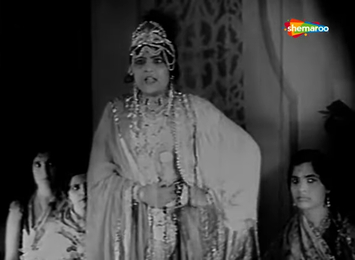
The scene now shifts to ten years later, still in the court. The king has become old and feeble in the intervening years; beside him is Parviz (and yes, it is actually Parviz, not Parvez; everybody even addresses him as ‘par-veez’; the actor playing the adult Parviz is Karimja). The queen is also present, as is the son she has borne in the meantime, Nadir (‘naa-deer’; played by Firoz Dastur).
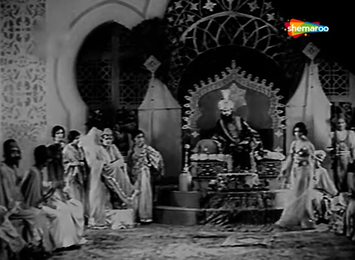
In court comes a man (?) who has brought along a heavily veiled girl with him. This is his daughter, and the man accuses Prince Parviz of having raped her. As evidence, Parviz’s handkerchief, which the victim’s father alleges was left at the scene of the crime, is offered.
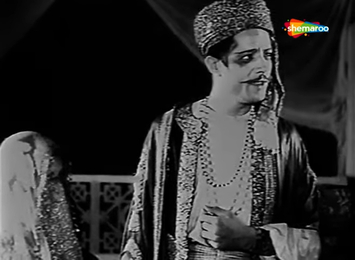
The girl herself says nothing, but her father’s testimony is enough for the king. He is furious with Parviz, and immediately orders his men to arrest the prince and imprison him.
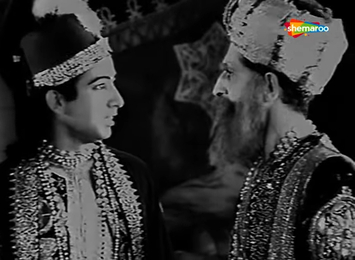
Parviz’s wife Lala Rukh (Kamla) is given this news by her sister-in-law, Parviz’s half-sister Mehru (Mayuri). Lala Rukh’s reaction is to laugh it off: this is a joke. Her husband would never even look at another woman, let alone molest her. [Kamla is a little odd. There’s something quite masculine about her, not just in the shape of her face but in the way she carries herself. I spent most of this film convinced this was a male actor in drag. I am still not absolutely sure].
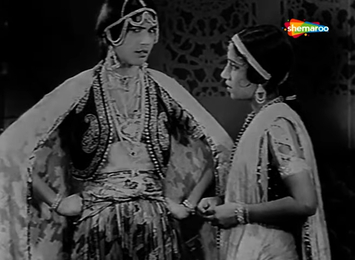
… an assertion which, we discover, is actually the truth. Parviz’s stepmother is in a hushed conference with the man who accused Parviz of rape, and it is obvious that she is the one who instigated this accusation. Her aim is to have her son Nadir sit on the throne, so the first step towards that goal is to have Parviz removed from the path.

Various things happen now. Parviz’s sister Mehru goes off to meet a saintly old man, a peer (Master Mohammad). She pleads with him to rescue Parviz, and the pir agrees. In prison, the queen’s minion comes to Parviz, trying to poison him by offering him a drink. Parviz [who is really too gullible, and by all the rules of the Darwin Awards, should be allowed to rid the earth of himself] keeps raising the drink to his lips but is interrupted again and again by his would-be poisoner, whose conscience is pricking him.
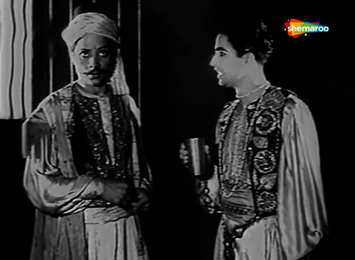
Eventually the man stops Parviz from drinking the poison and confesses his guilt. The queen, bursting in just then, is furious at this treachery and stabs her former abettor dead.
He’s barely dropped to the ground, dead, when Mehru comes in [what sort of prison is this, a thoroughfare with no guards to be seen, no barred doors, nothing?]. Mehru sees the queen brandishing a dagger, and immediately faints. Fortunately for Parviz [whose stepmother is now pretty much ready to kill him, too], the pir appears.
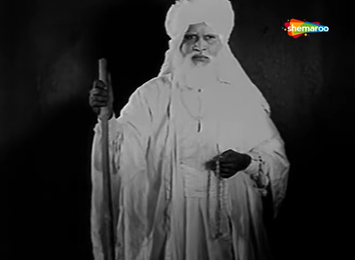
The pir’s magic works swiftly: he changes Parviz’s chains into garlands of flowers, which Parviz is able to rip off easily; and then he escorts Parviz out of the prison, through a door which he (the pir) has conjured up. The evil stepmother can only stand and stare, fuming all the while, as her plan is foiled.
Lots of stuff now happens in quick succession. The pir gifts Parviz a magic dagger. All Parviz has to do is draw it out of its sheath, and the dagger will turn him invisible. It will then also help him get rid of whichever enemy he wants to kill. Armed with this dagger, Parviz ventures forth into the world, and soon comes across a sort of ape man (Boman Shroff, not that you can see any facial features here). Parviz draws out the dagger, fells the ape man, and moves on—into a palace where he finds a princess named Parizaad (Padma).
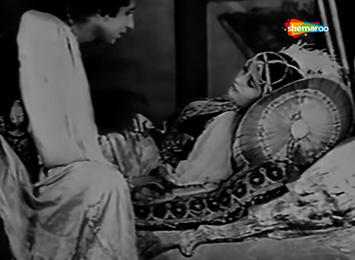
Parizaad, who has been imprisoned here by a djinn, is controlled by a pair of sticks stuck into the headboard of the bed on which she lies: pull the sticks together and Parizaad awakes; push them apart and she goes back to sleep. Parviz accidentally pulls the sticks together and ends up waking Parizaad. They fall in love with each other [Parviz has conveniently forgotten that he is married]. A talking parrot that sits on a perch in the nearby window keeps watch: it’s sympathetic to Parizaad.

When the djinn returns (Parviz quickly hides himself), he gets Parizaad to dance for him, and then proceeds to tell her how he may be killed: his soul and his life are here, encased in the flowers of this plant. What timing! Soon after, the ape man [he wasn’t dead after all] arrives, and blurts it all out to the djinn, who is his master: how an intruder stabbed him—and there he is!
To cut a long story short, Parviz manages to kill both the ape man [finally] and the djinn [those flowers, which Parizaad helps him by plucking].
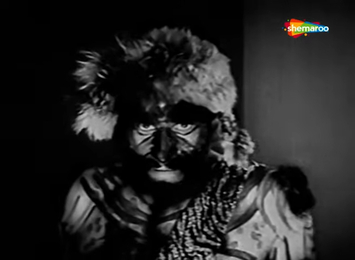
Meanwhile, Parviz’s wife, Lala Rukh, has donned white robes to show what a paak-daaman she is [her words, not mine] and has gone to the pir. He gives her directions to find Parviz, and, to help ease Lala Rukh’s path [this pir is a canny man and realizes how much easier life is for a man], he gives her a disguise as a man. For now, Lala Rukh looks believable in her get-up.
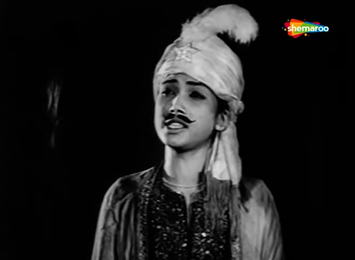
Also, meanwhile, the king has learnt the truth: that his queen is the one to blame; that Parviz, poor fellow, was innocent; and that basically he, the king, has committed a grave injustice by imprisoning Parviz.
To compensate, the king now proceeds to:
(a) have the queen blinded (she ends up looking very weird)

(b) banish the queen
(c) go mad
The last bit is very disconcerting for poor Nadir, who is now the only family member left with the king. One moment, the king is losing his temper at Nadir and threatening to execute him because Nadir is the spawn of that evil wretch [I paraphrase, since the original is in Urdu], the queen. The next, he’s weeping and telling Nadir that of course it’s not Nadir’s fault, the poor child.
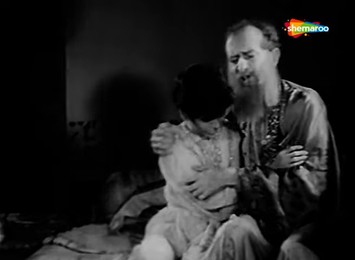
Nadir keeps his spirits up [and tries to keep Daddy’s spirits up] by singing all he can. He just sits there and sings. And sings. And then sings some more.
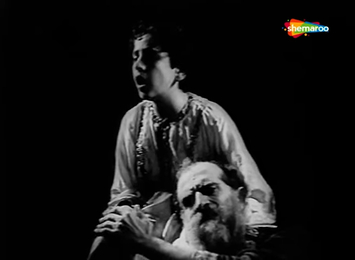
Anyway, that is the scenario. Manek Premchand described it well: it is an Arabian Nights-style fantasy, what with djinn, talking parrot, and the pir whose devotions have resulted in his magic powers. There is also the romance [rather unconvincing, if you ask me] between Parviz and Parizaad . There is the mad king and the singing prince, and of course all the stress people must go through before evil can be completely defeated and good can triumph [occasionally at the expense of other good].
Some general observations about this film:
I am going to resist the temptation to put in a ‘what I didn’t like’ section for Lal-e-Yaman, because even as I was watching this film (in instalments of 15 minutes; I couldn’t manage to sit through more at a time), it occurred to me that my impatience with this film was a result of viewing it through a lens of later years. Not necessarily a 21st century viewpoint, since I happily watch Hindi films from the 50s (and in some cases later 40s onward) with a good deal of satisfaction.
What struck me was that Lal-e-Yaman, though JBH Wadia had been inspired by the many Hollywood adventure films he’d watched and admired, owes as much to Parsi theatre. And to the silent films that had been a precursor to films like this one. True, the adventures, the magic and fights and a little of the interesting camerawork (some very tight close-ups, for example) are an obvious tribute to the American directors JBH Wadia so admired; but the songs, the acting, and the tropes are all very desi.
The acting is one of those elements that really struck me as a harking back to both silent cinema and theatre. The style of dialogue delivery—dialogues spoken really loud, and in a theatrical way (‘declaiming’ is how I’ve heard it put)—reminded me of old-fashioned plays. As did the exaggerated expressions of many of the actors: these were people, I thought, used to making sure they were seen and heard in all parts of a large hall or tent.
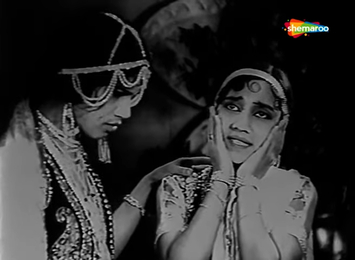
But while they were loud, their diction left a lot to be desired. Even actors playing major characters like Parviz and Parizaad, for instance, have voices that grated on my nerves: squeaky, shrill, poorly modulated, and generally very flat. Jal Khambatta was one of the very few whose acting stood out as relatively natural.
Another carry-over from theatre might be the abundance of songs in Lal-e-Yaman: there are loads of them, and most just a couple of minutes long. With lyrics by Munshi Aashiq and music by Joseph David and Master Mohammad, the best songs have been sung by Master Mohammad himself (he played the pir, as I’ve mentioned) and by Firoz Dastur, who played Nadir. Firoz Dastur, in later years to be known as Pandit Firoz Dastur, was a renowned classical vocalist of the Kirana Gharana who had trained under Sawai Gandharva. At the time Lal-e-Yaman was made, Firoz Dastur was only fourteen years old, but his mastery over his voice is admirable even at such a young age. Watch this film for his singing. And, if you’re a little irreverent (like me), for the fact that there’s tons of unintentional humour here. You’ll get some good laughs out of it, if nothing else.
 Dustedoff
This looks very old. The photos look like stills of a theatre (but of course, making a film back then was a big deal). I can understand why you could not sit through it. :))
Names of the characters are very interesting.
LikeLiked by 1 person
I did sit through it, eventually. But could only handle 15 minutes at a time! :-D It’s seriously dated. But I believe it was a big hit when it was released, so just shows… of course the novelty must have been a very major factor, given that this was one of the earliest talkies in India.
LikeLiked by 1 person
I laughed and laughed through your review (and at the screenshots) because I was imagining your reaction to certain portions. I actually visualized thought bubbles over your head. :D
I think I will pass on this one; your review, I’m sure, is more entertaining than the film.
LikeLiked by 1 person
I actually visualized thought bubbles over your head. :D
Hehe! Yes, this was what Greta would call ‘taking one for the team’. ;-) I completed this with a sense of achievement – at several points in the film, I didn’t know if I’d be able to sit through it!
LikeLike
I am kind of obsessed with early Indian movies. So, I obviously enjoyed your review a lot. It’s a pity that we will probably never get to see so many of the pre-1940s movies.
Now, coming to the actress playing Lala Rukh, as far as I seem to remember, she is Kamlabai Gokhale. Her mother was Durgabai Kamat, one of the first female actors to appear on the Indian screen. The late Vikram Gokhale was her grandson.
LikeLiked by 1 person
I’m so glad there’s someone else here you finds old Hindi cinema fascinating. :-) And yes, I totally agree: it’s such a shame that so few of these now survive. There are several of these films I want to see (as also silents: one that’s been on my list for a long time is Bambai ki Billi, starring Sulochana in multiple roles; I think it’s one of those gone-forever films, but I am always hopeful).
Thank you for the bit about Kamla. That is interesting!
LikeLike