
Does Udan Khatola hold some sort of record for largest number of love/lust triangles?
Here’s a rough count:
There’s the unnamed aviator, the pardesi (played by Dilip Kumar) who is in love with the local peshwa’s daughter Soni. Who, in turn, loves him back.
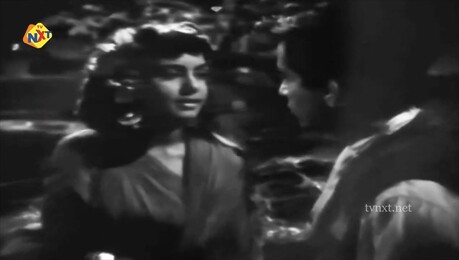
But:
The nasty villain Shangoo (Jeevan) is lusting after Soni and wants her for himself.
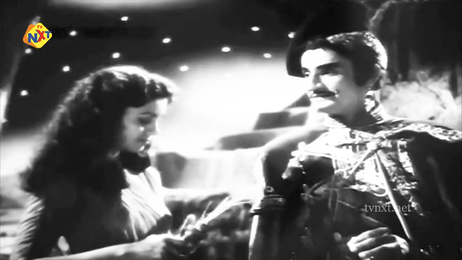
Also, once she claps eyes on the pardesi, the land’s queen, the Rajrani (Surya Kumari) not only falls in love with him, but also convinces herself that he reciprocates. This (given that the Rajrani isn’t one of those shy and retiring types; in fact, she’s definitely bossy) means that she immediately orders the pardesi to move into her palace so that he can woo her all day long.
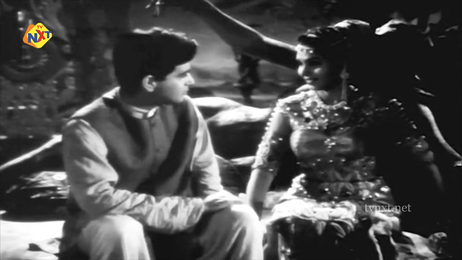
And Soni, all consumed by jealousy, disguises herself as a man and enters the palace to keep an eye on her beloved.
Still in disguise, she bumps into one of the Rajrani’s maids, a woman named Shaamia (Roopmala). This being the sort of film it is, Shaamia finds this very feminine-looking stranger immensely attractive. Ergo, she falls in love with ‘him’.
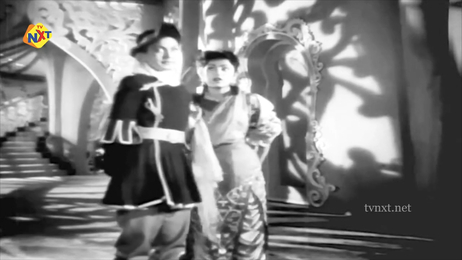
In all the confusion, Soni’s brother Heetu (or Heera, as IMDB lists him, though I definitely think it’s Heetu—played by Agha) also arrives there, and in his attempt to shield Soni from being unmasked, ends up trying to divert Shaamia’s attention… and falls in love with her.
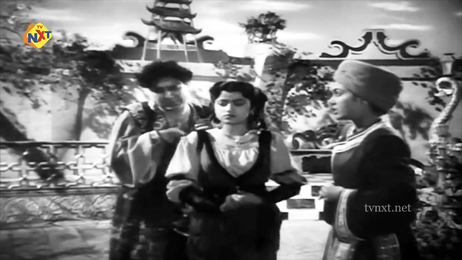
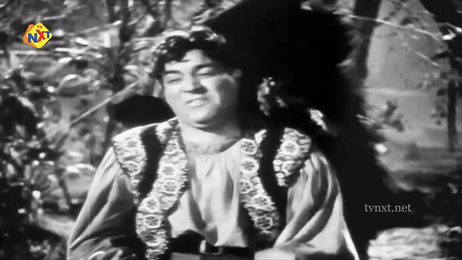
Not that he is without his admirers. In the world outside the palace, Heetu/Heera is assiduously pursued by a woman (Tuntun, in one of her sadly trademark roles) who won’t take no for an answer. Because she loves him, and firmly believes that he loves her back.

As if that wasn’t enough, there’s also one brief scene where this woman is upstaged by a sloth bear, which showers much affection on Heetu/Heera.
How many love/lust triangles there? Did you lose count? I did.
But at least in the process, I’ve given you most of the plot. Just a few details to fill it in, and then I’ll move on to what I liked about Udan Khatola (a couple of things) and what I didn’t like (also a couple).
The film begins with a storm at sea, and a shipwreck in which a lone man (?) is washed ashore. He makes his way inland through a tangle of overgrown undergrowth, toppled trees and general mayhem. He ends up at a hut where a bearded old man (Dilip Kumar, under all that shrubbery) is sitting by himself in front of a fire. The old man lets the newcomer shelter in the room next door.
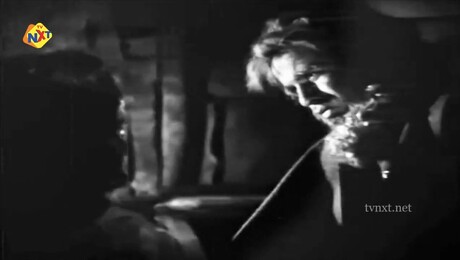
But barely has the man gone into the room than he hears a woman singing a spooky-sounding song. Looking out the window, he sees her approaching, a ghostly but beautiful figure, driving a chariot pulled by two horses, all of them—woman, horses, chariot—surrounded by plumes of mist. There’s something apparently so spooky about it all that the man starts gibbering in fear. The woman, who’s just gotten off her chariot, is spooked by his reaction; she runs back into her chariot and races off.
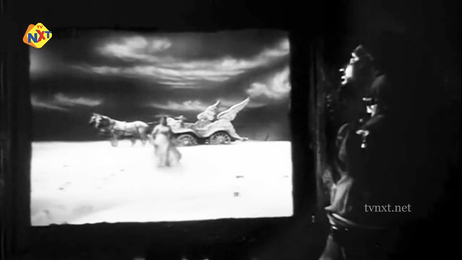
The old man is heartbroken, as well as furious: why did this fellow chase her off? The other man, however, tries to pacify him and eventually asks him what this was all about. The old man, though initially reluctant, agrees to tell him the story, and from here we go into flashback.
… which begins with a song, in the land of Sanga Dev, a rather tyrannical deity whom the local people worship. Sanga Dev seems to be pretty bloodthirsty, as we (and the aforementioned pardesi aviator) discover: if he is displeased about something, he wreaks havoc on the land, and will then be appeased only by a human sacrifice.
But, first things first: how the aviator got here in the first place. He was flying in his udan khatola (airplane) over Sanga Dev’s land, and his plane crashed. Soni, riding out in her chariot with various friends and singing happily, had been close at hand. She and her girl gang had rescued the aviator, Soni had brought him home, and he had fallen in love with her almost as soon as he had opened his eyes.
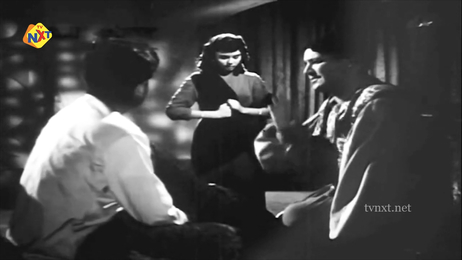
Soni is the daughter of the local peshwa (? Is this Amar?), who also happens to be the high priest. The aviator is warned: this land is not very welcoming of strangers, he had better get going soon. However, the roads are currently all closed and the land is cut off from the outside world, so it’s not even as if the aviator can go (especially since his aircraft is a wreck).

He had better be taken to the supreme power in the land, the Rajrani, who will pronounce sentence and decide what must be done with this man.
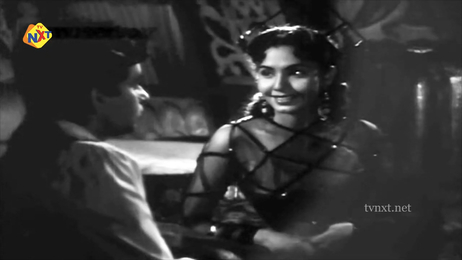
And we know, of course, what happens next. See love triangles galore, above.
Produced by Naushad (who, of course, composed the music for the film), Udan Khatola was directed by SU Sunny, who directed several other Dilip Kumar-starrers, including the weepfest Mela and the delightful-before-it-went-south Kohinoor. Nimmi’s role in the film was supposedly initially offered to Madhubala, who refused because of poor health at the time. The film was dubbed in Tamil and released in 1956 under the title Vaanaratham.
What I liked about this film:
The music. Naushad (with Shakeel Badayuni as lyricist) composed some truly memorable songs for his production: Mera salaam le jaa and O door ke musaafir are two favourites of mine, which I’ve included in several song lists on this blog over the years; but there are other great songs too, such as Hamaare dil se na jaana, dhokha na khaana and More saiyyaanji utrenge paar.
Surya Kumari and Nimmi, for two different reasons. Unfortunately, Nimmi has her usual tragic heroine role, but here I was glad to see that Soni has a bit more of a spine than Nimmi’s characters tended to be endowed with: she has the guts to go after the man she loves, and the guts to stand up to none less than the pretty vicious Rajrani herself.
For me, though, what makes this film memorable when it comes to Nimmi: how beautiful she looks. Nimmi has never been a great favourite of mine when it comes to looks (possibly because few women look gorgeous when they’re weeping through most of a film, as Nimmi sadly ended up doing): but here she looks really lovely in places. Especially in O door ke musaafir.
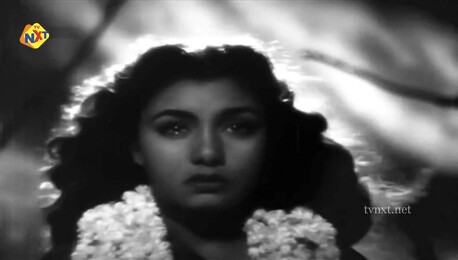
I last saw this film (also the first time I saw it) perhaps about forty years ago. I remembered the rudiments of it, but one person really stood out for me, even back then: Surya Kumari. The dignity, the fire in her eyes, the beauty. Now, watching the film again, I found that it wasn’t as if an impressionable and easily-pleased child me had been lenient. Surya Kumari is all of that: really, to me, she is more the main actress of this film than Nimmi is.
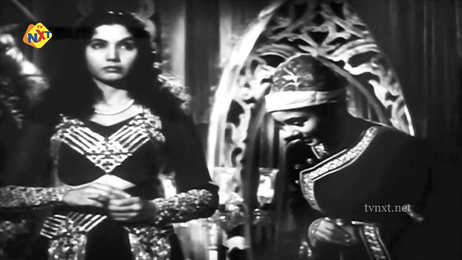
(Incidentally, there’s a very interesting article on Surya Kumari here, by historian/author Anuradha Kumar).
What I didn’t like:
The way it descends into this fatalistic we-must-die-because-we-must sort of stuff that I dislike. A happy ending never hurt anyone, did it?
And, the comic side plot featuring Agha and Tuntun. Why was it even there? Not only is it silly and a distraction, it goes nowhere. In fact, Soni’s brother seems to completely disappear after a certain point, which I found inexplicable: this man seems to be on very chummy terms with his sister; his sister and their father are key figures in the climax (and in the half-hour or so leading up to that), but Heetu/Heera himself has vanished, unaccounted for.
Overall, I didn’t find this irritating the way I did Mela (and the lead actresses and the songs are beautiful)… but I do wish it had been a little happier.
Edited to add:
An anecdote. My father, having read this post, shared an interesting little titbit from his life. In 1955, shortly after Udan Khatola was released, Surya Kumari had made a trip to Delhi. While in the city, she had to visit the Air India Radio studios, where my father’s elder brother—David Vernon, ‘Verni’—used to often be found. Back then, my father and another of his brothers would spend a good part of the summer in Delhi, staying with Verni Tau. Verni Tau, therefore, took his two younger brothers along to meet Surya Kumari at AIR. My father still recalls what a presence she had, and how tall she was (“taller than me,” he adds. He would have been about 17 years old, and went on to be 5’10”, so one can imagine that he would already have been pretty tall by then—which does put Surya Kumari’s height in perspective).
Interestingly, she asked Papa to sing something for her, and Papa chose to sing the aalaap of Aayega aanewaala. “She was impressed,” he says.
 Dustedoff
“A happy ending never hurt anyone, did it?” Exactly.
LikeLike
I especially don’t like this zabardasti ka sad end. If logically nothing else works (like Mughal-e-Azam) I can understand, but this love for forcing a sad end is something I cannot bear!
LikeLike
The songs are simply gorgeous. The story was so muddled. I wonder what the cinegoers in those times thought of such movies.
So few of movies of that era were really good.
LikeLike
You know, my father always looks back at the films of the 50s (not so much the 40s, which I don’t think he watched too much of) and says, “Good music!” At least as far as he is concerned, it’s the music, not the story, which is memorable. I think by the mid-50s there were more films that were entertaining and light-hearted, but this type was still around. :-(
P.S. Do check the end of the post again, please. I have added a fun anecdote that my father shared.
LikeLiked by 1 person
Hi Dusted Off,
Watching this movie is one of my earliest memories as a young kid nearly 40 years ago as well.
I re-watched this several times on Doordarshan while growing up – they would often play this movie.
This is of course before the days of 100+ channels of cable TV, and there weren’t a lot of options.
I agree with your review and assessment.
To me, there are only a couple of reasons to like this movie – the music (of course), and how good Nimmi, Surya Kumari and Dilip Kumar look.
The music is par excellence – classic Naushad – pretty much every song is a gem, although O door ke musafir stands out.
I like Haal-e-dil main kya kahoon and Dooba Taara as well.
The plot is all over the place and frankly interrupts the musical flow of one song after another.
A tidbit about this movie is that this was produced by none other than Naushad himself, under the banner of “Sunny Art Productions”.
So he had a free hand in music composition, and let totally cut himself loose.
The movie had 11 songs, which probably ranks it right up there in terms of number of songs in a movie, along with other Naushad musicals like Andaz, Babul, Pakheeza, etc.
To me, this movie is more about Naushad expressing his music, and then weaving some sort of a plot / story around it as an afterthought.
Naushad produced a couple of other musicals under the banner of Sunny Arts, notable among them is Babul with Dilip Kumar and Nargis.
Similar pattern as Uran Khatola – great music (even more songs than UK), but a forgettable plot.
Thanks for the review and trip down memory lane.
LikeLike
Yes, I’ve mentioned the fact that Naushad produced this, and of course that that allowed him to really showcase his music. Personally, the beauty of the people and of the songs are all that make this film what it is. Babul, I agree, is similar in that sense – looks beautiful, has lovely music, but otherwise boring and forgettable (and so depressing).
By the way, I have added a little postscript at the end of the post. You might like to check it out.
LikeLike
Thank you for the hilarious review of Udan Khatola. The number of triangles, or whatever geometric figure it is, is mind-boggling. I remember only the end of this movie, which was monumental, at least for the eyes of 10 year old, which I was at that time. The exoticism of the movie, which we criticise justifiably in old Hollywood movies, puts me off a bit. Of course the songs are wonderful.
LikeLiked by 1 person
Yes, and thank you for the short biography of Suryakumari. She seems to have been an impressive lady, which your Dad’s anecdote apparently proves.
LikeLiked by 1 person
Yes, indeed – very impressive!
LikeLike
Yes, the end stayed with me too – and I must have been around a similar age, perhaps about 12 or so. But the end and Surya Kumari really remained fresh in my mind.
I agree, it does have that exoticism to it, but I suppose when it comes to Hindi cinema, it doesn’t make an impression on me any longer – there were just so many Hindi films that were doing this stuff, exotifying everything from the West to local adivasis.
LikeLike
Madhu, I agree with almost every point that you made about this one. Music and beauty were the main things that made this film enjoyable. I watched Udan Khatola (or Uran Khatola, as I’ve seen it transliterated more often) maybe a dozen years ago, and I might even have watched it more than once (and certainly watched most of the song sequences many times), but I forgot about most of those love triangles; my mind just drifted away from them. And I guess I didn’t mind the fatalistic ending as much as you did, especially since the fatalism peaked with a song as beautiful as “O Door Ke Musafir.” (And, yes, all the music in this film was beautiful – one of my favorite Hindi film soundtracks.) It didn’t seem quite as bleak to me as Mela, maybe because this film contained so much strange fantasy, which distracted the attention too much to allow it to become a total weep fest. Mela was just relentlessly bleak, one of the most depressing films ever made.
P.S. I guess Nimmi just looks most beautiful when she’s dressed in drag. Though the idea that her drag could fool anyone here was just as silly as that idea is in most classic Hindi films where one of the main characters is supposed to be fooling everyone by dressing in drag.
LikeLiked by 1 person
How did I miss your comment?! Thank you for reading, and for commenting, Richard. I guess the love triangles aren’t really that (the Agha ones actually go nowhere) – but I think that was just my mind, wandering between all the lovely ones and trying to find ways to make the review, at least, not quite as lacklustre as the plot of this film.
I agree totally with your remark about Mela being ‘relentlessly bleak’: I couldn’t have described it better myself. Also that remark about the fantasy in this film rescuing it somewhat from going down the Mela road… yes, I hadn’t realized that, but I think so too. It becomes more fairytale-like, and therefore not quite so gloomy.
Nimmi in drag – LOL. Yes, she does look beautiful and (like every single other Hindi film actress disguised as a man) – obviously not a man.
LikeLiked by 1 person
Landed on your blog after a very long time, nice post.
I’d like to put forward how about doing a review of Daera-1953?
LikeLike
I reviewed it back in 2018. Here:
https://madhulikaliddle.com/2018/01/17/daaera-1953/
LikeLike
Madhuji, compulsive tragedies were in vogue then. Poor Dilip Kumar bore the brunt!
Udan Khatola for me is more about its music than the story line!
LikeLiked by 1 person
Yes, poor Dilip Kumar, indeed! So many tragedies (and that too needless, zabardasti ki tragedies) – no wonder he ended up having to go into therapy and opt to do Kohinoor.
LikeLike
Madu,
Though I am coming late to the Party, I have to compliment you for a very witty review. I had watched it a long back and couldn’t make head or tail of it. In spite of gorgeous music by Naushad, I may not perhaps see it again. Thanks for forewarning us.
AK
LikeLiked by 1 person
Thank you, AK – I’m glad you enjoyed this. Yes, despite the fabulous music, I wouldn’t recommend watching this again. It’s not as ‘relentlessly bleak’ (as Richard describes it) as Mela, but it’s certainly not one of those films that is worth rewatching.
LikeLiked by 1 person
You must have seen it on Doordarshan as a kid (just like me). It is spelled as Uran Khatola in English. Your assessment is spot on. As you have rightly asserted, the songs are the biggest plus point of this movie. And your analysis of the love triangles involved in its story is simply amazing.
LikeLiked by 1 person
Thank you, Jitendraji. I’m glad you enjoyed this. Yes, I too watched this on Doordarshan as a child. Some of my favourite films, I saw for the first time back then.
LikeLiked by 1 person
Gosh, this film is one which made me want to poke my eyes out with a fork. Talk about contrived tragedies! But, oh, the music!
Film lore has it that one of Naushad’s assistants stole his tunes for this film and so Naushad had to work at breakneck speed to finish the score and release it before the stolen tune could be used elsewhere. It was apparently after this film that Naushad became very secretive about his compositions. Can’t say I blame him if this is true.
p.s. O door ke musafir is a perennial favourite of mine, but oh, why did she have to die?
By the way, this is an adaptation / inspired from an obscure Hollywood film called Bird of Paradise. I only realised it when I caught the tail end of the Hollywood film, set in Hawaii, which had the scene of the girl, floral garland around her neck, being taken to a volcano to throw herself in. :)
LikeLiked by 1 person
I hadn’t known either about Bird of Paradise or about Naushad’s tunes having been stolen from right under his nose. Wow! Who’d have thought?
(Some further ferreting around has unearthed the fact that Bird of Paradise was a 1932 film, remade in 1951 with Louis Jourdan as the ‘pardesi‘. Now I am tempted to watch – it’s there on Youtube, though a pretty bad print from what I can see).
LikeLike