
I saw this on the big screen, on August 10, 2025.
Given that getting to see a Hindi film as old as this on the big screen, as a proper commercial release (re-release, in this case), is a very rare treat, it needs to be put up front.
To mark the birth centenary of Guru Dutt, the National Films Division Corporation of India (NFDC) and the National Film Archive of India (NFAI) collaborated to restore and re-release several of Guru Dutt’s films. These were shown at PVR and Cinépolis cinema halls across India on August 8th through to 10th. Left to myself, I would happily have seen all the films that were being screened; but duty calls. August 9th was rakshabandhan, and we had family coming over for lunch. I was busy all through the previous day cleaning and cooking and generally preparing, and then again through half of the next day. But, once our guests had eaten, I scurried off cinema-wards to watch Sahib Biwi aur Ghulam. The following day, I managed to watch Aar-Paar.

Sahib Biwi aur Ghulam I have already reviewed on this blog; so after I’d watched that film, I contented myself with a mini-review on my Instagram account, here. But Aar-Paar, though I’ve watched it a couple of times before, I had never got around to reviewing; so this post was in order.
The story is set in Bombay, and begins with the release, from prison, of Kaalu Birju (Guru Dutt), a taxi driver who had been speeding, had been involved in an accident, and been subsequently jailed. Kaalu’s exemplary behaviour has led to him being released two months before the date he was supposed to be freed.
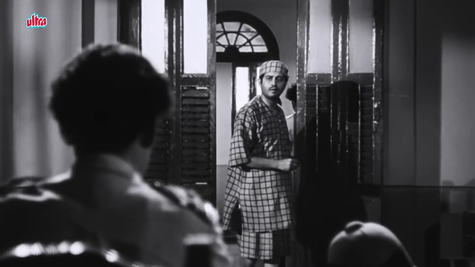
Kaalu’s prison term has meant that he’s lost his job in the meantime. His former boss (Rashid Khan in a delightful cameo) tells him off and boots Kaalu out. Kaalu, however, discovers that his beat-up old taxi is at a nearby garage, where it’s gone for repairs.
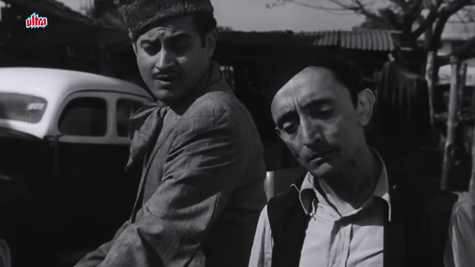
Kaalu goes to said garage, and there stumbles into Nikki (Shyama), who, clad in overalls, is busy tinkering under the car. Kaalu has no sooner seen Nikki than he’s fallen head over heels in love with her, and though Nikki, all flashing eyes and hands on her hips, flounces away from him, it turns out that she is not entirely unaffected either.
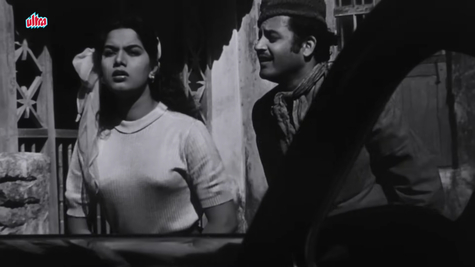
Kaalu is quick to approach Nikki’s father (Jagdish Sethi) and ask for a job; which he gets. Kaalu is bold enough to admit that he doesn’t have a place to sleep, either, so Nikki’s father agrees that Kaalu may sleep in the garage if he likes.
(Kaalu, actually, is not really without friends and relatives. His elder sister—played by Amir Bano—is affectionate and almost motherly in her love for her younger brother; but her husband disapproves of Kaalu, and Kaalu has too much self-respect to foist himself on a household where one person so obviously does not welcome him).

Kaalu’s tenure at Nikki’s father’s garage turns out to be short-lived. While it is useful in allowing Kaalu and Nikki to get to know each other better, this relationship is brought to an abrupt halt when her father catches them one day. Kaalu is immediately dismissed, and finds himself again without a job.
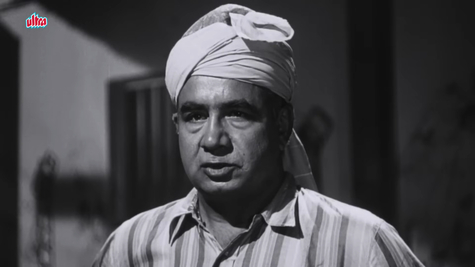
When Kaalu had been leaving the jail and saying goodbye to his fellow inmates, one of the men had whispered a cryptic couple of sentences to him. Go to such-and-such a hotel, ask for Captain, and give him this message. It’s obviously a code for something, but Kallu couldn’t care less. He had duly gone to the hotel, where he had happened to watch the song and dance of the in-house dancer…

… but when he had asked for Captain, it was to be told that Captain wasn’t around; he’d be back later.
The day after Kaalu had visited the hotel, the dancer had driven into the garage, along with a colleague, Rustom (Johnny Walker, in one of his best roles). She had told Kaalu that something was wrong with her car and that she wanted him to check it out—and while Kaalu was peering under the bonnet, Rustom had quietly opened the boot and carried away a couple of heavy boxes. The dancer had subsequently told Kaalu that he should attend to the car, and she’d return for it the next day.
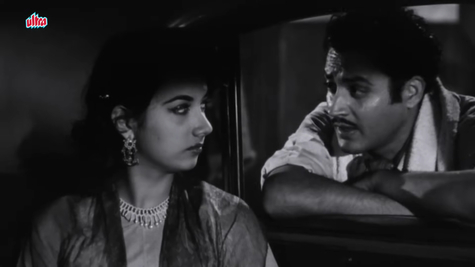
Before the dancer and Rustom could return, the police had turned up. It had been obvious that they’d had their eye on the car. They were suspicious and searched it inside out, besides questioning Kaalu. Kaalu answered honestly, not knowing what any of this was about; but now, with his job gone, he goes back to the hotel, to seek Captain and pass on that message.
Captain (Bir Sakhuja) is quite excited when he hears the message. He has been complaining about how the police have confiscated his car (the one left by the dancer and Rustom at Nikki’s father’s garage): without that car, his hands are tied, he cannot move about… but now, he sees a ray of light when Kaalu, answering Captain’s queries, admits that he used to be a taxi driver before he got sent to prison.
Captain offers Kaalu a deal: he’ll finance the purchase of a taxi for Kaalu. In exchange, Kaalu will be at his disposal anytime, anywhere that Captain needs him. Kaalu agrees; it’s a good deal for him.
At the hotel, Kaalu now comes more frequently in contact with the dancer (she is never named), who seems to be attracted to him, but says nothing to this effect. In fact, when Kaalu confides in her about his love for Nikki, and how Nikki’s father absolutely refuses to allow it—the dancer advises him to elope with Nikki.

It’s a plan Kaalu is all for trying out, and he quickly goes to suggest it to Nikki. But Nikki, from the very moment she hears of it, is reluctant. She knows that her father loves her (and she loves him, even if he doesn’t approve of her boyfriend); to run off like this, besmirching her father’s honour, is not something she’s ready to do. But Kaalu is persuasive (and uses some emotional blackmail), and finally Nikki agrees.
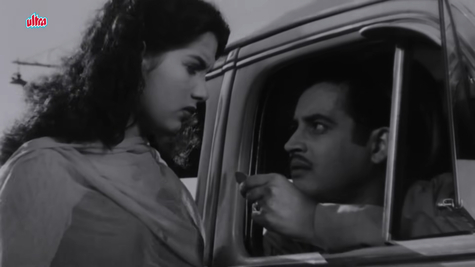
What next? Does Nikki elope with Kaalu? Or does the dancer express her feelings for Kaalu and manage to get a foot in the door? Equally importantly: when does Kaalu realize that Captain is really up to no good, and that he’s basically using Kaalu as an abettor?
I had watched Aar-Paar many years ago, as a child; then, more recently, I rewatched it for Johnny Walker Week on my blog. Both times, the greatest impression made on me was of OP Nayyar’s superb music: every song is a gem. The second time round, I also found myself really appreciating Johnny Walker, who proves not only how funny he is, but also what a good actor. Neither of these two viewings of the film, however, made much impact on me as far as the plot was concerned: it came across as rather pedestrian, not very suspenseful, and just a little too easily sorted out.
This time (perhaps because I was watching Aar-Paar on the full screen?), I could appreciate the film more fully.
What I liked about this film:
The overall entertainment value. From the songs (including Kumkum’s debut song, the ‘surrogate love song’ Kabhi aar kabhi paar) to the romance, the humour, the thread of intrigue—all of it comes together to create a film that’s fairly good paisa vasool. Especially among the standouts are:
The songs, composed by OP Nayyar and written by Majrooh Sultanpuri. Each song here is a gem, whether it’s the hilarious Arre na na na na tauba tauba tauba, the happy/tragic duo of songs Sun sun sun sun zaalima/Jaa jaa jaa bewafa, and the scintillating Babuji dheere chalna (in this delightful interview with Shakila many years later, Karan Bali quotes her as saying what a bad dancer she was, and basically threw one leg here and one leg there in her attempt to dance!). Another song also picturised on Shalika is the superb Hoon abhi main jawaan, one of the best ‘tipsy woman’ songs I’ve come across.

And Johnny Walker as the Parsi, Rustom. JW is always good, but here he’s especially fantastic: his accent, his mannerisms—oh, so believable. One of his best roles, this. (I must also point out: what a joy to see him with Noor, whom he would go on to marry soon after).
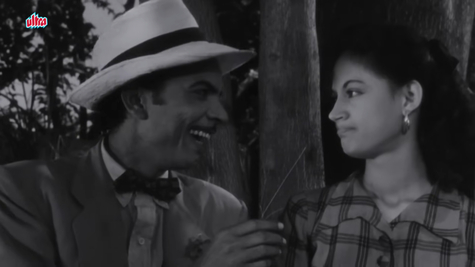
There are other elements, too, that I admired. V Murthy’s cinematography, the light and shadow, the frames.
Jagdeep, as Elaichi, Kaalu’s cleaner/helper, sidekick, and friend in need—eventually, not just for Kaalu, but for Nikki as well.

Shyama and Shakila, both so beautiful. And Shakila’s character is an enigmatic one that I found particularly interesting. One couldn’t tell, till the very end, what this woman’s agenda really was. At first, she seems just slightly intrigued by Kaalu, to the point of even being amused by what she probably regards as shenanigans; later, however, her interest in him appears to grow, to the extent that she is willing to push Nikki out of the way in order to get Kaalu for herself. But is that really the dancer’s objective? Or is she really just toying with Kaalu and is all along loyal only to Captain? It’s hard to say, but yes, Shakila plays this mysterious woman well.

Watching the film this time and paying close attention (I guess that’s one good thing about watching in a cinema hall as opposed to at home), I got the feeling that this was a run-up to CID (1956). There are many similarities between the two films, both of them produced by Guru Dutt and with several of the same cast and crew (VK Murthy, OP Nayyar, Johnny Walker, Shakila, Kumkum, Bir Sakhuja, Shamshad Begum, Rafi…). Raj Khosla, who was one of the assistant directors to Guru Dutt for Aar-Paar, directed CID. And there was the same combination of noir, romance, and a sprinkling of comedy. The same setting, Bombay. The theme of a vamp who nurses a tendre for the hero, who is in love with another, who also happens to be his boss’s daughter.
Yet, to me, CID is far more accomplished, more stylish. The suspense (CID was written by Inder Raj Anand, Aar-Paar by Nabendu Ghosh) is tauter, the plot far more complicated. The hero in CID (Dev Anand in what I consider one of his best roles) is up against much greater odds, and the very fact that he’s a cop ends up adding to his troubles. Even the vamp in CID (Waheeda Rehman in her debut role in Hindi cinema) is a more fleshed-out character. Like Shakila’s character in Aar-Paar, Kamini too is an underling to Bir Sakhuja’s villain, but the relationship is starker, darker, hinting at something rather more unsavoury than mere conniving in bank robberies, as in Aar-Paar: this woman has probably been a victim of paedophilia.
Ultimately, I’d say I enjoyed CID far more as an example of the sort of entertaining noir Guru Dutt was capable of producing—but Aar-Paar is still enjoyable. Very much so.
(And, as you can see, there’s nothing here that I didn’t like. Yes, it could have been better—as a comparison to CID proves—but it stands well on its own).
There’s a copy of Aar-Paar, seemingly fairly good quality (I haven’t seen it in its entirety, only here and there) on YouTube, here.


How nice that you got to see Sahib Bibi aur Ghulam and Aar-Paar on the big screen. Now I wish that I was in India at that time. I think, I wouldn’t have left the cinema hall.
I like Aar-Paar (1954) as a movie. As you said, there is nothing to not like about it. Particularly the dialogues by Abrar Alvi impressed me a lot. Both Shakila and Shyama look breath-takingly beautiful. CID was a bigger movie than Aar-Paar, thus it impresses. Aar-Paar is more intimate. CID in fact stands on the shoulders of Aar-Paar.
What intrigued me also was that Shakila’s character gets no name. It is as if she is just there for a purpose and has no value as such even to get a name. This is her fate after all…; and that hurts, which gives her fate/tragedy more depth.
LikeLiked by 1 person
I honestly felt so lucky to be able to watch these two movies. And interestingly enough, it seemed the same bunch of enthusiasts were doing the rounds of the halls where these Guru Dutt films were being shown. When I went to see SBaG, I met friends, a couple, who mentioned that they were going to watch Chaudhvin ka Chaand the next day. And, when I went to see Aar-Paar (at another hall) I met some people who’d been at SBaG the previous day! – we got chatting and comparing notes only on the basis of a shared love for these films.
Yes, I agree that Shakila’s character having no name adds to her character. Telling, and poignant.
LikeLike
I was also lucky to catch Aar-Paar on the big screen here in Pune and it really felt like stepping back into the golden era. Everyone looked so gorgeous, and VK Murthy’s camerawork made every frame sparkle, while OP Nayyar’s songs lifted the whole mood.
Reading your review was like adding another layer of insight to what I saw and it made me relive the film all over again. Honestly, watching these restored classics is nothing less than a tonic for life.
LikeLike
Honestly, watching these restored classics is nothing less than a tonic for life.
I totally agree with you. I came out of the hall after the film was over feeling completely rejuvenated. It was really such a wonderful experience; I wish they’d re-release more of these old films.
LikeLike
How I envy you, being able to watch these restored films in the theatre! I wish I were back in India…
That said, yeah, Aar Paar is no C.I.D, but it’s entertaining, nevertheless. Like you, I love all the songs as well.
Tom has a cleaned-up print of Aar Paar on his channel.
https://www.youtube.com/watch?v=ypS6d_XhvxE
LikeLiked by 1 person
I do think I was really lucky to be able to get to see the two films I did! I wish I could have watched Mr & Mrs 55 too (a guilty pleasure!), but – such a sad reflection on how cinema halls regard these old films now – pretty much most of the films were being shown only around 9:45 at night. Can you imagine? SBaG and Aar-Paar were around 4.30, but that was it.
Thank you for providing the link to Tom’s copy, Anu.
LikeLike
Madhu ji,
This is indeed a film whose music is irresistible.
Here is a YouTube link where Majrooh Sultanpuri explains how songs were made by Guru Dutt – https://youtu.be/s2D_qyA6RqQ
I like the way Sun Sun Sun Sun – the happy one – starts. Just before the song begins, Guru Dutt is learning English alphabets – just like Kishore Kumar does much later in Dilli Ka Thug with C…. A ….. T … CAT
Anita
LikeLiked by 1 person
I was also thinking of CAT when that scene came on, of Kaalu trying to learn the alphabet! :-)
Thank you for the Majrooh interview link, Anitaji. I had heard about this in other places (all referring to Majrooh’s talk) but hadn’t actually seen the interview before.
LikeLike
I had seen this movie long back on Doordarshan. Nice review from you as usual. What about Guru Dutt’s own acting in this movie ? Did you like it ?
LikeLiked by 1 person
Thank you, Jitendraji. I thought Guru Dutt’s acting was adequate. In any case, it’s not as if (contrary to his characters in SBaG, Kaagaz ke Phool or Pyaasa) this one needed any great acting skills. :-)
LikeLiked by 2 people
I just love the swag of Guru Dutt in Aar Paar with his hat on. Bombay itself is like a character in the 2 moves Aar Paar and CID . IT is difficult to imagine the happy go lucky layabout of Aar Paar went onto make Pyasa!
LikeLiked by 1 person
IT is difficult to imagine the happy go lucky layabout of Aar Paar went onto make Pyasa!
So true! They’re such completely different films.
LikeLike
Aar Paar had some good songs and an optimistic storyline [compared to the magnum opus of Pyassa and Kaagaz Ke Phool that will come next].
I think some of Guru Dutt’s films were shown on big screen in a retrospective recently though I could only see ‘Pyaasa’ on that [in quite an empty theatre, that too].
LikeLiked by 1 person
Someone I know also went to see Pyaasa during the retrospective (which was where I saw Aar-Paar), but had a different experience: the cinema was pretty full, and a large number of the audience was fairly young, maybe in their 20s and 30s. Heartening.
LikeLiked by 1 person