
Today, September 8, is International Literacy Day. In 1967, this day was designated as such by UNESCO to emphasize the importance of literacy in maintaining dignity and as a matter of basic human rights. Every year, a different theme related to literacy is used as the focus of special programmes and initiatives across the world: women’s empowerment, for instance; or the connection between literacy and controlling epidemics.
So what does that have to do with Hindi cinema? Not much, I admit, though there have been Hindi films—especially in the 50s, when India under Nehru was trying very hard to haul itself up into modernity—when there was the occasional film which made an attempt to underline the importance of being literate. Anpadh, for instance; or Bahurani, both of which showed how literacy can enlighten people. Similarly, Nartakee, and Ek ke Baad Ek, which too had literacy and education as important elements of the story.
While literacy may not be the point of most Hindi films, there’s no denying that few films go by without at least one character shown reading something. A book (to be seen in many films, even clearly identifiable books, as I’ve mentioned in these posts). A letter—at times so incriminating. A newspaper, often carrying some very vital piece of news, sometimes even shown rolling off the presses or being sold on the streets. A magazine (Life? Everybody fashionable in 60s cinema seemed to read Life).
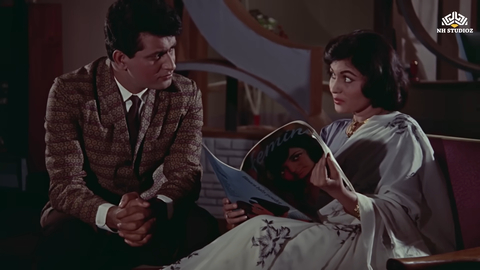
So, to mark International Literacy Day, characters reading things in Hindi cinema. No two of the same thing, and no characters from the same film. Of course, as is usual for posts on my blog, these are all from pre-70s Hindi films that I’ve seen.
1. Joy Mukherjee reads a book in Love in Tokyo (1966): Books, actually, are what brought me to the theme for this post, since I have previously, to mark World Book Day, done posts about Hindi film characters reading books. This was one book I came across in my researches for those posts, but which I was not able to identify. Since I haven’t imposed a rule that books must be identified for this post, why not bung it in here. For what it’s worth, Asha Parekh’s character in Love in Tokyo, here masquerading as a young Sikh, says that the book is one on child psychology; I have no way of knowing whether that is true or not (if anybody reading this can read Japanese, please help!), but I can well understand why Joy Mukherjee’s character, saddled with an obstreperous young nephew, might want to read a book like that.

2. Bhagwan reads a newspaper in Chori Chori (1956): And not just any newspaper, but Navbharat Times, one of the country’s most popular Hindi language broadsheets. Navbharat Times was launched in 1946, and it says a lot for the popularity of the newspaper that in Chori Chori, released just ten years later, it’s already featuring as the newspaper the common man reads.
In this case, it is also credited with having a substantial reach, since this is the newspaper in which the father of a runaway heiress inserts an ad offering a reward for news of his daughter. It is enough of an incentive for Bhagwan’s rather down-at-heel citizen, who immediately sees in this piece of news a way of possibly getting rich.

3. Babita reads a magazine in Kab? Kyon? aur Kahaan? (1970): And, as I’d mentioned in my introduction to this post, above, it’s Life. It’s not as if India didn’t have any English language magazines of its own: The Illustrated Weekly dated back to 1880; Femina began circulation in 1959; and Filmfare in 1952, to name just three of the more popular journals. But if you’re a stylish, well-educated character in Hindi cinema, and you have a little leisure time (say, while on a flight or a train), the magazine of choice, it seems, would be Life. An American magazine, Life has been around since 1883, and has always emphasized great photography. Perhaps its unmistakable association with America, with all that’s modern and posh (and, one must add, imported at a time few imported consumer goods were available in India) made it so popular as a prop in Bollywood.

4. Bela Bose reads a letter in Prem Patra (1962): One of the most common written things in Hindi cinema, the letter used to be—before e-mail came around—a standard means of communication. I still remember the long, highly detailed, and very regular letters my parents, for instance, used to exchange with relatives across the country. News of all kinds used to travel through letters, so there is a certain verisimilitude to the writing of a letter in Hindi films (or to the arrival and subsequent reading of one).
There are songs about letters (Phool tumhe bheja hai khat mein, Likhe jo khat tujhe, and more), and there’s this film, a guilty pleasure for me, that is centred round a love letter. At a hospital-cum-medical college, a pretty student (Sadhana) receives an anonymous love letter. Her classmates gather round and read it, teasing her mercilessly about it, even before she has had a chance to see what it’s all about.

5. A man (?) reads a telegram in Hum Dono (1961): Where letters were once the standard means for communicating when there was no pressure of time, telegrams were what you resorted to when it was urgent to convey a message. Though telephones had come to India very early on (in 1883, telephone exchanges were set up in Calcutta, Madras and Bombay), telephones were not very common till well into the 80s, even. I recall, when I was a child, most middle-class homes did not have a telephone: if someone had a phone, it would be used for emergency calls by much of the neighbourhood. And long-distance calls—trunk calls, which had to be booked and may take ages to come through, and then often the sound quality would be terrible—weren’t very dependable.
For most people, telegrams were the best way to convey urgent news. And when it came to conveying dreadful news, a telegram was the most convenient option. This is what happens in this scene. Lalita Pawar’s character, whose son (played by Dev Anand) is away fighting in the war, receives a telegram. Her daughter-in-law (Nanda) reads it, and bursts into tears, locking herself into her room. The mother-in-law, distressed and frustrated—she can’t read—asks a servant to read it for her, but he, having had a look, says it’s in English. Desperate, she finally goes onto the street, where she asks a passing stranger to read out the telegram to her. It’s a poignant example of how helpless an illiterate person can feel when faced with a situation that requires reading, and that urgently.

6. Vimmi reads a list on a blackboard in Humraaz (1967): Interestingly, a very similar situation, though the tragic news is conveyed in a different (and equally insensitive) way here. Raj Kumar’s character in Humraaz, an army officer, is forced to leave his girlfriend (Vimmi) when war is declared. He goes off to fight, and she waits anxiously for his return. But when she hears of a battle in which his platoon would have been involved, she goes to the local army headquarters to find out his fate: and there, on the blackboard, is his name. The list of names on a blackboard is rather more frequently encountered in films where exam results are declared in this format; this posting of the war dead and missing is somewhat unusual.

7. Biswajit reads a menu card in Kismet (1968): A departure from the sad, and on to the mundane: a menu card. It’s interesting to note that in a lot of films, especially from the 50s (but seen later too), in most eating establishments—and not just the rather down-at-heel greasy spoon type, but even relatively upmarket ones too—few menus are to be seen. The standard practice, instead, is to ask the waiter what is available, with the waiter then rattling off a list of menu items. In Kismet, the existence of a menu card serves to underline the fact that this is a modern, fashionable restaurant (fashionable enough to have Western-style live musical entertainment). It also gives Biswajit’s character something to look at while pointedly ignoring the person who’s trying to wheedle him into singing a song.

8. IS Johar reads a diary in Raaz (1967): Diaries may not be common in Hindi cinema, but every now and then, you come across them in suspense films. Invariably, they are used as evidence to prove a point: someone’s culpability, someone’s innocence. If a character in a Hindi film writes a diary, you can be pretty sure it will play a part at some later stage in the film. Here, too, in a film where Rajesh Khanna’s character is trying to prove that he was in Africa at a certain critical period, he suddenly remembers that for the four months in question, he had maintained a diary of all that he was doing—in Africa. All his friend (IS Johar’s character) has to do is read the diary to be convinced.

9. Joy Mukherjee reads a poster in Ishaara (1964): There are instances, a dime a dozen, in Hindi cinema where a poster appears. More often than not, it’s when a show is being advertised: a stage performance, for which the lead dancer’s name and face appear on the poster in question. This is a similar situation. This poster (held up by Agha and shown to Joy Mukherjee, who plays his friend and the boyfriend of the featured dancer), however, has a little more writing than usual. The name of the producer and the theatre company are there too, and (just after this still in the scene), Joy Mukherjee’s character reads them out aloud.

10. Rajendra Kumar reads an accounts ledger in Sasuraal (1961): An example of the more generic sort of documents that appear here and there in Hindi cinema: the reports that big businessmen look through in fat files on desks; the heavy court briefs that lawyers played by Ashok Kumar and Rajendra Kumar in Kaanoon carry; prescriptions; notes; panchaangs (Hindu calendars); horoscopes, and much, much more: all written, all to be read. Here is another such document: a bahi-khaata or accounts ledger. His ability to read the ledger accurately and spot the discrepancies enough to conclude that funds are being embezzled allows Rajendra Kumar’s character in Sasuraal to nab the culprit (Wasti)—who, then, in retaliation, sets out to ruin him.

Happy World Literacy Day!
 Dustedoff
That was an interesting piece of post to read, dear Madhu!
Life magazine was so in in the 50s and 60s Hindi movies isn‘t it? I particularly remember In Pyaasa (1957) when Mr. Ghosh (Rehman) breaks the news of Vijay’s (Guru Dutt) death at the breakfast table to Meena (Mala Sinha), she is reading the LIFE magazine with an image of crucified Jesus on the cover. Then in real life there was Madhubala‘s famous photo article in LIFE magazine. Pyaasa (1957) was a movie, where there were many readings going on.
Talking of readings there are also the farewell or good bye letters, which are encountered in Hindi films. Most of the times the scene shows the face of the person, who has written the letter appear on it and speak the content. A sub-genre of such letters are where the protagonist would ask the addressee of the letter not to search for him/her (mujhe dhundhne ki koshish mat karna).
Reading posters of dance recital as you say is quite common. In most of the cases it is the hero, who discovers the heroine, but it also could be family members discover their long-lost relative, who has most probably left the village and come to the city.
I am at times shocked how many people read other people’s diary in Hindi movies. Privacy is not valued a lot in Hindi films or in the Indian society for that matter.
What are also read in Hindi films are shopping lists. Most of the scenes are of a husband reluctantly going to a shop to do his wife’s bidding. We are expected to sympathise with him, as if he doesn’t profit at all from that.
Sorry, for not giving examples for all the scenes listed above. I have in most cases the scenes in front of my eyes but no information of the movies in my mind.
Thank you for the entertaining article and happy literacy day. Our life would be much deprived without the pleasure of reading (and understanding).
LikeLiked by 1 person
Thank you for those very interesting instances of things being read, Harvey! I am hitting myself for having left Pyaasa out of this list – of course it had plenty of people reading stuff. Letters, books, poems – and as you so rightly mention, LIFE magazine. I wonder, though, how commonly available LIFE was in India back then? I mean, was it like pianos in homes and sleek cars? – only a sign of the very well-heeled?
The farewell letter – yes, there are so many of them, no? Anita too, which I reviewed last week, had one such, though it was more a suicide note than anything else. In fact, I had included a screenshot of the characters reading that suicide note too.
As for shopping lists… yes, though offhand I can’t remember which film I might have seen that in. Possibly something like Joru ku Ghulam, though I will admit this is a stab in the dark!
LikeLike
I don’t know if LIFE magazines were sold in bookshops. Maybe they were in the 50s and 60s. I can’t recall seeing them in the 80s, when I could go to bookshops and browse. Given that they had an article on Madhubala, which she might have used for publicity purposes, I think LIFE must have been circulating in India at that time. In the 70s the market got more restricted I think even for overseas magazines. But even then they must have been quite expensive for Indian middle-class purses.
As for shopping lists, the images which come to my mind are more of Om Prakash or similar actors.
LikeLiked by 1 person
As for shopping lists, the images which come to my mind are more of Om Prakash or similar actors.
Yes, the homely (often henpecked) type. :-) I can totally imagine Om Prakash peering at a shopping list and trying to figure out what is what!
And yes, totally agree re: LIFE – I’m sure it would have been available pre-70s but (like Time or Newsweek when I was a kid) might have been fairly expensive.
LikeLike
WordPress really has it in for me, doesn’t it? :( Now, let me see if I can remember the scenes I’d added!
In Kala Pani, Dev Anand’s character goes to the newspaper office where Madhubala’s character works to look up his father’s case in the newspaper archives. He’s shown reading piles and piles of newspapers from that period, all pointing to his father as the murderer.
In Kala Bazaar, Vijay Anand is reading Hindi poetry aloud to Waheeda Rehman – something about their coursework – when she picks it out of his hand and throws it over the hedge. (Bad Waheeda!) The book hits Dev Anand (who’s eavesdropping on the couple), and is the beginning of his quest to be literate.
In Paigham, Dilip Kumar is sitting under a lamp post, reading Gandhi’s My Experiments with Truth.
In much later years, in Ek Duuje ke Liye, both Rati Agnihotri’s and Kamalhaasan’s characters are shown reading Learn Tamil in 30 Days and Learn Hindi in 30 Days, respectively.
I’d a few more listed; it’s all been wiped clean off my feeble brain!
[I think I’m going to write my comments down in a Word doc, so I don’t have to type them all in all over again, if they vanish!]
LikeLiked by 1 person
That is what I do now too, dear Anu. Writing the comment in a word doc helps. It gives a better overview, better possiblities to manoeuvre and WordPress doesn’t eat up your comment and there is a lesser possibility of posting your comment before it is complete.
LikeLiked by 1 person
So true. And if WordPress eats your comment, at least you can go back and cut and paste it again! Instead of subjecting your poor brain to more torture!
LikeLiked by 1 person
Yes, much easier, and far less irritating!
LikeLike
Anu, you are too sweet, to have listed these all over again! Damn WordPress, it’s such a pain. :-( Actually, what has happened is that some time back, they converted all the back-end stuff for posts into something called ‘blocks’. A block of text, so basically each paragraph becomes a block. Completely unnecessary, and very irritating. Now they’ve extended that blockish behaviour to the comments as well. Which basically means, if you press back space and aren’t careful – for instance, if you press too hard or too many times – the previous block (aka paragraph) gets wiped out. I’ve learnt by experience.
And thank you so much for the instances you’ve mentioned! In Kaala Bazaar, Vijay Anand is reading Kamayani; it was part of my first ‘characters with books’ post, here:
https://madhulikaliddle.com/2018/04/23/people-with-books-in-hindi-cinema/
And the Paigham scene found a mention in my second post on the subject:
https://madhulikaliddle.com/2024/04/23/hindi-film-characters-with-books-part-2/
The Anand brothers were keen readers, so IIRC books appear fairly frequently in several of their films.
LikeLike
The text on the book was indecipherable in the image above, so I went through the video of Love in Tokyo (1966) and realised that the book is not at all in Japanese but in English and it doesn’t even say anything about Children’s Psychology but just states Children Knowledge.
Joy Mukherjee’s character in the movie has, if I remember right, just arrived in Japan, so I think his talent in reading Japanese must be quite restricted.
LikeLiked by 1 person
Ah, I didn’t look beyond the cover, so I hadn’t realized the book was actually in English. Which is a bit weird. I wonder if this was just a prop put together for the scene – a random Japanese cover, and some printed pages glued inside to give it a certain level of authenticity.
And you’re right, given that he’s just arrived in Japan, it seems odd that he knows enough Japanese to be able to read a book in the language.
LikeLike
The text on the dust cover or better said, the title of the book on the dust-cover is in English. The text inside the book is not visible at all. So the book, if it is a real one at all, is an English book or supposed to be a book in English. Neither Asha Parekh nor Joy Mukherjee make any mention (at least in the part I watched) that the book is supposed to be in Japanese.
As you said it is quite possible that they just printed a dust cover with the words Children Knowledge (Psychology was a too difficult word to spell) and wrapped it around some book. But I should say, they have given the dust-cover a nice worn-out look on its upper edges.
LikeLiked by 1 person
I am losing my mind. How could I not have realised that the title was in English? (Or was I expecting it to be in Japanese, which is why my brain automatically made me see that way) :-( Jaisa bhi hai, thoda worrying hai.
LikeLike
I don’t think you are losing your mind. It is just how the brain works. Your eyes says alphabets arranged in a vertical manner. Your brain combined the vertical alphabets and the title of the movie and gave the verdict as Japanese characters. The mind said, how exotic to have a Japanese book in a Hindi movie! So it stuck to it.
LikeLiked by 1 person
Well explained! Yes, very likely that was what happened. :-)
LikeLike
Very interesting post. One needs to strain one’s brain to remember such scenes.
What I remembered first, was the train scene from DDLJ where Simran and Raj meet for the first time and he irritates her, and tries to flirt with her.
But if it’s necessary to read it aloud, this may not qualify.
Anup
LikeLiked by 1 person
No, no – reading aloud is not a criterion at all, so this scene works, completely! Thank you for this, Anupji. :-)
LikeLike
Madhu ji,
This is such a fabulous post! A film that comes to mind is Sitara (1980) where film posters while being stuck are occasionally read. Also Mahal (1949) has a scene of dead letters being read. This is of course a variant of the letter. WordPress will not allow me to post screen shots and so I will not even try!
Anita
LikeLiked by 1 person
I am so glad you enjoyed this, and thank you for the additions to the list! I have to admit I had forgotten that bit about Mahal (though other films in which post offices feature – Parakh, Baabul and Garam Coat among them – have had people at least reading a lot of envelopes ;-)).
LikeLike
Interesting post and a bit different from your earlier ones about characters reading / with books. Since it is reading anything, the field becomes quite wide.
In the 1961 film Hum Dono, Dev Anand’s character, Major Verma, reads his wife Ruma’s (Nanda’s) letter to Anand, a soldier he meets in the army camp. It creates an emotional connection between Verma and Anand, as Anand listens to the letter and witnesses Verma’s feelings, his vulnerability and his deep love for Ruma. The scene highlights the humanity and personal struggles of soldiers, reminding the audience that behind the uniform, they are individuals with lives and emotions. (Edited from AI response)
LikeLiked by 1 person
I had forgotten that scene from Hum Dono, though I’ve seen the film several times (including – a rare feat for me – on the full screen).
Thank you for reading and for commenting. I am glad you enjoyed this post.
LikeLike
A perfect post to celebrate the World Literacy Day.
Regarding reading magazines, I could recollect a couple of scenes:
LikeLike
I remembered the China Town scene now that you mentioned it! Ijaazat I actually haven’t got around to watching.
LikeLike
Characters reading letters of various kinds, ads and posters were seen often in earlier films, though all such scenes may not have in important role in the storyline.
Offhand, here are some scenes that came to my mind which were integral to the plot:
From the 40s: In Kismat (1943) before the climax, we see some of the key characters reading the advertisement of Mumtaz Shanti’s upcoming performance. Ashok Kumar and the inspector read the poster outside the theatre.
In Sanjog (1943) Wasti reads the newspaper which has an ad for the job which Charlie decides to go for. And earlier, Wasti is also seen reading visiting cards of people who come with marriage proposals.
Then there are appointment letters – In Dard ka Rishta 1982, Sunil Dutt reads an appointment letter offering him Surgery Head position in Tata Memorial Hospital. The film also has medical reports being read by characters playing doctors.
In Hip Hip Hurray 1984, both Raj Kiran and Dipti Naval read the job appointment letter of Raj Kiran.
Suicide note – Sunny Deol reading Moushumi’s suicide note in Ghayal 1990
LikeLiked by 1 person
Thank you for these! I think appointment letters and suicide notes need special places of their own on lists like this. Both can play such an important part in the story.
LikeLike