
This, actually, was not the film review I was intending to post this week. But then, over the weekend gone by, I met Moon Moon Sen, and I was reminded (of course I would be!) of her mother, Suchitra Sen.
I was in Dehradun on October 11 and 12, attending an arts and literature festival. The guest of honour was Moon Moon Sen, still beautiful, and with a serene calmness to her that was—as someone mentioned—very ‘peaceful’ (to which Ms Sen replied that she has a horrible temper!) Moon Moon Sen was mostly involved in graciously felicitating those who participated in panel discussions and so on; I was thrilled to have her place a scarf around my neck. But the last session of the festival was a conversation with her, and it was very interesting. She answered questions about herself, of course, but also about her mother (“always, ‘Madam’, never ‘Mrs Sen’ or ‘Suchitra’” she recalled). Not just a star, but a mother (“I only knew her as Mummy”), and one whom young Moon Moon was obviously very protective about: she said she shielded her mother when Suchitra Sen had to make her way through a crowd. She had no qualms even about punching anyone who tried to get fresh with her Mummy.
I remembered, then, that I had a Suchitra Sen film review ready to be published. Here it is, a light-hearted comedy, directed by Chitta Bose, based on a story by Balaichand Mukherjee ‘Banaphool’ and with a screenplay by Nipendrakrishna Chatterjee.
The story begins in the Calcutta home of Shushubhon Dutta (Uttam Kumar) and his wife Anita (Sabita Chatterjee), who have been married a few months. The two are constantly bickering, and we see them in the middle of an argument even as the film starts. Anita is hot-tempered, Shushubhon likes to needle her.
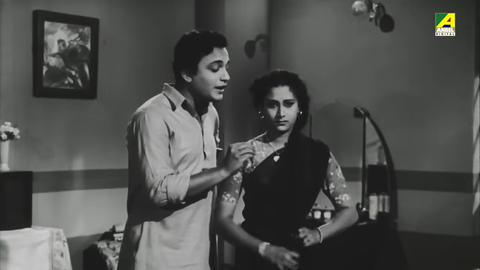
They are to travel to the home of a certain Digbijoy Babu, where they’ve been invited to stay. After much yelling and distress (on Anita’s part) and amused teasing (on Shushubhon’s) they set off for the train station, after having handed over the house to their maid, Khyanto (Menaka Debi). No sooner have the master and mistress of the house left than Khyanto invites a guest over: a man whom she pampers, giving him vast quantities of buttered bread, liberally smeared with jam.

Meanwhile, Shushubhon has somehow managed to get their over-a-dozen bags to Howrah Station and into the train to Muchkundpur, where Digbijoy lives. Anita has been seated inside the compartment, and Shushubhon tells her he’ll go buy a magazine and join her. He’s paying for the magazine when the train blows its whistle and begins to steam out of the station.
Shushubhon scrambles to get the change back from the magazine vendor; to run to the train—and in all the confusion, bangs into a woman (Suchitra Sen) who is also heading for the train. They aren’t strangers; Shushubhon knows her, Shantona, and they greet each other, even while lamenting the fact that the momentary chaos has resulted in both missing their train. Shantona too was bound for Digbijoy Babu’s home; she is a relative of his and had been also invited for the house party.

There isn’t another train to Muchkundpur today; the only way to get there now (and to reach perhaps by the time an obviously-furious Anita does) is to go by taxi. Shushubhon knows a local taxi stand near his home; he takes Shantona home, therefore, and from there makes a phone call, booking a cab to drive them to Muchkundpur.
While Shushubhon is busy making arrangements for their travel, Khyanto (who’s had to get rid of her gentleman friend very hurriedly) is asked to provide breakfast for Shantona. She does so, all the while directing suspicious glares at this beauty who has turned up with the master while the mistress is gone.
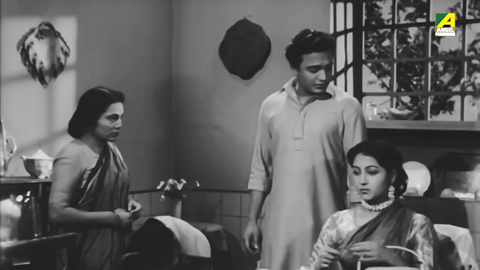
Soon after, the taxi arrives, and Shushubhon and Shantona leave for Muchkundpur along with Shantona’s beloved lap-dog, Jhunushona. Jhunushona is a pampered dog: Shantona carries the pooch around in her arms all the time, and frets about her (yes, Jhunushona is female, as we discover in a hilarious scene later in the film) well-being more than her own.
Shushubhon and Shantona leave; and soon after, Anita arrives back home in a taxi with all her luggage. She is furious, and when Khyanto tells her what has happened—that Shushubhon had come back, a strange but beautiful woman in tow, with whom he has now gone off—there’s no containing her suspiciousness, her fury, and her sense of betrayal.
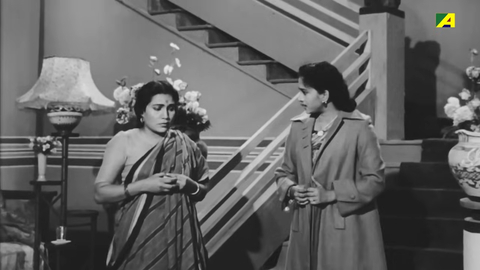
Anita frets and fumes and finally (much later), at night, phones her parents. Her father (?) is most unwilling to give up his sleep and get out of bed, but Anita’s mother Shoyamprobha (Molina Debi), a firebrand who insists that she had always dissuaded Anita from marrying this philanderer Shushubhon, refuses to sit still. No, they must go right now to Anita, and then they must figure out what needs to be done. Shushubhon’s behaviour is thoroughly reprehensible, according to Shoyamprobha, and she is not going to let him get away with it.

Meanwhile, far away, on the road to Muchkundpur, the car in which Shushubhon and Shantona are travelling breaks down. Night is drawing near, and the only place they can find shelter is a hotel (a terribly seedy and small one) owned by a man named Gosainji (Tulsi Chakraborty). Gosainji has very decided and prissy views about nearly everything, and has just parted ways with the cook because he thought the cook’s language was vulgar (it isn’t; even I can understand what the man is accused of having said, and it comes nowhere near obscene).
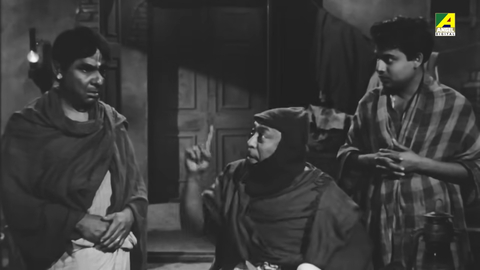
Gosainji, obviously, refuses to give out his (very meagre) two rooms to a man and woman who aren’t married to each other. Shushubhon and Shantona overhear this by chance; it’s not as if they have already asked to share a room. But they are now in a dilemma; what to do?
Fortunately (or not, as it later turns out) just then somebody stops by. Sadaranga Biharidas (Jiben Bose) is passing by on his motorcycle and needs water for the radiator, so has nipped into Gosainji’s hotel. He immediately recognizes Shantona: he knows her well. So sorry, he couldn’t make it for her wedding; he really wanted to, given that Shantona is married to such an illustrious man, the great national leader Professor Brojeshwar Dey.
Just then, Shushubhon enters the hotel’s reception area, and Sadaranga jumps to the conclusion that this is Shantona’s husband, since they are obviously together. He flatters ‘Brojeshwar Babu’, he fawns, he asks for Brojeshwar Babu’s views on such-and-such a political candidate (Shantona butts in and applauds the candidate on her husband’s behalf).
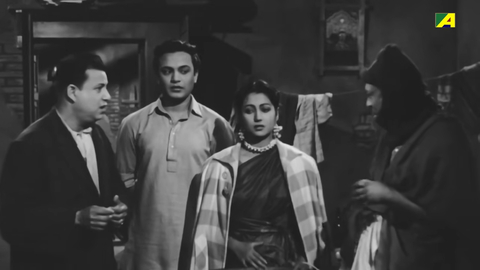
Gosainji has been watching all of this, and now feels that:
- These two are a married couple, so all is above board
- The man is no less than a national leader, so that’s there too
And Shantona, all wheedling smiles, begs Gosainji to let them have that room, please. Just for this one night. He cannot, without seeming irrevocably churlish, refuse (though Gosainji would probably not mind appearing churlish, methinks). He therefore gives them the room, getting Shushubhon to sign in the register (Shantona does this on his behalf, calmly signing him in as Professor Brojeshwar Dey).
The room is situated upstairs, and is a rather ramshackle, pokey little place. Shantona intends to have her beloved Jhunushona sleep with her—they always share a bed—but Gosainji puts his foot firmly down. No; the dog will sleep in the cowshed.
Shantona is horrified and makes many protests, but Gosainji is adamant. His much-beleaguered servant Photka (Anup Kumar) is sent off, Jhunushona in his arms, to deposit the dog in the cow shed, with Shantona giving the man instructions on how her darling is to be treated.

The dog taken care of, Shushubhon and Shantona go up to their room.
Shushubhon is inclined to be flirtatious and Shantona reciprocates, but this only remains flirtation, nothing more.

Shushubhon says Shantona can have the bed and he will lie down on the floor, but she refuses. No, he can go downstairs and spend the night in the little room where they’d had tea earlier. Willy-nilly, Shushubhon trudges downstairs, armed with a pillow, through a building which is now dark—and where he finds every room locked. He cannot enter the room he’d meant to sleep in, and floundering about in the dark, he bangs into something and there’s an almighty crash.

Gosainji wakes up and starts shouting. Shushubhon flees upstairs and gatecrashes the room where Shantona is asleep. This is where he’s going to sleep, Shantona’s wishes be damned. He therefore stretches out on the floor, and both he and Shantona pretend to be snoring loudly when Gosainji, panting and puffing, comes upstairs with Photka to check on his guests. He hears the loud snoring and is satisfied: these two are sleeping the sleep of the innocent.
… but not really. Shortly after Gosainji has descended the stairs, Shantona scrambles out of bed and opens the window. Her darling Jhunushona is howling! Poor baby, he must be scared and lonely. Shushubhon should take her shawl down to the cow shed, wrap Jhunushona in it, and smuggle the dog up here. Shushubhon puts up a stiff resistance, but to no avail.
As if Shushubhon hasn’t already had an adventure-packed day, now Jhunushona manages to wriggle out of the rope mooring him to the cow shed and escapes, trotting across the countryside with Shushubhon in hot pursuit.
And the adventure has just started.
The next day, away in Muchkundpur, their host Digbijoy Babu (Pahari Sanyal) and his wife (?), having waited for Shantona and Shushubhon and their respective spouses, have now gone off with another couple of guests with whom a long-awaited hunting trip had been planned.
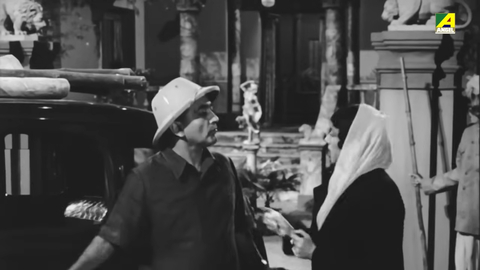
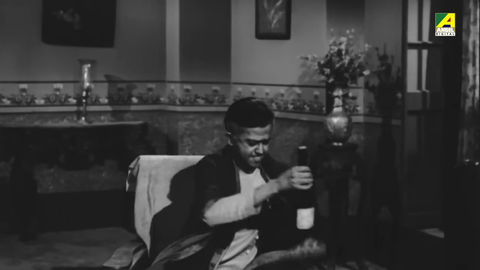
While they’re away, Digbijoy Babu’s wife’s brother, Chhokku (Bhanu Bannerjee)—who has made an excuse of being unwell to wriggle out of this hunting trip—gets out his beloved bottle. Chhokku is a confirmed lover of booze, and loses no opportunity to hit the bottle.
Elsewhere, Anita and her parents have made enquiries at the taxiwallah from whom Shushubhon had booked a taxi. Anita’s mother having discovered that Shushubhon was headed for Muchkundpur, decides that that’s where they should go as well.
And, not to be left out: there’s Shantona’s husband, Professor Brojeshwar Dey (Kamal Mitra), also headed for Muchkundpur.
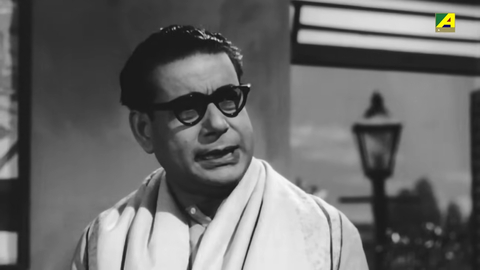
The scene is set for some fireworks, a dramatic fallout of Shushubhon’s and Shantona’s ekti raat.
What I liked about this film:
The humour of it. The screenplay and story are very good, with the humour coming through in different ways. For one, there are the situations: the convoluted circumstances which are funny, the mad coincidences. The way people’s paths cross at the most opportune (or inopportune) of moments. The way everything—Gosainji’s conservative nature, Anita’s mother’s bossiness, the fact that the train went off without two key characters—plays a logical part in how events play out. There is a reason for pretty much everything that happens in the course of this one night, and it’s funny.
Then, the characters, and the people who play them. I must admit that I had begun watching Ekti Raat for Suchitra Sen and Uttam Kumar, whom I’ve enjoyed seeing in many other films. But while these two are good here too (more on that just after this…), it’s really the character actors—especially Tulsi Chakraborty as Gosainji, Molina Debi as Anita’s mother, Jiben Bose as Sadaranga, and Bhanu Bannerjee as Chhokku—who steal the limelight. Each of these characters is a character, eccentric or fairly unique in some way, and they’re portrayed brilliantly by their respective actors.

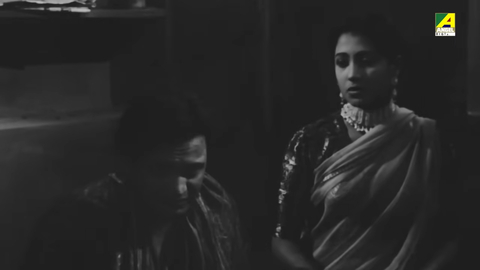
Suchitra Sen and Uttam Kumar are not given much chance to be particularly funny, except for a brief while when they’re upstairs in the room at Gosainji’s hotel. One of the best scenes here is when Jhunushona starts howling in the cow shed. The scene that plays out in the room is hilarious, with a fretting Shantona trying to emotionally blackmail Shushubhon into rescuing her dog (“if my husband were here, he would go and fetch Jhunushona immediately”) and then, when that doesn’t work, she whines about how that “poor, mute, animal” is being put to such trouble. To which Shushubhon snaps back that the way Jhunushona is going ‘waain-waain-waain’, the dog hardly counts as ‘mute’!
What I didn’t like found puzzling:
The obvious flirtation that happens between Shantona and Shushubon when they first go to the room, and until Shushubhon is forced to go to the cow shed. This just didn’t sit right with me. It would have been a different matter if the tone of the film were different (if, for instance, it was a somewhat mature drama, about an extra-marital affair): but for a comedy of this type, it didn’t fit. It left me wondering why director Chitta Bose decided to go this route, especially since nothing actually comes of the brief chemistry, the romantic song, et al. It’s as if it never happened.
Or was Bose simply thinking that an audience watching a film with Sen and Kumar would expect a romance, even if their characters weren’t actually romantically involved?
A small niggle. But otherwise, a delightful film, and one I’d whole-heartedly recommend. I loved this one.
A copy, with English subtitles, is available here.


This is a beautiful review, urging me to watch this film on a quiet evening soon! Why not, if it’s Suchitra Sen? Look at the impact she made outside Bengali cinema too, with just a handful of Hindi films! But even just Mamta and Bambai Ka Babu are enough :)
LikeLiked by 1 person
Suchitra Sen is quintessential. :-) Do watch this film – not just for her, but also for the supporting cast, who are simply brilliant.
LikeLike
Sounds to be quite an amusing film.
I find it truly remarkable and highly commendable that you review Bengali films and introducing them to a wider audience. In doing so, you help bring to light cultural treasures that might otherwise have remained hidden (at least from my eyes). Thanks for that.
LikeLiked by 1 person
Thank you for those kind words, Harvey. Bengali cinema seems to me to have the best strike rate when it comes to subtitled versions available for old films! There are so many Tamil, Malayalam, Marathi etc films that I want to watch but can’t because of the language barrier – so few of the films from old regional cinema (including major hits) are subtitled. :-(
LikeLike
Ohh, I found myself laughing through the review… I must watch this at once, Madhu. :) Thanks for this review and the link.
LikeLiked by 1 person
Anu, it’s a rare example of one of those films that I chuckled through most of! Do, do watch. And tell me what you think.
LikeLike