
RIP, Kamini Kaushal. Ms Kaushal, probably the oldest of Hindi cinema stars still living, passed away at the age of 98 on November 14, 2025.
Over the years I’ve been blogging, I’ve seen one after the other of some of my favourite stars pass out of our lives: Shammi Kapoor, Sadhana, Dilip Kumar, Kumkum… but with Kamini Kaushal, I have to admit to a somewhat pronounced sense of loss. Not because she was a particular favourite of mine (though I admitted to being quite impressed with her acting when I watched Biraj Bahu some months back). But because with her passing, the door seems to have shut firmly on those who heralded the start of the Golden Age in Hindi cinema.
Anyhow, a tribute seemed in order. A tribute to Kamini Kaushal, and to a film that I’ve been meaning to watch for a while now.
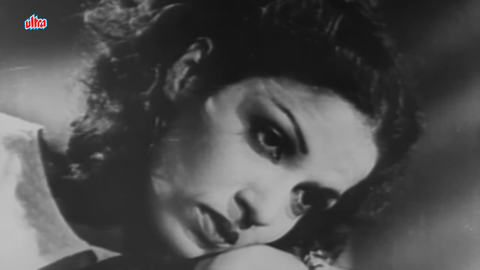
Shaheed is set in Amritsar, and the film opens in the household of Rai Bahadur Dwarka Das (Chandramohan). Dwarka Das is a police officer, a man proud of being quite Westernized, believing staunchly in the right of the British Crown to rule India: a ‘brown sahib’. Dwarka Das has two friends: one is, like him, a police officer, and is father to a teenager named Vinod (?). The other is Seth Himmat Rai (?), whose son Gopal (?) is a young man, already deeply committed to the cause of the Indian freedom movement.
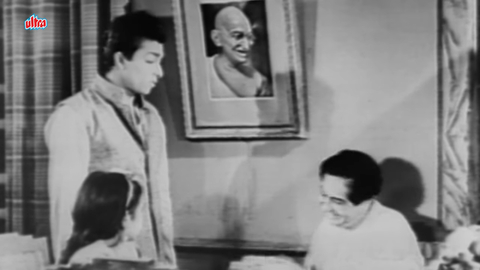
Gopal has joined the Indian National Congress, and his patriotism is making quite an impression on not just his little sister Sheela (?) but also her childhood sweetheart Ram (Sashi Kapoor), Dwarka Das’s son.
Vinod and Ram are about the same age, Sheela somewhat younger. Vinod’s loyalty to the British Raj is quite virulent, and it draws the ire of both Ram and Sheela, who gang up and beat him one day.

While Ram’s mother (Leela Chitnis) is inclined to brush things under the carpet and dismiss the episode as a childish argument, Dwarka Das is most displeased. He is even more annoyed when Ram and Sheela, under the aegis of Sheela’s brother Gopal, participate in a dance-drama where the refrain Toadie toadie bachche teri aisi ki taisi, touches on a raw nerve.

Dwarka Das’s anger, however, obviously does not have the effect he had hoped for. When the scene changes, the story has moved forward some eleven years. Ram (now Dilip Kumar) has followed in Gopal’s footsteps to become a freedom-fighter. However, unlike Gopal (now Prabhu Dayal; a Congress member who believes whole-heartedly in Gandhian non-violence), Ram is a revolutionary, willing to resort to violence in support of the cause.
Along with a group of his companions, Ram holds up a train near Ambala in order to loot it. Unknown to him and his fellow-revolutionaries, the police have been alerted, and they arrive in the middle of the hold-up. There is chaos, firing, and general mayhem. To escape the cops, Ram climbs into a compartment—where he comes face-to-face with a young woman (Kamini Kaushal).

Before she can raise the alarm, Ram tells her who he is—a freedom-fighter, only resorting to violence for the sake of the motherland. She still looks scared as well as annoyed, but when there’s a banging at the door and the cops come calling, she lets Ram slip into the attached bathroom and doesn’t say a word about him to the policeman who’s been searching for him.
… and this policeman happens to be an old acquaintance of Ram’s: Vinod, now a DSP. The woman, too (though Ram hasn’t recognized her, nor she him) is no stranger: this is Sheela, now grown up and presumably having been away somewhere all these years, studying. She is now a doctor and is heading back home. Vinod and Sheela greet each other; Sheela asks after Ram—surely Vinod must have met him recently?—and it’s obvious that Sheela’s interest in Ram is quite different from her friendly but relatively lukewarm greeting for Vinod.

Vinod goes his way, and Ram his, back to his own home.
In all the firing, Ram had got hit in one hand. This is bleeding profusely, so he tries to bandage it as best as he can and keeps a low profile in his own room. His mother, inclined to be a worrier (when did Leela Chitnis, at least from the late 40s onward, not play a worrier?) is soothed by being told he would like to rest.

The next day, however, come some unexpected visitors. Sheela arrives with her father to call on Dwarka Das’s family. After so many years! She has a sweet reunion with Ram’s mother, and enquires after Ram. Ma tries to make excuses, to say that Ram will be down shortly.

But Sheela, ebullient and eager to meet the sweetheart she hasn’t seen in so many years (if they were so close, did they not write letters? Did they not exchange photos?), uses subterfuge. She lulls Ram’s mother into thinking Sheela has acquiesced—and then she goes running upstairs, to fling open the door to Ram’s room.
Of course there is surprise and then joy on both sides. To think they’d already met just the previous night, and didn’t even recognize each other!
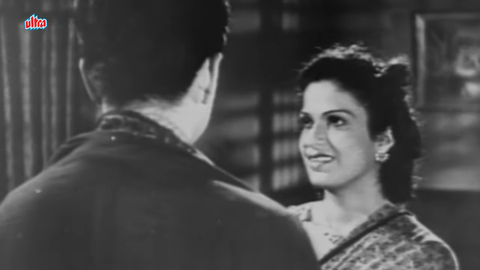
But amidst all the happiness, Sheela discovers that Ram is wounded, his hand bleeding badly. She says she’ll call the doctor, but Ram forbids her. The doctor will find the bullet, and will alert the police. That will be the end of the road for Ram.
Sheela, being a doctor herself, says that the bullet can’t remain in Ram; it’ll start poisoning him. There’s nothing for it but for her to operate. She doesn’t have anaesthesia (though she seems to have pretty much all the instruments she needs, which is odd), so Ram will just have to grin and bear it.
It’s excruciating, but Sheela succeeds in extracting the bullet. That, and the heavily stained bandages, cotton, etc, she throws into a kidney dish on the floor while Ram lies back.

This is not, however, a day for Ram to get much rest. Not only has Sheela come with Himmat Rai; so have Vinod and his father.
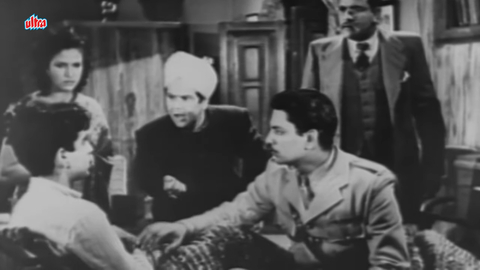
Vinod may be a nasty character, but he is also a sharp-eyed policeman. Too late, Sheela realizes that she hasn’t hidden away the blood-soaked bandages and cotton. She tries to push the kidney dish under the bed, but Vinod notices and stopping her, he picks out one of the bloodied bits of cotton. Sheela tries making a somewhat lame excuse for its presence, but Vinod isn’t buying that.

Worse still, he finds the bullet, and there’s nothing Sheela can say that can account for that. Vinod being the brute he is, decides the bullet can be used as a means to blackmail…
And he doesn’t stop at this. Vinod is nothing if not ambitious, and he knows exactly how to get ahead.
It’s a bit complicated, but what happens is that Gopal—wandering about where he shouldn’t be—is arrested as a suspected revolutionary terrorist. Ram is away from town and is with his group of revolutionaries, so he doesn’t realize what happens next.
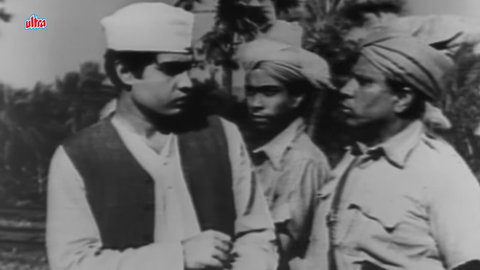
Which is that Vinod blackmails Sheela: marry me or I’ll send your brother to jail and to certain execution. And she agrees out of a sense of sisterly loyalty. Only, however, after having Vinod promise that he will be satisfied with her marrying him and will not expect anything more. Reading between the lines, i.e, the marriage will not be consummated. Vinod promises (poor Sheela. How gullible).
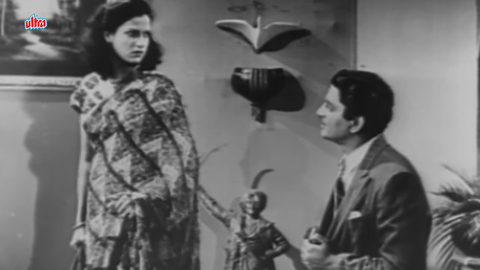
Just the other day, a blog reader commented on Mela (also a Dilip Kumar film, also 1948), saying that they hadn’t been impressed with the film, which was ‘dull’. My take was that it was also a singularly depressing and even regressive film.
Interestingly, when I watched Shaheed, it occurred to me that this film had something in common with Mela other than the male lead and the year of release. This too had the female lead marrying another man, and the whole thing ended in tragedy (you have been warned). However, on the whole, this was a film I liked more than I’d liked Mela. It’s still not a film I’d happily watch again, but it has its good points.

What I didn’t like about this film:
The tragedy of it all. I don’t like films that end sadly for no good reason. This film was released in 1948, after the British were gone; why couldn’t it then have had a happier ending, with India independent and Ram felicitated, and everything happy even after all the angst of the in-between scenes? But no. Beyond a certain point the film starts veering into sadness, and never recovers. It isn’t as deeply despairing in the way Mela was, but still.
There are some gaps. For instance, Sheela uses her skill and training as a doctor briefly, but beyond that, everybody (including her) seems to forget she’s a doctor. Also, there are a few jumps here and there in the narrative, but I am not sure if this is the fault of the film’s editor or whoever uploaded this film to YouTube (this is the copy I watched).
What I liked about this film:
The music, by Ghulam Haider, with lyrics by Raja Mehdi Ali Khan and Qamar Jalalabadi. Nearly all the songs are good, but my two favourites are songs that were runaway hits: Watan ki raah mein watan ke naujawan shaheed ho (in several versions) and Badnaam na ho jaaye mohabbat ka fasaana.
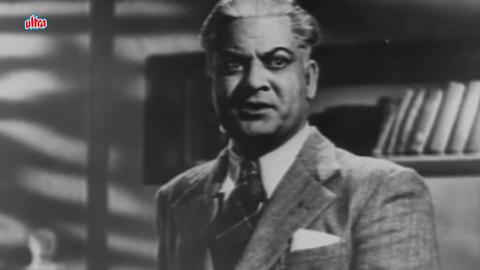
Then, the acting. Dilip Kumar, of course, is one of those who acted well in pretty much any film he was part of, even if the film itself was nothing to write home about. But the more I see of Chandramohan, the more I appreciate his acting. He has so much presence (rather like Prithviraj Kapoor), and his eyes, especially, are so fabulously expressive.
And Kamini Kaushal. I have a feeling she was probably one of those actors whose acting depended a lot on the director; while Bimal Roy might have been able to draw out one of her best performances in Biraj Bahu, Ramesh Saigal in Shaheed is able to elicit a fine performance too. I actually liked Kamini Kaushal as Sheela: for one, though she does sacrifice herself (is she the ‘shaheed’ in this sense?) at the altar of sisterly love, it’s not as if just by marrying Vinod she succumbs to the Hindi film trope of ‘mera pati mera devta hai’, no matter if he’s a complete lowlife. Vinod has forced her to marry him, and she doesn’t forgive him for it. Being married to this lout doesn’t mean that she transfers her loyalty to him: Ram is still the man she loves, his cause the one she too still upholds.
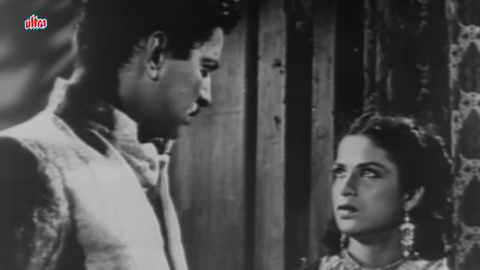
The female lead’s (relative) feistiness, I think, is what contributed a good deal to my enjoyment of this film. It’s not as if Sheela is very progressive or a rebel; it’s just that she has a little more spine than the average Hindi film heroine of this period. Definitely more progressive than Nargis’s character in Mela, at any rate.
Do you have any favourite Kamini Kaushal films (or songs?) you would like to mention? Please share!


From this post only, I have come to know the demise of Kamini Kaushal. I had seen this movie on Doordarshan long back when I was a kid. I had liked it then. Your review is spot on. You have assessed the movie appropriately. I have been an admirer of Kamini Kaushal. She had performed well in another Shaheed (1965) also, playing Bhagat Singh’s mother. I liked her performance in Upkar (1967) also. As a young heroine, I was pretty impressed by her performance in Aag (1948). Thanks and compliments for the good review which made me feel like watching this movie again.
LikeLiked by 2 people
Thank you, Jitendraji. Oddly enough – though I’ve watched all the films you’ve mentioned – I had forgotten that she’d acted in them (though now that you mention it, I do remember her playing Bhagat Singh’s mother in Shaheed). Somehow the roles I remember her in are from the 40s and 50s – Nadiya ke Paar, Night Club, Biraj Bahu.
LikeLiked by 2 people
a befitting tribute.
LikeLiked by 1 person
Thank you!
LikeLike
I might have seen Shaheed as a kid on DD, but I can‘t remember anything about it. The only reason why I would want to watch is for Chandramohan. And you are right, I too find many parallels between him and Prithviraj Kapoor and thus then also to Awara.
Kamini Kaushal is an actress, whom I mostly know as screen mother or grand-mother. She had that benign smile, which endeared her to me. And then I remember her also as a supporter of children‘s films. She used to appear quite often in Bombay DD‘s Hindi children programme (Bombay DD used to have children‘s programme in four different languages; English, Hindi, Marathi, and Gujarati) and she made quite sympathetic impression on me in my early teens. That is why maybe I feel sad about her death…
As for her movies as a heroine, I can‘t remember any, where she left a deep impression on me. Sohrab Modi‘s Jailor is one film that comes to my mind, but that had Geeta Bali as the lead heroine, I think. But it doesn‘t matter what roles she played, what matters for me personally is that a nice human being is no more. And God knows, how much we need nice human beings on this planet right now.
What striked me about your review is your usage of the term “sisterly loyalty“. If Hindi film presss reports are to believed, she would leave her then boy-friend, Dilip Kumar, and marry another man (her brother-in-law) out of sisterly loyalty. Life imitating art?!
Thank you, dear Madhu, for the review and hommage.
Good bye Kamini Kaushal, thank you for your legacy and may your journey ahead be peaceful!
LikeLiked by 1 person
And God knows, how much we need nice human beings on this planet right now.
So true! Nice people are sadly in such short supply these days. :-(
I honestly hadn’t known about Kamini Kaushal’s real-life ‘duty-over-love’ story. I went and looked it up, and was thinking, “This is so much like Gumraah“. Similar scenario – dead sister, two children.
I have watched a few films of Kamini Kaushal in her later years – mostly when she was playing mother roles – but TBH, I don’t remember which films, which roles. For me, the roles that I remember are the ones from her earlier years, when she was playing the female lead.
LikeLike
Just a small comment on Upahaar. KK acted as the (widowed) mother in law of Jaya Bhaduri. I was accustomed to the Leela Chitnis/ Lalita Pawar type of mother/mother -in-law, old, white haired, withered and wizened. And here was Kamini Kaushal, beautiful, slim, with flowing black hair. I remember discussion in my household about how ‘inappropriate’ it was on KK’s part to dye her hair (especially since she played a widow)! However now I realise that she was only 43 years old and had every right to sport her natural hair shade.
Nitin
LikeLiked by 1 person
Uphaar was the film based on the Rabindranath Tagore story (Satyajit Ray’s Teen Kanya had a section based on it) about a tomboy who is married off and learns to be a ‘responsible wife’? I haven’t seen the film, but I have been meaning to. Now, especially, to see Kamini Kaushal being a refreshingly fresh-faced saas!
(Though I must admit I think Hindi cinema often aged characters well before their time. Look at Sharmila Tagore’s character in Aradhana for instance: she’s a young woman when she is imprisoned, and she’s probably in prison only a little over a decade, but by the time she emerges, she is really old and decrepit).
LikeLike
KK played for the first time a mother in Shaheed 1965
LikeLiked by 1 person
if not mistaken Dillip Kumar name in Shaheed was Manoj Inspired by the name one Harikishan Goswami named himself Manoj Kumar as his screen name.Read an article long time ago but could be wrong
LikeLiked by 1 person
Not this film, since Dilip Kumar’s character here is Ram. I think he plays Manoj in Shabnam (1949), but I’ve not seen that film, so cannot say for certain.
LikeLike
Yes probably growing old 😀
LikeLiked by 1 person
Arre, here too. :-D
LikeLike
Madhuji,
Kamini Kaushal had a very unique voice, I felt. Her dialogue delivery style was very different because of that. She was wonderful as Biraj Bahu!
I happened to attend the inauguration of the National Museum of Indian Cinema in Mumbai in 2019. A wheel chair bound Manoj Kumar had come and as soon as he saw Kamini Kaushal in the auditorium, he began pulling her leg reminding he how she had played his mother in Shaheed (1965).
Anita
LikeLiked by 1 person
Thank you for sharing that anecdote, Anitaji. That must have been amusing! (BTW, on a somewhat similar note: I remember reading that when Rishi Kapoor co-starred with Malayali star Prithviraj Sukumaran in Aurangzeb, he insisted on always addressing the younger actor as Dadaji). :-)
LikeLike
Kamini Kaushal in the later part of her life, after retiring from the films, engaged herself in puppet making and got herself trained in it. She actually made the puppets by her hands and she gave voice to them all in her plays and tv serials for children. Anita ji mentioning about her dialogue delivery made me remember this part of her interview which I watched as a part of research as I was planning a post on her songs. The post however got postponed now. So many veterans from Hindi films passing away in a span of months. Really..
It’s shocking. And I don’t know when would I be posting that post.
Anyway… (a sigh)
……
LikeLiked by 1 person
I completely missed this comment! Thank you for pointing it out to me, Anupji.
And thank you, too, for reminding me about Kamini Kaushal’s stint as a puppeteer. Now that you mention it, I remember watching brief snippets of her work with puppets, on DD. I think she appeared on Tabassum’s show – was it called Phool Khile Hain Gulshan-Gulshan?
LikeLike
Yes! That was the name. It was quite popular and the only show of the era where we got see the celebrities being interviewed. The only other source of magazines, Mayapuri was one. And Goutam Rajyadhyaksh also used to publish a magazine called ‘जी’. I think the letter stood for the word Glamour. A few others like Chanderi which was Marathi were also there.
I too remember watching her puppets as a kid on DD.
LikeLiked by 1 person
I don’t think I ever came across those Hindi film magazines – though I think I’ve heard of Mayapuri. The only film magazines that ever came to our home were Stardust, Filmfare and Star & Style, but that was infrequent because by then the best days of cinema were over, according to my father! (You can see where I draw my influences from). :-)
LikeLike
A truly fantastic read. Your writing style is both engaging and informative.
LikeLiked by 1 person
Thank you so much. I am glad you enjoyed this post!
LikeLike