
This is a film that’s been on my radar for a long time—in fact, from when I first read about it on Memsaab’s wonderful but now sadly defunct blog. As those who have read my Muzaffar Jang books might know, I find certain sections of Mughal history (especially around the reigns of Akbar, Jahangir and Shahjahan) fascinating. So rich, so interesting, a period of such efflorescence, in different ways. Spirituality; art; architecture; beauty in myriad forms. Among the greatest examples of the Mughal contributions to culture is the exquisitely beautiful Taj Mahal, ‘a teardrop on the cheek of time’, as Rabindranath Tagore put it.
The Taj has been the subject of numerous films over the year (the latest one seems to be controversial enough to have run into trouble). Arguably the most famous film on the subject is the 1963 version, starring Beena Rai and Pradeep Kumar and directed by M Sadiq; there have been more recent ones, including a 2005 one named Taj Mahal: An Eternal Love Story, supposedly the most expensive Hindi film of its time.
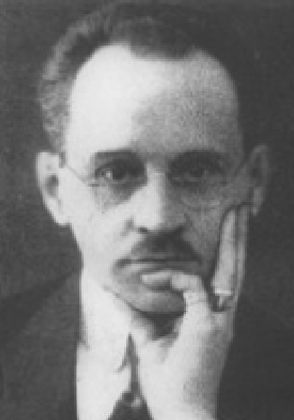
Long before all of these was this silent film, directed by the Bavarian film-maker Franz Osten and produced by Himanshu Rai (who also played the titular role in the film). Himanshu Rai’s interest in cinema had led him to visit Germany, where he had spent some time with the Emelka film production company, exploring ways of getting German collaboration to produce an Indian film. When Rai returned to India, he brought with him one of Emelka’s best directors, Osten, as well as several of their top technicians. Osten went on to direct 16 films in India over the years, of which the second was this one, a story about how the Taj came to be built.
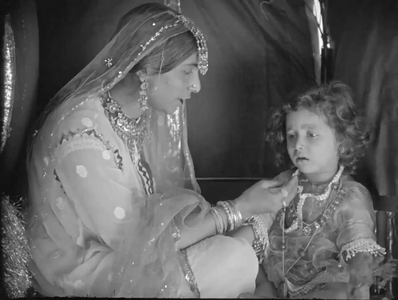
The story begins in the Persian desert, across which a camel caravan is travelling. Part of the caravan are a little princess (?) who is accompanied by a woman (it is revealed much later in the film that this is the little girl’s mother).
As the caravan makes its way across the wild desert, bandits watch, and eventually attack. The princess and her mother have a large troop of soldiers guarding them, and these men quickly move forward to defend their charge, while a handful of soldiers escort the camel, its attendant, and its passengers away, out of harm’s way.
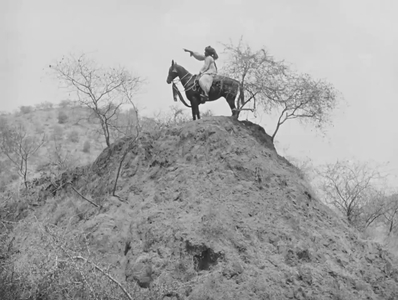
Not really, as it turns out. The bandits kill everybody, including the little princess’s mother. Once they’ve gone away, the little princess climbs out and goes and sits on a rock.
It is here that a potter named Hasan (?) finds her. Even as he watches, a cobra rears up near the little girl, but then slithers away, seemingly daunted by the sight of the amulet the child wears around her neck.
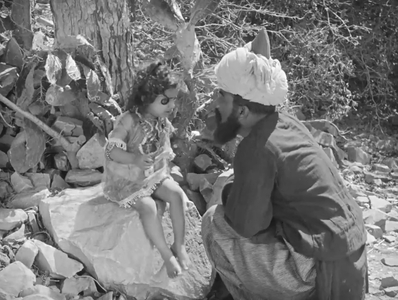
Hasan looks around, discovers the wrecked caravan and realizes the truth: this little girl is the only survivor of this carnage. He therefore takes her home with him, where she is welcomed into the household and the family by Hasan’s wife and his son, Shiraz (?). Since nobody knows who she is, they decide to call her Selima.
Soon after, the family take Selima to a holy man, who blesses the little girl and then also has a closer look at the amulet she’s wearing. The man says little Selima is (I paraphrase) not to be sneezed at. A gift from Allah, and one Hasan should cherish. Also, that amulet she’s wearing is to protect her from harm.
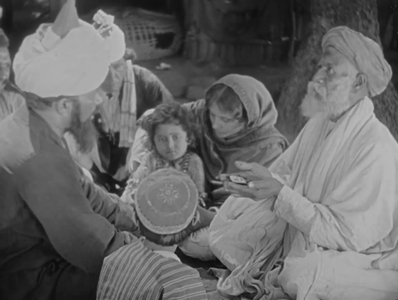
Anyway, Selima and Shiraz grow up (respectively, now Enakshi Rama Rau and Himanshu Rai). They’re great friends, always hanging out together, chatting. To anybody it would seem that these two are in love. Shiraz, at least, hopes that someday Selima will marry him. He keeps crafting little figurines and such-like from clay, to gift to Selima.
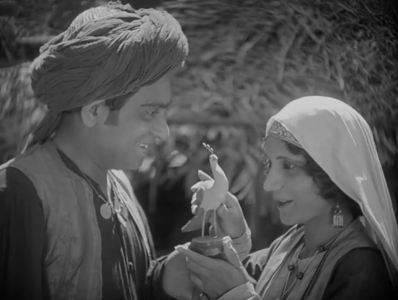
But disaster strikes. One day, when Selima goes to fill water from the well, a couple of slave-raiders see her and decide she will be a worthy addition to their catalogue, so to say. They follow Selima to her home.
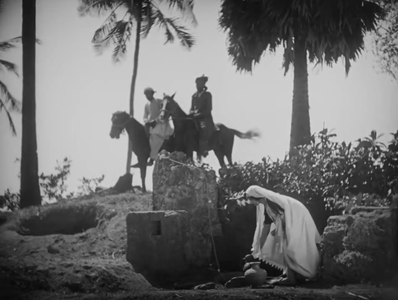
There, they pretend to be interested in buying some of the pottery Hasan and Shiraz make, but in reality, they only have eyes for Selima. Shiraz notices the sidelong (and clearly lascivious) looks being directed at Selima, and shoos these two brutes away. They aren’t so easily fobbed off, however…
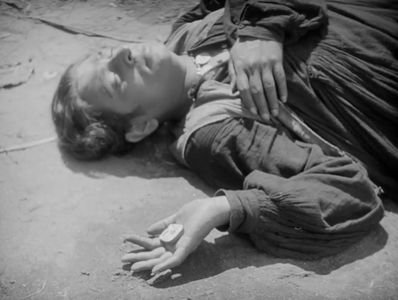
Soon after, Selima and Shiraz are chatting, standing somewhere far from home (and possibly other people as well?) when the slave-raiders attack. This time they make no pretense. They grab Selima, and in the tussle that ensues, Selima’s amulet comes off in Shiraz’s hand. The slave-raiders carry Selima off.
She ends up being presented in front of Prince Khurram (Charu Roy), along with several other girls who have similarly been forced into slavery. While all the other girls prostrate themselves before the prince, Selima only bows slightly. Her dignity impresses Khurram a lot, and when she tells him that she was free-born and has been unrightfully made a slave, he is even more enchanted.
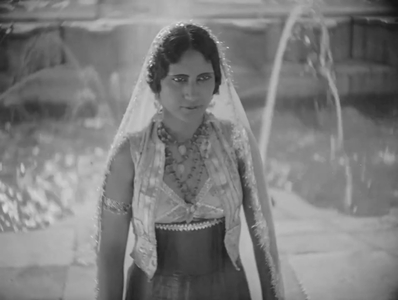
In fact, Khurram is already halfway to falling in love with Selima. He gives orders that she is to be looked after. Selima is taken to apartments of her own, decked out in fine clothing and given loads of grand jewellery. Khurram tries to hurry her into a romance, but Selima is still mourning the loss of home and family.
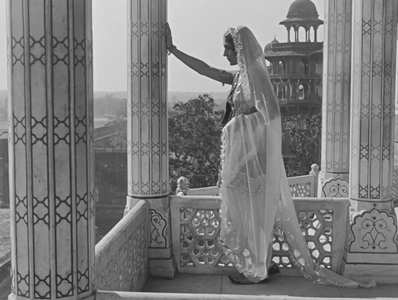
It’s not as if she is completely anti-Khurram, though, and before long Selima is reciprocating.
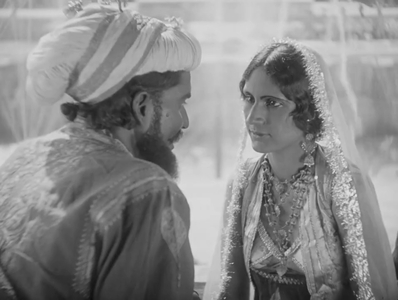
This romance has not gone unnoticed. While everybody else seems happy to have Khurram and Selima be an item, one person who sees red when she notices them together is Dalia (Seeta Devi), the daughter of the general. Dalia has been pursuing Khurram for a while, and so assiduously that Khurram has had to ask her father to get his daughter to desist: why is she going around telling everybody that Khurram will marry her?
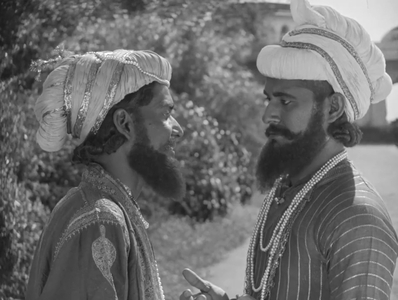
Dalia’s father the general is in charge of sanctioning the passes that have to be made for all outsiders wishing to enter the palace. His personal seal is used to endorse each pass, and Dalia knows this well.
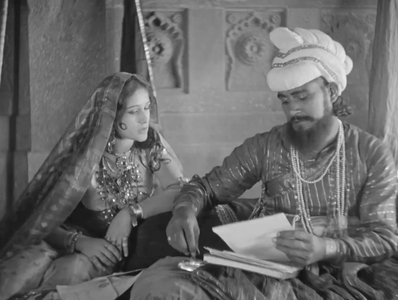
… and it will come in use, sooner rather than later. For Shiraz, loyal and very anxious on Selima’s account, follows the slave-raiders’/slave Selima’s trail to the palace. Having discovered that Selima is there, he is desperate to get inside, to talk to Selima and somehow get her out, but (of course) the guards at the gate don’t allow random visitors to enter.
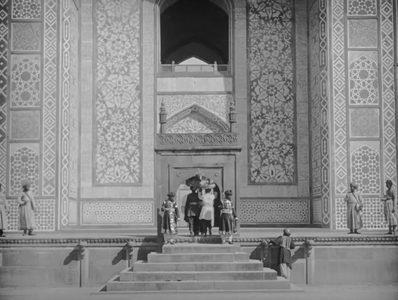
Dalia, naturally, would be happy to help anyone who will get Selima out of the way, leaving Khurram free for Dalia to get her claws into (and, yes, in case you were wondering: Dalia is not really in love with Khurram; she admits that all she wants is to be the Empress). But Dalia won’t be satisfied with just getting Selima out of the picture. Her plan is to ensure that Khurram is so incensed that he gets rid of Selima once and for all.
She therefore hatches a wicked plot, forging a pass by sneaking her father’s seal and using it to create a document that will allow Shiraz to enter the palace. This pass Dalia gives to her maid (?) to hand over to Shiraz. And, just as Shiraz is making his way into the palace, all unsuspecting, Dalia sends urgent word to Khurram that a stranger has come to meet his beloved Selima…
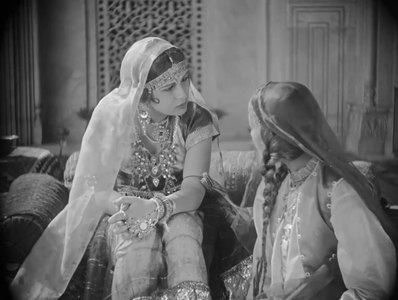
At this point, of course, this doesn’t look as if it has very much to do with the Taj Mahal. In fact, all the historians I know—people who don’t subscribe to the PN Oak theory of ancient origins for the Taj—will agree emphatically that even the rest of the film has nothing to do with the Taj, except for the fact that it’s shown to have been built as a mausoleum for Shahjahan’s Empress, Mumtaz Mahal. The rest of the story is completely fictitious.
What I liked about this film:
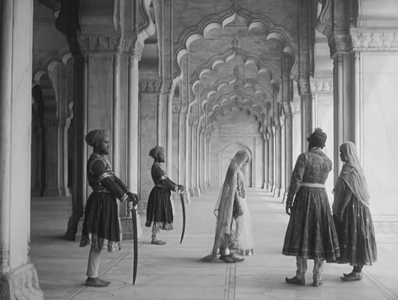
The beauty of it, the sheer visual delight that it is. Shiraz was filmed all in natural light, and in settings that already existed: not a single set was constructed for the film. Franz Osten filmed scenes across identifiable sites—the Agra Fort and Sikandra among them, as also parts of the palaces at Jaipur (the Maharaja of Jaipur co-operated in the production of the film). There have been other films shot in these locales, but never have I seen another which showcases these monuments in such an aesthetic way.
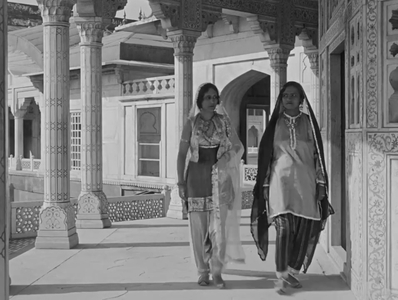
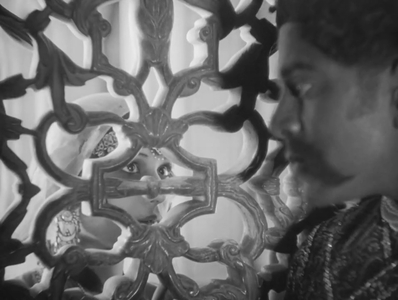
Then, there’s Seeta Devi. Born Renee Smith, Seeta Devi was an Anglo-Indian who debuted in the 1925 Franz Osten film The Light of Asia/Prem Sanyas, where she played the female lead. By the time Shiraz happened, she had moved from centre stage to playing the villain of the piece, but to me, at least, Seeta Devi as Dalia outshone Enakshi Rama Rau as Selima. Yes, she’s a self-serving soul and rather heartless, but there’s a fiery beauty to her which I really liked, more than Selima’s somewhat vapid sort of dignity.
The story, while nowhere close to fact, is at least entertaining. It’s fairly straightforward and simple, with no diversions and side plots: good ‘time-pass’.
What I didn’t like:
The liberties that have been taken with the story. Of course. This doesn’t even pretend to be anything near the truth, not only as far as the architect of the Taj Mahal is concerned, but in other ways too: Dalia; Persian princess Selima; Shiraz himself—it’s all fiction.
But then, I suppose one shouldn’t be expecting cinema to be based on fact; the aim, at least in much of Hindi cinema across the decades, has been to entertain. That Shiraz does well, and beautifully. If for nothing else, watch this for the visual splendour it offers.
A very good print, newly restored, of Shiraz can be viewed here.


Madhuji,
This is such a happy coincidence that Acchut Kanya (1936) that I just wrote on is a story by Niranjan Pal and so is this!! The documentary on Pal is indeed worth watching. I have provided its link in my post.
Anita
LikeLiked by 1 person
That is really a coincidence, Anitaji, because I completely missed seeing in the credits that Niranjan Pal had written the story for Shiraz (or saw it, but it didn’t register). I had noticed the link in your blog post about the documentary, I’ll try to make time to watch it. Thank you.
LikeLike
Thanks for the recommendation, dear Madhu.
I am watching it right now and am absolutely bowled over by the visuals. Here are a few thoughts, which arose while watching it.
The whole movie has “EXOTIC INDIA” written all over it.
As a (past-life) botanist, it was interesting to see the carefully placed cactii in many scenes. I doubt cactii reached India or Persia so early.
Not only is the movie a journey in time of the Mughals but also a journey in time of the 1920s and how Europeans perceived India as well as Mughal India and how India was marketed.
I know that music was composed at times for silent films, which was played live in some cinema halls. So I wonder if it is the same original music which was added to this film or a new score. I think there also might have been recorded music of the original score, which might have been used here.
I agree with you Seeta Devi was the highlight of the film in the acting dept. I will have to look her up in wiki.
LikeLiked by 1 person
I am so glad this review inspired you to watch the film, Harvey. Thank you! And yes, I totally agree with you about the film having ‘Exotic India’ written all over it. The Germans were, of course, among the leaders in Orientalism, and while they produced some of the best scholars in India studies (as far as I know), there was also a lot of this exotification happening… I did wonder though why Himanshu Rai went along with it. Was he too much of a brown sahib to see it for what it was? Or did he not care? (Or, more likely, was he catering to a Western audience and knew this would appeal to their sensibilities and ideas of what India was all about?)
But yes, either way: such a visually pleasing film. And Seeta Devi is a total rock star! :-)
LikeLike
I think it was a bit of everything and more. And more than that I think it might be the desire to see India (or the idea of India) being portrayed in a positive light (or portrayed at all in Europe) was a driving force. Moreover, including a commoner in the story of Taj Mahal felt like a revolution itself. Russian Revolution was only 10 years old during the making of the film.
LikeLiked by 1 person
You’re right about that ‘commoner in the story of the Taj’ being a revolution in itself. Yes indeed. And of course the Russian revolution (and, over time, the Soviet Union itself) did become an important influence in India too.
LikeLike
I didn’t know this got a restoration from the BFI! And it has a new soundtrack from Anoushka Shankar. Really looking forward to watching. I had heard of this but didn’t know much about it. Amazing it was all shot on location! Thank you for your writeup.
LikeLiked by 1 person
I am so glad you liked this review. Do please watch – it’s a beauty, a visual treat. And let me know what you think of it.
LikeLike
Appears to be a mute film. Anyway, your review is fabulous and instigates the reader to watch the movie. Compliments.
LikeLiked by 1 person
Thank you so much, Jitendraji. You are always so supportive.
LikeLiked by 1 person
I haven’t been a great fan of silent movies but there are some that have made me admire the film-making – this sounds like the latter. And your review makes me interested enough to want to watch it. :)
LikeLiked by 1 person
I know what you mean, Anu. I too tend to steer clear of silent films. But, again in sync with what you say, I have found several that are very good examples of the art of film-making. Metropolis, for example, and The General. Shiraz isn’t great cinema, but it’s entertaining enough, and the visuals are stunning.
LikeLike