
My husband and I end up visiting Select CityWalk Mall every other week or so, invariably combining shopping with lunch, followed by coffee and cake, mostly at either The Coffee Bean and Tea Leaf or Starbucks. When we saw that … Continue reading

My husband and I end up visiting Select CityWalk Mall every other week or so, invariably combining shopping with lunch, followed by coffee and cake, mostly at either The Coffee Bean and Tea Leaf or Starbucks. When we saw that … Continue reading

Middle Eastern cuisine is a firm favourite with both my husband and I. We love the flavours, we love the textures and the light, fragrant dishes—all the way from relatively rich rice-and-meat dishes to simple pita-olive oil-za’atar snacks. So, when … Continue reading

Amongst India’s best-known museums, Hyderabad’s Salarjung has the distinction of being possibly the largest collection of art and artefacts built up by a single man: Mir Yousuf Ali Khan (Salarjung III). The Salarjungs were one of Hyderabad’s most important aristocratic … Continue reading
‘Seven Tombs’—the name by which this tomb complex in Hyderabad, one of the city’s major heritage attractions, is known—is very deceptive. Firstly, because while the large tombs, those of various rulers of the Qutb Shahi dynasty, do total up to seven, there are dozens of other tombs, of everybody from dancers to physicians to queens. And more, making this possibly the largest necropolis in the Deccan. Secondly, there aren’t just tombs in this complex; there are also several other types of buildings.

The tomb of Hayat Baksh Begum.
Or, if you want the complete, expanded name, Ugetsu Monogatari (Tales of Moonlight and Rain), named for the collection of supernatural stories by 18th century Japanese writer, Ueda Akinari. Two of the stories from this book—Asaji ga Yado (House amid the Thickets) and Jasei no In (Lust of the White Serpent) were adapted, and directed by Kenji Mizoguchi in what was to become one of the most highly acclaimed Japanese films of all time: Ugetsu went on to win the Silver Lion at the Venice Film Festival; has been listed as one of the best films made in Sound and Sight magazine’s top ten critics poll; and has appeared in countless other ‘best movies’ lists.
Without wasting more time on listing its achievements, though, something about what the story is all about.
We begin with a brief introduction to the time and place. This is 18th century Japan; a civil war is raging; and in a small rural community, the villagers are trying hard to keep body and soul together despite the violence that surrounds them. When we get into the story proper, it’s to find a potter, Genjûrô (Mayasuki Mori), loading a consignment of his pottery onto a cart to take to market.

Of the forts of the Deccan, Golconda is one of the most famous—and it’s one of Hyderabad’s major tourist attractions. We’d decided this had to be among the first sights we visited, so after we’d seen the Qutb Shahi Tombs, … Continue reading
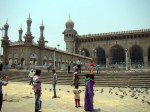
Sadly, the only thing I knew about Hyderabad’s Mecca Masjid, before I began researching the city to create our itinerary, was that it was the scene of a brutal terrorist attack in 2007. Someone mentioned to us that, in the … Continue reading
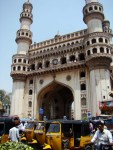
Bang in the heart—literal and spiritual, so to say—of Hyderabad is the ornate four-towered building known as Charminar. We visited it on our second day in Hyderabad, but even on our first day, while sightseeing elsewhere, we were constantly asked: … Continue reading
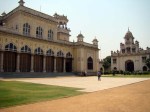
When my husband and I were setting out to draw up an itinerary for our trip to Hyderabad, most websites we visited raved on and on about the Charminar, the Golconda Fort, the QutbShahi Tombs and the Salarjung Museum (all, … Continue reading
Several weeks back, a two-day festival called Dilli ka Apna Utsav was organised in Delhi. As part of the festivities was a heritage walk led by my sister, Swapna Liddle. This walk took us to buildings and landmarks associated with the poetry spawned in Delhi: famous venues for mushairas (like the Ghaziuddin Madarsa and the Haveli Razi-un-Nissa Begum), or places which were once residences, even if only briefly, of famous poets (Ahaat Kaale Sahib, Zeenat Mahal, Ghalib’s Haveli).
What connection does all of this have to Hindi cinema? Just that it got me thinking of the links between Hindi film songs and classic poets. I can’t think of too many classic poets (except Mirza Ghalib and Meera Bai) who have been made the central characters of Hindi films, but the works of famous poets crop up every now and then in Hindi film songs. Sometimes in their entirety, and very well-known, too (as in most of the songs of the Bharat Bhushan-starrer Mirza Ghalib).


 Dustedoff