Hindi Film Characters with Books, Part 3

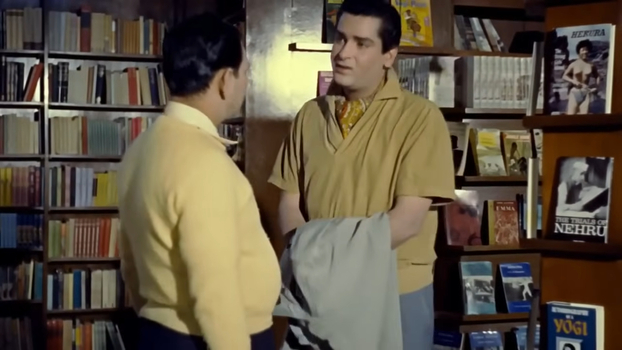
In 2018, for World Book Day, I compiled a post on Hindi film characters depicted with books. I had not meant it to be the first part of a series of posts; not at all. It had taken me a good bit of effort, many days of trawling through films, much research, to come up with those ten books on that list. To be honest, besides those ten books, those ten characters, I couldn’t think of any other Hindi film characters I’d seen with books.

I don’t know how it is with you, but I have noticed one thing about myself: as soon as I’ve done a post on some theme (or even thought of one), I keep noticing that theme again and again in films I watch. After 2018, I found myself spotting books in several old films I watched. Enough to enable me to post a follow-up list: ten other books.

And now another ten. As I’ve done for the other book lists I’ve made, these are all from films I’ve seen, and (barring one film, Dil Daulat Duniya, 1972), from before the 1970s. I’ve made an exception for Dil Daulat Duniya because (like—say, Sharmeelee—it has a very 60s look and feel to it, and is anyway on the cusp of the decade). These ten books are all real books, and can be bought online even today; I’ve provided links to buy, wherever possible.
Continue reading

Ten of my Favourite ‘Multiple Version’ Songs: Duets

By which I mean two versions of the same duet.

This is part of an admittedly sporadic series of posts that focus on multiple versions of songs in old Hindi cinema. Composers and film directors have, again and again, homed in on songs that have staying power: songs that audiences wouldn’t mind listening to repeatedly in a film. Multiple version songs, as I’ve shown in previous posts of this type, take various forms. The type, for instance, where both a woman and a man sing the same song, but as solos. Or where a song is sung both as a duet and as a solo. Or, even, where the same singer (male or female) sings the same at two different points, but usually in two different moods.

And then there’s this: where a duet is repeated. Invariably, in two distinct moods. Given that the overwhelming number of duets in Hindi cinema tend to be romantic ones, there’s a certain predictability to the tones of these songs. One version is, more often than not, a happy version: two lovers celebrating their love and vowing eternal fidelity. The other version, just as often, is the complete opposite in tone. Things have fallen apart, fate (or disapproving parents, nasty relatives, lecherous villains, etc) have intervened and either sown the seed of suspicion, or used emotional blackmail to force one of the couple into giving up the other. There are also sorts of possibilities—and they lead, as below, to the old duet being again sung (often as an impossible duet, the estranged lovers physically too far apart to be really singing together).

Continue reading