Ten of my favourite ‘multiple version’ songs: solo/duet (or more)

Many years back, I’d begun doing a series of posts on multiple version songs in old Hindi cinema. Songs that seem to have struck their composers/film directors as so impactful that they needed to be repeated, in different scenarios, sometimes in different moods and even with different singers, singing differing lyrics. I did two of those posts, then something cropped up (I don’t remember what) and the project got abandoned.

But I’ve got back to this now, and here’s a third post on multiple version songs. My earlier posts focused on solos: two-version songs sung by a male singer and a female singer; and the same song, sung by the same singer but in two versions.

This time, I’m focusing on songs that appear at least twice in a film, but at least once in the form of a solo and the other time as a duet (or more: one of the songs in this list has three singers).
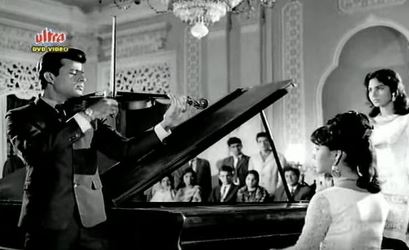
Continue reading

Ten of my favourite Geeta Dutt duets

This was not the post I’d got planned for this week. But then, when so many people commenting on my Geeta Dutt solos post began writing about Geeta Dutt duets, I decided I may as well compile my list of the Geeta Dutt duets I love the most. After all, I knew I’d do this post, sooner or later. So why not now?

Geeta Dutt Continue reading

Ten of my favourite O P Nayyar songs

My sister gave me Ganesh Anantharaman’s Bollywood Melodies: A History of the Hindi Film Song for Christmas. Yes, I know, my sister’s a gem: I adore her. I also adore a lot of the people Anantharaman writes about in his book. He admits he’s biased towards classical music, but then he does go on to acknowledge the worth of people like O P Nayyar, who’s a classic example of unclassical.
Omkar Prasad Nayyar was born on January 16, 1926 (now you know why this post today, of all days). He grew up in Lahore, and was composing music for All India Radio Lahore by the time he was fifteen (makes me feel utterly worthless. All these child prodigies do). When India was partitioned in 1947, Nayyar left Lahore and came to Bombay. Thank heavens. The rest, clichéd though it may sound, is history.

O P Nayyar

Continue reading