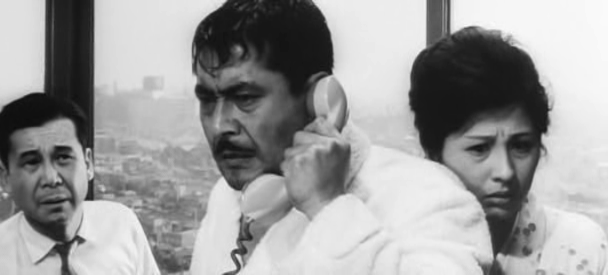
Point and Line (1958)

In the original Japanese, Ten to Sen. The English title is also often translated as Points and Lines, which was how I originally saw it being referred to.

In a cinema that—at least to the outside eye—seems to be dominated by the works of directors like Akira Kurosawa and Yasujiro Ozu, films that are rather more ‘pure entertainment’ tend to get overlooked. The amusing yet insightful little look at childhood, Ohayo (1959), for example; or this classic noir, a police procedural that revolves around trains: their schedules, their stations, their networks… and how they (along with a ferry and various aeroplane routes) might have been instrumental in helping a murderer pull off a crime.

The story begins on a bleak and deserted seashore, where two dead bodies have been found. The cops from the Fukuoka Police Department have come to investigate, and seem to have reached a consensus that this is a case of a double suicide: everything points to it. A man and a woman, her head sweetly pillowed on his arm, lying stretched out beside each other. The police doctor comes to the conclusion that they’ve died of cyanide poisoning.

Continue reading

Rashōmon (1950)

Although it’s been several years since I first watched Rashōmon, I’ve always avoided reviewing it, for the simple fact that this film, one of the most highly rated works of one of the world’s greatest directors, has been dissected and written about so frequently (and by people so much more capable of doing justice to it than I am), that the idea of reviewing it was always succeeded by the thought: what could I possibly write about Rashōmon that hadn’t been already written?

But after I reviewed The Woman in Question last week, I decided it was probably high time I did review Rashōmon. I have, after all, reviewed several films of this type: not exactly based on the Rashōmon Effect, but close to it, variations on the theme of multiple narratives. To not write about the film that gave this trope its name seemed like a gap that needed filling.

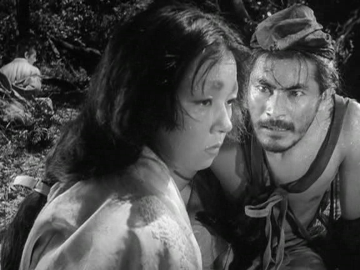
Toshiro Mifune and Machiko Kyo in Rashomon

Continue reading

Kakushi-toride no san-akunin (1958)

Known in English as The Hidden Fortress, though the literal translation is The Three Villains of the Hidden Fortress. One of Akira Kurosawa’s finest samurai films.

I’ve made it a blog tradition that, every year on my birthday, I review a film featuring someone who shares the same birthdate as me, January 8. So, over the years, I’ve reviewed films starring Nanda, Fearless Nadia, Elvis Presley and José Ferrer, among others. This year, I decided it was time for a change. Two changes, actually. For one, the film I’m reviewing is neither in English nor in Hindi: it’s Japanese. And, the person who shares my birthday in this case—Japanese actor Susumu Fujita—isn’t one of the leads. In fact, he doesn’t even appear in the film till the second half. But he is there in The Hidden Fortress, and he’s a good actor. Plus, even though his role here is fairly small, it’s a critical one. Enough reason.

Susumu Fujita as General Hyoe Tadokoro in The Hidden Fortress. Continue reading

Tengoku to Jigoku (1963)

This blog’s been focussing on Hindi cinema for a while now, so I decided it was time to get back to being a bit more diverse. And this time with a film from one director whose work I admire a lot: Akira Kurosawa. If all you’ve seen of Kurosawa are his samurai films, I’d recommend Tengoku to Jigoku (High and Low) as a good way of getting introduced to the films he made in other genres. If you’ve never watched a Kurosawa, this is still one of his best films – and one of the best classic crime films I’ve seen.

Loosely based on King’s Ransom, a novel by American crime writer Ed McBain, Tengoku to Jigoku is about a kidnapping and its repercussions. The result is an unforgettable film that brilliantly combines the personal, the social, the psychological, the dramatic and the mundane, with the sheer sweat-and-drudgery of the police procedural.

Continue reading

Shichi-nin No Samurai (1954)

I first heard about this film when I was a child—The Magnificent Seven was being shown on TV, and one of my parents said it was based on Seven Samurai. End of story, for then.
I’ve grown up since. I’ve heard about the brilliance of Akira Kurosawa. And I’ve recently read that Shichi-nin No Samurai (Seven Samurai) was supposedly the first film ever to use the concept of a group of unconnected people being brought together for a common cause. It therefore seemed high time to finally see the film for myself.
Having just finished watching it, I’m still stunned. This is a mind-blowing film, colossal and profound, gut-wrenching and brooding and action-packed and funny and romantic and… Well, simply unforgettable.

Continue reading