Butch Cassidy and the Sundance Kid (1969)

RIP, Robert Redford.

I will not pretend that Robert Redford was my favourite actor. In fact, offhand, I’d be hard put to remember how many (or, embarrassingly, how few) of his films I’ve watched. All the President’s Men, yes; A Bridge Too Far, yes. A few others, none of them (like Captain America: Winter Soldier) films for which he’s known.

Mea culpa. It isn’t a reflection on Redford, but on me, because most of my life has been spent watching Hollywood from the 30s to the 50s; my favourite era in Hollywood was over by the time Redford burst upon the scene. But it says a lot for him that despite that, I liked him in the few films of his that I watched. A great actor (and so handsome!). Deeply committed to the cause of environmental conservation, and by all accounts, a genuine, warm-hearted person.

Continue reading

The Treasure of the Sierra Madre (1948)

This is one film I’ve known of for a long time, but have always had conflicting views on whether I wanted to watch it or not. On the one hand, I usually enjoy Westerns (more the escapist adventure kind, I will admit; but also, increasingly, those which go just beyond that). On the other hand, Humphrey Bogart is not one of my favourite actors. Then, again: I knew that this film (unlike another ‘seeking-gold-in-the-West’ film I love, McKenna’s Gold) was more gritty, more real. So Bogart—whom I do acknowledge as a good actor—might have done well in it.

The only way to find out, I guessed, would be to watch it for myself.

The story begins in a small Mexican town, Tampico, where a broke American, Fred Dobbs (Bogart) is wandering about, trying to make ends meet. Dobbs seems to have no set idea in mind of what he wants to do: he doesn’t seem to make any attempts to get a job, and all his energies are directed towards relatively prosperous-looking fellow-Americans who might be able to spare him some money to buy a meal.

Continue reading

Cat Ballou (1965)

As a child, I was surrounded by music. On the radio, on the LPs my parents played so often. The LPs, thanks to the fact that my maternal grandfather had worked with HMV for many years, were a very mixed bag, ranging all the way from Pandit Hariprasad Chaurasia to Runa Laila and Geeta Bali to The Golden Gate Quartet, Harry Belafonte, Jim Reeves, Engelbert Humperdinck…  and one of my absolute favourites, Nat King Cole.

Continue reading

The Outrage (1964)

Rashōmon, set in the Wild West.

I hadn’t heard about this film, let alone seen it, till a few weeks back, when blog reader Hurdy Gurdy Man, commenting on my review of Rashōmon, mentioned it.

Rashōmon—and the Rashōmon Effect—fascinates me, to the extent that I will watch just about any film, read just about any book, that uses this potentially gripping style of multiple narratives. From Andha Naal to The Woman in Question: I am game for them all. So The Outrage, starring one of my favourites (Paul Newman), and in a genre for which I have a soft spot (Western) was immediately bookmarked.


Continue reading

Rawhide (1951)

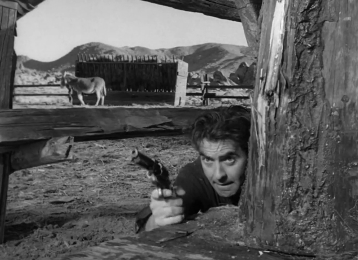
The other day, a blog reader, Dr Pradeep Prahlad, commented on one of my reviews of a Tyrone Power film, Witness for the Prosecution. It reminded me that a few years back, I went through a longish spell of complete and utter Power fandom.  I watched, over the space of a few months, just about every Tyrone Power film I could lay my hands on. Some were good, some were forgettable. Some I reviewed. Some I thought I’d review—and then forgot about them.

So here is one film that I liked, but ended up not having the time to review back then. I rewatched Rawhide a couple of weeks back, saw flaws in it I hadn’t noticed the first time round, and decided it merited a review. Even if only to keep the Power love alive, and even if only to draw attention to a Western that generally tends to get overlooked.

Tyrone Power as Tom Owens in Rawhide

Continue reading

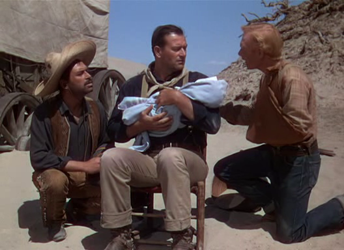
3 Godfathers (1948)

There are two traditions I’ve maintained on this blog ever since I began blogging. One is to celebrate my birthday with a pertinent post (coming up in two weeks’ time). The other is to, for Christmas, review a Christmas-themed film (of which there are examples aplenty). For once, though, the Christmas film I’ve chosen is one with a difference. It’s a Western, and – while it doesn’t have any actual blood and gore shown – there is death here. It’s not a sugary film, and even though the first half has its share of humour, the final impression is one of a bittersweet story of a world that isn’t quite black and white.

Three godfathers Continue reading

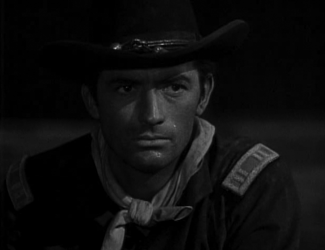
Only the Valiant (1951)

Someone once told me “I don’t watch Westerns and war movies. Too much blood and gore, too little character development, and no message to take home. Nothing but guts and glory.”

True, if (and this is a very big, very emphatic if) the only war films or Westerns you’ve ever seen are the straightforward action types (and even among those, old films tend to be far less gory than their newer counterparts—modern Westerns and war films like The Thin Red Line, Saving Private Ryan, True Grit, etc are, on the whole, far more graphic than their predecessors). But there’s nothing to stop a film—irrespective of genre—from also being well-written, from having good characterisation and character development, and from being something more than a battle of “let’s see who’s braver”. Some of the best films—in fact, even the films that I’ve found affirming virtues like humanity, peace, equality, and so on—I’ve seen have been war films or Westerns: Paths of Glory, La Grande Guerra, The Searchers

My point being, there are films out there that may seem, at first glance, deceptively run-of-the-mill genre film. Then, at closer inspection, they turn out to be something more.

Gregory Peck in Only the Valiant Continue reading

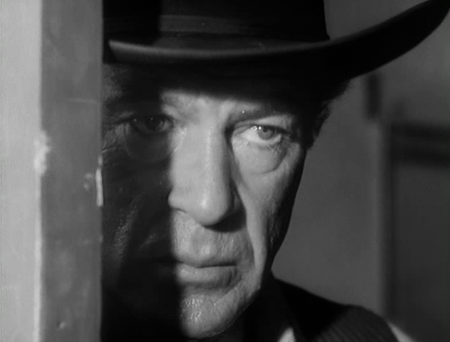
High Noon (1952)

I was – at least as far as emotional maturity is concerned – a baby when I first saw High Noon, and I didn’t care for it much then. Not that I wasn’t fond of Westerns; I adored Westerns. In book form, in cinema, in song. For me, the genre was all that was gloriously outdoorsy and never-say-die: cowboys and Comanche, Monument Valley, smoking barrels and rearing horses, the good versus the bad in that final gunfight. High Noon turned all of that on its head, and left me feeling uncomfortable and disappointed.

I didn’t realise till much later that that disappointment was not the disappointment of watching a film that was bad. Rather, it was the disappointment of discovering that what I’d been rejoicing in till then was not the ultimate in a genre. Some growing up had happened.
I have rewatched High Noon since then, and I’ve come to appreciate this film deeply. I still do like hard-core Westerns like The Good, the Bad and the Ugly and Stagecoach and The Magnificent Seven a lot – but High Noon is in a class all by itself.

Continue reading

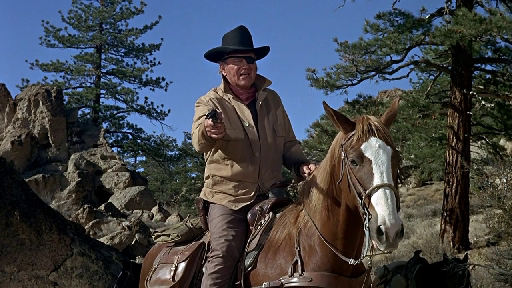
True Grit (1969)

This last Saturday, on a mere whim (brought on by a good newspaper review) I went off to watch True Grit. The 2010 version, starring Hailee Steinfeld in an Oscar-nominated role as Mattie Ross. It was a good film, in true time-honoured Western mould, with tinges of both feminism and noir. And it spurred me on to finally watch the original True Grit, the film that won John Wayne his only Oscar.

Continue reading

The Magnificent Seven (1960)

After having watched Akira Kurosawa’s brilliant Shichi-nin No Samurai last week, I figured it was time to rewatch this film, which goes so far as to mention that it’s based on Shichi-nin No Samurai. For me, The Magnificent Seven has much to recommend it. Firstly, it’s a Western, a genre I’m usually fond of (as long as it steers clear of the run-of-the-mill formulas that John Wayne acted in during the early 30’s—and which, sadly, continued in a lot of films well past the 30’s). Secondly, The Magnificent Seven stars one of my favourite actors, Yul Brynner. Thirdly, it was directed by John Sturges, the very capable man behind classic adventure films like Escape from Fort Bravo, The Great Escape, and Ice Station Zebra.

Continue reading