
The first time I watched Kaala Bazaar was perhaps in my early teens: the film was being shown on Doordarshan, and given that back then I was very fond of Dev Anand, I watched it. I have very vague recollections of that viewing. What I do recall, vividly, is that I didn’t like that my hero was a criminal.
… which, as I came to realize later, was actually not so very uncommon a style for the characters Dev Anand played. Unlike the other major romantic hero of the time, Shammi Kapoor, Dev Anand didn’t just play characters who got up to ‘mischief’, so to say; his characters—from Tony in Jaal to Raju in Guide, from Chhagan in Roop ki Rani Choron ka Raja to Babu in Bambai ka Babu, plus others—were outright criminals: thieves, conmen, smugglers, men definitely on the wrong side of the law.
Like Raghubir ‘Raghu’ in Kaala Bazaar. Raghu is a bus conductor when the story begins, and within the space of a couple of minutes, his life takes an about-turn. A belligerent passenger is standing in the bus (which is against the rules), and when Raghu asks him to get off the bus, the man refuses. Both he and Raghu lose their tempers. Fists fly, and the next thing we know, Raghu is without a job.
Raghu’s mother (Leela Chitnis) is ill, and he has a sister (Nanda) and a young brother (?) as well; he cannot afford to be without a job. Desperate, Raghu flounders about, trying to find work. If not work, money.
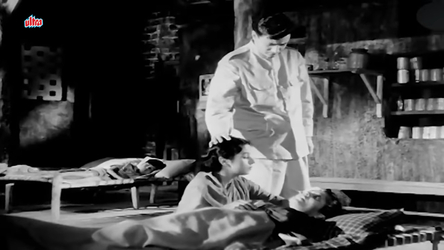
This he finds when he sees a lawyer (Chetan Anand) withdrawing Rs 5,000 from the bank. Raghu follows the man, assaults him in a building, and runs off with the money.
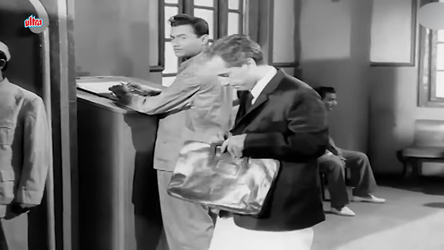
Not long after, Raghu goes to a cinema hall to watch a film, and in the queue at the ticket window, finds something fishy going on. Kaalu (Rashid Khan), wearing a disguise of fake moustaches, sun glasses, cap et al buys a few tickets, then circles around, and now (without the disguise) sets about buying more tickets. Basically, buying up the stock so that he can later sell them at a premium, when impatient cinema-goers, eager to watch the film but faced by a ‘House Full’ sign, are ready to pay Rs 2 for a Re 1.50 ticket. Or so on.
Raghu immediately cottons on to the idea. He has the capital to invest, after all. He walks across and has a chat with Kaalu, and from then on, there’s no looking back.
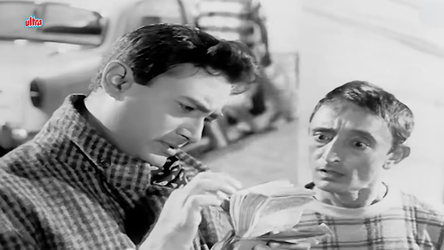
Within days, Raghu has become not just firmly entrenched in the world of the black market around film tickets, he is also the gang leader of a large band of crooks who do much of the work (among the actors here is Jagdish Raj, who—while he holds Hindi cinema’s record for most onscreen appearances as a policeman—ended up playing crooks in several of Navketan’s films). They commandeer film tickets across cinemas. They keep an eye on the hottest films being released, and make sure they’ve bought up tickets for those.

Especially film premieres, like that of Mother India, for which all the biggest names and faces in Hindi cinema show up, and for which fans are willing to shell out exorbitant sums for a ticket.

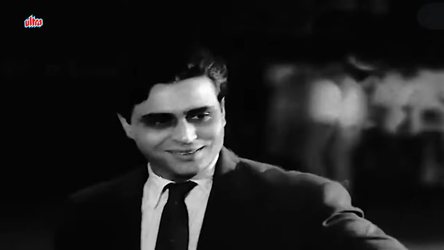
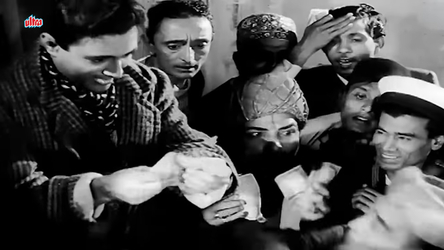
Raghu soon comes up against another major gang leader in this field, Ganesh (Madan Puri). Ganesh is an arrogant, belligerent sort who tries to push Raghu out of the business; but Raghu uses strategy to get the better of Ganesh. In a matter of a few hours, Ganesh is forced to kowtow, to agree to take orders from Raghu.

Things seem to be going well for Raghu.
And then, suddenly, his life takes a different turn: Raghu falls in love. This happens one day when he’s standing outside a cinema theatre, getting ready to sell tickets in black, when he eavesdrops on a group of college students. They’re waiting for a fellow student, Alka, who’s late; her boyfriend, Nand (Vijay Anand, who also directed Kaala Bazaar) comes in for some ribbing. When it seems that they’ll miss the show if they don’t get tickets soon, Nand is elected to buy tickets…

But Raghu’s gang has already bought up all the tickets, and Nand will have to buy them in black. There is some discussion among the students, and finally Nand pays up, with trepidation: he and his classmates know that Alka, with her high ideals, will not be pleased about this. Never mind; they won’t let her know.
Raghu is watching all of this, and watches, too, when Alka (Waheeda Rehman) arrives. One of the students, joking around, spills the beans about the tickets, and Alka is livid. She grabs the tickets from Nand, tears them up, and gives him a piece of her mind.
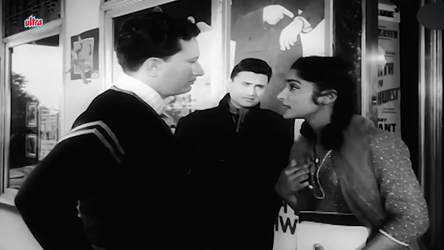
Raghu is intrigued: so intrigued, in fact, that he follows Alka around (very stalkerish). To her home, to college, to the garden where she goes with Nand, and where Raghu, lounging nearby, is able to hear their conversation. This scenario is repeated a second time, and Raghu is able to hear more of what’s happening with these two.
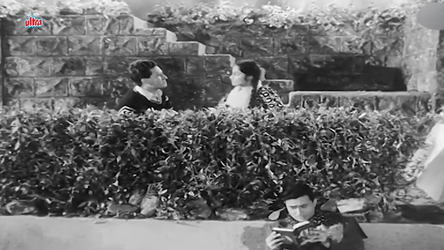
Nand is studying hard so he can go abroad for higher studies. When Alka protests about him leaving her and going off overseas, Nand says that it will be good for them to be apart from each other for a while: it will be a test of their love, to see whether this is indeed true love or just a youthful infatuation.

Raghu (who has, in the meantime, bought a fancy new home for his family) is also—inevitably—around when Nand catches his flight. Alka and her parents (MA Latif and Mumtaz Begum) have come to see him off, and once they’ve waved goodbye, Alka’s parents console her: she will be happier once they’re on holiday. Ooty will help her miss Nand a little less.

Of course, Raghu, who’s been listening to all of this, makes sure he is not just on the same train to Ooty as them, he’s also in the same compartment. He soon has them convinced he’s a good man, a God-fearing soul; and when Alka’s father suffers a bad backache, it’s Raghu who comes forward to massage his back. He manages to ingratiate himself with the family as a result, and both parents are delighted to discover that their new acquaintance is also going to Ooty.
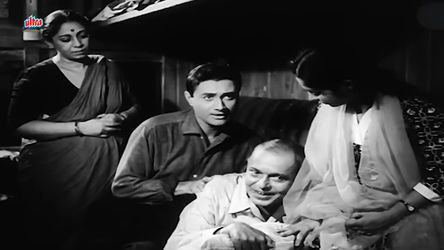
Naturally, then, in Ooty, Raghu calls often on the family, and dogs Alka’s footsteps. He has soon made it clear to her that he’s in love with her, but Alka, while playful enough (and possibly, in her own way, attracted to him), makes it clear that her heart is Nand’s.
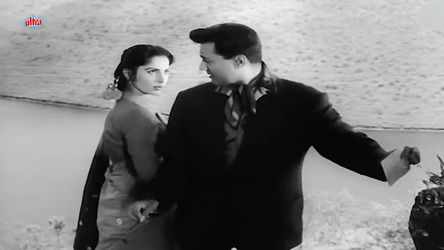
One day, however, matters take a turn: Raghu and Alka are sitting near a cliff and chatting, when they happen to look up and see a flower jutting out from the cliff. It’s impossibly high, and the branch on which it’s growing reaches out over a steep incline: but Raghu, gripped by daredevilry, decides he must get the flower for Alka. She tries to stop him, again and again, but he’s not listening.
The long and the short of it is that Raghu falls off the cliff, but manages to grab hold of a ledge just long enough for a terrified Alka—who’s tried calling, in vain, for help—to whip off her sari, tie it around a rock, and haul him to safety. The ordeal brings home to Alka the fact that she has, indeed, fallen in love with Raghu: but now what?

As she tearfully tells Raghu, she is already engaged. She cannot be unfaithful to Nand; she cannot reciprocate Raghu’s feelings.
So Raghu returns to Bombay, a more introspective, thoughtful man than he had left it. Some time earlier, he had met a rather erudite man (Krishan Dhawan), helping out the poor people of the footpaths. Raghu was so impressed by the man’s firm belief that education enlightens, and his selfless endeavours to help others, that Raghu brought him home. Since then, under his tutelage, Raghu has begun to educate himself, and to turn over a new leaf: that endeavour now gathers momentum.
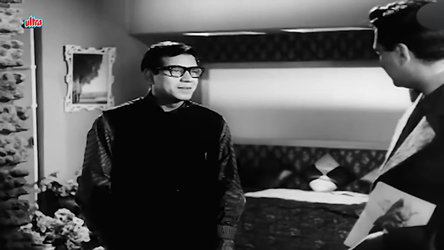
But is it enough? Is there still time, and scope, for Raghu to change? Or is it too late?
Like most of Navketan Films’ productions, Kaala Bazaar examines themes of social friction, of disintegration, lawlessness, poverty—and tries to show how there might be redemption. A serious sort of subject, but the way it’s worked into a film, lightened by moments of humour, and by several excellent songs, makes for an entertaining, enjoyable film.
What I liked about this film:
The ‘modernism’ of the story, the level-headedness of many of the characters. There’s a progressiveness about it, and a (very refreshing) lack of the predictable melodrama that would have characterized most other Hindi films of the time. For instance, there’s Raghu’s reaction to Alka’s assertion that she’s engaged to Nand: on some level, he’s probably prepared for it (after all, he’s been eavesdropping on their conversations, and knows she loves Nand), but he does not argue or plead; he accepts her decision.
I like, also, the realistic way in which Alka is depicted: a woman who does not blame herself for having fallen in love with one man while betrothed to another. In fact, the Alka-Nand relationship is one of the sanest romantic (or friendship-mistaken-for romance?) relationships I have seen in a Hindi film from that period.
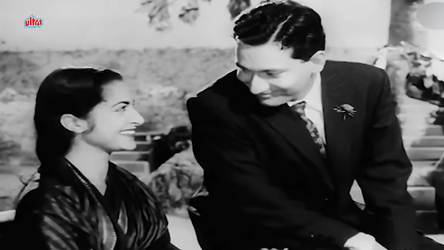
Then, the songs (music by SD Burman, lyrics by Shailendra). Kaala Bazaar has a stunning score, with some great songs: among my favourites are Na main dhan chaahoon, Khoya-khoya chaand and Apni toh har aah ek toofaan hai, though there are several others—Saanjh dhali dil ki lagi, Rimjhim ke taraane leke aayi barsaat, and Sach hue sapne tere among them—that are also very good.
And, the cinema! Kaala Bazaar is one of those films that are a paean to cinema, by virtue, of course, of its lead character’s dubious occupation. There is Raghu hovering about outside a cinema theatre showing Alfred Hitchcock’s North by Northwest.
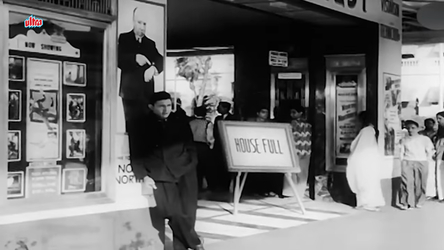
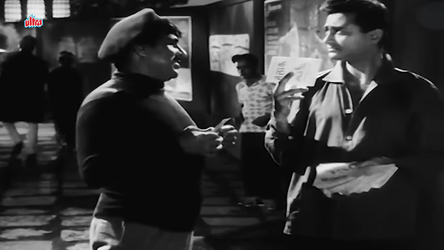
There is Raghu selling song booklets of Talaq, outside a theatre that’s showing the film.
Plus, in what is possibly the single most star-studded sequence in Hindi cinema, there is the real-life premiere of Mother India, which has one famous cinema personality after another coming to the show: Nargis, Nimmi, Kumkum, Mohammad Rafi, Baby Naaz, Lata Mangeshkar, Guru Dutt and Geeta Dutt, and so many others.

What I didn’t like:
Nothing, really, but I do wish there had been more about the peripheral characters, especially Raghu’s family. I wanted more about these people, more about how they felt, how their lives worked out (and the merely-hinted-at relationship between Raghu’s scholarly mentor and Raghu’s sister—the characters played by Nanda and Krishan Dhawan—in particular).
On the whole, though, an interesting, enjoyable film.
 Dustedoff
It is , isn’t it . A very sensible film (mature has other connotations in hindi cinema :D
An all time favourite like the hero of the film.
Almost all Navketan films very very progressive and modern (and I use the word here very consciously) , quite like the three bothers Anand .
LikeLiked by 1 person
“(mature has other connotations in hindi cinema :D””
LoL! Yes, you’re right. ‘Sensible’ fits far better. And yes, Navketan were very progressive, their cinema truly modern. Have you read Sidharth Bhatia’s book Cinema Modern: The Navketan Story? An excellent insight into the many ways in which their films were way ahead of their times.
LikeLiked by 1 person
I have !
LikeLiked by 1 person
Excellent review. Watched this around 23 years back. Time to watch this again.
Very timely post – Centenary of Dev Anand, Waheed Rahman getting the Phalke award and Dada Burman’s birthday on 1-Oct.
Many Many things that are good about this film.
Most artistes were at the peak of their career.
Even Dev Anand’s bad dancing in “Khoya Khoya chand” cant spoil the timelessness of the song.
And the less heard but wonderful song on power of money – “Teri Dhoom Har Kahi”
LikeLiked by 2 people
Talking about Dev Anand’s bad dancing in Khoya-khoya chaand – I remember watching that song, for the first time, on Doordarshan’s Chitrahaar, and my father commenting: “He swings his arms about like a gorilla.” Since then, I cannot watch those sequences of the song without remembering that comment and how apt it was!
Yes, Teri dhoom hai kahin – I don’t know how I forgot to mention that! Such a great song.
LikeLiked by 2 people
I’m going to watch it. Thank you for sharing the review. ‘Khoya khoya chand’ is a beautiful song, and ‘Upar waala jaankar anjaan hai’ is fun to watch! ☺️
LikeLiked by 1 person
Do watch, and please tell me what you thought of it! :-)
LikeLike
I found it (very clear) on YouTube and saved it to watch later. Will let you know. :)
And you might enjoy this bookish post. Guess whose book is featured as a must-read?☺️
https://bohemianbibliophile.com/september-2023-reading-wrap-up-must-read-books-to-add-to-your-tbr/
LikeLiked by 1 person
Oooh, thank you so much for pointing me to that blog post! That made my day. :-)
Looking forward to seeing what you think of Kaala Bazaar, whenever you watch it.
LikeLike
While the Nand Alka relationship has a maturity otherwise lacking in Hindi films, I didn’t like the way Alka accuses Nand of having fallen out of love with her leading to the cracks in their relationship while she herself had quite clearly fallen in love with Raghu. It would have been much better had she been honest about it and not merely blamed the man.
LikeLiked by 1 person
You’re right, she should have been honest about the fact that it’s not as if she is doodh-mein-dhuli either. On the other hand, I thought this was a more realistic way of portraying Alka as a person, not necessarily a ‘perfect’ person, but one with her own flaws and her own weaknesses. Just the fact that she tries to push the blame onto Nand makes her more three-dimensional, I think. But if that was the intention, I would have liked her duplicity (so to say) to have been remarked upon – if Nand had slyly called that out, it would have been far better.
LikeLike
Maybe she was righteously indignant because she did hold out to Raghu’s advances, even knowing that she did care about him deeply, just because she had committed to Nand. And when he (Nand) confesses to his deviation (which may have been more serious, read non-platonic), she takes umbrage. She anyway was portrayed as a bit of a righteously indignant person as we see in the ‘tickets in black’ incident. And her relief and joy in Sach Hue Sapne is palpable, as is her mischievous sense of humour in ragging Raghu into believing that she is singing for Nand. All in all a well thought out, REAL sort of a modern young woman. Impetuous, with a sense of humour, articulate and passionate.
LikeLiked by 1 person
Yes, that’s a very good point. Very likely – and it makes me like her that much more.
LikeLiked by 1 person
Dev Anand
Waheeda Rehman
Bambay Monsoon rains
and a single umbrella
Magic, simply magic
Rum jhum ghum ghum
Naache man kaa mor !!!!!!!!!!
LikeLiked by 1 person
:-) Indeed!
LikeLike
Hitherto I’ve been under an impression that you have already reviewed this movie. This review has, therefore, proved to be a pleasant surprise for me. I’ve watched this movie twice – first on Doordarshan and then, after a decade or so, on a video cassette (you must be well-acquainted with the VCR/VCP era of the eighties and the nineties). Now I am feeling as if I have watched it again through this post. I am in complete agreement with your analysis and assessment of Kaala Bazaar. It’s a quality movie with timeless songs. Thanks and compliments.
LikeLiked by 1 person
I am glad you enjoyed this review, Jitendraji. There are actually quite a lot of well-known movies that I haven’t got around to reviewing yet; I decided it was high time I reviewed this one! I agree with you, it’s a good film.
LikeLiked by 1 person
Excellent review. May be the only movie in which all the three Anand brothers starred together?
LikeLiked by 1 person
Thank you for reading, and for the appreciation. Yes, I believe this is the only film which featured all three of them.
LikeLike
Just as a trivia, but I think Raj Kapoor and Dilip Kumar are also seen in the movie ( at the premiere of Mother India). So does this not make this movie the only one in which the Big Three starred together?
LikeLiked by 1 person
Given that the premiere shots are probably what would count as ‘footage’, I’m not sure that applies! ;-) But this film is probably the biggest gathering of Hindi cinema’s who’s who from that era.
LikeLike
Brilliant review Madhulika! This movie is a favorite and completely agree about the mature manner in which Waheeda Rehman and Vijay Anand handle their falling out of love and continuing to be good friends!
One piece of trivia I had read about this movie was that Nanda did not want to play Dev Anand’s sister in the movie as she was afraid of being slotted. Dev Anand then promised her that if she agreed to play his sister this time, he would take her as heroine in his next. She agreed and he fulfilled his promise by taking her as one of his heroines in Hum Dono.
LikeLiked by 1 person
I am so glad you enjoyed this review. Thank you! Thank you, too, for that piece of trivia. I think I had heard it before, but I’d forgotten about it.
LikeLike
I liked Kaala Bazaar very much. I was never a big Dev Anand fan but I really love Jaal. Do review it if you can? If Kaala Bazaar is very balanced in terms of emotions Jaal is even more stark. I have never seen a Hindi film where the hero plays a flawed character who remains flawed till the end with no redemption in sight.
LikeLiked by 1 person
That’s a good suggestion. It’s been so long since I watched Jaal, I’ve forgotten most of it. Will certainly watch it sometime soon and review it. I do recall watching it as a young teen (or earlier?) and being quite shocked – I was used to the very clear-cut black-and-white style of conventional Hindi cinema, and couldn’t accept a ‘hero’ who was so unheroic.
LikeLike
Madhuji, I feel Kala Bazaar as well as Teen Deviyaan were two movies which were more progressive. Moving on and keeping options open was what these two films were all about. The music is ethereal in both.
LikeLike
Very true. They’re both more ‘real’ in that sense, than most Hindi films of their times. And yes, fabulous music in both films!
LikeLike
Good review. I thought, it was an adaptation of some bengali film. Wrong
LikeLiked by 1 person
Apni Toh Har Aah Ek Toofan Hai always referred to as a double meaning. In the song, atleast what I perceived, Upar wala jan kar anjaan hai, the ‘upar wala’ is both referred to as ‘God’ in one sense and as the heroine sitting in the upper berth as picturized.
Either case, this was Dev Anand at his peak. He would continue as lead hero but in interminable decline post 70s.
LikeLike
Yes, indeed. I had written about Apni toh har aah in this post on Shailendra:
https://madhulikaliddle.com/2023/08/30/shailendra-in-ten-moods/
LikeLike