
Some weeks back, when I reviewed Police (1958), the thought that had stayed in my mind regarding Madhubala’s character—and her acting—in that film and otherwise, in the larger context of her career, was that she got sadly stereotyped. Too many people, film-makers most of all, ended up slotting her as the ravishingly beautiful woman who need only be cast for the fact that she could light up a screen like few others could. Her acting ability (which was actually very good) got overlooked far too often.
Something similar, though in a different way, happened to Meena Kumari. In Meena Kumari’s case, the ‘Tragedy Queen’ label got affixed fairly early in the actress’s career and branded her forever as the Main Chup Rahoongi type: the weepy, self-sacrificing, stoic Bhartiya naari. Despite films like Kohinoor, Azaad, Majhli Didi, Tamasha and Bandish, most people today associate Meena Kumari with ‘serious’ roles.
So, this film, which starred Meena Kumari in one of her lighter roles.
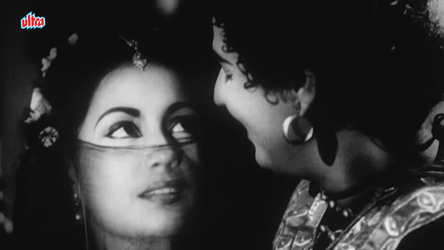
Homi Wadia (who produced and directed Aladdin aur Jaadui Chiraagh) was known, along with his brother JBH Wadia, for films like this: swashbuckling, adventure-romance-grand sets masala films, often fantasies set in the Middle East. Aladdin, strictly speaking, wasn’t originally part of the Arabian Nights (read here about how it became associated with the Arabian Nights), but in this film, the character, named Aladdin bin Mustafa (and played by Mahipal) is quite obviously the citizen of some place in the Middle East.
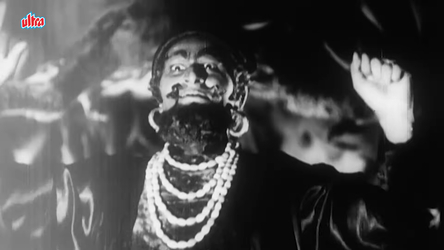
But first, we are introduced to an evil sorcerer named Hikmat Jaadugar (BM Vyas) who is doing some mumbo-jumbo. These shenanigans allow Hikmat to command a magical creature whom he calls Chimgaadad [this one doesn’t resemble a bat at all, but maybe that’s because I automatically see Batman when I think of that]. Chimgaadad may be at Hikmat’s beck and call, but it doesn’t stop him sneering at his master and looking for Hikmat’s downfall.
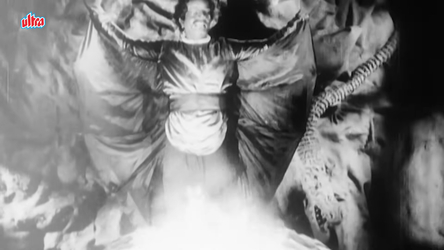
Right now, Chimgaadad is obliged to tell Hikmat the location of a magic lamp, but he gloatingly tells Hikmat that there’s more. The lamp cannot be taken forcibly by an evil brute like Hikmat; it can only be picked up by a good, pure soul, who can be identified by the twenty-one moles on his arm that form a pattern of a lamp [who came up with this one?]. Also, that good soul should not be coerced into helping Hikmat on this mission. A tall order, and Hikmat is suitably miffed. Where is he to find someone like this?
The action now switches to the city where Aladdin lives. Aladdin is a footloose and fancy-free sort, who spends most of his day gadding about with his pal Fakhru (Babu Raje?), much to the annoyance of his mother (Jillo). In his latest escapade, Aladdin has made a bet with one of the city’s noblemen that he will endeavour to see the face, unveiled, of the princess Badr-ul-Badar (Meena Kumari).

This Aladdin succeeds in doing, by the simple [and underhand] trick of tripping up the princess’s palanquin carriers as she’s making her way through the marketplace. The palanquin carriers fall, the princess is flung out, and her veil comes away from her face. She sees Aladdin and he sees her; they fall in love.


Of course, the princess is quickly ‘rescued’ and bundled back into her palanquin, and Aladdin—now feeling rather contrite, because he tried to see the face of a veiled woman and thus dishonoured her—goes his way, a changed man.
But Aladdin has got into trouble. The evil wazir (?) of the kingdom, along with his son Nazim Begh (?) has decided that Aladdin must be gotten rid of. Nazim Begh, especially, is baying for Aladdin’s blood, mostly because he (Nazim Begh) is lusting after Princess Badr-ul-Badar and would rather not have any rivals, thank you. So Nazim Begh and his daddy contrive to get Aladdin arrested on grounds of having attempted to assassinate Nazim Begh by poking at his horse (which might have made the horse throw its rider).
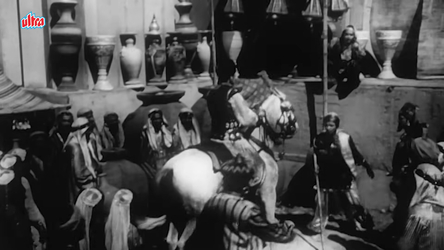
To cut a long story short: Aladdin, much to the horror of Badr-ul-Badar, is flogged and thrown out of the city, exiled forever.
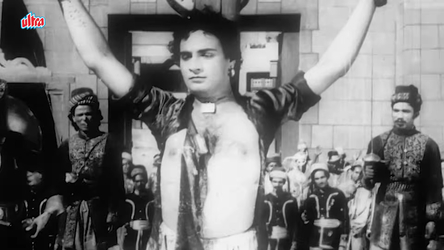
While he’s being flogged, though, something momentous happens. His now ragged sleeve rides up, and his forearm is exposed—on which can be seen a collection of lots of moles. Among the crowd looking on is Hikmat Jaadugar, and it takes him just a glimpse of those moles to [literally] join the dots and see that they would, constellation-like, form the image of a lamp. Aladdin is his man!
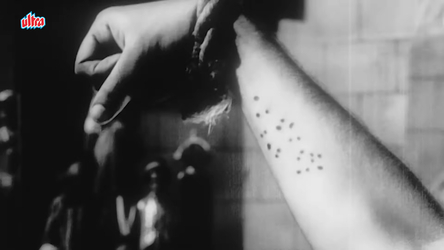
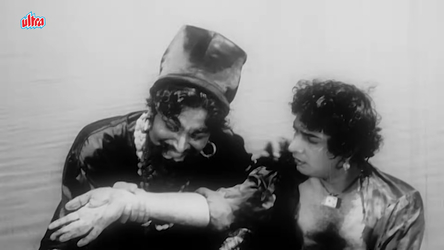
So, the exiled Aladdin finds himself befriended by Hikmat, who introduces himself as Aladdin’s chacha, his long-dead father’s brother, who was estranged from the family many years ago. Aladdin tells his newfound uncle his sob story, and Hikmat promises that vengeance for Aladdin will be his. He will make sure Aladdin gets his due. But to do that, they must first trek to a faraway cave and find a certain lamp hidden inside…
Hikmat sweet-talks Aladdin all the way there, and into the cave, which he insists Aladdin enter all alone. Once inside, Aladdin discovers not just that there are lots of skeletons and random bits of treasure (jewellery, coins, etc) scattered all about, but plenty of obstacles in the way of getting his hands on the lamp. There’s a river of fire, a gorge across which he must leap [or swing from a convenient rope, as Aladdin figures out] and plenty of crocodiles in the river flowing through the gorge.
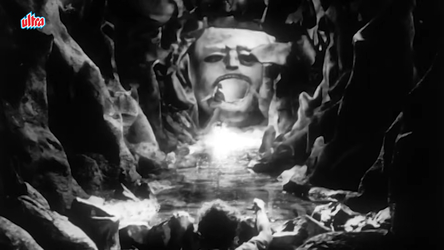
But Aladdin is intrepid and resourceful. He manages to grab the lamp, and discovers soon after that it obviously has magical powers of some sort: the fire retreats, the crocs keep their distance. Aladdin, it turns out, isn’t just a brave soul; he also has brains and realizes that there’s something about the lamp, and perhaps this is why Hikmat is so eager to get his hands on it. When he gets back to the entrance of the cave (which is akin to a trapdoor) and Hikmat demands that Aladdin hand over the lamp before being helped out, Aladdin puts his foot down. No; first Hikmat must help him out.
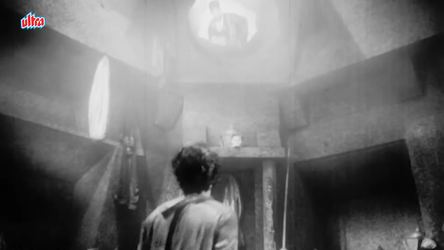
There’s an impasse, and an angry Hikmat slams the trapdoor down in a fit of rage, leaving Aladdin trapped underground. Aladdin is looking around for ways to get out, and in the process:
(a) sees some creepy mummy-like characters approaching menacingly
(b) drops the lamp in his hurry to get away from them; and
(c) picks up the lamp and rubs off the cobwebs and dust it’s acquired…
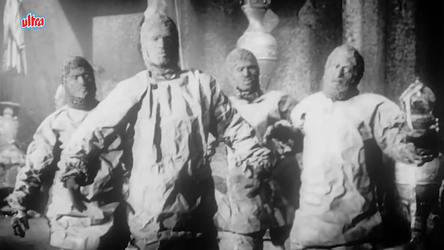
… and you know what happens next. Aladdin’s inadvertent rubbing of the lamp ends up being a summons for its resident genie (Vasantrao Pahelwan), who materializes, asking how he may be of service to Aladdin.
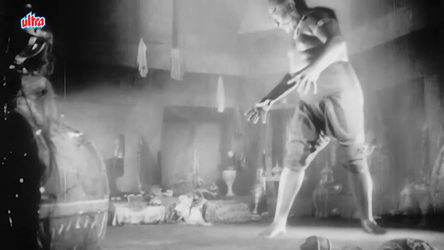
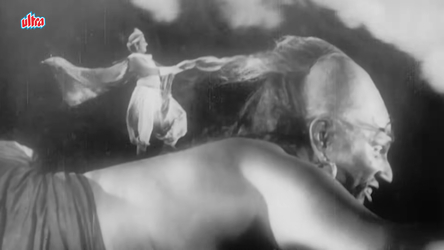
It doesn’t take Aladdin long to take advantage of the situation. The advancing mummy-monsters have already fled before the genie; now Aladdin also gets the genie (who has in the meantime exchanged Aladdin’s rags for more fancy clothing) to take him back home. First class, no less, hanging on to the genie’s braid.
At home, Fakhru and Aladdin’s mother are overjoyed to see him back. Within a very short time, Aladdin has got the genie to give his rather ramshackle home a makeover, and to provide a sumptuous feast. All is well.

Now all elegantly kitted out, Aladdin can get back to wooing Princess Badr-ul-Badar, who is having a hard time fending off the unwelcome attentions of the nasty Nazim Begh.
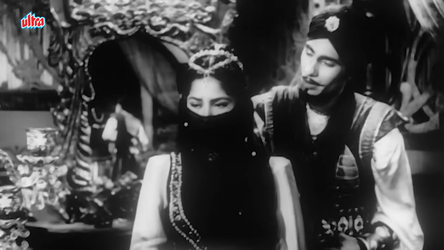
And Nazim Begh is a nasty character indeed, as is his father, the wazir. In fact, the wazir’s nastier than anybody realizes: many years previously, he has imprisoned the rightful Sultan (SN Tripathi, I think), Badr-ul-Badar’s father, and has replaced him with a lookalike cobbler who is happy to let the wazir be the power behind the throne. It is because of this paper tiger king that the wazir—and by extension, Nazim Begh—is able to have his high-handed way in every way.

Plus, of course, also unknown to both Aladdin and his beloved princess, there’s the evil Hikmat Jaadugar, who’s not going to give up so easily. He has his eye on that lamp, and he’s not going to rest before he’s managed to get it back from Aladdin.
Homi Wadia was to go on to direct a 1978 film called Adventures of Aladdin, starring Sachin and Nazneen. It was the last film he directed, and (like most of the other Aladdin adaptations made in India, about which you can read more here), it left little of a mark. This one, the 1952 Mahipal-Meena Kumari Aladdin, however, is generally regarded as the best Aladdin version to be made in Hindi, at least: a fun frolic, a good example of the fantasy genre.
What I liked about this film:
The entire package. The story is an engaging, fast-paced one; there are few diversions and silly side-plots (even the romance between Fakhru and Badr-ul-Badar’s lady-in-waiting Sufia is not a distraction). The music (by SN Tripathi) is good, and the leads are not just easy on the eye, they also seem to be having a lot of fun acting in this film. Even the special effects, given that this was so long back, in an era well before CGI, aren’t bad at all.
Most of all, though, I liked Mahipal and Meena Kumari as Aladdin and Badr-ul-Badar. Mahipal acted the swashbuckling hero in many, many films; but here there’s something about him—a cheeky sort of flair—that I found much nicer than in a lot of his rather more sedate roles.
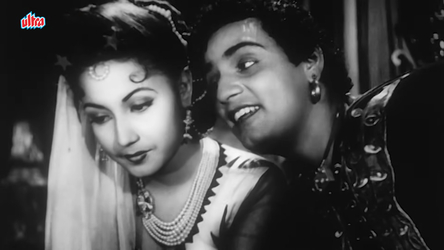
Poor Meena Kumari doesn’t get to do anything heroic or unusual for a heroine, but at least she’s not being weepy or self-sacrificing. And when this song-and-dance began, I honestly, for a moment, thought the dancer was Helen!
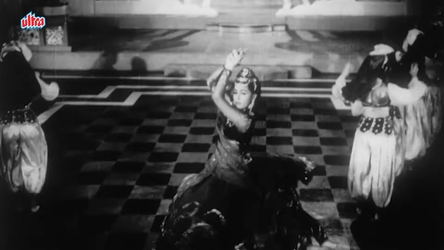
Plus, a special note of the songs. SN Tripathi composed the music for Aladdin aur Jaadui Chiraagh, to lyrics by Shyam Hindi, Anjum Jaipuri, Pandit Chand and RC Pande. Most of the songs are pleasant enough, but two stood out for me: Aankh mein jaadu bharke (perhaps the prettiness of Meena Kumari has something to do with that?) and the delightful Hai naam mera Ramzaani (which is possibly the only song to which I’ve seen BM Vyas lip-syncing).
Overall, a fun, satisfying film. Do watch if you enjoy fantasy films.


“She sees Aladdin and he sees her; they fall in love.” 😊😊
To be honest, I don’t like Meena Kumari and the way she speaks. But here she looks cute. In the first photo, I couldn’t even recognize her. And I haven’t seen any Mahipal film but I know he used to be a famous actor.
This film sounds fun. Very much like the children’s story (except for the romance thing) we have read.
LikeLiked by 1 person
Yes, it’s a fun film. And the romance is the sort that most (not too small!) children will find completely acceptable. ;-) I would gladly show this one to my daughter, aware that I won’t face any embarrassing questions!
LikeLiked by 1 person
Madhu,
Thanks a lot for your review. You end with a favourable recommendation. Otherwise, we have prejudice that fantasy films are no good.
But I have to specially thank you for the link about the real story of Alladin and the Magic Lamp.
AK
LikeLiked by 1 person
You’re welcome, AK. I have to admit that most of the fantasy films I’ve seen have been pretty bad – Parasmani is a case in point, such a waste of fabulous music. But this one is enjoyable.
LikeLike
I remember seeing this film on Doordarshan and it was a revelation – Meena Kumari was so young, so slim, so pretty and graceful!
This was after I had already seen Pakeezah, where she was not young and not slim, but still so graceful.
Lovely to be reminded of this movie.
LikeLiked by 1 person
Yes, it’s a good movie, isn’t it. And Meena Kumari really is such a revelation if all you’ve seen before are her later, more sombre roles, or even when she lost her beauty.
I am still flummoxed about how her biographer Vinod Mehta said that she was ‘plain’, especially before 1962!
LikeLike
Madhooooo…. I’d seen this film on my sidebar so many times and despite my love for Meena Kumari, was put off by the fact it starred Mahipal opposite her. I only remember Mahipal as a wet blanket in most of the films I’d watched. But here, man, he looks very handsome! And now, after reading your review, I must, must, must! watch this.
Thank you. :)
p.s. I know taste is subjective, but how anyone can dislike Meena and her speaking voice is beyond me! :(
LikeLiked by 1 person
Anu, I was under the impression that you had recommended this film to me as a good early Meena Kumari one! But if you haven’t watched this yet, do. She’s so pretty, and Mahipal is actually quite handsome – and he looks like he’s enjoying himself. :-)
I totally agree with you about how anybody could dislike Meena Kumari’s voice – but yes, tastes are subjective. Also, this is likely someone who has seen very little cinema. If the only films of Dev Anand or Shammi Kapoor that I’d seen were from 1970 or so, I wouldn’t like either of them at all!
LikeLike
A nice review of a enjoyable fun film. Glad to read it.
It reminded me to revisit the film. This one has been part of my movie collection as I had liked it when I first saw it. Will check my discs if still working, if not, then will catch up on YT.
One of the few films that I was ok with Mahipal. Of course, Meena Kumari looks lovely and lively.
And yes, thanks, for the link on Aladdin’s incorporation into Arabian Nights. It was interesting. Would like to read about Alibaba and Sindbad too.
LikeLiked by 1 person
Thank you for reading, and for the appreciation. I’m glad to know that you liked this film as much as I did. I’ll try to look out for the back stories of Sindbad and Alibaba (both of which, as far as I know, were originally from the Arabian Nights)… I have watched the Shakila – Mahipal Alibaba and liked it quite a bit. Perhaps it’s time for a rewatch and a review.
LikeLike
Thanks a lot for this wonderful review, Madhuji! One of the reasons the movie is good is perhaps because it was not in colour. The outlandish costumes of fantasy films only get more highlighted when the film is in colour. Since the movie is of 1952, it was still early days and Meena Kumari had still not become the ‘tragedy queen’.
LikeLiked by 1 person
Yes, the black and white look of the film does give it a more appealing look. But then there were fantasy films like Lal-e-Yaman that were in black and white, but were quite mad! ;-) (That was a film, though, which I would have liked to see in colour: the costumes and sets looked genuinely sumptuous).
LikeLike