
I realized the other day that there are umpteen well-known old films that I have seen but have never got around to reviewing on this blog—invariably because I had watched them before I started Dustedoff, and because there were so many ‘new’ old films to watch and write about, I never got around to rewatching stuff. It’s time to amend that, and revisit some films that perhaps should be talked about.
To begin with, Himalaya ki God Mein. Directed by Vijay Bhatt, Himalaya ki God Mein beat Haqeeqat and Waqt to win the Filmfare Best Film Award, and was a superhit. I had watched this donkey’s years ago, when it was telecast on Doordarshan. I remembered almost nothing of it except the fact that Manoj Kumar played a city doctor who relocated to the mountains to treat villagers and ended up falling in love with a village girl played by Mala Sinha. That was it. Time for a rewatch, I decided.
The film begins at night, on an aeroplane where Dr Sunil (Manoj Kumar) and his fiancée, also a doctor, Neeta (Shashikala) are travelling. Another passenger on the plane suddenly clutches his chest; Sunil examines him, diagnoses a heart problem, and asks that the plane land immediately.

So it does, in the middle of nowhere, in what seems like a valley surrounded by wooded mountains. [This is the first time I’ve heard of a plane making an emergency landing like this for reasons other than that the plane is likely to crash if it doesn’t land; the more logical approach would be to head for the nearest air strip, wouldn’t it?]. Over the next few hours or so, lots happens. Sunil attends to the ailing man (who recovers surprisingly quickly) and then gets separated from the rest of the group…
And comes up against a gang of dacoits led by Laakhan Singh (Jayant), who beat up Sunil and leave him for dead.
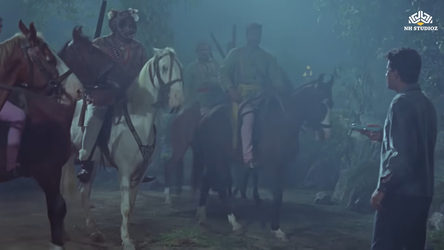
Meanwhile, Neeta and the other passengers are wandering about on their own. They too run into Laakhan Singh & Co., and the dacoits loot them well and proper. Neeta is wearing a chunky gold necklace which Laakhan Singh takes from her.
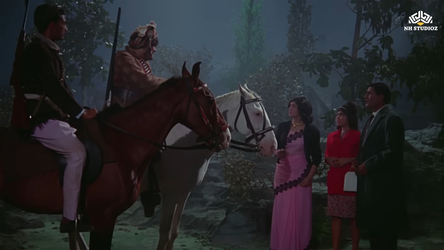
The next morning, some of the women from a nearby village discover the unconscious Sunil. Phulwa (Mala Sinha) is very concerned and has her friends help her take Sunil to her home where she lives with her uncle Dayal (David), though Phulwa doesn’t know Dayal is her uncle, not her father. Dayal and Phulwa get the local jhaad-phoonkwaala, a charlatan named Ghogar Baba (Kanhaiyalal), to come and work his magic on Sunil.
Ghogar Baba and his assistant Buddhimaan (Mukri) are going about chanting mantras, throwing ash about and whatnot when Sunil comes to, a little bleary-eyed and disoriented. He recovers consciousness soon enough to get furious at all this superstitious nonsense; he flings the ash into the air, abuses Ghogar Baba and refuses to have him do anything more.
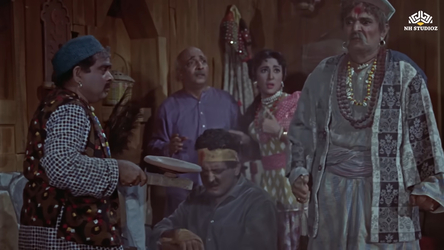
Ghogar Baba, mad as a wet hen [or an ash-covered hen?], curses Sunil: may he die within the next two hours. He stomps off, and a distraught Phulwa turns to her friend Bindiya (Jeevankala). If this stranger dies in their home, that will be very inauspicious. They have to do something. Buddhimaan, who is sweet on Bindiya, gives Phulwa some rigmarole about some woman whose ill husband had refused to take treatment from Ghogar Baba; the woman, desperate to have her husband healed, therefore took treatment by proxy—and her husband got absolutely okay!
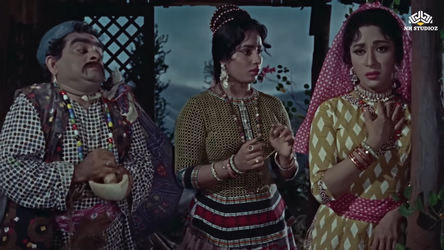
So Phulwa [dimwit that she is] says that she will ask Ghogar Baba to treat her instead. Because after all everybody is connected to everybody else in this world, and if she is treated, the stranger in her home will get well. Of course, Sunil [who isn’t so badly hurt after all, and is young and probably strong enough to recover quickly on his own] gets well. When he learns what Phulwa’s been doing—taking Ghogar Baba’s medication, which can’t have been pleasant—he’s charmed. There’s no accounting for tastes.
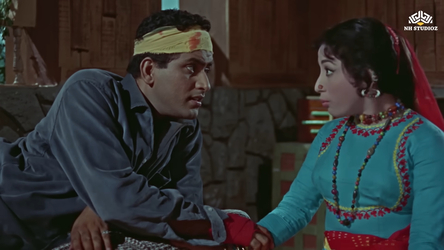
Anyway, once Sunil gets well, he goes back to the city, to his parents and Neeta and his work at the hospital. Sunil’s father Shyamlal (DK Sapru) is a police officer, and his doting mother (Achla Sachdev, for once all glamorous) is eager to have Sunil and Neeta get married soon.
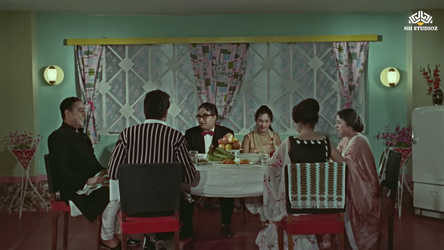
Neeta also wants to get married, or at least to spend time gallivanting with Sunil, but Sunil wants to focus on his work, on healing people. This causes angst; for Neeta—whose father is also a successful doctor—medicine is just another profession, a lucrative one at that.
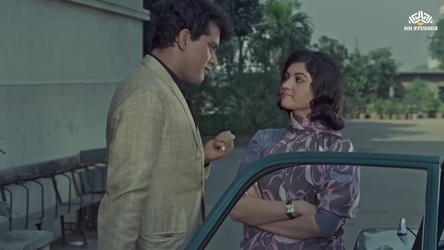
Soon after, Sunil receives a new patient at the hospital: it’s Dayal, brought to the city by Phulwa. Some epidemic seems to have broken out in the village and several people have died. Things are pretty bad, it seems, and given that there are no hospitals or healers [other than King of Quacks Ghogar Baba] in the villages of the mountains, the only option is to come to the city.
This is brought home to Sunil again a little later: there’s a party at Neeta’s [and no songs, not even a single “please sing us a song” request]. Here, her father announces that he has set up a new hospital, and Neeta is going to be in charge.

Dayal, who is present [puzzlingly. Is he invited, or has he gatecrashed?] is impressed. Another hospital, within the same city? And back there, in the mountains, there aren’t even small clinics, let alone large hospitals.

Sunil therefore decides to move to the mountains, to Phulwa’s village, where he will set up a clinic and work amidst the poor villagers.
This decision draws a lot of flak. Neeta, for one, thinks Sunil has taken leave of his senses. When he asks her to accompany him to the village and work alongside him, Neeta refuses outright. No thank you.
Sunil’s parents are equally disapproving. His mother, all quavery-voiced [and Achla Sachdev could do quavery voice and emotional blackmail as well as the queen of them all, Leela Chitnis] pleads with him to rethink this. His father mentions that those mountains are infested with dacoits: the fierce daaku Laakhan Singh is a much-wanted bandit, and he operates in that area. If Laakhan Singh comes to know who Sunil’s father is, Sunil could be in danger.

But Sunil brushes aside all of that and goes off to the village with Phulwa and Dayal. He is greeted with opposition from the superstitious villagers, who are all convinced that Ghogar Baba is their only hope [much brainwashing and egging on by Ghogar Baba being the primary reason for this attitude]. It takes much selfless slogging and enduring of brickbats on the part of Sunil before he’s accepted. But when he is, the villagers take him to their collective bosom and make much of him, much to the disgust of Ghogar Baba, who suddenly finds himself persona non grata.
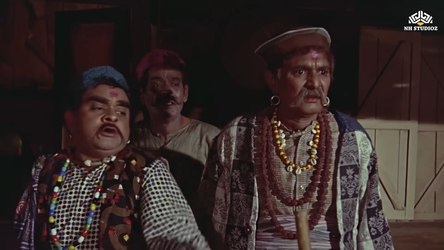
In the meantime, Phulwa—who has been helping Sunil at the little hospital and whom he affectionately dubs ‘compounder’ has fallen in love with Sunil. Sunil sings a romantic song to her in public, places bangles on her wrists, and makes other somewhat oblique references to being just as kindly disposed towards Phulwa, but doesn’t come right out and wear his heart on his sleeve like Phulwa does.
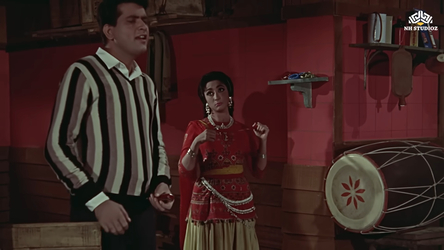
What neither he nor Phulwa know is that [besides Neeta, who—as Sunil’s fiancée—is not going to be happy about Sunil and Phulwa being an item] there is someone else too who won’t take kindly to this relationship. That’s Daaku Laakhan Singh, who, believe it or not, turns out to be Phulwa’s father. Dayal has brought up Phulwa as his own daughter, but Laakhan Singh comes by surreptitiously now and then, just to gaze on his bitiya from afar, and to leave her a gift now and then [this particular gift is Neeta’s necklace].

Of course you can guess where this is going to go. Laakhan is a daaku; Sunil’s father is a cop. Neeta’s stolen necklace is in Dayal’s house, and Dayal’s niece is the woman whom Neeta’s fiancé has fallen in love with. Fireworks await.
Frankly, I cannot see why Himalaya ki God Mein won the Filmfare Award for Best Film—and that too beating Waqt (Haqeeqat might be considered a little offbeat, not quite so commercially a winner). The idea of a doctor doing selfless service and leaving a commercially successful practice to go and work in the villages was by no means, at this point, a novel idea. It had been done before, for instance in Doctor (1941) and in Anuradha (1960), and there is really very little about the film that strikes one as being award-worthy.
What I liked about this film:
What there is, though, is the music, composed by Kalyanji-Anandji, to lyrics written by Anand Bakshi, Indeevar and Qamar Jalalabadi. Himalaya ki God Mein gave Mukesh two of his most famous songs of the mid-1960s: Main toh ik khaab hoon and Chaand si mehbooba ho meri kab aisa maine socha thha [and am I the only one who thinks the lyrics of that, written by Anand Bakshi, are a little odd? He never thought he’d have a beautiful sweetheart, and she’s just as he’d imagined?] There are other good songs too, including the two-version happy/sad Ik tu jo mila saari duniya mili and Ik tu na mili saari duniya mile bhi toh kya hai, and O tu raat khadi thhi chhat pe.
And, the landscape, which is lovely.

What I didn’t like:
Besides the rather predictable plot, the one major irritant in Himalaya ki God Mein was Mala Sinha as Phulwa. Mala Sinha is an actress I generally like: I find her very pretty, and she is capable of some good acting, as I’ve indicated in reviews of films like Aankhen and Dillagi. Here, however, she is nothing short of painful. She looks lovely enough, but the faces she makes, the over-the-top quavery hamminess, I found unbearable. Phulwa, to me, doesn’t come across as a kind-hearted, simple village girl; to me, she’s extremely juvenile. Her antics—stealing Neeta’s clothes, dressing up in them and painting her face with Neeta’s makeup, for instance—aren’t just being Phulwa being light-hearted; it’s Phulwa being immeasurably childish.
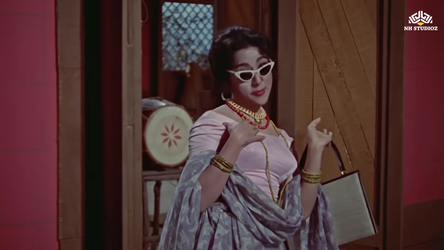
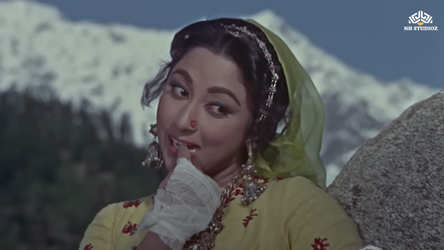
Very irritating character, and I couldn’t for the life of me understand how anyone could fall in love with Phulwa: it would be akin to cradle-snatching.
Actually, come to think of it, a large portion of my dislike for Himalaya ki God Mein stems from my loathing of Phulwa. If she had been a more mature, level-headed, sensible character, I might have ended up liking this film more.
 Dustedoff
I am surprised that this won Filmfare award against 2 of the best films of their respective genres – Haqeeqat and Waqt.
LikeLiked by 1 person
Exactly. I find it very surprising. Or was there some sort of hanky-panky going on behind the scenes? Were the jury influenced?
LikeLike
Chaand si mehbooba ho meri kab aisa maine socha thha – I’ve had also thought about this whenever I heard the song. Looking at the rest of the lyrics and the story as reviewed by you, he probably means he was never so ambitious to want the moon or anything very exotic. He wanted someone simple, plain, down to earth and real and that’s exactly what he got. The song is better than the movie, now that I think of it.
LikeLiked by 1 person
That is an interesting interpretation of the lyrics. Somebody else (in the comment following yours) has suggested another alternate interpretation, which also makes sense. At any rate, the songs of this film far outdo the film itself.
LikeLike
Maybe the lyricist meant – kab meri chaand si mehbooba ho(gi) aisa mai sochta tha.
LikeLiked by 1 person
That makes a lot of sense! Yes, perhaps that’s what the lyricist meant.
LikeLike
‘ Waqt ‘ was miles ahead of ‘ Himalaya ki god men ‘. So was ‘ Haqiqat ‘. It seems, manipulating the voting had already started in that era.
More than Mala Sinha, I found Manoj Kumar more irritating.
LikeLiked by 1 person
I usually find Manoj Kumar very irritating – especially in his uber-patriotic films, like Purab aur Paschim. Here, however, I disliked Mala Sinha so much, even he was tolerable by contrast!
LikeLike
i can understand the position when even Manoj Kumar becomes comparatively tolerable !
Bravo !
LikeLiked by 1 person
My first reaction was “This film won the Best Film Award? Over Waqt and Haqeeqat?” I see I’m not the only person who reacted that way! Mala Sinha is a hit or miss for me – mostly miss. I’ve never liked her very much, so when I see her in a half-decent role, I am impressed. Yes, the bar is that low. :)
As for the lyrics, I agree with the poster above – if you think of it as:
Chaand si mehbooba ho meri kab
Aisa maine socha tha
Paraphrased as: I wondered when I would have a beloved as beautiful as the moon…
It makes more sense? Sort of? :)
p.s. Thanks for steering me away from this – especially since it stars two people whom I cannot stand.
LikeLiked by 1 person
Yes, that explanation of the lyrics does make sense. But it always makes me wonder: didn’t anyone else – director, music director, Mukesh, Manoj Kumar – think as I do and point it out, that it could be interpreted in another, hardly flattering, manner? ;-)
And yes, give this a wide berth. Really not worth it. The Filmfare Awards jury must have taken a good bit of money to rate this above Haqeeqat and Waqt.
LikeLike
hi madhu ji ! An apt review of himalaya ki god mein. As I watched the movie recently by chance. I can say mala Sinha character phulwa is irritating. As I have said already i don’t find shashikala negative. Neeta does not want to serve in village and she is straight forward.
i like the locations of manali and songs chand si mehbooba hogi meri kab and mein toh ek khwaab hu ( typical Mukesh solo).
Pratibha sinha was interviewed in 1990. She said although her mother is considered in bracket of better actress but she does not think her mother was great actress. she said she feels her scenes are stagey.
she blamed her grandfather that he had dictatorship approach. He felt his daughter is best actor and as the shooting ended he took her from sets. Never allowed her to mix thinking she is too good to mix with rest. He also choose her costumes.
Mala ji said she used to take her father approval after shot without disturbing director.
There was income tax raid on mala ji house before the shooting of song kankaria maar k jagaya. But she danced freely but was heartbroken from inside.
LikeLiked by 1 person
Thank you for that very interesting comment. Pratibha Sinha’s very candid, to be so frank about her mother’s acting!
LikeLike
Very interesting review. I have watched this movie many many years ago, like you said when it aired on Doordarshan. I don’t remember anything. Mala Sinha getting treatment on behalf of Manoj Kumar thing is so funny.
I don’t really like Mala Sinha, and I agree Mala Sinha doesn’t seem like an innocent village girl (that photo where she is chewing her finger —trying too hard to look bholi bhali types); I think she is more suitable for roles she played in Aankhein. Also David, he doesn’t look like a villager, in fact he looks like an educated, city person (like he was in Abhimaan).
Manoj Kumar looked very handsome in these movies (also, in Woh Kaun Thi), no? Later, he became really annoying.
Regarding the ‘Haan tum…’ lyrics: I think he means he never expected to have an extraordinarily beautiful woman (what men usually want), and he likes her as she is (even if she is irritating:)).
LikeLiked by 1 person
I agree, Manoj Kumar was pretty handsome in films like Woh Kaun Thi. Later, he acquired this very ‘constipated’ (as my mother calls it! – specifically for Manoj Kumar in Shor) expression that completely negated his looks. I didn’t mind him here, but Mala Sinha was appalling. That bholi-bhali, chulbuli village belle acting just didn’t fit.
LikeLiked by 1 person
Madhu,
You have exactly expressed my feelings about Mala Sinha as the irritating Phulwa. Even without that irritant, the film was not good enough to beat Waqt and Haqeeqat in the Filmfare race.
If you pardon me, I was a little puzzled by the discussion between the language experts about the lyrics of Chaaand si mehbooba ho meri kab. The first law of interpretation is, if the literal meaning is obvious and it is not repugnant to the context, that meaning is to be taken. Moon landing was a few years away, but by then it was known its surface was full of craters. Now everything falls in place. When did I ever think of my beloved to be like the (ugly and craggy) moon. Yes, you are exactly like the beautiful girl of my dreams.
AK
LikeLiked by 1 person
Hehe! That is a brilliant interpretation of the lyrics, AK.
LikeLike
I completely agree with you that Himalaya Ki Gaud Mein was hardly anything that could be deemed award-worthy- especially in the category of Best picture. It’s basically a decently done and visually (and musically) appealing cross between Phani Majumdar’s Doctor and Tarun Bhaduri’s (Jaya Bhaduri’s father) iconic novel Abhishapta Chambal. Indeed, atleast 8-9 pictures in Hindi that year were better than this one. And these include Aasmaan Mahal, Haqeeqat, Oonche Log, Shaheed, Arzoo, Shaheed, Choti Choti Si Baatein, Waqt and Kaajal.
Ideally, Haqeeqat or Aasmaan Mahal should have been awarded as the best film (didn’t consider Waqt as that movie while being much better directed than this one, is just like this one, quite unoriginal, borrowing liberally from Kismet, Awaara, Andaaz, Humrahi,Ami Bodo Hobo and Pava Manippu). But then Filmfare awards have seldom been awarded correctly.
As far as Mala Sinha’s acting is concerned in this movie, I share a different view though. I find her delineation of Phulwa as very lively and charming, which added greatly added to the film’s charm, especially given that its hero Manoj Kumar, while being handsome, was largely sedate and listless in this film. But yes, I do get that opinions differ and they should differ, for variety and diversity is the spice of life.
LikeLiked by 1 person
I have to admit I don’t care for either Kaajal, Aarzoo, or Shaheed. I have seen Choti Choti Baatein (the Nadira – Motilal one), is that the one you mean? I don’t think that would have stood a chance anyway: too off-beat, too low-key for them to have considered it. I agree Waqt is hardly original, but I still think it’s a delightful film.
LikeLike
Hi madhu ji ! manoj kumar ji passed away on 4th April. Co incidentally shashi kala ji also passed away on the same day 4 years ago. 🙏
here is tribute of Mala Sinha ji.
https://timesofindia.indiatimes.com/entertainment/hindi/bollywood/news/remembering-manoj-kumar-his-himalay-ki-god-mein-co-star-mala-sinha-says-the-actor-was-sweet-dedicated-and-very-involved-exclusive/articleshow/119984389.cms
there have been many pairs and trios. but i always find the trio of manoj ji , mala ji and shashi kala ji very believable.🙏 om shanti. 🙏🙏
LikeLiked by 1 person
Yes, I read about that. Sad. I will be posting a tribute in the coming week.
LikeLike