
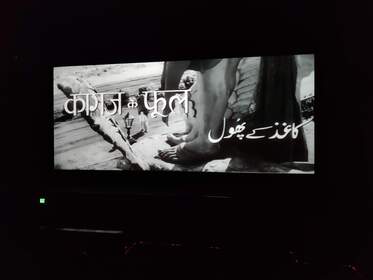
That first photo, because the space beyond the screen is so dark, may not be very obvious as regards context. But this is a photo from a full-sized film theatre, where I watched the re-released Kaagaz ke Phool on July 17th. The re-release was to mark the 65th anniversary of this film, a semi-autobiographical work that was a flop when it was first released, but has gained in popularity ever since. My niece had alerted me to the fact that PVR Inox would be showing Kaagaz ke Phool across its theatres, one show a day for a week, and I knew I couldn’t miss this one. If only for the fact that I get to see precious few old films on the big screen (Hum Dono was the last I saw).
I had thought I’d probably be one of a handful (ten, at the most?) of people in the theatre, because this, after all, is an old film; and this was an afternoon show on a weekday. But to my surprise, there were actually quite a few people, and—best of all—many of them were fairly young. Heartening.
But, to get to the film.
The central character in Kaagaz ke Phool is Suresh Sinha (Guru Dutt), whom we first see as an old, bedraggled man walking through the grounds of Ajanta Film Studios. He makes his way into a set—deserted, without another soul around—and from there, the story moves into flashback, to many years earlier, when Suresh Sinha is a very successful, wealthy and powerful film director.
Just how powerful may be gauged by a brief scene at this point. A leading actress, Kanta (Nilofer) is being considered for Sinha’s film Devdas, as Paro: and Sinha has told her that Paro is to be a simply-dressed, pristine character. No jewellery, no curled hair, not even the side-parting Kanta is hell-bent on retaining. The producer, Seth Dayaram (Munshi Munakka) takes Kanta’s side, but when Sinha says no, even Sethji backs away. Kanta will have to toe the line.

Another scene shows us another aspect of Sinha’s character. A woman extra is sitting in a small room, tending to her baby while a somewhat older girl sits nearby. One of the staff members, a manager perhaps, comes to summon the woman; he’s angry with her for being late and tells her to leave the baby. The woman has just handed over the baby to the little girl to mind when Sinha comes in. Having heard what’s the matter, he reassures the woman, telling her to finish feeding her baby and come when she’s ready.
As he’s leaving, he pats the girl on the head, and gives her some money. There’s a wistful expression on his face as he looks at the child…
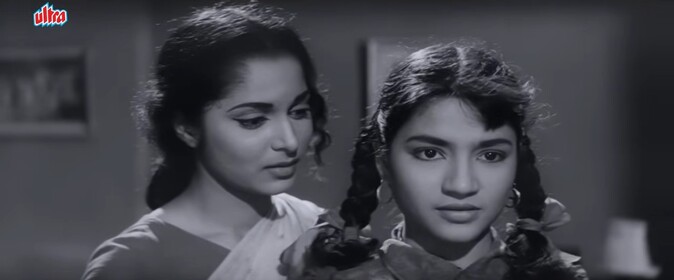
… and we see why, later, when Sinha goes to a girls’ boarding school in Dehradun. His daughter Pramila ‘Pammi’ (Baby Naaz) is studying here, and the affectionate reunion of father and daughter is touching.

While it lasts, that is. Pammi’s teacher comes by and drags Pammi off, having told Sinha that he is not welcome here. Pammi’s mother (Sinha’s estranged wife Veena) is the one who has admitted Pammi here, and there are no instructions to allow Sinha to visit.
An angry Sinha goes to Delhi to meet Veena, who lives with her parents, the very wealthy and very Westernized Sir BB Verma (Mahesh Kaul) and his wife (Pratima Devi). Verma is imperious, a pukka brown sahib (this is set in a pre-independent India) who speaks more often in English than in Hindi. His wife and he seem to be more interested in their dogs than in Sinha—which says a lot about how they feel about him.
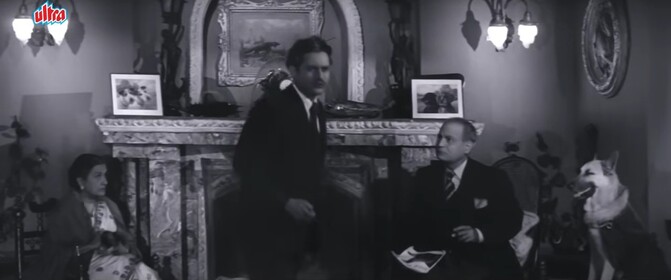
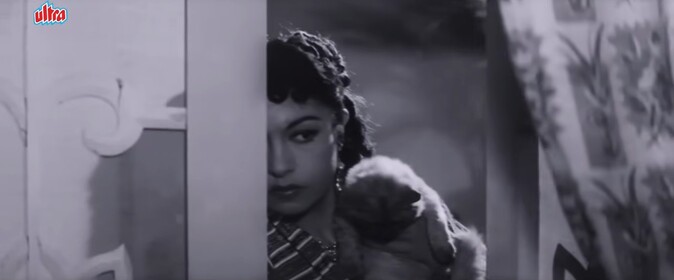
This echoes the sentiments of their daughter Veena (Veena), who separated from Sinha after he joined the film industry. Veena and her parents think the film industry is despicable; Veena’s mother, in a fit of righteous indignation, says that if Veena had only known, back then, that Sinha would end up joining films, she would never have married him. Now Veena simply shuts the door in Sinha’s face when he tries to go talk to her. (She does peek out once he’s gone away, which makes one wonder how Veena really feels, but this is never explored further in the film).
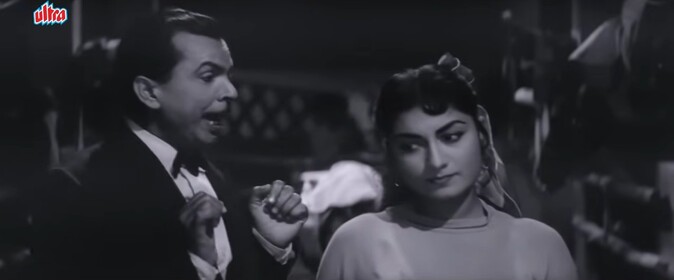
There is one person in the family who is more kindly disposed towards Sinha: Veena’s brother Rakesh ‘Rocky’ (Johnny Walker), a bit of a clown who spends all his time at the races or at the stables. This is where, too, he falls in love with veterinarian Juliet Singh (Minoo Mumtaz), their frothy, mock-strained romance serving to lighten (somewhat) the mood of an otherwise tragic story.
While in Delhi, Sinha is caught in a thunderstorm and takes shelter under a tree. Here, he makes the acquaintance of Shanti (Waheeda Rehman), who has also sheltered under the same tree. Shanti’s forthright honesty (she’s sure Sinha, after having said hello and commented on the weather, will now ask her out to dinner or a film, etc) charms him. So, when he realizes she is cold and wet, he takes off his overcoat and places it across her shoulders.
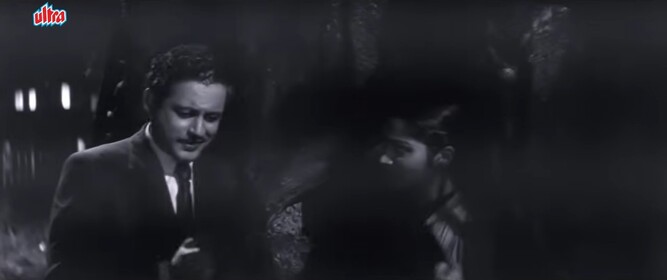
Then, seeing a taxi, he hails it and goes away, leaving Shanti calling out to him to take the coat.
Sometime later, Shanti (who is an orphan but has managed to educate herself by stitching clothes) arrives in Bombay. She’s found Sinha’s card in his coat, and uses the address on that to come to the studio and return his coat—where she blunders onto the set, and all inadvertently is captured on camera.
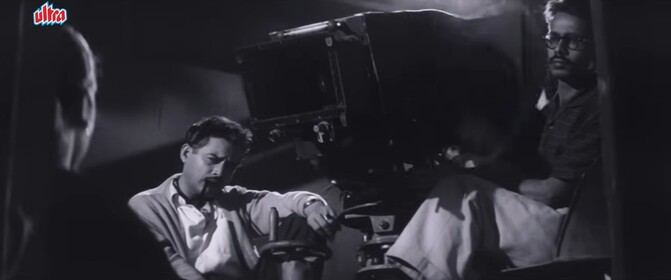
Sinha, when he sees the rushes, is mesmerized: this is his Paro, he decides. He proposes a fee of Rs 1,000 to Shanti, who can’t believe her ears—but, also, is not very eager.
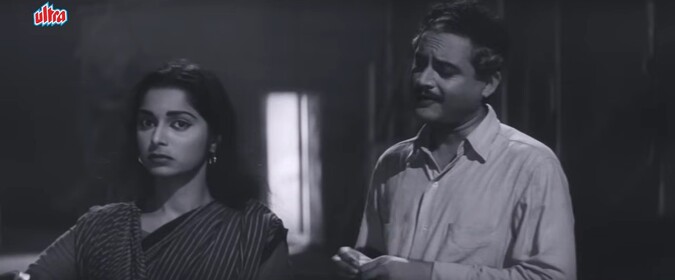
However, she eventually agrees. Over the following days and weeks, she plays Paro in Sinha’s Devdas. At first, it is a purely professional relationship; but there has been, ever since their first meeting in the storm, an unspoken attraction. Every now and then, this reveals itself, invariably only in fleeting expressions, in perhaps involuntary gestures.
For instance, when Sinha gets furious at seeing a dolled-up Shanti at a party, looking like a ‘bandariya’, as he calls her: to her obvious joy. It’s clear that Sinha’s letting his anger show points to a feeling of possessiveness towards Shanti, especially as he praises her otherwise usual self, her simple beauty.
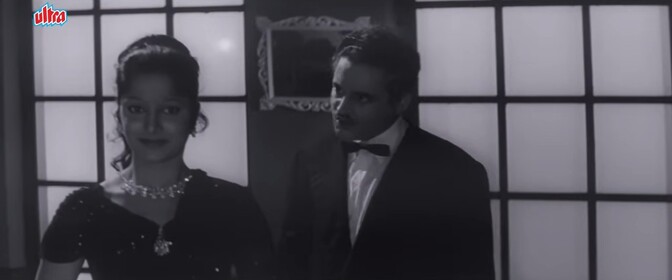
Or in the chemistry that is apparent while they drive, her hair flying in the breeze, the day after the party.
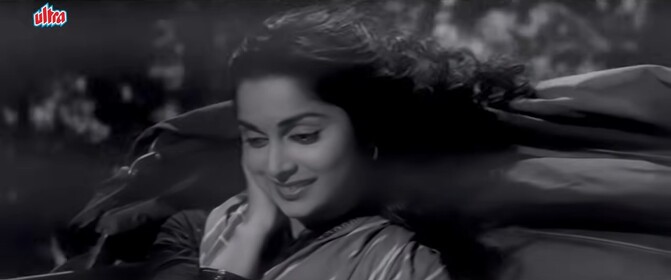
The growing attraction between Shanti and Sinha is eventually expressed when, in a car accident, Sinha is injured and even has to have his eyes bandaged. Shanti, distressed and anxious for him, stays over to look after Sinha even though there are servants as well as a nurse at home. An inadvertent remark by Sinha alerts Shanti to how he feels about her: and how he, despite his feelings for her, wants to push her away.

A relationship, even when completely platonic, between a director and an actress cannot go unnoticed; and soon, the gossip columns are full of speculations. Pammi’s classmates tease her about it, and a hurt, angry Pammi gets into a fight. A fight which leads to her running away from school and coming to Sinha. She declares that she will now live with her Daddy.
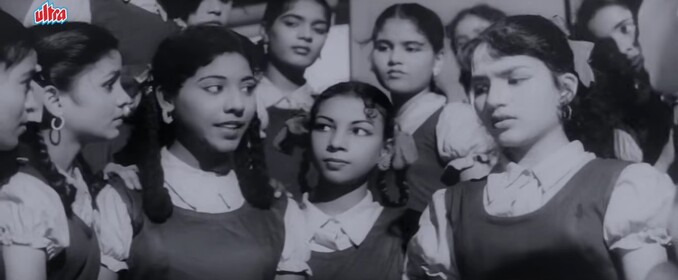
But while Sinha is briefly happy to have his daughter with him, this impulsive act of Pammi’s has consequences neither of them could have foreseen at this point.
Kaagaz ke Phool, of course, is considered semi-autobiographical: mirroring Guru Dutt’s own sense of disillusionment, with the film industry and with his marriage to Geeta Dutt. His adoption (so to say) of Waheeda Rehman as a muse, which played a part in the ultimate collapse of his marriage, leaving him a lonely, embittered man.
Whether all of this was indeed true of Guru Dutt’s life or not is a moot point, but it makes for a disturbing, tragic film.
It shows the underbelly of the Bombay cinema industry on several levels: the high-handedness of producers and financiers, the exploitation of labour (in this case, extras), the objectification of women (though this is only subtly indicated, in the party scene where Sinha ticks off Shanti). Most of all, the ephemerality of fame, the riches-to-rags story which, sadly, is all too true of life even beyond the world of cinema.
What I liked about this film:
A lot, but here are some of the stand-outs.
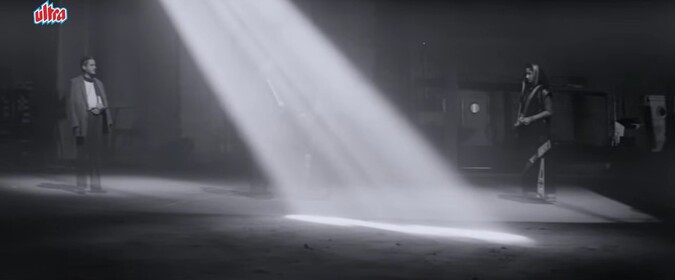
VK Murthy’s superlative cinematography. Shammi Kapoor is supposed to have said that Murthy was the true star of Kaagaz ke Phool, and I agree. The shots, the diffused light, those rays of light sharply highlighting a figure here, an object there… his work is brilliant. A well-deserved win of the Filmfare Best Cinematographer Award for Kaagaz ke Phool.
Waheeda Rehman. She’s lovely, yes; but how expressive she is, too. I have always admired her acting, and this time, seeing her full screen, I appreciated her even more. Those eyes say so much, even when she isn’t saying anything.
And, the music. SD Burman’s tunes and Kaifi Azmi’s lyrics work together to create some immortal melodies. Waqt ne kiya kya haseen sitam and the equally haunting Dekhi zamaane ki yaari are my absolute favourites, but the others are wonderful too. While on the topic of the songs of this film, one thing that struck me is how even seemingly light-hearted songs tie in to the film’s central themes of loneliness, despair, and disillusionment. Look at Hum-tum jise kehta hai shaadi, sung by a happy-go-lucky Rocky in the presence of a miffed Juliet. On the surface, it’s a mock (I suppose?) poking of fun at the institution of marriage, but the fact is that this song comes right after Sinha’s marriage has been dealt a death blow (not that it needed one), so there is perhaps that irony about marriage being never too reliable…
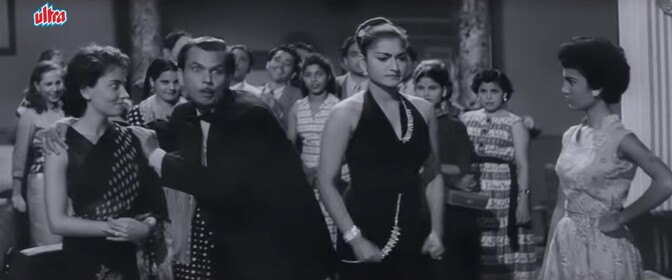
Then, there’s the sweet kiddie song, Ek do teen chaar aur paanch. This one, through much of the song, is frothy and cute, turning sombre only in the last verse. But even when it’s cute, it talks of loneliness: of #1 and #0, each ostracized, each alone. It’s only when they team up and find a friend in each other do they find happiness and a sense of belonging, of being something—but that happiness is not acceptable to the others. The story, in brief, of Sinha and Shanti.
What I didn’t like:
The lack of a back story. How did Veena and Sinha get married in the first place? Given her family’s (and her own) worldview, it seems a little strange that she could have married a man so unlike her. And how did Sinha end up directing films?
Perhaps if these questions had been answered, I would have understood Veena’s, and her parents’, perspective better. As it is, these three people come across as outright villains. Pammi, though her actions play a major role in Sinha’s ultimate failure, is more believable, more of a sympathetic character. Not only is she just a teenager, she is also a lonely person: bundled off to boarding school, having to live amidst classmates who tease and bully her. One can imagine even an adult feeling repressed and lonely enough to want to escape such a situation, let alone an adolescent.
Also, Kaagaz ke Phool is a depressing film, unrelentingly sad, despite the scenes (too few and far between) featuring Johnny Walker. Pyaasa was very sad too, but there was a glimmer of hope at the end; that is missing here.
Still, all said and done: a landmark film, and one that deserves this re-release.
Note: Though I do wish Ultra had made some effort to get a good subtitler. The English is mostly all right, but at times, it takes a nose-dive. In one scene, Veena’s mother gets somewhat overwrought and hysterical; her husband, Mr Verma, calls for (in English) “smelling salts”. Which, given that it’s anyway uttered in English, would have been a cinch to subtitle. But no; the subtitle has him demanding a ‘snorting device’.


What a wonderful review, Madhu!
LikeLiked by 1 person
Thank you so much, Abhik! I’m glad you enjoyed this. :-)
LikeLike
How was the print, Madhu? Did they restore the film? I heard that Manthan was recently restored to 4K resolution and screened at Cannes. I wish some of these old mainstream classics are restored to 4K.
LikeLiked by 1 person
I don’t know whether they restored the film or not, Soumya, but the print was pretty good. Not fantastic, but – given the usual quality of prints one has come to see in Hindi films that old – not bad either. I echo your wish to see these classics in 4K, they deserve it.
LikeLike
It’s a very nice review. I haven’t watched this movie (or Pyaasa) but I have always felt that it indeed looked utterly sad and depressing.
I like Guru Dutt (The hint of a smile on his face). He looked very intelligent and different from any other actor. Waheeda Rehman looks so beautiful and graceful.
I wonder if she actually ditched Guru Dutt or he just misinterpreted her feelings.
LikeLiked by 1 person
It is a very sad and depressing film; to me, more so than Pyaasa, which at least had the saving grace of a (possibly) happier aftermath.
I agree about Guru Dutt; I think because he was more a director than an actor, it wasn’t his looks that really took centre stage. He does have a sensitive, thoughtful look about him that fits a lot of the roles he did.
LikeLiked by 1 person
For me, Guru Dutt’s greatest contribution as an actor in Hindi cinema was that nobody embodied the thoughtful, brooding, artistic and sincere Bengali Babu on the Hindi screen better than him. Hindi cinema didn’t quite have the fortunate luxury of getting a Uttam Kumar or Basanta Choudhury or Soumitra or Anil Chatterjee on screen to present this type of hero on screen in all its glory on most occasions, but Guru Dutt did a very good job of it on the Hindi celluloid . Films after film like SBAG, Pyaasa, Bahurani, Sautela Bhai benefited from his representation of the same. And for that GD deserves credit
LikeLiked by 1 person
Yes, indeed. Basanta Choudhary and Anil Chatterjee, in their all-too-brief forays into Hindi cinema, didn’t really get to show off that particular style. But I think Abhi Bhattacharya did, and in fact ended up being typecast, often, as that type of character. Not necessarily actually Bengali, but recognizably so.
LikeLike
How nice of you to review Kaagaz Ke Phool! I like the movie and still don’t. For me it somehow doesn’t have the coherence of Guru Dutt’s previous films. All the elements of a good film are in it, but they just don’t gel together to make a whole or a total artwork. Something is missing. I love Johnny Walker, but here he seems misplaced.
Meanwhile I was reminded of two more films, which I would love to see of big screen and they would be Mahal (1949) and Pakeezah (1972).
LikeLiked by 1 person
I like the movie and still don’t.
Harvey, I couldn’t have put it better. Yes, I like it but don’t – it looks beautiful and sounds beautiful, but it’s too depressing. And yes, though Johnny Walker is fun as usual, his character and that plot thread are a mismatch here.
I have to admit, I find Mahal somewhat similar – looks beautiful (Madhubala!), and sounds beautiful, but too depressing and a little incoherent after a while. But I would really like to see Pakeezah on the big screen.
LikeLike
When I first watched Mahal I was very impatient with all the characters. I think, I expected the hero to be hero-like and the heroine to be heroine-like, but they were not. Then after a gap of some twenty years I watched it again. At that time I think, I was ready to accept broken heroes. Then I found the whole self-destructiveness very fascinating. It was gripping to watch a tragedy unfold and where you know they are all doomed. Even the romance, which is not romance at all but more of an obsession seemed riveting. It is hard to accept Ashok Kumar in such a role. After all, we were used to see him as a level-headed person. One thing is for sure the story is not of sane, level-headed people. Not a single person takes a wise decision in that story. So there is consistency for sure in the movie. I loved Kamal Amrohi’s direction as well and the photography is simply stunning.
LikeLiked by 1 person
You make me want to watch it again! :-) It’s been many years since I last watched Mahal.
But you know, besides all these critically acclaimed films, the ‘good’ films, I’d also love to watch, on the big screen, entertainers like Teesri Manzil, Waqt and Mera Saaya.
LikeLike
Do try watching Mahal once again. Maybe with other eyes, you might like it better. Often I think about it how the image of the actors and actresses effect the perception of a story. Particularly disturbing is how often the perception of hero and heroines as role model effect the viewers of Indian cinema. I haven’t watched Darr, but was aghast to read that the audience (male, I presume), were rooting for the character played by SRK.
I understand fully your wish to watch other movies on big screen too. Yesterday I was listening and watching some Rafi songs on his death anniversary and then I came upon ik haseen shaam ko from Dulhan Ek Raat Ki and there I thought I would love to see a better print of it on a big screen. Then I thought of many songs, which have beautiful visuals and/or good photography which would be wonderful to watch on a big screen. One of them would be tere bina aag ye chandani from Awara. Another would be the climax of Chandralekha, although it is not a song. Maybe this would be a nice topic for a list: My ten favourite songs which I would love to watch on the big screen.
LikeLiked by 1 person
aghast to read that the audience (male, I presume), were rooting for the character played by SRK.
Awful! But just goes to show the power of a star.
I agree, there are lots of songs that I would like to see full-screen. And yes, certainly that fabulous drum dance from Chandralekha, though it’s not a song. Also, I think, Tu chhupi hai kahaan, which has some stunning sets.
LikeLike
I agree with you totally about Mahal. In fact, I had written a post after watching Mahal, which was not exactly a review, but I needed to vent my frustration after watching it. Here’s the link, in case you want to read it.
https://anitamultitasker.wordpress.com/2020/10/23/musings-on-mahal-1949/#comment-69
LikeLike
Kaagaz ke Phool is a film I want to like better than I do. The cinematography, as you point out, is fabulous; the songs are great; the acting is brilliant, even Guru Dutt’s. But… oh, it’s so self-indulgent and so whiny and self-pitying that I find it difficult to watch again. Self-destructive protagonists are somehow not my favourite people.
Love your review more than I like the film, actually.
LikeLiked by 1 person
I agree with you, Anu. It’s not a film I like – it’s just elements of it (the music, the look of it, Waheeda) that I admire deeply. Actually, if this one and Pyaasa had both been shown on the big screen, I know which one I’d have rewatched! Pyaasa is sad too, but it’s not as depressing as Kaagaz ke Phool.
I actually find my reaction to this rather like my reaction to Guide: love some elements, don’t like the film as such, though I can see why so many people would admire it so much.
LikeLike
Madhuji, the melancholy and the ways of dealing with failure and frustration in the film put you off. In fact, after the film was released and there was a lot of booing and jeering in the theatres, Guru Dutt was very depressed. The audience was not able to understand what exactly the movie wanted to convey.
Apparently, the song Waqt ne kiya, kya haseen sitam was not there in the film. Shabana Azmi says- “You know there is such a lovely story about Waqt Ne Kia Kya Haseen Sitam. Abba said that they had written the song on their own. There was a tune that SD Burman had given, and Kaifi sahab wrote the lyrics. They had just written the mukhada,” she said. The actor added, “Guru Dutt fell in love with the song. And he said that I really want this song. So they said, ‘There is no situation in the film.’ He said, ‘You can make the whole song, and I will create the situation. And that’s how this iconic Waqt Ne Kia Kya Haseen Sitam was made.”
Guru Dutt vowed not to direct a film after Kaagaz Ke Phool. In an article called Classics and Cash that Guru Dutt wrote he said, “In the formula ridden film world of ours, one who ventures to go out of the beaten track is condemned to the definition which Mathew Arnold used for Shelly- ‘an angel beating its wings in a void’. I believe that one who goes out against the winds has to be prepared for bouquets as well as brickbats, for triumphs as well as heartbreaks, whether or not one only makes a classic or collects the cash. It is the baffling unpredictability that gives edge to the thrill of movie making.” Here is the Bitly link to the article – https://bit.ly/4dsyfcG.
LikeLiked by 2 people
Thank you for that interesting insight! Yes, I can see why Guru Dutt would have made a film like this, and really, there are elements of it that I think are simply superb. But yes, overall it’s too tragic and self-pitying. And perhaps the message is a little too obscure (unlike Pyaasa, where it was a little more in-your-face)… I can well imagine why audiences used to rather more entertaining and escapist cinema (or even stuff that wasn’t escapist but really depicted everyday people – like Do Bigha Zameen) would have rejected this one.
That story behind Waqt ne kiya kya haseen sitam is fascinating. Thank you.
LikeLike
That was quite an insightful article. Thank you for the link. It was nice to read Guru Dutt’s own words and what he thinks. Till now whatever I’d read about him was second-hand. I wonder how his Alibaba would have shaped up.
Thank you very much indeed for the article.
LikeLike
One annoying bit about the film is the fact that it bears no story credit. The story was actually written by the great scriptwriter Nabendu Ghosh, but due to a perceived slight (Guru Dutt wrongly believed that Nabenduda was giving more preference to Bimal Roy, for the latter’s Sujata), he was left bereft of his due credit. An annoyed Guru Dutt, thus gave no credit for story in this film. Further he added bits from his own life, from life of his mentor Gyan Mukerji (the maker of possibly Bollywood’s most influential film ever in Kismet), PC Barua’s Mukti and Holly classic A Star is Born to Nabendu Ghosh’s story. The additions and influences, I believed added to the picture’s allure and increased its thematic versatility. But it would have been better, if misunderstanding of this sort had not happened, so that Nabendu Ghosh would have got his rightful due- for the basic story of KKP is indeed wonderful. Anyways, Dutt accepted in real that the story was Ghosh’s and planned to work together in their next venture. But his early death meant that this new venture of theirs never saw the light of the day.
LikeLiked by 1 person
That’s sad – and unfair. It wouldn’t have hurt to give credit where it’s due.
LikeLike
One thing that I like in KKP is the respect that Dutt shows for PC Barua’s Devdas and Debaki Bose’s Vidyapati in the film- two of India’s greatest filmmakers and films, whose contributions, today have been largely obliterated by hailing far more mediocre talents of the country by certain vested media. But KKP stands as a testament to the greatness of both Barua and Debaki Bose, and for that one can’t thank Guru Dutt enough.
LikeLiked by 1 person
Devdas, of course; but I missed the reference to Vidyapati – or have forgotten it. Was it the film Shanti is working in near the end of the film?
LikeLike
And yes, there is another great thing about KKP and that it is possibly the first Hindi film to deal with the lives of people working in the film industry. Even otherwise, it is the second Indian film to be set in a film land- the first probably being Khela Bhangar Khela, a Bangla film from 1958.
In a nutshell though, Kaagaz Ke Phool is a great film- and quite easily Guru Dutt’s greatest film for sure. His Pyaasa was a little bit too one- sided in its indictment of the society, and his other really famous film “Sahib Biwi Aur Ghulam” (directed by Abrar Alvi) was less faithful and more artificial remake of the 1956 blockbuster Bangla movie of the same name. Rest of his movies, while being innovatively directed and crafted, don’t really rise above the status of being good and largely gripping entertainment, whatever be the reasons for that be. But in KKP, it all comes together. Guru Dutt’s control over both the material and the craft is evident here in almost every frame of this remarkable picture.
Overall, Kaagaz Ke Phool is an all- time great Indian picture, which ideally should always get its rightful place as among the twenty best films this lovely country of ours has ever produced till now.
LikeLiked by 1 person
Brilliant review….. Loved it !!
LikeLiked by 1 person
Thank you. Glad you enjoyed this!
LikeLike
This film, in a sort of way, mirrored Guru Dutt’s personal life as well. IIRC, just like in the film, his real life marriage wasn’t going too well. The film had a semi autobiographical touch to it.
Felini would have his iconic Eight and a Half four years later to much critical acclaim. That also revolves around a film director and his struggle with the inner artist ( a meta-commentary possibly on the film industry); though both the films’ plot is distinctly separate.
Whilst Felini’s take would garner him instant success, Guru Dutt’s thematic presentation took multiple decades to be picked up. I forget exactly, but it was NOT in India originally where this film’s critical reputation was restored. It became a cult classic originally after being shown in French theatres or something.
It was chosen by BFI at #11 on list of ‘Greatest Indian films’ with Pyaasa [which I believe should have trumped to top position] sharing #4.
LikeLiked by 1 person
Yes, of course it’s semi-autobiographical, and possibly that – and the lack of any sort of ‘happy ending’ (as Pyaasa had) was what made it bomb at the box office.
LikeLike