
Lalita Pawar plays an ageing and very wealthy woman who employs a man (played by Shammi Kapoor) to reform her granddaughters, who are getting too wild for her liking. The man, poor and in desperate need of money to pay for the treatment of an ailing family member, takes up the offer, even though it will require him to pretend to be someone he’s not. In the process, he ends up falling in love with one of the granddaughters—much to the annoyance of the indignant grandmother.
This was the gist of the story of Professor (1962), though with one qualification: Shammi Kapoor’s Preetam in that film is initially hired just as a tutor for the younger brothers of the granddaughters; it’s only a little later that he’s also given the task of tutoring the young women. It was, as I’ve said on more than one occasion—and of course in my review of the film—a delightfully entertaining film, romantic and fun and with absolutely fabulous music.
Seven years later, Shammi Kapoor acted in another film with a somewhat similar plot. Here, in Tumse Achha Kaun Hai, he is Ashok, a musician; and Lalita Pawar plays Sarojini Devi, the very wealthy woman who approaches him with a proposition: that he take on the task of setting to rights her granddaughters, all three of whom (she feels) are a disgrace to Sarojini Devi.
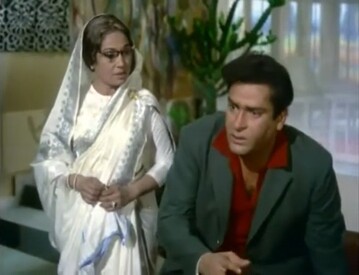
Sarojini Devi provides some background. She has an estranged identical twin sister, who went wayward very early in life and whom Sarojini Devi has not seen in years. Sarojini Devi has seen how her sister’s wild ways wrecked her life, and is beginning to spot glimpses of a similar wildness in her two younger granddaughters.

The youngest, Anju (Lata Sinha) has fallen in love with a debauched ‘Prince Gataudi’ [I can imagine Sharmila Tagore being furious about this] …
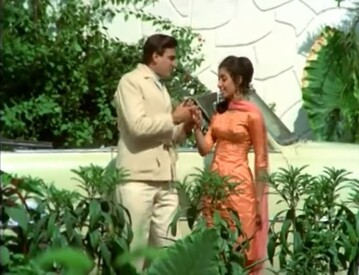
And the middle sister Manju (Snehlata) is being romanced by a playboy named Manmohan (Manmohan) who she’s convinced is in love with her.

Neither of these men is any good and will certainly destroy the lives of Anju and Manju, which is why Sarojini Devi wants Ashok to prise them loose and encourage them to be ‘good’ girls, agreeing tamely to marry the men their grandmother has chosen for them.
Anju and Manju’s elder sister Asha (Babita) is a different kettle of fish. Asha’s mother, Sarojini Devi’s daughter, had married for love and ended up very unhappy, in a disastrous marriage. Her parents’ bitter relationship has put Asha off love and marriage. Get her back on track too, is Sarojini Devi’s second task for Ashok.
Some of this information Ashok gets through Sarojini Devi when she offers him the job; the rest he receives from a chance acquaintance he strikes up with Mahesh (Mehmood), who is Sarojini Devi’s chauffeur and general man Friday (but seems to have tons of free time in which to get up to all sorts of irritating, illogical and completely pointless shenanigans).
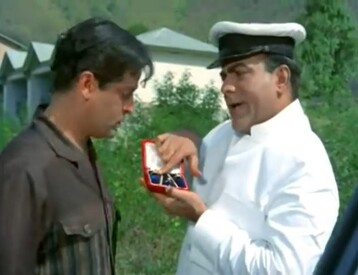
Mahesh is a Hyderabadi, and is in love with Sheila (Shubha Khote) whose father (Dhumal) is Maharashtrian and mother (Leela Misra) is Sindhi. These two people are divorced but seem to think being divorced consists of having different bedrooms; they live in the same house and spend all their time quarrelling—mostly about whom their daughter will marry. Her mother will only let Sheila marry a Sindhi; for her father, only a Maratha son-in-law will do.

Mahesh being neither, he and Sheila are very frustrated, and Ashok, being sympathetic to their plight, becomes a friend and confidant.
Ashok initially refuses to take on Sarojini Devi’s offer. On second thought, he realizes that this could be the perfect way to get the money he needs. Ashok’s only living relative is his younger sister, Roopa (Jayanthi) who went blind after a childhood accident for which Ashok blames himself. Ashok has recently learned that there’s a very accomplished eye surgeon in town who will be able to treat Roopa—but the operation will cost Rs 15,000.
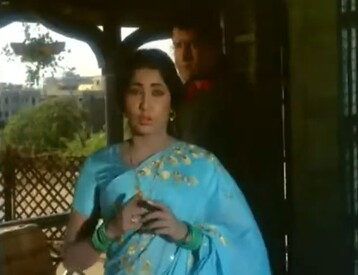
Sarojini Devi’s many millions suddenly seem palatable, so Ashok accepts the offer. He first begins to work on Anju’s and Manju’s respective romances, and has soon managed to show them both the light. Ashok’s work in this respect is relatively easy, since both the girls’ boyfriends are nasty good-for-nothings who only want the money these heiresses can offer them. In any case, both men now think the time is ripe for them to make their moves—and Ashok, keeping a close watch on both relationships, is able to enter the scene at the right time.
… to prevent Manju being the victim of a drug rape; and
… to save Anju, who’s been tied up, robbed of her jewels, and left in a train by her (now former) boyfriend.
In between all of this, Ashok also manages to make inroads on reforming Asha. Asha is a firebrand, going about brandishing a gun and beating up any man to tries to get fresh with her (I approve of her intolerance on such matters). Ashok engineers things so that Asha ends up coming to a rendezvous with Manmohan: she is taking Manju’s place in an attempt to get rid of Manmohan, and Manmohan thinks he’s got a date with Manju.
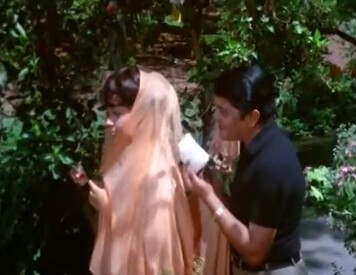
But when Asha fires at Manmohan, it’s Ashok who comes in the way and pretends to have died. From then on, it gets crazy, with Ashok pretending to be a ghost who’s romancing Asha, telling her that he and she have been lovers from many lifetimes. Even crazier, Asha falls happily for all this rubbish and melts into a puddle as soon as the ghostly Ashok gifts her a red saree and tells her this was her bridal saree in their last lifetime together.

From then on, Asha is all simpering and cooing and wearing sarees and being the good girl Granny wants…
Until Granny discovers that Asha and Ashok are in love with each other. This isn’t what Sarojini Devi had bargained for, at all. She loses her temper and flings money at Ashok, telling him to take what he wants, just leave Asha alone. To Asha’s horror, Ashok picks up Rs 15,000 and goes away.
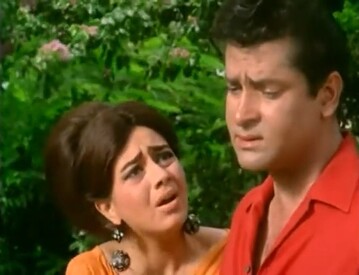
Of course, this is for Roopa’s eye operation, the reason why Ashok had taken up this job in the first place.
However, what Ashok doesn’t know is that Roopa’s life has turned topsy-turvy over the past night. She had gone to the temple, on a night when a storm was building [why would any woman do that? Let alone someone who can’t see]. Emerging from the temple, she fell down and lost the ring she wore, and which she had earmarked for Ashok’s bride. A stranger (Pran) came to help, and didn’t just escort her home, but then proceeded to rape her.

The next morning, the man has gone away, leaving a distinctive locket on a chain behind. His car whizzes past Ashok, who comes home just then and sees the number plate of the car, though he doesn’t know yet why he should make a point of noting the number. Ashok finds Roopa’s broken bangles and realizes what has happened, but by then Roopa has run away and thrown herself into the river.

The Pran character (his name is Pran) isn’t just a random stranger either [how could he be, being played by Pran?]. He is the nephew of one of Sarojini Devi’s most trusted confidants (Ulhas), who has fooled Sarojini Devi into thinking that Pran is away in London, spending his time in the company of ‘dukes and lords’: a worthy match for Asha. Sarojini Devi has agreed, sight unseen, unaware that Pran, far from being in London, has spent the past several months (or years, it’s not clear) in jail.
But now, having raped Roopa and indirectly caused her death, Pran turns up at Sarojini Devi’s doorstep, Uncle in tow, and given that Ashok has seemingly deserted Asha for money, Asha reluctantly agrees to marry Pran.
And this being a Pramod Chakraborty film (see Love in Tokyo), this is nowhere near the end. There’s plenty still to go. Remember, too, that Sarojini Devi has an evil twin, and that we saw Roopa only fling herself into the river—never a guarantee that a suicide attempt has indeed been successful.

If you go back to the introduction to this review, you can see the parallels between this film and Professor. But that—a vague similarity in gist of story—is where it ends. For me, it served to show how much scripting and direction can make a difference to a film; Lekh Tandon’s direction and Abrar Alvi/Shashi Bhushan’s story/scripting made Professor an enjoyable entertainer, even if it did veer off into melodrama right at the end. Tumse Achha Kaun Hai, written by Sachin Bhowmick and directed by Pramod Chakraborty, is a comparatively tiresome film, over the top in all aspects.
What I didn’t like about this film (because there’s so much here, and so little that I liked):
The biggest irritant for me: the entire Mehmood-Shubha Khote-Dhumal-Leela Misra track. Each of these people, individually, I have found likeable in come other films; here (and in other Pramod Chakraborty films, like Love in Tokyo and Ziddi) they are simply appalling. The ‘comedy’ is unfunny and thoroughly juvenile, the acting (especially Mehmood’s, and especially in a scene which seems to be a horrible replication of the famous Mehmood-Om Prakash scene from Pyaar Kiye Jaa) painfully hammy. The worst part is, this track isn’t just a one-off thing; this annoying quartet keeps returning again and again.
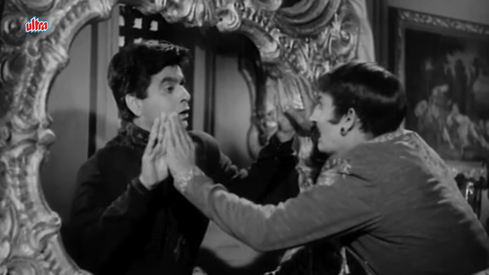
(Incidentally, copying comedy tracks from earlier films seems to be one of the important elements of ‘comedy’ here. There’s a long sequence of the ‘supposed mirror’ scene in which a drunk thinks he’s looking at his reflection, though what it is, is actually another person carefully mirroring his every move. Done so brilliantly by Dilip Kumar and Jeevan in Kohinoor, recreated so awfully by Mehmood and Dhumal here).

Then, the mindless ‘romance’. I have seen too many Hindi films to be surprised by sudden ‘love’ which has no basis in getting to know someone—but this one takes the cake. Asha falls in love with a man she is convinced is a ghost simply because he slinks around in her garden at night, singing suggestively to her? And gives her a saree? That is enough to convince her that this is her janam-janam ke phere man? So much so that she forgets he is a ghost and not a man (unless some slipshod editing is responsible for this, it’s a glaring oversight).
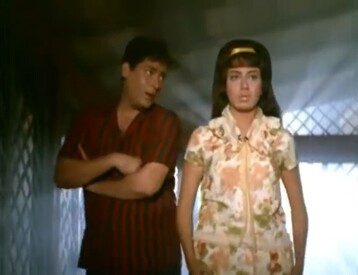
Then, Shammi Kapoor and Babita. Shammi Kapoor is one of my favourites; but by the time this film was made, he was looking too pudgy and tired to really be playing roles like this. Babita I have never enjoyed watching, and this film is no different. They have zero chemistry and look too bored to even want to go through the paces.
Lastly, Jayanthi as Roopa, whom I found extremely irritating and over the top. If there was one redeeming factor about her character arc, it’s what happens to her right at the end of the film. I had expected a different (and predictably regressive) turn of events for her, but fortunately, that didn’t happen.
What I liked:
The music, by Shankar Jaikishan. Specifically, three songs: Janam-janam ka saath hai nibhaane ko; Rangat teri soorat si kisi mein nahin, nahin; and Aankhon mein aankhen na daalo mujhe kuchh hota hai.
All said and done, the good thing about this film was that it made me revisit Professor; it renewed my love for that film, which shows, I think, how it’s possible to make a solid Hindi masala film without resorting to painful ‘comedy’ or nonstop melodrama.
 Dustedoff
Prince Gataudi’ [I can imagine Sharmila Tagore being furious about this] …
As much as I love your reviews, they seldom make me laugh out loud -but this line quite literally did. :)
LikeLiked by 1 person
That was a snide bit of naming, wasn’t it! :-D
LikeLike
I find side-tracks featuring Mehmood (more often than not present in movies of 60s and 70s) irritating beyond measure.
LikeLiked by 1 person
I totally agree with that. He was a little controlled in the earlier films, but when he really hit his stride and became very popular, the side tracks that featured him were simply awful. The only one I can think of, offhand, where I enjoyed his role (and co-star, Mumtaz) was Pyaar Kiye Jaa.
LikeLike
Mahesh & Sheela aka Mehmood Subha Khote have worked in more than dozen films by the same screen name Starting with Chothi Behn.
LikeLiked by 1 person
Oh, I had never realized. That’s interesting, though I wonder why that happened – not the pairing, because I suppose film-makers simply realized that they seemed to work well together – but the names too. Were film-makers too lazy to think up new names? Or did they perhaps think “yeh naam chal gaye, ab inko badalna badshaguni ho sakti hai“?
LikeLike
Badalna badshugni is the right word Most of the Producers have the rare quality of having a good omen for the success of the film Director Pramod Chakraborty of Tumse Acha kaun hein went one step further After Ziddi Love in Tokyo above named Film was casting for Naya Zamana he named Mehmood as Mahesh Also in his next Jugnu he followed the same formula Shubha Khote had then become old to be casted opp him Aruna Irani and Jayshree T were opp Mehmood Do not recall their names I think Sheela,,,,,
LikeLiked by 1 person
Gosh, poor you! Imagine having to sit through this travesty (without Shalini to make things bearable!) I watched it last when it was shown on DD, I think. Babita has never been someone I liked very much, and as you point out, Shammi looked tired and much older than his years in this one.
And I completely agree with you about how irritating the Mehmood-Dhumal-Leela Misra- Shubha Khote track was.
And yes, this was a tired rehashing of Professor, which was quite a decent watch until the end. (I still think Lalita Pawar got the short shrift in that one.)
But I enjoyed your review (and thanked my stars that I did not have to revisit it!
LikeLiked by 1 person
Anu, I agree with you that poor Lalita Pawar did get short shrift in Professor – but despite that (and despite Kalpana, another actress I find irritating), I still think that was a far more satisfying film. As you say, quite a decent watch till the end.
This one… o, God. What a travesty. :-( I thought, when I’d finished, that I wouldn’t review it. But then public spirit kicked in. For the sake of the reading public, for those who might be tempted to watch it, it was my duty to review it!
LikeLiked by 1 person
Sounds like a LONG movie full of a lot of drama. It seems to have so many tracks and characters that I couldn’t keep track.
A grandparent hiring someone to teach/discipline their grandchildren reminded me of Parichay but there’s no comparison, I think.
Leela Mishra looks so funny in that photo.
LikeLiked by 1 person
Oh, Parichay is a much nicer film! (Which reminds me, it’s been far too long since I watched it – need to see it again). Also, Gulzar’s films are the only ones in which I have really liked Jeetendra. :-)
LikeLiked by 1 person
‘Gulzar’s films are the only ones in which I have really liked Jeetendra.’ —Yes.
Like Khushboo. I re-watched it recently. I have the book (PanditJi, Hindi translation). Now I feel like re-reading the book.
LikeLiked by 1 person
Oh, so it wasn’t a Hindi novel to start with? Which language was it originally in?
LikeLiked by 1 person
It is based on Saratchandra’s novel, ‘Panditmashai’.
LikeLiked by 1 person
Thank you.
LikeLiked by 1 person
hi madhu ji ! I have not watched this movie tumsay acha Kaun hain. It’s available on YouTube and length is 3 hours. The movie seems to have plenty of all 60s things.
Another 3 hour movie was o p rahlan talaash made for brother in law rajender Kumar.
The screencap of Lalita ji took my attention. By the review i understood the movie.
i am mainly writing for what I have thought on Babita. After read sadhna ji interview in which she said raj Khosla ji said see babita copies you.
I thought think babita as an actress. Babita ji had a fit body and height. In her photos for star and style magazine she looked gorgeous.
as an actress i feel she was average not having histrionics. she had good screen presence.
If she had chemistry with her heroes. My answer will be no. Many times I feel she was fine in her individual scenes than with her heroes but I liked her pair with Sanjay khan in dus lakh.
people say she replaced sadhna ji but industry always look for fresh faces. 😃
LikeLike
I cannot agree with people who say Babita replaced Sadhana. Kahaan Raja Bhoj, kahaan Gangu Teli! :-D Sadhana’s beauty as well as her acting ability were well beyond anything Babita could boast of.
LikeLiked by 1 person
i suppose part of the “replacement” theory here is driven by the fact that they are cousins.
LikeLike
Possibly… but still a far-fetched idea. :-)
LikeLike
After reading your review, I want to watch this film. I know you liked it only little so I’ll fast forward dhumal-mishra bits.
Mindless love- Hmmm, being Babita, if one gets to romance Shammi Kapoor (even a slightly pudgy one) why not? Much better than her real life romance.
Of course, I would prefer ‘Professor’ any time. Shammi looks yummy, songs ate fabulous.
LikeLike
“if one gets to romance Shammi Kapoor (even a slightly pudgy one) why not? Much better than her real life romance.”
Hehehe! Though her real life romance was also quite pudgy! But yes, no comparison between the two Kapoors. :D
LikeLike
LikeLiked by 1 person
Yes, the songs Babita appeared in were often very good, but that’s about it – her films are invariably not especially watchable.
LikeLike