
Last week, to commemorate the 100th birth anniversary of Raj Kapoor, I reviewed my favourite film of his as an actor: Chori Chori, which was a remake (uncredited) of It Happened One Night. I had seen Chori Chori before; I had also seen It Happened One Night before, though in both cases, I had not reviewed the film in question.
Since I’ve finally reviewed Chori Chori, it seemed to me about time I reviewed It Happened One Night as well (which is why there’s also a comparison with Chori Chori further along in this post). Directed and co-produced by Frank Capra, this film was based on a short story, Night Bus, by Samuel Hopkins Adams. It is generally regarded as the first ever screwball comedy, having pretty much invented the genre; it was also the first of only three films so far to have won all five major Oscars: Best Picture, Best Actress, Best Actor, Best Director and Best Adapted Screenplay.
But, to start at the beginning: on a private yacht moored off the coast at Miami, where Ellen ‘Ellie’ Andrews (Claudette Colbert) has been confined by her banker father (Walter Connolly). Mr Andrews disapproves, unreservedly, of Ellie’s having gotten married to a man named King Westley (Jameson Thomas), whom he (Mr Andrews) is convinced is a rotter: only interested in Ellie’s wealth, nothing else.

Ellie, on the other hand, is convinced of Westley’s love for her, and is dead set on travelling to New York to be with him. Mr Andrews threatens to have the marriage annulled; Ellie loses her temper and, having upturned her father’s lunch table long enough to disconcert him, manages to escape. She jumps overboard and swims ashore.

Soon enough, Ellie has bought herself a ticket for the night bus from Miami to New York. On the bus, she has a run-in with a journalist named Peter Warne (Clark Gable). Warne is fresh from another run-in, with his editor in New York, and has also had an altercation with the bus driver: he’s not in a good mood, and to find Ellie sitting happily in the seat Warne has earmarked for himself (and fought for) is the last straw.

Warne soon realizes just how pampered, cosseted, and overly protected Ellie is: she has no idea how anything is done in the real world. How much things cost, how far the few dollars she’s got will go—even something as basic as having to queue up for something. Pretty much right in front of her eyes, her bag is stolen. Warne, who has witnessed this theft and tries to (unsuccessfully) catch the thief suggests they call the cops, but Ellie is vehement in her refusal (she realizes, of course, that her father will have probably informed the police about her escape, and they will be on the lookout for her).
Mr Andrews, though, has not informed the police. Instead, he has hired private detectives to try and find his fugitive daughter.
Ellie knows nothing of this and is going on her own clueless way, on the night bus. She is so clueless, in fact, that when the bus stops for half an hour along the way to allow passengers a meal and a break, Ellie happily tells the bus driver to wait for her, while she goes off to a big hotel in town.

When she returns—half an hour after the bus has gone, right on time—she is shocked to discover that the driver actually did not pay heed to her instructions to wait for her.
Warne has not gone on the bus, and is sitting at the bus station. He now gives Ellie some disconcerting news: he knows who she is. It’s there in the newspaper. He shows her: the headlines are all about Mr Andrews’s runaway daughter. Warne has a proposition: he will help Ellie get to New York and to King Westley, in return for this story. What a scoop it’ll be, the runaway heiress travelling cross-country in defiance of her father to be united with her husband.
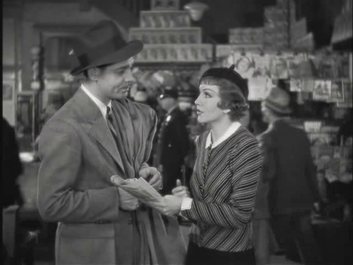
Ellie, by now, has very little money left (she spent most of it, in an ill-advised move, at the hotel). Also, of course, she is woefully inept at this business of roughing it out. She could definitely do with some help. So Ellie agrees, and the two of them set off on a grand adventure which will end up being something neither Warne nor Ellie could have imagined when they first climbed on to the night bus to New York.

What I liked about this film:
The entire package. It’s witty, it’s light-hearted, and the two leads are fabulous.
But, to break it down further. Firstly, Claudette Colbert and Clark Gable, who’re superb. They’re very natural, their timing is perfect, and the chemistry is spot on. One can see why these two got awards for their portrayals of Ellie and Warne: they make this mismatched couple very believable indeed. (Interestingly, the only kisses in the film are between Ellie and King, not Ellie and Warne—and yet it’s obvious whom Ellie really loves: even without the lip-lock, the sizzle is there).

Then, the screenplay (Robert Riskin) and direction (Frank Capra): brilliant. It’s snappy, it’s fun, it’s fast-paced, and it’s very well thought-out, each dialogue and each scene helping to cement the bond forming between Ellie and Warne, and/or helping explain their characters a little better—even when, superficially at least, it seems like just another amusing scene.
In this context, I found it admirable that though Ellie initially comes across as a somewhat self-centred and spoilt ‘brat’ (which is what Warne dubs her), there is more to her. For one, she is kind and warm-hearted, and actually not the snooty sort one would have expected the stereotypical rich girl to be. Look at the way she interacts with the women in the line for the showers, for example; or the way she looks after the fainting woman in the bus, and then her weeping son. Ellie may be rich, but she does not put on airs.

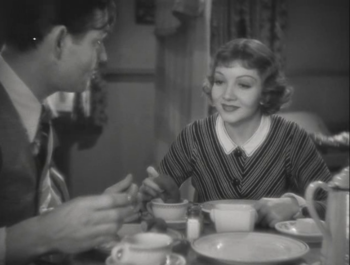
Then, one also begins to see glimpses of the loneliness Ellie might feel, imprisoned in the golden cage she has lived in all her life. It has left her unaware of how the outside world lives, and now, as she sees life beyond her own limited view, you can see how Ellie begins to enjoy all this, everything new and interesting. The gusto with which she joins in when everybody in the bus sings along to The Daring Young Man on the Flying Trapeze; or the joy with which she practises doughnut-dunking after Warne teaches her. This is a butterfly emerging from its chrysalis, opening up in the sunlight.
Comparisons, comparisons:
Since I’ve recently re-watched Chori Chori, it makes sense to put in a few words about how these two films compare.
… and yes, Chori Chori is a very good, fairly faithful, remake of It Happened One Night. In spirit, almost an exact copy, though there are some differences. The characters, barring Warne/Sagar and Ellie/Kammo, aren’t exactly the same; for instance, Johnny Walker’s poet is not quite the Oscar Shapeley (Roscoe Karns), though both are nuisances who cotton onto Ellie’s identity. The Bhagwan character and his wife are missing in the original Hollywood film, but the vehicle that the hero manages to get hold of comes from another source—which isn’t there in Chori Chori.
However, the broad strokes of the story, the main elements, the way the ‘Walls of Jericho’ are put up every time the two share a room—remain mostly the same in both films.
What I did find interesting was the way Agha Jani Kashmiri scripted Chori Chori, to account for what might appeal to an Indian audience. Indians, at least back in the 1950s, would not have accepted a heroine already married to another man, even if it’s obvious that the marriage is only on paper and can be annulled. No; Kammo is only in love with Sumant, not married to him.
Then, also, there is obvious and clear reason for Sumant/King Westley to be labelled a ‘pill’ (as Warne calls him at one point). In It Happened One Night, we only have his reputation to go by; Ellie’s father and Warne both talk of him being a bad sort. But in Chori Chori that isn’t enough: we are shown what a lousy character Sumant is. He has a frank chat with a friend, where he discusses the wealthy women he’s ‘conquered’ so far, and whom he now has in mind (a dancer he’s been watching with greedy eyes).
There is, too, that bit about the hero and heroine sharing a room. In Chori Chori they’re forced to share a room because the owner of the accommodation refuses to give rooms to any but married couples. In It Happened One Night, the room is shared for reasons of economy: Warne cannot afford two rooms. This suggests that it wouldn’t have raised too many eyebrows if they had indeed shared one room despite being able to afford two. Of course, the entire ‘Walls of Jericho’ thing reinforces the idea that two unmarried people co-habiting isn’t fine.

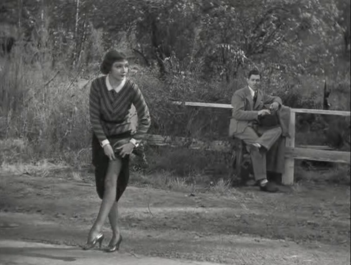
In the 90 years since It Happened One Night, it has been remade many times, sometimes (Chori Chori is a case in point; so is Dil Hai Ki Manta Nahin) fairly faithfully, at other times (Basant, 1960) as a rather more distant inspiration. Two especially iconic elements from the film have been carried forward into umpteen other films: one, the Walls of Jericho; and the other the scene where Claudette Colbert lifts her skirt to show off her leg to hitch a ride.
This is a cult classic, no two ways about it. If you haven’t watched this one yet, do.
 Dustedoff
This is a nice and comprehensive review, making me want to watch this original. I didn’t know that Basant with Shammi Kapoor and Nutan was loosely inspired by this film. And Chori Chori is also my favorite Raj Kapoor film for other directors. But it ties the top spot with Hrishikesh Mukherjee’s Anari.
LikeLiked by 1 person
I was very pleasantly surprised when I began watching Basant, many years back – because the first 1/3 or so of the film is almost exactly the same as this, and Shammi Kapoor and Nutan were lots of fun. Then the film goes completely on its own (very incoherent) way, and – if I remember correctly – ends up bringing in that trope from Love Affair/An Affair to Remember/Bheegi Raat (woman has an accident which leaves her crippled, and she convinces her sweetheart that she has married another). It’s very garbled, such a waste.
LikeLike
Oh, Basant was such a waste of Nutan and Shammi. Seriously! Shalini and I reviewed it here:
https://anuradhawarrier.blogspot.com/2024/05/basant-1960.html
And we had such high hopes of that pairing. At least, I did!
LikeLiked by 1 person
Yes, I too had such high hopes! They would have been fabulous together. The only other film of theirs I’ve seen was the equally forgettable Laat Saheb. Sigh.
LikeLike
I love It Happened One Night – both Gable and Colbert are brilliant in this and their repartee splits your sides. :) Love the back-to-back reviews with the original, Madhu. You’ve made me want to watch this again!
LikeLiked by 1 person
It’s a fabulous movie, isn’t it, Anu? And Chori Chori is such a good remake (someday, I should make a list of films that are really laudable remakes of the original – recently, Chori Chori and Kundan are two that have impressed me a lot).
LikeLike
Oh, do! I was thinking of that when I saw this review so soon after Kundan! Please do write it soon.
LikeLiked by 1 person
Unfortunately, there are so few films of that type. :-( Or, I suppose, I’ve seen so few. Recommendations for the list will be very welcome!
LikeLike
I had 12 Angry Men and Ek Ruka Hua Faisla in mind as well. I thought the copy was very well-made, even if, by that time, the jury system had been scrapped.
Aradhana /To Each His Own
Satte pe Satta/Seven Brides for Seven Brothers
But neither Aradhana nor Satte pe Satta are scene-by-scene adaptations like the two you mentioned.
LikeLiked by 1 person
I think this is a list that might fit better with your blog than with mine, given that several of these remakes (Ek Ruka Hua Faisla, Satte pe Satta) were in later years! If you go into non-Hindi cinema, the superb Bengali film Thana Theke Aschi was a very good remake of An Inspector Calls. Oh, and back to Hindi, Do Phool was a good adaptation of Heidi.
LikeLike
There was a film starring Bette Davis, which had a plotline with similarities to To each his own, before the later was even made. The name is escaping my mind right now. The 1945 Hindustani Blockbuster Zeenat ( released before TEHO) too borrowed plot elements from that Bette Davis film.
As far as Aradhana is concerned, it has pretty much a very different screenplay from TEHO. It’s rather like what Salim-Javed used to do i.e. take the story idea, and make a different script out of it on most occasions. Of course, at times, they were more blatant. Zanjeer, Majboor, Don are cases in point, which makes me wonder why not talk about SJ and their remade films here?
Or, maybe they are just too sacred to be talked about and more superior artists to the likes of Sachin Bhowmick, Basu Chatterjee, and AR Kardar, even though unlike the former, these men did actually have some great original films to their credit.
LikeLiked by 1 person
Incidentally, my review of To Each His Own includes a comparison with Aradhana:
https://madhulikaliddle.com/2020/08/04/to-each-his-own-1946/
LikeLike
Madhu,
Nice review. I saw it long ago, it is time to rewatch it. I remember Clark Gable instilling some sense into the pampered daughter of the rich baron a little roughly. A throwback to “Frankly dear, I don’t give a damn”. Chori Chori I have seen in bits and pieces. I have something about Hindi remakes of English classics. Many of them have been so poor. But with praise by all of you, I must get down to watching it, despite some irritating distractions by the comedy scenes.AK
LikeLiked by 1 person
Do give it a try, AK! I personally think the comic scenes aren’t terribly distracting – most of the comedy is centred round the two main characters, rather than the occasional comic interlude with Bhagwan and Johny Walker, so I didn’t find it very irritating.
LikeLike