
I have never really wanted to watch this film, the main reason behind that being a long-ago comment by my father, saying that it was a ‘serious’ film. Which meant, basically, that you shouldn’t expect a happy ending. Whatever may happen before that—starry-eyed romance, good songs, even some humour—is all the light-heartedness you could hope for. When tragedy came, it would pile up.
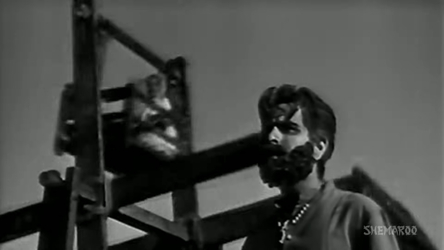
Mela (which I ended up watching mostly for the songs, and partly because I like both Dilip Kumar as well as Nargis) gets off to a bad start, because it begins with gloom and doom. Mohan (Dilip Kumar), old and sad-looking, is released from prison after what seems to be a long, long time in jail. He goes out into the wide world, and walking along, comes across someone singing Yeh zindagi ke mele, while—in the background—crowds of happy, laughing people throng a fair, whirling about on carousels, milling about stalls, enjoying themselves.
The story then shifts into flashback, many years earlier when Mohan (?) is a schoolboy. Mohan’s best friend and childhood sweetheart Manju (Baby Zubeida) is the daughter of the schoolmaster. Mohan’s father (Amar) is the village halwai, and is best friends with Manju’s father.
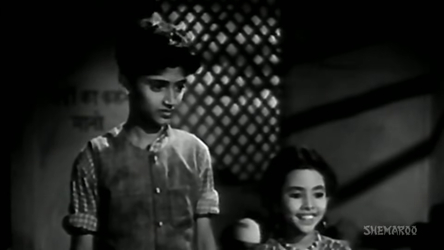
Mohan and Manju are so much in love already that they spend their spare time crafting little dolls’ houses out of mud, with a male doll in his house and a female in hers. Someday this will all be for real, is the theory. [Aside: I have never been able to figure out how filmi couples form jodis so early in life. It’s a different thing to be good friends and later have that turn into love; but romance when you’re not even approaching adolescence?]

Anyway, they grow up (Manju is now Nargis). And of course they are deeply in love with each other. They don’t play with those dolls’ houses any more [thank heavens for small mercies] but they haven’t forgotten about them. [This isn’t a random comment; it has substantial significance to the plot].

Manju’s father, a widower, has remarried in the meantime, and Manju’s stepmother (?) is the quintessential stepmother, nasty, selfish, but always pretending to be oh so good. She doesn’t beat Manju or bully her into doing back-breaking housework, but it’s not as if she has Manju’s best interests in mind, either.

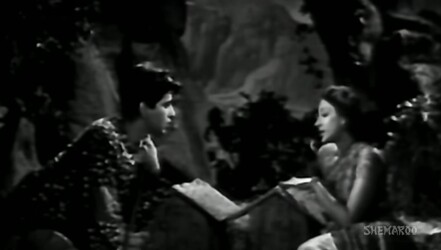
Manju and Mohan meet each other pretty much every day, at a designated spot away from the village, among the rocks and hillocks where as children they had made their dolls’ houses. Whoever arrives first at the rendezvous sings out “Dharti ko aakaash pukaare, aaja aaja” and the other responds. It is their signature song.
Manju’s best friend is Basanti (Roopkamal? IMDB lists Basanti as Noorjehan, but I know for a fact that this is not the famous Mallika-e-Tarannum). Basanti is a feisty girl, not just Manju’s most loyal and stalwart supporter, but also a friend of Mohan’s.
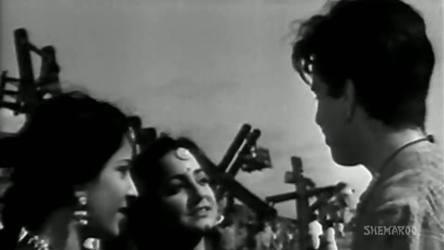
Shortly after we first see this lot grown up, there comes into the picture a man who bumps into Basanti in the village street and immediately falls head over heels with her. Mehku (Jeevan) used to be a schoolmate of Mohan and Manju, and has been away from the village many years, serving in the army. His stint in the army, and that too in the war, abroad, has given Mehku many airs. He goes about talking [or trying to talk] English, saying “Cheedio, cheedio” when he’s leaving a home, for instance, and flinging garbled English words around at all the ignorant villagers, who, of course, don’t know any better.

Mehku is brother to Manju’s step-mother, and now that he’s back, he lends a sympathetic ear to her woes regarding Manju. In between, he spends time with an equally despicable friend named Kaluva (?). Kaluva and Mehku are rascals of the first order, not above thievery; but nobody in the village seems to realize that at the moment.
Mehku even tries to court Basanti (for now, at least, he’s not flinging himself on her or trying to coerce her), but Basanti knows how to stand her ground—and to teach Mehku a lesson, by making sure he ends up falling into the all-too-powerful arms of Basanti’s father, a rather belligerent wrestler.

Meanwhile, Mohan’s and Manju’s romance has borne fruit: Mohan’s father has made note of it, and has gone to his old friend, Manju’s father, to do a little matchmaking. Manju’s father agrees readily, though his wife is not at all happy with the match. He doesn’t listen to he: Mohan is a good lad, and the young couple are so much in love; where is the harm in them getting married?
Mohan and Manju are delirious with joy when they hear the good news. Meeting at their usual spot, they exult over their coming nuptials, a week from now. Manju brushes away the dead leaves and twigs that have hidden their two dolls’ houses all these years, and they withdraw the two dolls from inside their respective houses. Mohan hands over his male doll to Manju, and takes her female doll: they will now be in each other’s homes, so to say. Mohan and Manju take their dolls to their respective homes, and store them away safely for the next week.
Mohan’s father has saved up money for this occasion, and tells Mohan that this bit here is for the jewellery. A delighted Mohan, one week before the wedding, takes the money and goes to the city to buy ornaments for Manju.
There, he buys all that he likes, all that he can afford. His enthusiasm is such that he grows careless; careless of who may be watching. A thief is looking on, taking note of all the ornaments Mohan has bought.
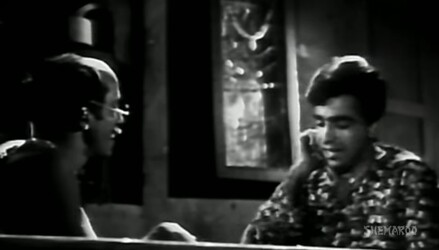
When Mohan emerges from the jeweller’s shop, this man attacks him. Mohan fights back, and in the tussle that ensues, the two men go sprawling in the street. A passing car hits Mohan, injuring him badly. The thief escapes with the jewels, and sympathetic passersby take an unconscious Mohan to the hospital, where he remains, still unconscious, for the next five days.
Back home in the village, Manju and her father, Basanti, and Mohan’s father are worrying about Mohan. Where has he disappeared? What has happened to him? [Given that Mohan’s father is healthy and whole, it seems odd that he doesn’t travel to the city in search of his son; all he does is fret].

The nasty Mehku is quick to take advantage of this situation. He goes to Manju’s mother and tells her that Mohan has run off with some other woman, and had betrayed Manju. Call the panchayat, he says, and we’ll sort this out. When the panchayat (and pretty much the rest of the village) gathers, Mehku repeats his lies: Mohan has decamped, dumping Manju and leaving her honour besmirched. She was to have been married the next day; how can they let her remain still unmarried at the end of the day? Give me thirty rupees, he says, and I will find a worthy groom to take that scoundrel Mohan’s place.

The panchayat doesn’t have the wits to ask Mehku how he knows Mohan has run off with another woman, and who said woman might be. They’re so gullible, in fact, that they happily hand over the thirty rupees to Mehku…
… who goes to the household of a local thekedaar (a contractor) and speaks to the said thekedaar’s sister (Chanda), who is desperate to have her brother married. To this woman, Mehku offers a very good match: a girl, he says, who will be the perfect maidservant, to take over all the housework of the place. Give me thirty rupees, he tells the woman, and I will arrange the match.

And thus it is that, in the absence of Mohan, Manju is married off to the thekedaar. She hasn’t seen him, he hasn’t seen her, so it comes as a shock to both of them to discover who the other is. [IMDB—in the case of this film, just one stab in the dark after another—lists Rehman in the cast, so I was hoping Manju’s new husband was him, but alas, no].
He is an old man, on shaky knees, the father of four young children. And he is aghast that she is so young; how on earth will she look after his four children? These boys have gone to rack and ruin, they’re dirty and uncouth and neglected, he tells her: he wanted a wife who could be mother to them, bring them out of their squalor.

So of course Manju, Sati Savitri that she is, becomes unpaid maid, loving mother, and exploited wife all at once. Unaware, all this while, that Mohan, suddenly gaining consciousness on the day of his wedding, had hurried back to his village only to discover that his fiancée has married another.
What next? Whom did Mohan kill, that he ended up jailed for so many years? Why is Mehku such a nasty character? Why didn’t feisty Basanti stand up for Manju and help her run away from the mandap?
All questions that bugged me, but to only one of which (whom did Mohan kill) did I get an answer. And, to be honest, I couldn’t be bothered. This film, beyond a point, gets just too irritating.
What I didn’t like about this film:
Yes, the ‘what I didn’t like’ comes first, because it’s not a film I liked.
The sheer stupidity of a lot of the characters involved. People just don’t use their brains. The obvious solution to a problem stares them in the face, but they look away.
Okay: I suppose that is par for the course for a lot of old Hindi films of this type, but still.
Then, Manju’s behaviour. This woman was told that her fiancé ran off with another, and while I give her credit for still going on believing in him, I find it irritating that she calmly accepts her fate and marries the thekedaar. There’s no demur, no objection raised, nothing but a lot of silent tears shed and some sad songs.
Also, the whole thing about the thekedaar’s children being neglected and filthy and illiterate and whatnot. Why?? A contractor would be expected to be fairly wealthy; why are his home (plaster peeling, dimly lit) and his children in such a condition? As a father, has he completely abdicated any responsibility? Is only a mother able to make sure the kids bathe and go to school, etc? Manju is later shown sending them off to school, all clean and scrubbed, so obviously it’s not that there’s no money to send them to school. It’s just that these children have the misfortune to be saddled with a neglectful and irresponsible father.
On the whole, a regressive, irritating film. Dilip Kumar and Nargis do what they can—they look good, their acting is fine—but it’s not enough to redeem Mela. Director SU Sunny (who went on to make the delightful—mostly—Kohinoor) wasn’t yet at the top of his game, as far as I’m concerned.
What I liked:
The one reason you should—I won’t say ‘watch’, but perhaps check out, as in ‘fast-forward from one song to the next’—Mela is for Naushad’s wonderful music. He was already a hit composer before this film came along, and he gave it several very good songs, sung mostly by Mukesh and Shamshad Begum, though the famous Yeh zindagi ke mele is by Mohammad Rafi. Among the great songs here are Gaaye jaa geet milan ke tu apni lagan ke, Dharti ko aakaash pukaare aaja aaja, Aayi saawan rut aayi, and Main bhanwra tu hai phool.
Actually, save yourself the pain of watching any bit of this film and just listen to the songs.
 Dustedoff
I will follow your advice and I already know the songs, so why bother.
Long time ago, I might have watched this film on DD and didn’t understand a bit of the film, because I was too young to understand. But the songs were always a big hit.
LikeLiked by 1 person
I already know the songs, so why bother.
Hehe! That’s the most recommended course to adopt. :-)
LikeLike
Gosh! I wondered why you would have watched this film! Poor you!
By the way, doesn’t the thekedaar vow not to ‘besmirch’ his wife? And doesn’t he kick the bucket leaving poor Nargis a young widow? Or am I confusing this film with another equally-reprehensible one?
Like Harvey, I already know the songs, and I’ll pass on rewatching this contrived tragedy!
LikeLiked by 1 person
I don’t recall the thekedaar vowing not to ‘besmirch‘ her (good description, that, Anu!), but you could be right (and no, I don’t have the patience to go back and watch even those few scenes all over again to ascertain). I’m sure you’re right. It was quite obvious that he didn’t really need a wife – just a nanny-cum-maid. So the fact that he kept her at a distance, so to say, isn’t surprising. And yes, he does kick the bucket, leaving her a widow (who then vows to remain faithful to his memory – aarghh!)
LikeLike
The childhood romance – while the marriageable age was set at 15 for girls in 1949, child marriage continued (still continues according to data sources quoted by Wikipedia). So, these story elements must have communicated some sense of familiarity/ nostalgia especially in village settings. I thought this was another variation of Wuthering Heights, but seems to be something different, but still unwatchable! The songs are fantastic – especially, the echo/ resonance effect for Shamshadji’s voice in Dharti ko aakaash pukaare
LikeLiked by 1 person
Oddly enough, just today I was being told about some distant relative who, when she got married, was 15 – and this was in 1972! In a rural, or even fairly orthodox and old-fashioned society I might have thought it plausible but not in an educated urban family, in the 1970s.
I didn’t really see a resemblance to Wuthering Heights (or did you mean in the sense of childhood sweethearts, who end up separated by circumstances and one married to someone totally different?) It is completely different, yes.
LikeLike
Yes on the childhood sweethearts getting separated theme – perhaps it’s also an allegory of partition whose impact was raw and traumatic in the 50s.
LikeLike
Possibly, yes…
LikeLike
Madhu,
Excellent review. I remember, your sentence, “This film, beyond a point, gets just too irritating“, sums up my feeling at the time. To my mind, this film was an illogical tragedy. Not for nothing, Dilip Kumar was known as the ‘Tragedy King’. I saw some more films of his, which had a senseless tragedy. One I remember was going as a joyous film all through, until suddenly some unforeseen tragic events strike.
AK
LikeLike
I completely agree with you, AK – this one is definitely an illogical tragedy. One of those ‘zabardasti-ki-tragedy’ films where everything comes together, from coincidental disasters to people deliberately choosing the path of greatest grief and pain, to make sure the story stays well clear of even a glimmer of a decent ending. I can well imagine why Dilip Kumar went into a state of depression after having worked in a slew of such films.
LikeLike
Madhu ji,
Mela is a movie which I would never think of watching. While the songs are great but like AK ji says, somehow the latter half of such movies are completely messed up. These are like compulsive tragedies!
Anita
LikeLike
Yes, compulsive tragedies, true. I can never understand why people would want to make such films. Itna bhi kya rona! (actually, it’s not the rona I object to, it’s the needless unhappiness – there was so much in this film that could have been prevented).
LikeLike
I watched this film more than a decade ago in grainy 240p. It was one of the first films starring Dilip Kumar I saw. And it didn’t impress me too much either, only the song ‘Yeh Zindagi Ke Mele’ remained in mind. The story sure remained dull and both Dilip Kumar and Nargis, the latter especially with Raj Kapoor, would go on to have more studded careers in the 50s.
LikeLiked by 1 person
Yes, Yeh zindagi ke mele was a good song, but otherwise the film was not the type I would watch again (actually, I guess if I’d known just how weepy and even regressive it was, I wouldn’t have watched it even once). You’re right, these two went on to act in much better films later on in their careers. More cheerful films too.
LikeLiked by 1 person