
When, for May 31st this year (the 100th birth anniversary of film director Raj Khosla), I wanted to review one of his films, Anita was on my shortlist. Over the course of the years I’ve been writing this blog, I’ve reviewed several of Khosla’s films, including two of the three films (Woh Kaun Thi?, Mera Saaya and Anita) that comprise Khosla’s Sadhana suspense trilogy. Since Manoj Kumar had also passed away earlier this year, it seemed fitting to watch and review Anita, the last of the three films, and a film that starred Manoj Kumar opposite Sadhana.
For a tribute to Khosla, I ended up reviewing Kaala Paani instead. But I did watch Anita (a film that I’d last seen so long back, I remembered only the basics of it). And it seemed appropriate to review it too.
Therefore…
The film begins with a short, rather abrupt scene in which Seth Biharilal (Sajjan) visits a somewhat shady-looking pandit (Ulhas). Biharilal has brought along the horoscope of his 19-year-old daughter Anita for the pandit to have a look at, and to comment upon. The pandit has a peek, and says that this year is going to be really vile for Anita.

The scene now shifts abruptly to Anita (Sadhana) herself, who is being serenaded at home by her lover Neeraj (Manoj Kumar). Neeraj and Anita have been in love the past four years [from when she was fifteen? Wow. Old Hindi cinema keeps reminding me how different India was, just a few decades ago]. Neeraj and Anita are being all lovey-dovey when Anita’s father arrives, livid that Anita is still hanging out with this good-for-nothing.
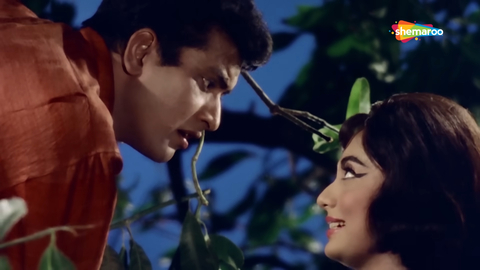
… because Seth Biharilal would much rather have Anita marry a man of his choice: in this case, the somewhat slimy-looking Anil Sharma (Kishan Mehta). Anil is one of Biharilal’s trusted confidants, and a marriage between him and Anita would benefit all concerned [barring Anita and Neeraj, of course].
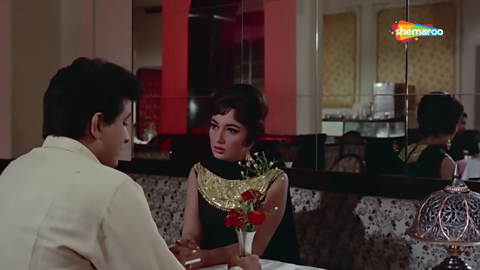
Soon after, Neeraj is sitting at a restaurant with one of his friends when Anita arrives, wanting to talk to Neeraj urgently. Is he willing to marry her, she asks; and when Neeraj says yes, she tells him that they are to get married today, right now. She has already made all the arrangements at the registrar’s, they are to go at once.
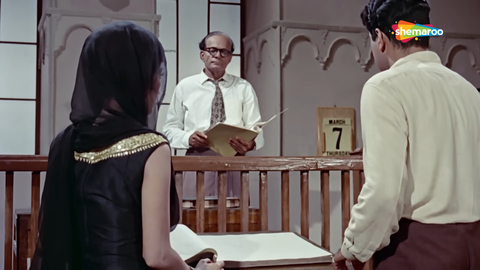
But just as Anita is about to sign in the registrar’s register, an irate Seth Biharilal arrives there and gives her hell. This wedding cannot happen, he will not let it happen.
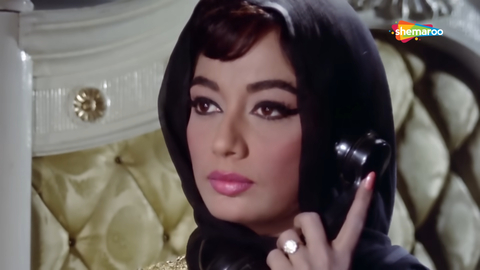
Biharilal’s spanner-in-the-works is effective. Neeraj and Anita are separated and Biharilal takes her home. Neeraj follows in their wake, but Biharilal refuses to let him see Anita. Biharilal is with Anil, and the two of them do the good-cop-bad-cop routine with Neeraj. Biharilal raves and rants, Anil is the smooth-talking, rational man who reasons with Neeraj and lets him speak to Anita on the intercom: she tells him to forget her, their story is over and done with.

Neeraj is so devastated, he decides he cannot even stay on in Bombay anymore. He hands in his resignation, but his boss refuses to let Neeraj go for so minor a reason. Instead he offers a solution: Neeraj is to be transferred to Delhi. Neeraj accepts and goes off to Delhi, but has barely been there a couple of days when he receives a letter from Anita, summoning him to Bombay. At once. It is a matter of Anita’s life, and of her honour.
Meanwhile, in Bombay, Seth Biharilal is hosting a grand party at which he’s going to announce the engagement of Anita and Anil. All the gathered guests are waiting for Anita to put in an appearance, when a maid (sent to fetch the young woman from her room) comes, nervously extending a note she found in Anita’s room. Anita has run away from home.
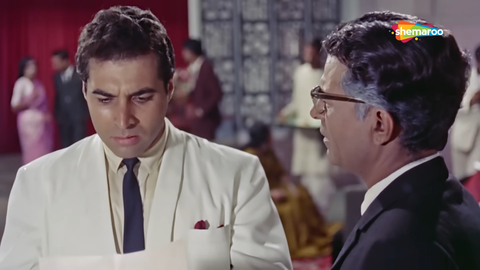
… and has killed herself. When Neeraj arrives in Bombay, his friend and colleague Romani (?) greets him with the news, which has appeared in the newspapers. Anita’s body was found, drowned, in a lake.

Neeraj goes to meet Seth Biharilal in the hope that perhaps the newspapers have it all horribly wrong. But a distraught Biharilal has even more frightful news to share: when Anita’s autopsy was done, it was discovered that she was pregnant.
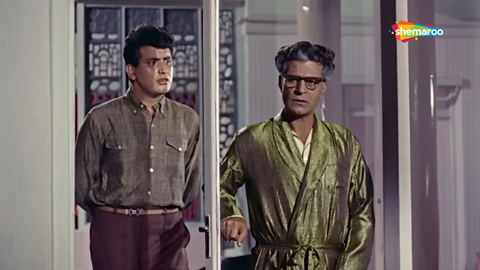
Neeraj refuses to believe this. His Anita was a sweet, pure, beautiful soul; she could never have done something so shameful as that. Anil, who is also there, now takes Neeraj in hand and into another room in Biharilal’s house, where there hangs a somewhat risqué portrait (risqué by 60s Hindi cinema standards, that is) of Anita.

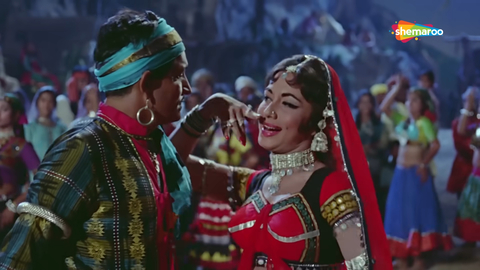
Anil proceeds to provide more proof of Anita’s waywardness, her lasciviousness, so to say. He recalls a long-ago day when, at a party in Shimla, he discovered her missing from the party and instead whooping it up with a gang of banjaras in the woods outside. Singing a bawdy-ish song, dancing uninhibitedly: not at all the way a ‘good girl’ would behave.
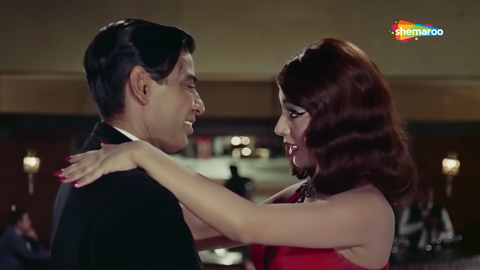
Anil also suggests Neeraj go and meet the artist who painted that portrait of Anita’s: he will have more to say. So Neeraj tracks down the man, Chitranand Saraayan (IS Johar), and sure enough: Saraayan talks about encountering Anita on board a ship, and how she seemed to have no inhibitions, no shame, whatsoever. She drank, she danced, she flirted wildly.
Neeraj is thoroughly confused, yet also inconsolable. The Anita he knew was not the woman these others describe. In a haze of misery, he wanders around the shores of the lake where Anita’s body had been found; and as he looks up at a ruined building nearby, he catches a glimpse of a familiar face looking down at him from a window.
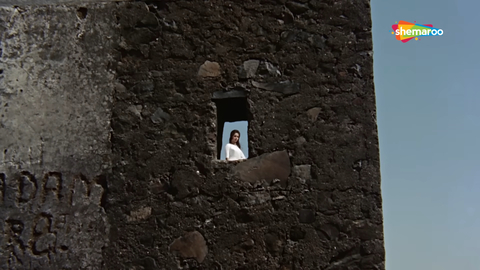
It cannot be Anita, can it? Neeraj rushes after the woman, but she gives him the slip, moving up a path that leads to a dilapidated-looking mansion.
Neeraj finds a bell broken from one of Anita’s paayals [an unusual man, this, to recognize a tiny element of his sweetheart’s jewellery] and is even more certain that this is Anita, none other. But she is nowhere to be seen, and he has to give up.

However, Neeraj’s friend Romani can help: he takes Neeraj to a private detective he knows. Rajdan (Dhumal), his assistant Roshandan (Birbal) and a secretary (?) run a non-existent business in the perpetual hope that someone will ask them to solve some case. Right now the only problem they seem to be dealing with (and that in a very ham-handed way, also given that this isn’t really detective work) is the ongoing feud between a henpecked husband (Mukri) and his bossy wife (Tuntun).
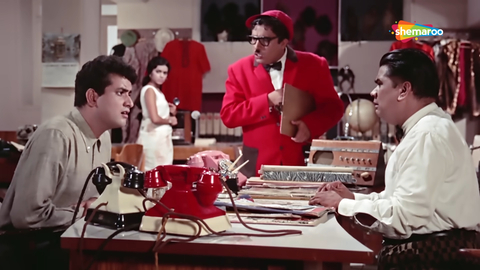
Rajdan is more than happy to try and discover what really happened to Anita, but when he and Roshandan stake out the spooky old mansion, all they run into are a couple of ghosts, or so Rajdan and Roshandan are firmly convinced. [And I, by now, am wishing I hadn’t decided on rewatching this film; I had forgotten just how tedious this comedy track was].
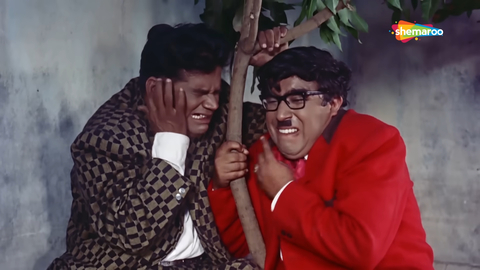
But it all gets back on track when Neeraj, now going out of his head with all the confusion, collapses and is prescribed a rest cure in a hill station. Romani arranges for him to go and stay with Romani’s brother and sister-in-law (Chand Usmani) in Nainital…
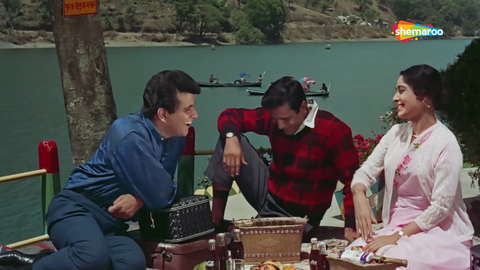
And there, while picnicking with his hosts (and definitely on the road to recovery), Neeraj sees Anita again, in a completely different avatar.
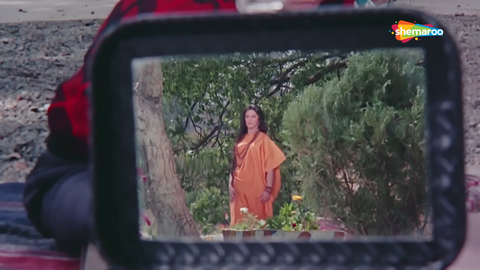
It’s interesting to see how Raj Khosla (who had thought up the story idea for Anita) refers back occasionally to the other Sadhana-Manoj Kumar suspense thriller he had directed, Woh Kaun Thi? The mysterious woman, whom the man sees every now and then, and who behaves in such an odd way. The spooky mansion (with its gate, which shuts all by itself, mirroring the graveyard gate in Woh Kaun Thi?) The Himalayan hill station to which the hero flees in an attempt to regain his peace of mind—but where he again meets the woman, or spectre, or whatever she is.
Personally, however, I think Raj Khosla couldn’t really repeat the suspense and overall entertainment value of Woh Kaun Thi? in Anita. Here’s why.
What I didn’t like about this film:
That absolutely awful comic side plot featuring Dhumal, Birbal, et al. They are unnecessary to the plot, and detract from the story of Neeraj and the mysterious woman. Compare this to Woh Kaun Thi?, and the earlier film scores in the way the suspense never slackens (except for some songs, which in some cases—like Lag jaa gale—actually serve to heighten the suspense and take the story forward).
Then, the plot holes. Yes, Woh Kaun Thi? had its fair share, but despite that, when the denouement came, it mostly all fitted together.
Spoilers ahead, both for Anita as well as for Woh Kaun Thi?:
In Woh Kaun Thi?, the mysterious behaviour of the woman—her cryptic utterances, and often puzzling and contradictory actions—are explained by the fact that Anand is actually seeing not one, but two women: and one of those is deliberately out to mess with his mind. There’s a reason for that very odd behaviour. In Anita, however, there’s only one woman, and she isn’t inimical to Neeraj, just out to try and keep him away from danger. And when one looks back at the end, knowing that there’s only one Anita, it doesn’t really work: her cryptic utterances and contradictory actions don’t fit. They might have fitted if we’d been shown that Anil or one of his henchman was constantly holding a gun to her head and preventing her from speaking the truth, but that’s not the case. All I can surmise, then, is that this was a case of ‘let’s bung this in to heighten the suspense’, without really thinking about whether it makes sense or not.
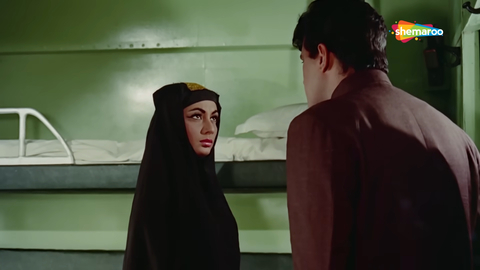
In a similar vein, the back story of why and how this whole rigmarole happened doesn’t hold water. I can see why Anil had to pretend Anita had killed herself; but the rest of it didn’t hang together. If his whole plan was to get Biharilal and Anita out of the country and away to safety [how magnanimous of him!], why faff around and not do so faster? Given he’s a smuggler, I’d have thought he’d have been a pro at this.
Spoilers end.
(And: what was the point with that initial scene with Biharilal and the pandit and Anita’s horoscope? Utterly pointless, unless it was supposed to underline the idea that astrologers know everything).
What I liked about this film:
Sadhana, though not as drop-dead gorgeous as she was in Woh Kaun Thi? still manages to look pretty through much of the film.
And Laxmikant-Pyarelal’s music (to lyrics by Raja Mehdi Ali Khan) isn’t bad. I especially like Tum bin jeevan kaise beeta; and Gore-gore mukh par, repeated now and then throughout the film, isn’t bad. Pichhwaade buddha khaansta, the Anita version of Mera Saaya’s Jhumka gira re [‘good woman’ is proved to be actually ‘characterless’ because she’s dancing and singing a raunchy song in public], is of course a popular one.
Even as I finished watching Anita, I realized that this would never have done as a tribute to Raj Khosla. It’s not one of his best, by no standard. And given its similarities (forced?) to Woh Kaun Thi? (to which it comes off a poor second), it must needs be relegated to the wings of Raj Khosla’s filmography. Or even Manoj Kumar’s.


Thank you for the great review and totally agree. It was a case of let’s insert some suspense to replicate the earlier movies and leave out the logic. Disappointing. By the way 2nd Sep was Sadhana’s birthday. Born in 1941, so she would be in her 85th year…?.
Regards, Gaurav
LikeLiked by 1 person
Born in 1941, so she would be in her 85th year…?.
Yes, would have been, if she were still alive… she passed away in 2015.
LikeLike
Not the best suspense but entertaining enough if you let the movie flow along. You know how horridly patchy some movies of this time were. I like the Mukesh songs a lot. Poor Neeraj being led around by the ‘haunting’ spectre of his beloved. I watched this quite a while ago so I have forgotten the tedious bits.
Thanks for the lovely review. Made me think a little about the movies I used to like in my pre-teen and teen years that didn’t hold up well later.
LikeLiked by 1 person
Hai na, Ava. There are so many films that I first saw back when they were aired on DD in the 80s, liked them a lot (or enough to want to rewatch them now) – and then realized that I was much more forgiving, obviously! I guess we’ve become more discerning, or also perhaps more jaded.
But still: at least this one is entertaining. I suppose it’s also unfair to compare it to Woh Kaun Thi?, which is in a class all its own.
LikeLiked by 1 person
I am in complete agreement with your analysis and assessment of the movie. Raj Khosla made it in the hangover of Woh Kaun Thi without having a good script at his hand. When the script was poor, nothing (including the music and the photography) could save the movie, not even the gorgeous Sadhana.
LikeLiked by 1 person
Yes, it’s a pity that the film suffered from a bad script. The music and Sadhana (and actually most of the cast) are pretty good, so there could have been a suspenseful film here – but the script really lets it down. A shame.
LikeLiked by 1 person
It was fun reading your review, Madhu. I watched this movie some 10 years back and was pretty disappointed by it.
Biharilal not only tolerated his 19 year old daughter meeting a person, whom he didn’t like, but also tolerated it for four long years and that also since she was 15. He also didn’t mind his daughter hanging a risque portrait of hers in her room, whose sole aim, going by its artistic qualities, was only to titillate. And in all the four years, in which Neeraj was visiting her, he never ever saw the painting. If she was only 19, then she would have needed her guardian’s consent note (in the 1960s) for her to marry Neeraj.
Just some thoughts that went through my mind while reading the starting part of your review. Not that Hindi movies ever cared for such details….
LikeLiked by 2 people
Thank you for reading, Harvey: I’m glad you enjoyed this review (more than the film!) :-)
You’re very right, there’s lots of stuff here that doesn’t make sense. Utterly illogical, and no explanation is ever given for it. Though as far as the risque portrait in Anita’s room goes, I thought that that had been part of the plot hatched by Anil, he had put it up on the wall after Anita’s disappearance to add heft to his story of her being awara and badchalan. (Though of course if Neeraj had been a frequent visitor, he should have realized that the portrait had not been there before…)
LikeLiked by 1 person
When I watch movies of the past century I get a major attack of cringe for such elements. They are usually put in just for the sake of plot without regard to logic or niceties.
LikeLiked by 1 person
Also, I think that most (still not all) film-makers are more aware today of what may be politically incorrect, or just not ‘done’. In real life, they may behave differently, but onscreen, in order to keep audiences happy, they try to conform to certain standards. I often get the feeling that older film makers didn’t do that so much – or perhaps it’s just that those times had different standards.
LikeLiked by 1 person
Madhuji, as I can see from your review, this is not one of Khosla’s best offerings. The music of L-P is good though. But the only thing that makes me happy is that my name was remembered when making the movie!!😂
LikeLike
LoL! Yes, at least it’s a film that underlines the importance of Anita. ;-)
LikeLike
I missed this review, Madhu. (Last week was especially horrid.) I have, I think, seen Anita when they showed it on DD. I’m sure I must have, since, those days, we hardly missed anything shown on television. But I have no recollection of it, not even after reading your detailed synopsis.
The comic side plots in a lot of old movies were as tedious as the devil. So I guess the CSP in this one is par for the course?
It’s really sad when you notice that what could have been a good movie turns out to be not-quite-so, because they couldn’t be bothered to write a decent script.
I think I will pass on rewatching this one. Your excellent review gave me the gist, after all. :)
LikeLiked by 1 person
You’re right, Anu – CSPs in films of this period were invariably awfully tedious. Here, I think it especially irked me because it really intruded in the main plot (which could have been much more taut without this forced digression – films like Mera Saaya and CID manage to have comic characters – not necessarily a full-fledged CSP – without it really eating into the main plot).
But yes, do not waste your time rewatching this. There are better films waiting to be seen!
(Also, re: your mail about the comment on the latest post. Sorry, but it seems WordPress swallowed that up. Nothing in the spam folder. :-( Damn WP!)
LikeLike