
A couple of years back, I watched (and later reviewed) the Meena Kumari-Dharmendra starrer, Bahaaron ki Manzil. A good suspense thriller, it put me in mind of another film starring these two: Phool aur Patthar. I had seen the film many years ago, as a child (implication: this would have been in the early 80s, when Doordarshan’s sole TV channel was our only entertainment besides books and radio, which meant we watched anything that was aired, no matter how mediocre). I remembered nothing of it except that Dharmendra played a thief who ends up being cared for by Meena Kumari, playing a widow.
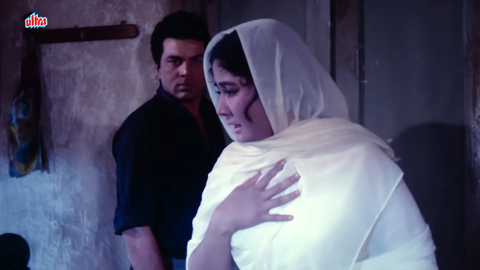
Of course, just because these two acted in the very good Bahaaron ki Manzil didn’t automatically mean that Phool aur Patthar would also be good (in fact, they were co-stars in one of the most excruciatingly awful Hindi films of the 1960s, the utterly cringe-worthy Chandan ka Palna). But I reasoned that if it was that bad, surely I’d have remembered?
Anyway, I rewatched it. And here’s what it’s about.
The story begins with Shakti Singh ‘Shaka’ as a young boy (?), picking a man’s pocket at a mela and then being chased by a policeman when the alarm is raised. Shaka goes running down the road and out of sight, the cop in hot pursuit… and shortly after we see Shaka (now grown up into Dharmendra) returning, still pursued. He’s become a full-time thief, and even as the credits roll, we see Shaka stealing here, being chased there, burgling this house, being caught there [he seems to be pretty useless as a thief: he keeps getting caught]. Also, in between, Shaka has been taken under the wing of a criminal kingpin (Madan Puri, only referred to as ‘Boss’). As is usual with Hindi cinema of this period, Boss owns a hotel which he uses as a front for shady business.

And [also as is usual] there’s a dancer at the hotel, Rita (Shashikala in a bad peroxide wig) who is madly in love with Shaka. Somewhat unusually, though, instead of spurning her, Shaka seems to enjoy being with Rita.

Boss briefs Shaka about a job he must do, in a town far away from the city. There’s a Seth Jeevan Ram (Jeevan) who prefers to keep his millions, not in a bank, but at home. He’s a sitting target for Shaka.
Shaka first attends to a rival named Shaamu (Shyam Kumar), because Shaamu has been elbowing his way into Shaka’s territory:
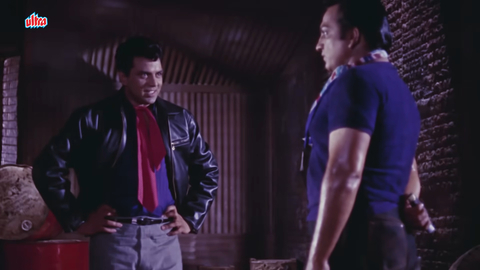
And then he takes a bus to the town where Seth Jeevan Ram lives. Here, Shaka runs into an old friend named Sadak Ram (OP Ralhan, who also directed and wrote Phool aur Patthar). Sadak Ram is a petty thief who is hoping to soon marry his girlfriend Kamala (Indira Billi). Sadak Ram and Shaka have a cheery reunion, which is rudely interrupted by a panicked announcement from a jeep racing through the area: plague has spread in the town, everybody should get out.
This, agree Shaka and Sadak Ram, is a boon: if Seth Jeevan Ram leaves home, Shaka can burgle it at his leisure.
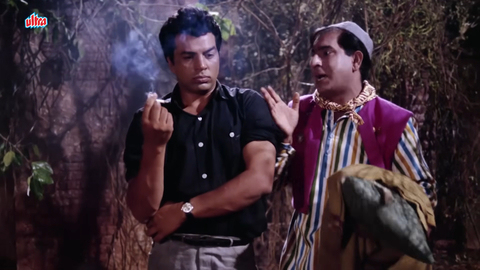
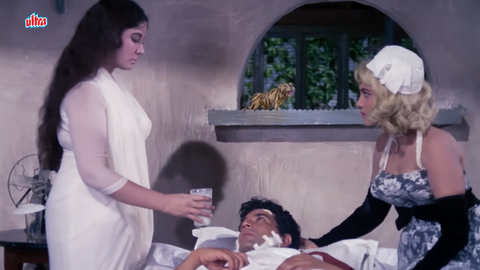
Unfortunately for Shaka, Seth Jeevan Ram has more sense than to abandon all his wealth. He’s taken it along, and Shaka, ransacking the place, finds nothing. Frustrated, he’s on the verge of leaving when he hears moaning and whimpering from the next room. It’s Shanti (Meena Kumari), Seth Jeevan Ram’s widowed daughter-in-law. She is very ill, and has been left to die while her in-laws have fled.
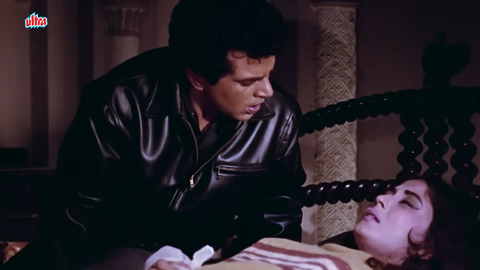
Shaka [there has been no suspicion so far that he’s inclined to kindness] takes it upon himself to look after Shanti. He fetches a local vaid (Sunder) whose skill he had witnessed on the bus ride to this town. Once the vaid has worked his magic and gone, Shaka is the one who stays behind, attending to Shanti for what seems like at least a couple of days.
When she is well enough to get out of bed, Shaka leaves her to go buy some food. While he’s gone, who should return but Shanti’s in-laws: Seth Jeevan Ram, his wife (Lalita Pawar) and their younger son Kali Charan (?). [I find it odd that the plague has ebbed so swiftly that they’ve come back within a couple of days]. There is much horrified screeching and exclaiming when Shanti’s mother-in-law (poor Lalita Pawar, always the shrew) discovers that her bahu is alive and well.
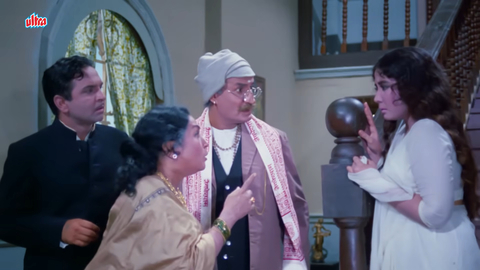
There is much more screaming when a handful of cigarette butts are found in Shanti’s room and this foul trio realize that there’s been a man in Shanti’s room [um. Why? Couldn’t Shanti have taken to smoking? I just might, and hit the bottle as well, if I had to deal with a bunch of nasties like these]. Mother-in-law starts thrashing the life out of Shanti.
Later that night, Shanti is attending to her bruises when Kali Charan sneaks into her room and tries to rape her.
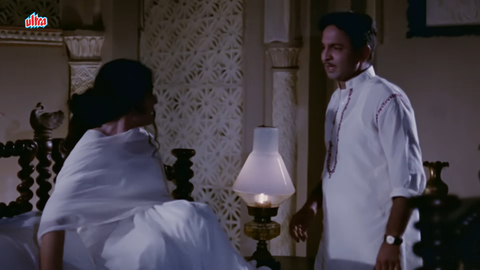
Shanti screams [her mother-in-law, in another part of the house, wakes up but goes back to sleep] and tries to fight him off, but is failing—when Shaka returns and bashes up Kali Charan. He also then quickly gathers up Shanti and takes her away, racing off into the night while Kali Charan screams for Mummy.
Jeevan Ram, his wife and son regard Shanti’s disappearance in the light of good riddance—until two days later, when a lawyer (?) turns up. He represents the estate of Shanti’s late uncle, who had bequeathed six lakhs to Shanti. Jeevan Ram’s wife spins a tale of Shanti having gone on pilgrimage, and Jeevan Ram himself encourages the man to hand over the papers: they will have them signed whenever Shanti returns. The lawyer, however, is canny, and says no; whenever Shanti comes back, they can let him know and he’ll come again.

This won’t do: they must do all they can to get their hands on the money, decides Jeevan Ram. They have no idea where Shanti has gone; the only hope is that the police will find her. But how to put the police on Shanti’s scent? Jeevan Ram decides they must pretend that all of his wife’s jewellery has been stolen: file a report with the cops, they’ll assume Shanti and/or Shaka are the thieves, and will be able to track Shanti down [so complicated. Why not simply hire a private detective?]
And, just so that the jewellery actually appears to be missing, the family bury the stuff in their backyard.
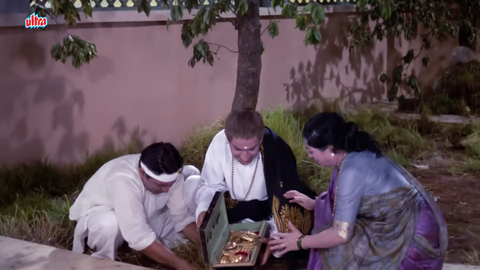
What they haven’t realized is that there’s a witness, watching everything surreptitiously. The vaid had come by to look up his patient and sees what’s happening.
… and then, once Jeevan Ram and his family have gone away, he pinches all of the jewellery and takes it home so that his wife (Tuntun), perpetually complaining that he doesn’t buy her things, can deck herself up in gold.

In the meantime, Shaka has washed up at his home with Shanti. Shanti soon settles in and starts turning his house into a home [sigh. How is it that women in Hindi films cannot enter a messy space without wanting to set it to rights?], and as time passes, there’s also a gradual softening of their mutual respect into something more.
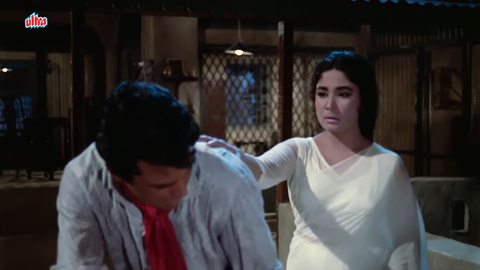
If only the neighbours could be a little more accommodating, because [again, as neighbours in ‘respectable’ filmi neighbourhoods tend to be] this lot immediately starts pointing fingers at Shanti and Shaka.
So much happening. And that’s without Rita—possessive and hot-tempered—even knowing that her beloved Shaka has lost his heart to another woman.
What I didn’t like about this film:
Since my previous sentence was about the Rita-Shaka-Shanti love triangle, let’s stick with that. I actually see Rita’s point of view here, since it’s obvious that she and Shaka are really an item. In the pre-Shanti days, Shaka is quite clearly happy with Rita. It’s not as if she’s piling on, or seeing a relationship which doesn’t exist. So to have Rita be painted as some sort of ‘other woman’ here is grossly unfair.
I’m not implying that it’s impossible for a man to fall out of love with one woman and into love with another; but surely there should be some introspection about this? At no point is Shaka shown to be on the horns of a dilemma; never does he look or say anything to the effect that (since he’s ‘with’ Rita) he feels guilty about how he feels for Shanti. If Shaka is the criminal-with-a-heart-of-gold they’re trying to make him out to be, there should be some conscience at work here, and it should be shown.
Basically, this points to a lack of nuance in the scripting. There is a good deal that could have been shown in other, more nuanced ways, but isn’t. For example,
(Minor spoiler ahead)
When Shaka rescues the girl from the burning house, the entire neighbourhood—up to now, all berating him and Shanti for being ‘bad’—does a complete turn-around and becomes fans of his. Not one person says ‘Okay, so what if he saved her. He’s still a thief, and she’s still a fallen woman.’ (Or words to that effect, since that is what they do say in the pre-heroism days).
Spoiler over.
Then, there’s the waste of good actors. This is actually a fairly good ensemble cast, with some big names; but people like Shyam Kumar and Leela Chitnis (she as a blind beggar whom Shaka looks after, but not enough to bring into his own home) add next to nothing to the plot.
Basically, this isn’t an awful film (I’ve seen much worse), but it’s not good either. Just about middling, and with a tendency to veer into the melodramatic at the drop of a hat. The music (Ravi’s, to lyrics by Shakeel Badayuni) is mostly forgettable; the only song that stayed with me was Zindagi mein pyaar karna seekh le, and that because the nonsense chorus of it is obviously lifted from Nat King Cole’s Brazilian Love Song.
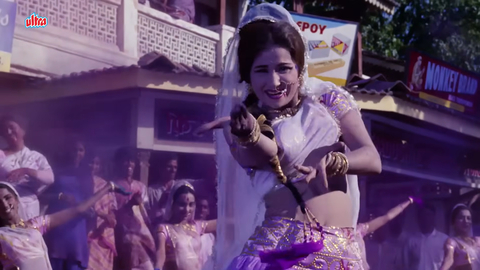
And yes, a shout-out to the lovely, graceful Madhumati, who appears (alongside Laxmi Chhaya et al) in the song Laayi hai hazaaron rang Holi. I hadn’t realized it, but Madhumati passed away on October 15th: Anupji posted this tribute which has some of her best dances, as well as lots of interesting information about her. RIP, Madhumati.


I recall seeing this movie when I was about 11. I don’t remember much about the movie excepting a scene where a bare chested, sozzled Dharam standing at the side of a sleeping (or was she pretending to sleep) Meena Kumari’s bed. This scene was on the posters of PAP. It was a mega hit and made Dharmendra into a mega star. There was apparently some real life chemistry between the two!
LikeLiked by 2 people
I hadn’t known the movie poster replicated that scene. Yes, Meena Kumari is pretending to be asleep because she’s terrified when he comes home drunk and bare-chested (bare-chested because he’s draped his shirt over a shivering Leela Chitnis). She fears he will do a Kali Charan-type stunt when she sees him approaching, but all he does is pull up the blanket over her. It’s a pivotal moment in their relationship, because it makes her realize (as if all that caring he did when she was ill, didn’t) that he’s a good man, even if he’s a thief.
LikeLiked by 1 person
I remember watching it in the good ol’ b/w DD days (early 80s) and was touched by its message at that time. Then saw something of it somewhere a few years back and was aghast at the heavy make-up and over-acting. Not as bad as Mehmood’s Chandan Ka Palna (1967), but cringeworthy nevertheless. I am sure to find some good points in it, but I don’t have the courage to watch the film.
LikeLiked by 2 people
Furthermore, thanks for the Holi song, not because of its melody, but because it was nice to see Saroj Khan in it.
LikeLiked by 2 people
Yes, Meena Kumari’s make-up was terrible here (I think she was in pretty poor health by this time, and drinking quite heavily too, so the make-up department had to work hard to cover that up, and the only way they could think of doing that was to pile it on). And the over-acting, yes. But at least the story wasn’t as absolutely horrible as Chandan ka Palna. That, in my opinion, takes the cake. Us jaisi bekaar film nahin hai.
Incidentally, Hindi cinema lost two famous dancers recently. Sandhya also passed away, I think in October itself. Richard posted a nice tribute to her.
LikeLiked by 1 person
Interesting review. I haven’t watched the movie myself, but generally knew the barebones plot from my parents’ discussion.
Incidentally, the vaid seems to be Sundar, rather than Mukri.
LikeLiked by 3 people
Ugh! I don’t know why I wrote ‘Mukri’ instead of ‘Sunder’. Of course I know it’s Sunder. Thanks for pointing that out, have corrected it.
LikeLiked by 1 person
Hi Dusted Off,
I remember watching this movie many years ago as well.
Like you, I believe this was a let-down, esp. given the cast of actors.
In addition to the wasted talents of Leela Chitnis, I’d have expected the comedy to be better given Tun Tun, Sunder, and O.P. Ralhan.
BTW, the village vaid is Sunder, not Mukri – I am sure it was just an oversight.
The music is also disappointing.
Not the best compositions by Ravi, and the lyrics do not sound like Shakeel Badayuni at all.
I think you were too gracious in your review.
The only thing I like about this movie is the presence of Meena Kumari and Dharmendra, both being among my top favorite actors of all times.
LikeLiked by 2 people
I am with you on considering Dharmendra and Meena Kumari among the best actors ever – yes, indeed. Meena Kumari is of course highly acclaimed but I think Dharmendra often gets short-changed because most people generally regard him only as an action hero. But he could act when he was given the chance to, and even otherwise, he worked in some very entertaining films and was great fun to watch. In fact, right now I am watching Aaye Din Bahaar Ke. Again, not a great film, but he’s very watchable.
Thank you for pointing out the Sunder-Mukri goof-up. Yes, oversight! My brain was playing up.
LikeLiked by 1 person
I had seen this movie long back and as I am able to recall my viewing experience, I agree with you that it’s not a very good movie but not a trash either. It’s a one time watch. Dharmendra had got the He-man tag after this movie only. Thanks for the nice review and objective assessment Madhulikaji.
LikeLiked by 1 person
Yes, indeed, it makes for a good one-time watch. Thank you for reading, Jitendraji, and for your kind words.
LikeLiked by 1 person
Madhu ji,
I have seen this film and Meena Kumari looks too old for this role. The film, like you say, is neither bad nor good. Some scenes like the one where Dharmendra jumps on to the train is quite innovative (not sure of it’s been lifted from somewhere). The ending is hopeless! One or two scenes like the one with the dog is repulsive. It is terribly long – almost 3 hours.
Anita
LikeLiked by 1 person
I agree with all you say. The dog, the looks of Meena Kumari (I think all the drink and the poor health were beginning to show) – who would imagine she was only in her mid-30s at this time? She looked much older.
LikeLike
Heh. I wondered if you would like it. I should have known you wouldn’t. :)
They remade it in Malayalam as ‘Puthiya Velicham’ ( New Dawn). With Sree Vidya standing in for Meena K. Less melodramatic than PaP (love that the acronym is so apt *grin*). And stellar music by Salil C. The songs were superlative, the film not so much. But I had a soft corner for Sree Vidya, Jayabharati (Shashikala) and even Jayan (*gulp*). In my defence (for that last one), I was a kid!
Grinned at your asides as usual, especially about being driven to drink. I hear you, sister! :):)
LikeLiked by 2 people
:-) Glad you liked the asides, Anu – they are what keep me going when reviewing a bad or not-that-great film!
And, question: why is a soft corner for Jayan a reason for a guilty gulp? Not nice? (I had a crush – albeit brief – on Biswajit as a child, so I am very accommodating of silly soft corners) I have watched I think all of two Malayalam films, so have no recollection of Jayan. And still photos that crop up on a Google search are ambivalent – as good-looking or not as many other actors of that era (though I will admit I have seen several Mallu actors who are really much more handsome).
LikeLike
This review was a blast to read – the review and the comments both! I was laughing out loud at “ I just might, and hit the bottle as well, if I had to deal with a bunch of nasties like these“!
The actor playing Kalicharan seems to be Ram Mohan – of Dhanno ki aankhon mein fame. What do you think?
And finally, a crush on Biswajit?!! Really? On second thoughts, I had one on Manoj Kumar in Kranti. So I’m noone to talk.
Thanks for a very entertaining review!
LikeLiked by 1 person
I am glad you enjoyed this, Rajani. :-) Somehow the worst films make for the most entertaining reviews! I have to admit I am not very familiar with the picturisation of Dhanno ki aankhon mein (I have seen it once, I think, but don’t remember it), but yes, the man is Ram Mohan.
Lol, yes. Biswajeet. Very short-lived crush during my very early days!
LikeLiked by 1 person